Phone Answering Service for Lawyers: A 2026 Buyer's Guide


57% of callers who left voicemail messages didn't receive a return call within 72 hours in the 2019 secret-shopper study described by Clio. That's the problem a phone answering service for lawyers should solve, not just a ringing telephone, but an inquiry that never becomes an actionable intake record.
For a small or midsize firm, AI is good enough to complement reception staff on routine questions, information gathering and consultation booking. Start with the calls your team can't cover. Buy on the quality of the handoff, and keep legal judgment with lawyers.
What a Phone Answering Service Does for a Law Firm
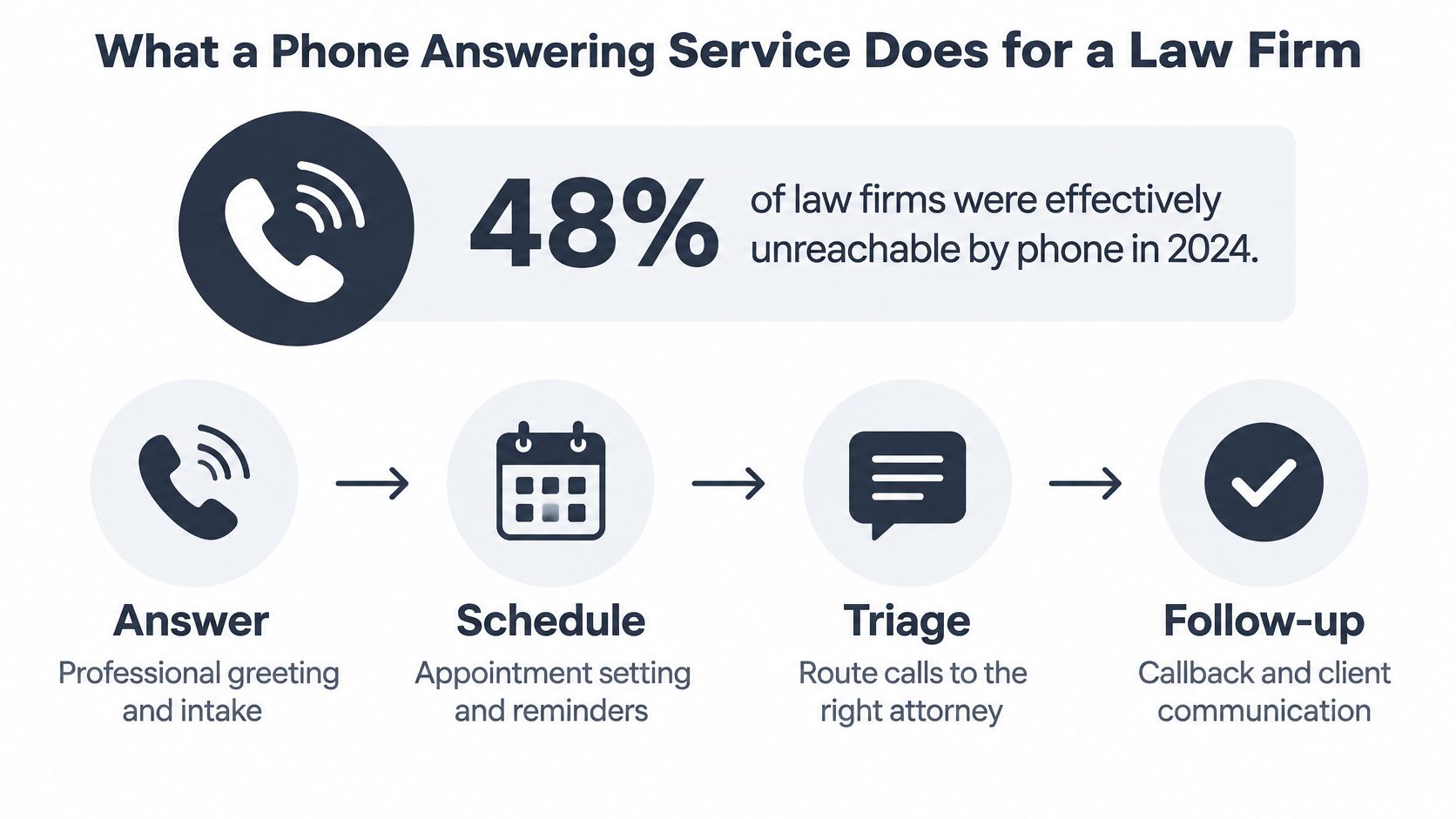
A caller who can't get through may move on before anyone at the firm knows they needed help. In 2024, 48% of law firms were effectively unreachable by phone because they neither answered nor returned prospective clients' calls, according to Clio's Legal Trends Report as reported by Above the Law.
A phone answering service sits between that caller and your staff, whether the voice is human or AI. Its job is to answer, gather intake facts and route or book, within a lawyer-approved script. Giving legal advice, predicting outcomes and deciding whether a conflict exists stay with your attorneys.
Follow a caller through the handoff
A prospective client calls about a separation while your receptionist is helping someone at the front desk. Here is what that caller experiences:
- They dial your existing firm number. There is no separate intake line for them to find.
- The assistant answers on the first ring and greets them with the firm's name.
- It picks up their language and asks which practice area fits their situation.
- It takes their name, callback number, jurisdiction, urgency and a short description of the issue.
- It books an eligible consultation, or tells them who will call back when the matter needs a lawyer's attention.
rednea's assistant answers every call in seconds at any hour, so coverage like this doesn't depend on an attorney interrupting a consultation to collect administrative details.
Notice what the caller is not asked for. Intake needs enough to identify the next step, then it stops. A concise account is more useful than an unrestricted narrative, and every extra sensitive detail you capture is a detail your firm now has to store and protect.
Buying test: A successful call leaves your team knowing who to contact, what they need and who owns the next action.
Before you compare providers, list the calls your firm missed last month and check what each one produced. The outcome to buy is a usable intake record: a name, a need and a next step. A bare notification that someone called is a smaller thing, and a provider that delivers only that has not solved the problem the 48% figure describes.
Must-Have Features to Check Before You Buy
Use this scorecard for comparing phone answering services during a live demonstration. Don't accept a polished sample recording as proof that the service can handle your intake requirements.
| Criterion | What to require | Red flag |
|---|---|---|
| Coverage and speed | Calls answered on the first ring, 24/7, including holidays and overlapping calls | Voicemail after hours or hold music |
| Greeting and language | Firm name, caller's language detected, AI assistant disclosed | Generic greeting or no disclosure |
| Intake fields | Name, callback number, matter type, jurisdiction, urgency, opposing party, preferred time | Only a free-text message is taken |
| Advice boundary | Scripted refusal on case outcomes and fees beyond published rates | Agent gives opinions on merits or quotes unapproved fees |
| Summary format | Structured email or SMS summary within minutes | Summary arrives next day or as a raw transcript |
Score each row from 1 to 3: failed, needs configuration, or demonstrated successfully. Reject a provider that fails the advice boundary or can't capture the required intake fields. Compare prices only after those gates are passed.
Test behavior rather than feature labels
Coverage means more than an overnight greeting. Clio found that only 40% of firms answered calls in its 2024 study, according to its Legal Trends Report announcement. Make overlapping test calls and check what happens when the transfer recipient doesn't answer. A service that moves callers into another unattended queue hasn't solved the problem.
For greeting and language, begin the demo in a language your clients use, then ask a routine question. Listen for accurate understanding, not just fluent pronunciation. Our assistant detects the caller's language and converses in English, Spanish, French, German or Italian. For any other language, require a demonstrated capability or an interpreter and callback fallback rather than assuming universal coverage.
Test intake fields with a caller who gives information out of order. Give the opposing party's name before the caller's own name, then correct the callback number. Check whether the final record preserves the correction and puts each detail in the right field.
Inspect the record your staff will receive
For the advice boundary, ask whether the caller has a strong case or should accept a settlement. The assistant should decline to assess the merits and offer the approved human next step. On fees, it should repeat authorized published information or explain the consultation process, not improvise a quote.
Our after-call email provides a concrete summary model: the caller's name, cell number, address, problem and what was booked or promised. Configure the legal intake record around the fields your team needs, rather than collecting an address automatically when it serves no intake purpose.
A raw transcript makes staff reconstruct the conversation. A structured summary lets them act. Run the same scorecard on three providers, using the same caller scenario, and save the resulting records alongside the quotes.
Confidentiality, Recording Consent and Data Retention
Privacy is a pre-purchase test, not a setting to revisit after launch. Before routing client inquiries through an assistant, establish whether it records or transcribes calls, where the information goes and who can retrieve it.
A 2025 ABA discussion of AI notetaking, summarized by Adams and Reese, warns lawyers to examine confidentiality, storage, retention and user control, and notes that some jurisdictions require all parties' consent to recording. A blanket record-every-call policy isn't a safe starting point.
Set the collection rules first
- Default to no recording unless there's a clear need. Distinguish retained audio from live processing and saved transcription. Turning off recordings doesn't necessarily turn off every other record.
- Disclose at the beginning that an AI assistant is answering. Keep that disclosure separate from any recording notice so callers understand both.
- Resolve consent before recording or retaining a transcript. Have counsel assess the rules for the jurisdictions involved, including the caller's location. Configure the required notice and consent mechanism before capture begins.
- Collect only what staff need for follow-up. Keep detailed medical histories, allegations and document contents out of routine summaries unless the approved workflow requires them.
For cross-border work, professional secrecy, privacy obligations and recording rules can overlap. A caller may be in another state, the UK or the EU even when they dial a local number. As a conservative operating standard, configure for the strictest applicable requirement identified by counsel, rather than assuming the firm's office location determines everything.
Put storage and deletion in the contract
- Set a retention period for each record type. Separate audio, transcripts, summaries and backups. Confirm what deletion on request removes and whether any contractual exceptions apply.
- Confirm hosting locations and subprocessors. EU or UK hosting can support a firm's requirements, but location alone doesn't establish compliance.
- Restrict staff access by role and require access logs. Reception staff may need scheduling details without access to every sensitive intake record.
Our service uses European server infrastructure, stores only what's necessary and supports real-time data deletion on request. Put any required configurable retention periods and access-log capabilities into the procurement checklist rather than assuming they're included.
Use a written customer data protection checklist to document these decisions. Include sensitive-matter escalation, incident notification, subprocessor changes and the return or deletion of information when the contract ends.
Automation isn't compliant by default. The firm still has to approve how information is collected, used and retained.
Send those questions in writing and keep the answers with the signed agreement. A sales assurance isn't an operational control.
Intake and Triage From First Call to Callback
An answered call only opens the file. A finished intake is what wins the engagement. Firms that convert prospects treat triage as a staffed workflow with a named owner, a deadline and a logged result, rather than a message dropped into a shared inbox.
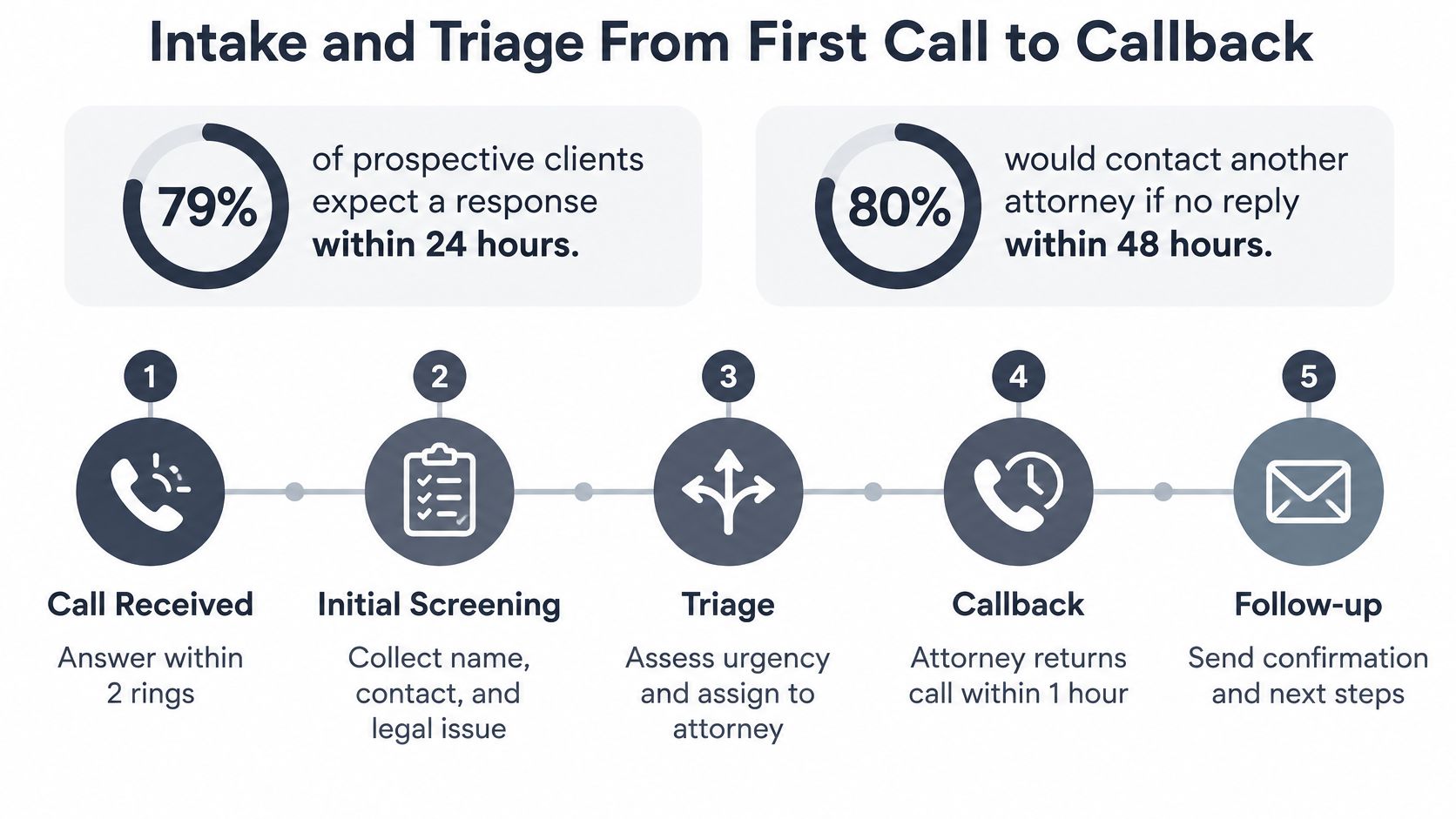
Response expectations are tight. In Clio's 2019 Legal Trends Report, 79% of prospective clients expected a response within 24 hours. A separate survey cited by Pareto Legal found that 80% of legal consumers would contact another attorney if they didn't hear back within 48 hours (legal intake statistics review). Those figures justify answering live; they say nothing about whether the follow-up was any good. Intake quality is the buying test.
Give every inquiry an owner
- Check urgency before the questionnaire. Confirm the caller's language, then ask whether anything requires immediate attention. A distressed caller should never work through a long form before urgency is established.
- Collect the approved intake fields. Capture opposing-party information for staff conflict review without telling the caller that a conflict has been cleared.
- Route and book inside the firm's rules. Transfer urgent calls to the person the inquiry maps to, and book routine consultations only for callers who pass required screening. A calendar opening isn't permission to bypass it.
- Send the summary to a named recipient. The structured summary should reach one accountable person within minutes, not an unmonitored shared inbox.
- Log callback completion. Record whether staff reached the caller, left a message or need another attempt. An alert only starts follow-up; the callback still needs logging.
Clio's 2024 secret-shopper research found that most firms that missed a call never returned it. Give every callback a timer, an owner and a backup owner.
The following illustration shows the handoff stages. Use the urgency table beneath it to configure response commitments rather than applying a universal callback deadline.
Response targets by matter urgency
These are recommended internal service targets, not legal deadlines or promises about attorney availability.
| Matter urgency | Example call | Response target | Who handles it |
|---|---|---|---|
| Emergency or imminent deadline | Arrest, same-day filing deadline, threats | Transfer or alert at once | On-call attorney or staff |
| Time-sensitive consultation | Injury claim near a limitation date, business dispute | Same business day | Intake attorney |
| Routine consultation request | General practice question, estate planning inquiry | Within 24 hours | Intake team |
| Information request | Office hours, directions, fee process | Answered on the call | AI assistant using approved script |
Escalation triggers should include imminent deadlines, arrests, threats, domestic violence concerns and any request for a lawyer. The assistant identifies the trigger; it never determines the legal deadline or manages an emergency independently. Script it to describe the firm's process and decline to give legal advice or confirm that representation exists.
Under our settings, an unanswered query becomes a message or a human transfer, depending on the firm's rules, so no call is lost. Configure a backup alert when the intended recipient is unavailable, and never let the system tell a caller a lawyer has accepted the matter merely because a message was delivered.
Build these rules into your law firm intake service workflow. Each month, track calls answered, callbacks completed within the assigned window and consultations booked. I treat the completed callback as the metric that matters, since it is the point where speed turns into a signed consultation or a lost lead.
Pricing Models and What Each One Costs
Choose the billing model by monthly call volume, call length and the importance of a human voice. There isn't a useful universal price without those inputs. Request an itemized quote for the same workload under each model.
Billing models compared
| Billing model | How it is billed | Best fit | Check before signing |
|---|---|---|---|
| Per-minute usage | Billed for call minutes used, often with top-ups | Variable volume and small firms | Long calls raise cost; check minimums |
| Monthly plan | Fixed monthly fee with included features | Steady call volume | Check overage rates and which features need a higher tier |
| Enterprise plan | Custom fee with API access and a service-level agreement | Multi-office firms | Negotiate response-time guarantees in writing |
| Live 24-hour answering | Billed per hour or per answered call | Firms that want a human voice | Check per-call minimums and transfer charges |
Normalize the quote
For a hypothetical firm receiving 40 after-hours calls a month averaging 3 minutes, the workload is 120 minutes. Multiply that by the quoted minute rate, then add fixed charges and any extras. Compare the result with a monthly plan covering the same calls, booking work and summaries.
Also estimate the value of a booked consultation using your own attendance and engagement records. Don't treat every booking as a signed matter or count gross fees as profit.
Our Basic plan includes 24/7 answering, calendar-linked appointment booking, email notifications, website chat, a choice of 10+ voices and no setup fee. Our Scale plan includes everything in Professional plus API access and a custom service-level agreement. Billing is per minute, with top-ups available anytime, and nights, weekends and holidays aren't billed at a premium.
Count internal cleanup time
Use the AI voice agent pricing guide to structure the comparison, then confirm the commercial details in the quote:
- Usage rules: Minimum commitments, rounding increments, included minutes and overage charges.
- Transfer costs: Whether connected time, unsuccessful transfers and carrier charges are billed separately.
- Included work: Whether booking, structured summaries, optional SMS and integration maintenance carry additional charges.
- Exit terms: Renewal, cancellation notice, data export and deletion after termination.
Cost rule: A cheap message that an attorney must reconstruct isn't necessarily cheap intake.
Write down your monthly after-hours call count and realistic call duration. Select the lowest total-cost model that produces usable records and reliable follow-up, not the lowest headline rate.
How Firm Size and Practice Type Change the Choice
The right configuration depends on who is unavailable, which matters arrive and what staff must review before booking. A solo practitioner needs different controls from a firm operating across jurisdictions.
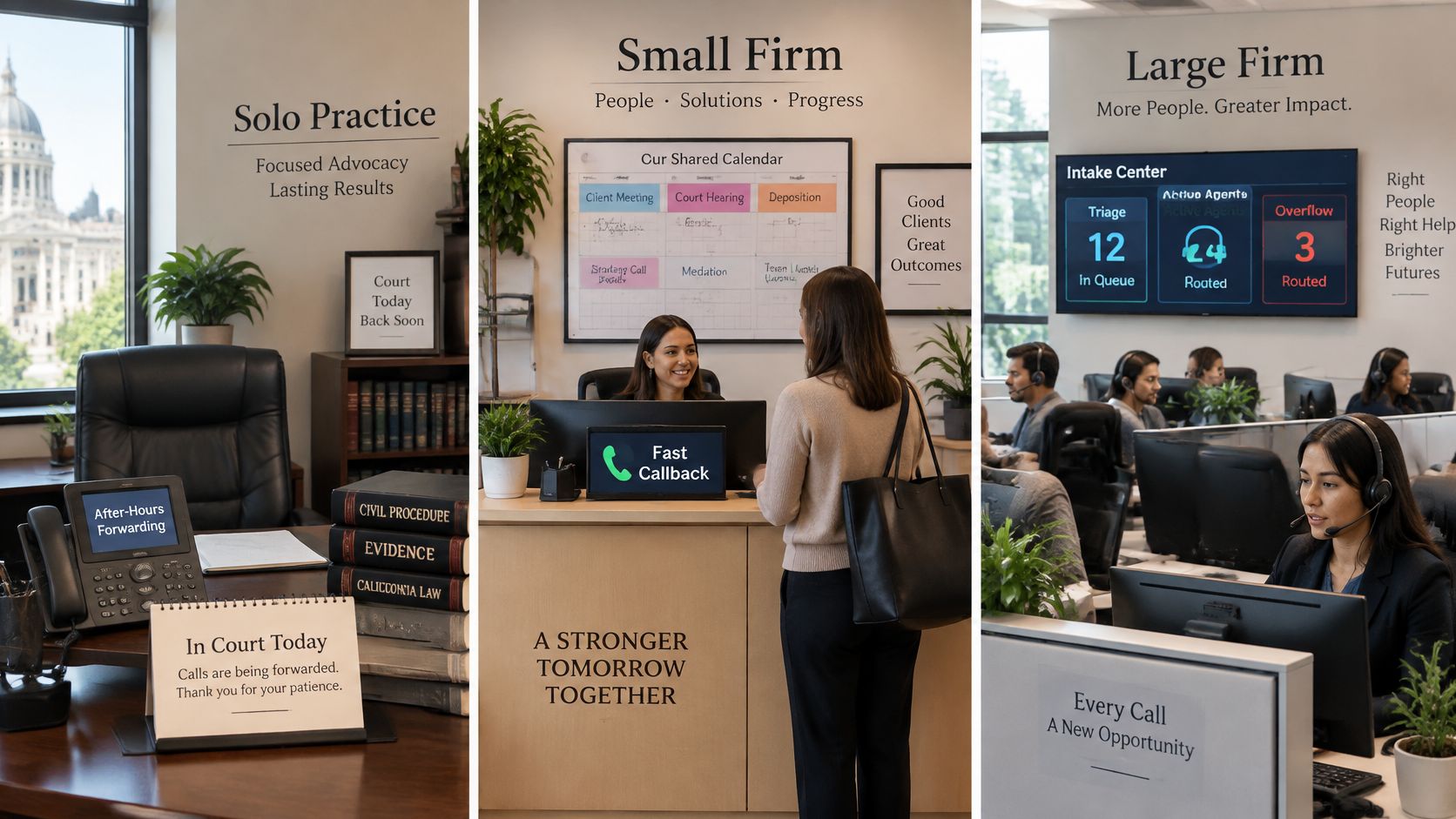
A solo practitioner with limited desk coverage
For a lawyer who spends much of the day in court, start with after-hours and unanswered-call forwarding. Use a short routine-question script and route designated urgent inquiries to a mobile number, with a backup contact when court attendance prevents an answer.
Keep the consultation calendar realistic. Block preparation time, travel and existing-client work so an assistant doesn't fill every apparent gap. The goal is a dependable callback and a manageable diary, not the largest possible booking count.
A small firm with several practice areas
Consider a hypothetical firm of 5 to 15 lawyers handling personal injury, family and general commercial matters. Its priority is practice-specific routing and controlled screening, rather than sending every inquiry to the same receptionist.
Personal injury and family calls should reach different intake attorneys when that reflects the firm's responsibilities. Use matter-specific questions, separate consultation types and a shared calendar with explicit booking permissions.
- Practice routing: Assign a primary and backup intake owner to each matter category.
- Screening status: Distinguish information collected from review completed. Neither label should imply automatic conflict clearance.
- Language handling: Test the languages clients use, including names, locations and legal terminology.
A multi-office or multi-jurisdiction firm
Use per-office numbers, jurisdiction questions and office-specific routing. An enterprise agreement should define support, incident handling and service commitments, while retention configurations should reflect the firm's approved requirements.
For a hypothetical UK family law firm with 60% of calls arriving after 5pm, I'd forward out-of-hours calls first and leave daytime reception intact. Review the split after a 30-day pilot, checking whether the right matters reached the duty solicitor and whether reception spent less time repairing incomplete records. Those figures describe a test scenario, not an industry benchmark.
AI shouldn't decide fee disputes, case strength, conflict clearance or emergency responses. It can recognize that a call belongs with a human and execute the configured handoff.
Choose the closest fit: solo coverage, practice-area routing or multi-office governance. Start with that constraint. The assistant supplies speed and consistency; lawyers keep professional judgment.
Connect Your Calendar and Test a Provider Before You Commit
Keep the first deployment narrow enough to inspect every result. A test line or after-hours window is easier to evaluate than replacing the entire reception workflow immediately.
Configure the handoff
- List your existing number and intended coverage. Separate new inquiries, existing-client calls and administrative requests.
- Choose forwarding for all calls, only when busy or only when nobody answers. Forwarding is configured through your phone provider.
- Call our live demo number before forwarding anything. Prospects can test the assistant directly before paying.
- Connect the appropriate calendar and define eligible appointment types. Use the appointment booking and calendar checklist to check availability and booking rules.
- Map intake fields to your case-management system or CRM. Confirm records arrive as structured data where the integration supports it, not merely as email text.
- Have a partner approve the script, escalation contacts and backup route.
- Run a two-week pilot. Compare answered calls, summaries received, consultations booked and completed callbacks.
You keep your existing phone number and forward calls to rednea. Our setup is handled for you in about 30 minutes, and a business can be live within 24 hours by arranging forwarding with its phone provider. Calendar permissions, internal approvals and integration testing still need their own sign-off.
Make the commitment conditional
Use a written go or no-go checklist:
- Coverage passes: Most calls are answered or transferred as intended, with failures investigated.
- Records arrive: Summaries reach the correct staff within minutes and contain usable details.
- Escalation works: No urgent test call is lost, including when the first recipient is unavailable.
- Privacy is approved: Consent, storage, access and deletion terms are signed in writing.
This week, book a demo call and forward a test line. Commit only after the pilot passes your intake and privacy checks.
---
For firms that need dependable telephone coverage without replacing human judgment, rednea offers around-the-clock answering, consultation booking, structured summaries and inquiry-based routing. Visit rednea to test the live assistant before paying, then use your own intake script to evaluate a limited rollout.
Try rednea, no strings attached
AI phone assistant for business. Hear a live demo in your browser, book a call with our team, or get started — from £90/month, cancel monthly, no minimum term.
GDPR-compliant · EU & UK GDPR · Multilingual