Law Firm Intake Service Explained for Growth


A prospective client calls your firm at 11:42 a.m. You're in court, your assistant is helping a walk-in, and the call goes to voicemail. The caller leaves a short message, waits a few minutes, then taps the next firm in search results. By lunch, you've lost a matter you never even got to assess.
That's not a branding problem. It's an intake problem.
For small and mid-sized firms, intake is the moment where marketing either turns into revenue or disappears. Clio's 2024 Legal Trends Report secret-shopper study found that only 40% of law firms answered the phone when a prospective client called, and only 33% responded to a prospective client's email. That means most firms still struggle at the very first point of contact, not deep in the consultation process, but at hello and reply (Clio intake responsiveness benchmark summarized here).
Many firms think a law firm intake service is just a nicer way to answer calls. It isn't. A good intake system helps the right people get answers, feel guided, understand next steps, and book time with your firm without friction. That's where growth happens.
This matters even more now because AI has become useful in a very practical way. It doesn't need to replace your staff. It can handle routine first contact, capture details, answer common questions, support callers in different languages, and hand urgent or sensitive matters to a human. For small teams, that's often the difference between “we should follow up later” and “the consultation is already booked.”
Introduction Why Every Missed Call Costs Your Firm
A potential client calls at 8:12 a.m. after a car wreck. Your receptionist is helping someone at the front desk. The call rolls to voicemail. Ten minutes later, that same person reaches another firm, gets a live answer, hears what the next step will be, and books a consultation.
That matter did not disappear because your lawyers were less capable. It disappeared because the first handoff failed.
For small firms, intake is often treated like an admin function. Answer the phone. Take a message. Call back later. But revenue is won or lost in that first contact window, especially when the caller is stressed and comparing options in real time. A missed call cuts off the chance to assess fit, explain fees, or guide the person to a clear next step.
The post-answer gap matters just as much. Even when someone does reach your firm, many firms still leave prospects hanging after the initial conversation. The caller gets a polite response but not enough direction. They still do not know what it may cost, what happens next, or whether they should expect a consult, a conflict check, or a follow-up call. Intake works like a relay race. Answering the phone is the first baton pass. If pricing clarity and next-step guidance never arrive, the firm can still lose the matter.
Clio's 2024 secret-shopper research found that only 40% of firms answered calls live, and only 33% responded to a prospective client's email, as summarized earlier in this article.
Those numbers help explain a common problem inside growing firms. Attorneys assume the issue is volume. Operations staff assume the issue is staffing. Often the issue is system design. Prospects need two things quickly: a response and a path.
That is why many firms are shifting to a hybrid model instead of adding headcount right away. AI can handle the repeatable first-contact work, gather facts, answer basic questions, and keep the conversation moving. A human steps in where judgment, empathy, or case nuance matters. Done well, that setup does more than catch missed calls. It closes the gap between “someone answered” and “this person knows what to do next.”
That is the difference between intake as clerical work and intake as a revenue lever.
What a Law Firm Intake Service Actually Does
A law firm intake service is the system that moves a stranger from first contact to scheduled consultation, or to a polite no, without chaos.
That sounds simple. In practice, it covers much more than answering the phone.
It handles the whole first-contact journey
Think of intake like a well-trained front desk that never sleeps. Not a voicemail box. Not a phone tree. A front desk that can greet, listen, ask the right questions, collect details, and get the person where they need to go.
A solid intake service usually covers these moments:
- Initial response: Someone answers right away by phone, chat, form, or message.
- Basic triage: The caller explains what happened and why they're reaching out.
- Qualification: The firm gathers enough detail to see whether the matter fits.
- Routing: Urgent, high-value, or sensitive matters move to the right human quickly.
- Scheduling: Qualified prospects get a consultation booked without back-and-forth.
Here's the hierarchy most firms are trying to build:
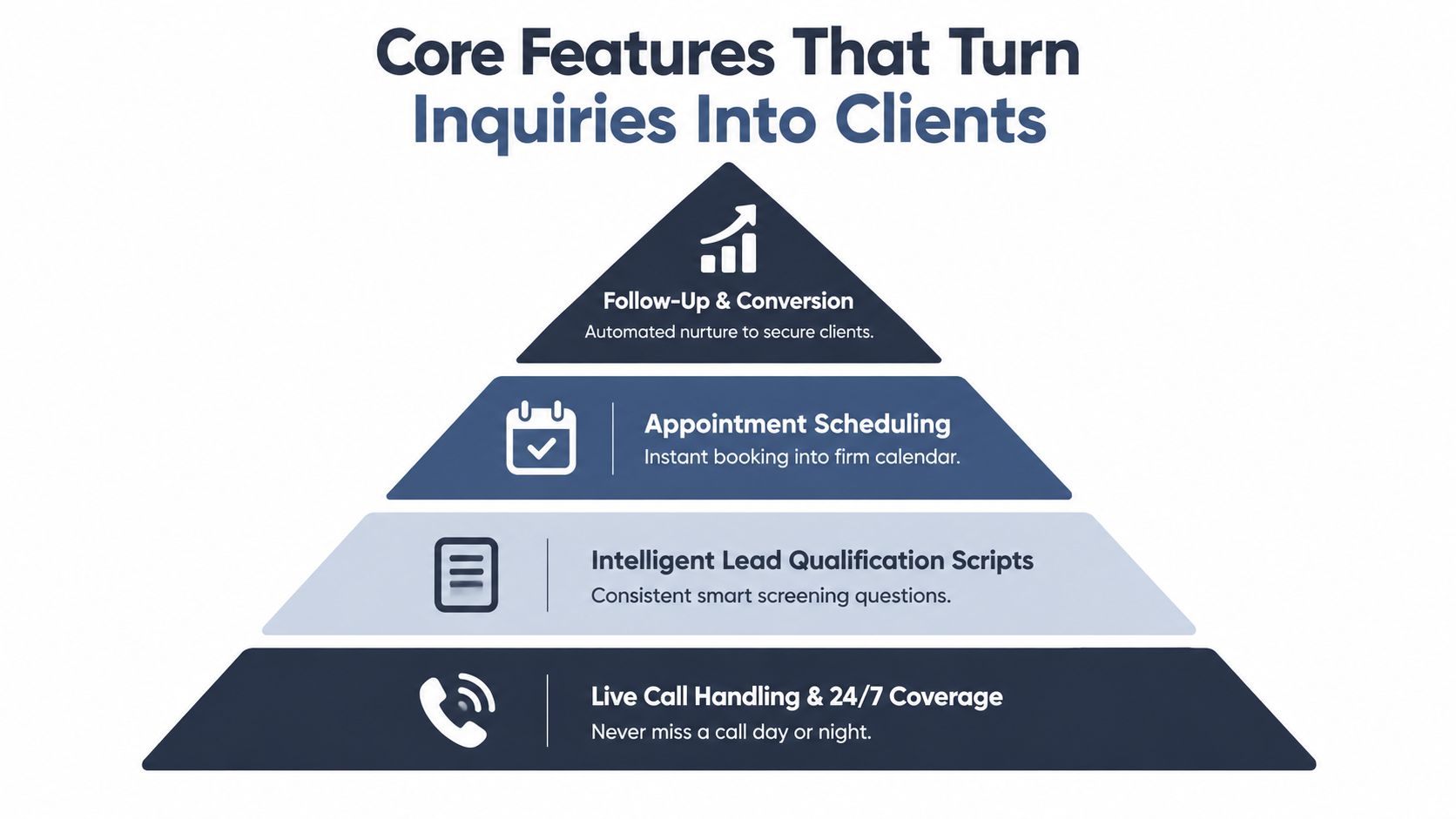
Good intake reduces friction, not just rings
A lot of confusion comes from treating intake as “who picks up the phone.” But the job is to reduce friction at every early step.
For example, a caller says, “I need help with a custody issue.” A weak process takes a message and promises a callback. A stronger process asks a few consistent questions, checks urgency, confirms contact details, explains what happens next, and offers a booking slot.
That's why many firms now look at structured, always-on workflows, including AI support for law firms, to cover first contact without forcing staff to interrupt legal work every time the phone rings.
It can be human, AI, or hybrid
Who “does” intake varies by firm. Some use internal staff. Some use an outsourced team. Some use AI for first contact and handoff. The best choice depends less on fashion and more on call volume, language needs, and how often your team is unavailable during the day.
Intake works best when the client feels guided, not processed.
The key idea is simple. Intake is not the task of collecting a name and number. It is the work of helping a potential client cross the gap between interest and action.
Core Features That Turn Inquiries Into Clients
A caller reaches your firm, gets an answer, and feels relief for about ten seconds. Then the questions start. Do you handle this kind of matter? What will happen next? How soon can I speak to someone? What might this cost?
Those moments decide whether intake produces work or just activity.
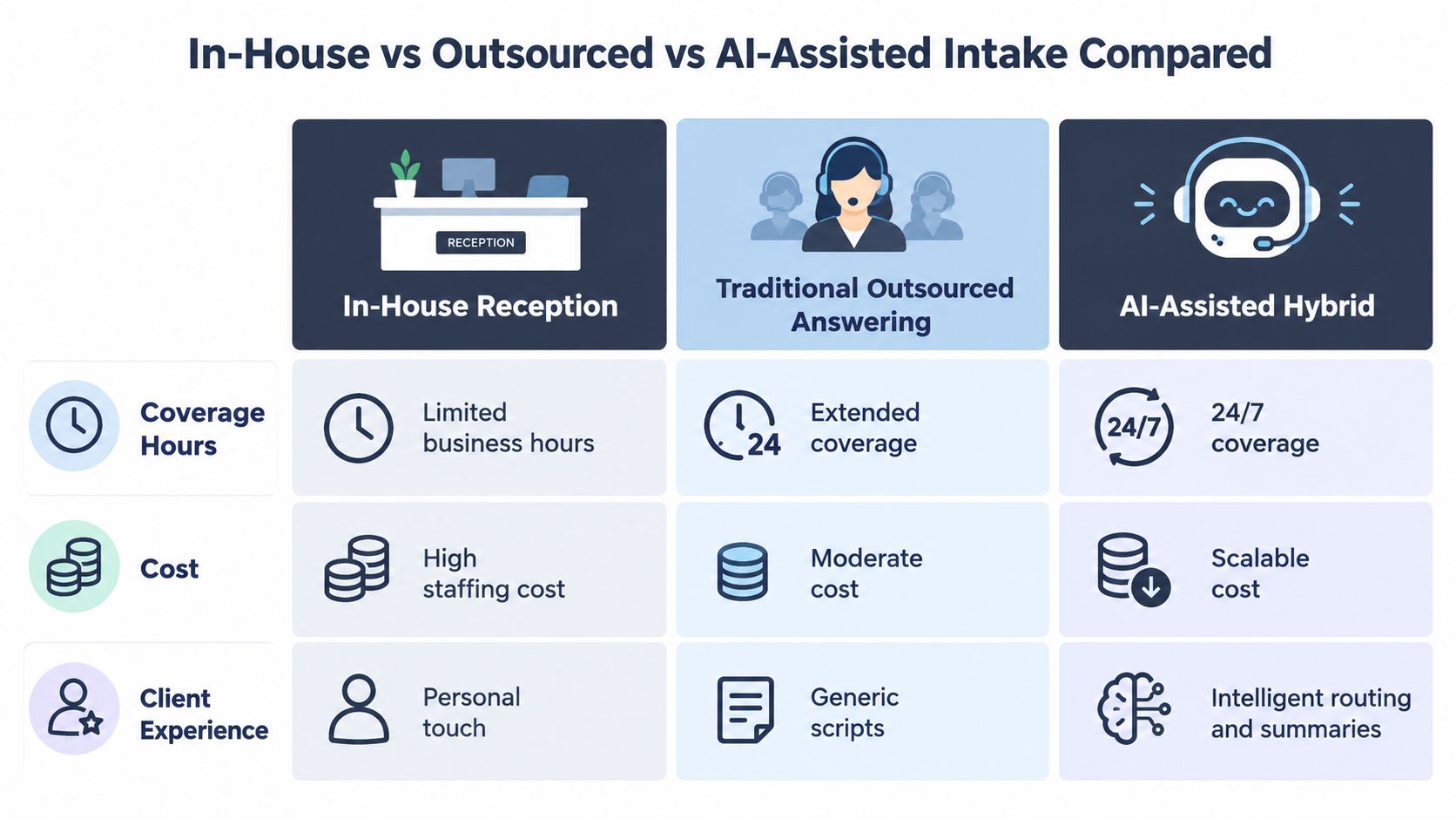
The five features that matter most
A strong intake service works like a front desk, triage nurse, and scheduler in one process. Each part has a job. If one part breaks, the caller feels it right away.
First is live call handling and extended coverage. If a potential client calls during lunch, after work, or while your staff is tied up, the intake system still needs to respond. Coverage creates the chance to begin. No answer means no intake.
Second is qualification scripting. A script is a checklist with good manners. It helps the person answering gather matter type, urgency, conflict details when appropriate, and contact information in a consistent order. That keeps your team from calling back to fill basic gaps.
Third is appointment scheduling with calendar sync. Interest cools fast. If the intake flow can offer a consult time while the caller is still engaged, the firm avoids the common stall of "someone will call you back to book."
Fourth is message capture and summaries. Lawyers need the short version, not a pile of disconnected notes. A useful summary tells your team who called, what legal issue they described, how urgent it sounds, and what the promised next step is.
Fifth is escalation logic. Some matters should never sit in a general queue. A custody emergency, an arrest-related call, or a ready-to-retain prospect may need immediate routing to a person with authority to act.
Fast response still matters, as noted earlier. But speed alone does not finish the job.
The leak that happens after the answer
Many firms focus on pickup rate and stop there. The bigger revenue leak often starts one minute later.
A caller can reach a real person and still leave unsure about price, process, timing, or whether the firm is a fit. That uncertainty is expensive. It creates ghosting, delayed callbacks, and consultations that never get booked.
One recent benchmark on law firm inquiries found a consistent pattern. Many firms answered, but far fewer gave clear guidance on fees, likely costs, or next steps. That gap matters because a caller who feels informed is much more likely to keep moving than a caller who hears, "An attorney will get back to you."
Intake now shifts from admin task to revenue lever. The answer is not only "pick up faster." The answer is "reduce uncertainty before the call ends."
For a small firm, that does not mean hiring a full extra intake team. A hybrid AI and human setup can handle the repeatable parts, collect the details, offer scheduling, and tee up the right pricing or process guidance for a person to confirm. AI covers the routine path. Humans step in where judgment, empathy, or exceptions matter most.
That model closes the post-answer gap without adding headcount.
Intake Feature to Client Outcome Map
| Core Feature | What It Solves | Bottom Line Benefit |
|---|---|---|
| Live answer coverage | Missed calls during busy periods | More chances to begin intake |
| Qualification script | Inconsistent questions and weak screening | Cleaner handoff to the right person |
| Calendar booking | Delays between inquiry and consultation | Faster movement toward retained matters |
| Summaries and notes | Lost details and messy callbacks | Better attorney preparation |
| Urgent escalation | Sensitive or time-critical matters sitting in queue | Faster response where judgment matters most |
| Pricing and next-step guidance | Callers who leave confused after getting through | More booked consults and fewer dropped leads |
Good intake feels simple to the caller.
Behind that simple experience is a system built to answer, clarify, guide, and move the matter forward.
In House Outsourced and AI Assisted Intake Compared
Firms usually choose between three operating models. Internal staff, outsourced human coverage, or an AI-assisted hybrid. Each can work. The right fit depends on what kind of gaps you need to close.
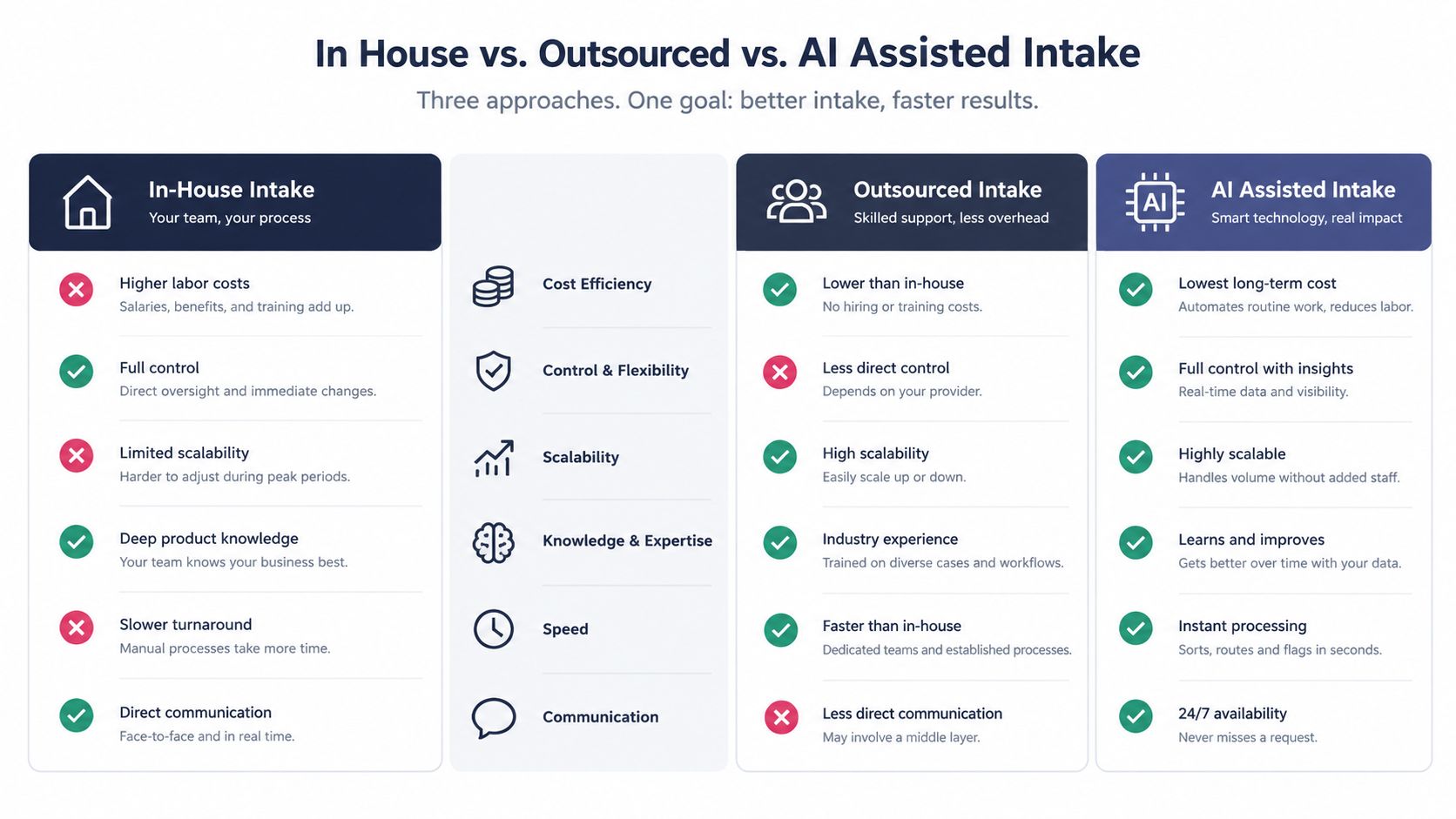
In-house gives control but limited coverage
Internal staff usually know your tone, your attorneys, and your preferred clients best. That's a real strength. They can pick up nuance quickly and often make warm handoffs inside the office.
The downside is coverage. Even excellent staff can't answer while helping another client, eating lunch, taking leave, or leaving at the end of their shift. For firms with uneven call flow, that creates dead zones.
Outsourced human intake extends hours
An outsourced intake team can widen availability and reduce interruptions for your office. This often helps firms that need steadier call handling but don't want another full-time employee to manage.
The tradeoff is distance from your day-to-day operations. Scripts need upkeep. Escalation rules need clarity. If that setup work doesn't happen, the service can feel generic even when the people are capable.
AI-assisted hybrid is often the most practical fit for smaller teams
This model uses AI for repeatable first-contact work and humans for judgment-heavy moments. That's where many small and medium firms get the best balance.
A 2022 peer-reviewed study on chat-based customer service found that AI is strongest for speed, availability, and scalability, while humans remain better for empathy, judgment, and critical assessment in complex or sensitive inquiries. The study framed the best model as AI complementing human agents, not replacing them (peer-reviewed study on AI and human service roles).
That lines up with what clients already prefer. A 2024 Capgemini report found that 55% of consumers prefer customer interactions enabled by a mix of AI and humans (consumer preference for hybrid support).
And for small service teams, the coverage problem is real during business hours, not just overnight. Research summarized in a 2026 AI adoption report for local service businesses found that businesses with 1 to 50 employees miss 20 to 35% of incoming calls during stated business hours (small-business missed-call research summary).
If you're looking at that model more closely, this overview of an AI receptionist for law firms in the UK is a useful example of how hybrid coverage is being applied in practice.
Bottom-line view: Use humans where trust and judgment matter most. Use AI where consistency, speed, and language coverage matter first.
Integration Privacy and Compliance Essentials
Intake that answers calls but creates data messes is not a win. The safest setup is one that fits into your existing workflow and handles sensitive information carefully from day one.

Integration should remove duplicate work
The goal is simple. A call comes in, the intake runs, the summary lands where your team already works, and the appointment appears on the right calendar.
Look for these connections:
- Calendar sync: Consultations should book directly into the calendar your team uses.
- CRM or matter-tracking connection: New inquiries shouldn't require manual re-entry.
- Call routing rules: Urgent matters should reach the right person, not a general inbox.
- Email and SMS summaries: Staff should get short, readable handoff notes fast.
When those pieces connect cleanly, intake feels lighter. When they don't, your team ends up doing cleanup work that defeats the purpose.
Multilingual support is now a practical intake decision
If your firm serves more than one language group, intake should reflect that from the first hello. This doesn't need to be complicated.
Independent 2026 guidance for multilingual customer support recommends starting with a few practical steps: identify your top customer languages from support data, decide where translation is needed across live chat, email, and knowledge base, verify CRM or helpdesk integration, and test privacy and GDPR requirements before committing to a plan.
For law firms, the same logic applies to phone intake. Start with the languages your firm receives. Then make sure summaries, routing, and follow-up still work for staff.
Privacy checks to run before you sign
A short diligence pass can prevent major headaches later. Use a checklist like this:
1. Ask where data is stored. If confidentiality matters, geography and infrastructure matter too. 2. Ask what is retained. You want clear limits, not “we keep everything.” 3. Ask how deletion requests work. This should be operational, not theoretical. 4. Ask who can access transcripts or summaries. Roles should be controlled. 5. Test disclosures and escalation paths. Sensitive legal issues should not sit in the wrong workflow.
If you need a practical framework for these reviews, a GDPR compliance checklist is a good starting point for the questions your team should ask.
Pricing Models and How AI Keeps Costs Predictable
Pricing gets confusing because intake services aren't sold in one standard format. Some charge by minute. Some by call. Some by lead. Some use flat retainers. Some mix a base plan with extra usage on top.
That sounds messy, but the buying decision is usually straightforward once you tie pricing to workflow.
Match the model to your call pattern
If your firm has steady, predictable inbound volume, a flat monthly structure may feel simpler. If calls come in bursts, around hearings, ad campaigns, or seasonal legal issues, usage-based pricing often tracks reality better.
What matters most is not the label. It's whether you can answer three practical questions:
- When do calls spike?
- How many of those calls are routine?
- Which calls need a human immediately?
If you can separate routine intake from judgment-heavy conversations, costs become easier to control. AI helps here because it can cover repetitive front-end work without requiring another staff schedule.
Digital intake tools are linked with stronger firm outcomes
Intake stops looking like overhead.
Clio's 2025 Legal Trends data found that referrals remained the top lead source for 59% of solo and small firms, while digital tools such as e-signatures, intake forms, schedulers, and text messaging correlated with 53% higher revenue for solo firms and 28% higher revenue for small firms. The same announcement noted that 78% of firms were using some form of AI in marketing or intake, while only 25% reportedly respond within five minutes and 26% do not respond to online leads at all (Clio 2025 solo and small firm data).
That doesn't mean every firm should automate everything. It means the firms treating intake as a business system, not just an admin chore, are generally in a stronger position to convert demand.
Start simple and add depth later
A practical rollout often looks like this:
- Stage one: Use AI to answer every inbound call, capture details, and send summaries.
- Stage two: Add appointment booking and basic qualification logic.
- Stage three: Add language handling, routing by matter type, and urgent escalation.
One option in this category is rednea, which handles 24/7 phone coverage, language detection, appointment booking, qualification, summaries, and escalation, with setup built around small-business workflows and per-minute plans. If you're comparing billing styles, this guide to usage-based pricing helps frame what predictable spend can look like.
The key is to buy the smallest system that closes your biggest leak first.
How to Choose and Launch the Right Intake Service
The firms that get intake right usually don't start with a long wish list. They start with the point of failure.
If your biggest issue is missed calls, solve coverage first. If your team answers but callers still disappear, fix pricing clarity and next-step guidance. If your staff is overwhelmed by incomplete messages, fix structure and handoff quality.
A simple decision framework
Use this filter before you choose any law firm intake service:
1. List your top call reasons. New matter inquiry, existing client question, urgent issue, wrong number, billing, scheduling. 2. List your top languages. Don't overbuild. Start with what comes in. 3. Mark must-have integrations. Calendar first. Then contact or case tracking. 4. Test the intake path yourself. Call in. Ask about next steps. Ask about fees in a routine way. See if the process feels clear. 5. Check the handoff. The summary should help your lawyers act quickly, not reread the whole interaction.
Watch for the common buying mistake
Most firms shop for answer rate and ignore the post-answer drop-off.
That's a mistake because a person can answer promptly and still lose the lead by sounding vague on fees, uncertain about process, or unable to explain what happens next. Intake only works when clarity follows contact.
The best intake systems don't just pick up. They reduce uncertainty.
Launch with a small pilot
You don't need a grand rollout. A pilot works better.
Pick one practice area or one phone line. Run a defined intake script. Review summaries for quality. Listen for repeat questions from callers. Tighten the script where prospects get confused.
A practical launch checklist looks like this:
- Choose one intake path first
- Decide what always gets escalated
- Set booking rules clearly
- Review sample summaries daily at the start
- Update FAQs when the same question appears repeatedly
The goal isn't perfection on day one. It's dependable first contact, clear next steps, and fewer good leads slipping away while your team is doing real legal work.
---
If your firm wants that kind of coverage without adding another front-desk burden, rednea offers an AI phone assistant built for 24/7 answering, multilingual intake, booking, summaries, and smart escalation to humans when needed. It's designed to help small and growing firms stay reachable and handle routine intake cleanly. You can see how it works at rednea.
Try rednea, no strings attached
AI phone assistant for business. Hear a live demo in your browser, book a call with our team, or get started — from £90/month, cancel monthly, no minimum term.
GDPR-compliant · EU & UK GDPR · Multilingual