How to Call Back a Missed Call Professionally

You're finishing a repair, helping someone at the counter, or driving between appointments when your phone rings. By the time you can check it, there's a missed call and no clear sign of what the caller wanted. Returning it feels simple until you have to decide whether it's genuine, what to say, and whether someone else has already called them.
Knowing how to call back a missed call professionally means making a checked, timed contact with a clear next step. For a small team, that starts with an accountable callback routine. AI can handle the first response when nobody's available, while people keep control of safety, sensitive questions, and judgment.
How to Call Back a Missed Call Step by Step
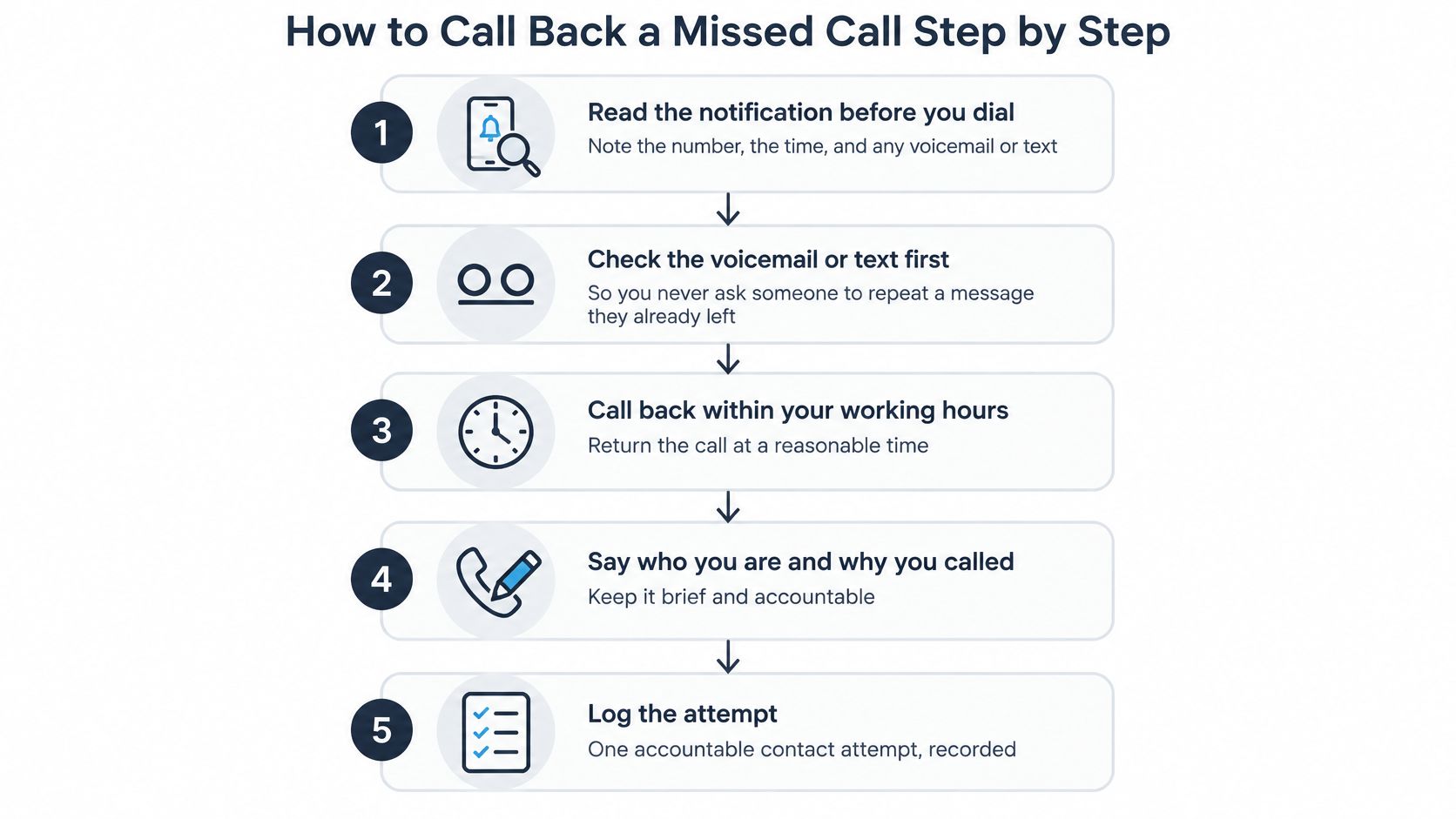
A callback works best as a checked, recorded contact attempt with one named owner. Before anyone dials, the team should know what the caller may need, who is handling the response, and what outcome to log. A shared inbox helps only when someone is responsible for acting on each entry.
Make each return call count
- Read the notification before you dial. On iPhone, open the Phone app's Recents tab; on Android, open Call history, though labels can vary. Check the number, time, voicemail, transcript, and any text before calling. If the caller has already described a leaking radiator, start with that context rather than asking why they called. Check unfamiliar numbers against the do-not-return table below, and verify unexpected organizational calls through a published number first.
- Use the business number customers recognize. Return the call through your business line rather than a private mobile whenever possible. An office administrator, for example, can call from the same outward-facing number shown on appointment confirmations. That gives the caller a familiar route back and keeps replies out of a personal inbox.
- Identify yourself and ask permission. Say your name, business, and reason for calling, then leave space for the caller to respond: “Hi, this is [name] from [business]. We saw a missed call from this number. Is now a good time?” If they are busy, agree on a time to call again instead of rushing into questions.
- Confirm the practical details. Ask what the caller needs, where the work is, how urgent it is, their preferred appointment window, and the best way to reach them if the call drops. A solo electrician might check whether an issue affects the whole property. A dental desk can ask whether the caller wants an appointment without inviting unnecessary clinical detail. Tailor the questions to the job, then record the answers consistently.
- End with a specific commitment. Book an available slot or say who will call and when. For example: “The scheduler will call during your agreed afternoon window to confirm availability.” Only promise a visit once it has been approved. A clear next step is more useful than a vague assurance that someone will be in touch.
- Leave a useful message if nobody answers. Keep it brief: give the business name, callback number, opening hours, and one next step. Leave personal or sensitive details out. Follow up by SMS only when consent and local rules permit. A short text can acknowledge the missed call and offer a route to reply; how missed call texts recover leads explains that role, while this missed-call text service guide outlines the workflow.
- Log the outcome and set a limit. Record the call time, result, promise, owner, and any opt-out. For a legitimate enquiry, retry after 10 to 15 minutes, then make one final attempt later that day before moving to permission-based follow-up. Stop that sequence for suspicious or unverified numbers, and suppress duplicate attempts if a teammate has already connected.
Keep the routine visible
Put the checklist beside the phone or in the shared call record. A colleague between site visits should be able to see what has happened, what was promised, and who owns the next move without reconstructing the call from memory.
The Five-Minute Window for a Missed Call
A plumber finishes a fitting before checking a missed call. The caller may already be asking another business whether it can take the job. During opening hours, aim to return a recognized caller's number within five minutes. That is a practical target, not a promise that every caller will still be available.
The research behind the timing has a narrower scope. A 2007 study led by James Oldroyd, then associated with MIT, examined three years of activity across six companies, more than 15,000 leads, and over 100,000 call attempts, as summarized in Blazeo's account of lead-response timing.
Callback windows and the move for each
For inbound sales leads, the study found approximately 100 times greater contact odds and 21 times greater qualification odds when a company responded within five minutes rather than waiting 30 minutes, according to Blazeo's summary of the study. These figures describe that study, not guaranteed results for every missed personal or business call.
The same study found that moving from five minutes to ten minutes reduced contact odds about fivefold and qualification odds about fourfold, as described in Blazeo's account of lead-response timing. Use the table's later windows as operating rules, not as additional measured findings.
| Window | What the research implies | What you do |
|---|---|---|
| Under 5 minutes | For inbound sales leads, about 100 times the contact odds and 21 times the qualification odds versus a 30-minute wait, according to Blazeo's study summary | Call now from the business number |
| 5 to 10 minutes | For those leads, contact odds fall about fivefold and qualification odds about fourfold versus a five-minute attempt, according to Blazeo's study summary | Call immediately and mark the attempt late |
| 10 to 30 minutes | Treat the strongest early contact window as missed | Make one recovery attempt, then offer a booked slot |
| Later the same day | The caller may already have chosen another business | Make one final attempt, then use a permission-based queue |
| Next morning | Reserve this workflow for after-hours callers who received an acknowledgment | Sort by urgency and job value, not arrival time |
A clear timing standard helps colleagues make the same call without guessing. See this guide to a customer-service response-time standard. If notifications are easy to miss, missed call alerts for small businesses can help route them to the person responsible.
Before dialing, label the record known customer, likely new enquiry with no message, or unknown number requiring verification. The five-minute target applies after that check. Speed helps recover a legitimate enquiry, while a quick classification keeps the team from treating every caller the same way.
Missed Calls You Should Not Return
Caller ID isn't proof of identity. A familiar area code or an organization's name on the screen doesn't establish who called. Scammers can spoof those details, so an unexpected number needs an independent check before you return it.
The U.S. Federal Trade Commission's warning about unexpected loan calls specifically says not to call back about loans you didn't apply for, even to opt out, because that can lead to more scam calls. Don't interpret urgency or an official-sounding message as permission to skip verification.
When to return a missed call and when to stop
| What you see | Return the call | First move |
|---|---|---|
| Known customer or a job you expected | Yes | Call within five minutes from the business number |
| No message and an ordinary local enquiry | Once only | Use a neutral script, capture the reason, then stop |
| After-hours caller who already got an acknowledgment | Yes, next morning | Sort by urgency and job value before dialing |
| Unexpected loan, prize, or tax demand | No | Don't call back, even to opt out |
| Request for a code, payment, or account details | No | Hang up, block, and report the number |
| Flood, no heat, or another emergency on your own list | Yes, to a person | Take the address and a callback number, then hand it over |
An ordinary local enquiry means a plausible business contact with no suspicious content, not a number that looks local. If the identity remains unclear, don't keep dialing to investigate.
Verify through a separate route
Find the organization's official website yourself, or use the number printed on an existing statement or bill. Don't rely on a number supplied in the suspicious message, and don't treat a search result alone as confirmation that the caller was genuine.
Never read out authentication codes, card numbers, or account details on an unverified return call. If a caller claims there's a payment problem with a supplier, end the conversation and contact the supplier through your established account contact.
A genuine issue can be handled through a verified channel. You don't have to stay on an unexpected call to resolve it.
Give the team a consistent call-screening process so the newest administrator isn't making these decisions from scratch. Record the concern without copying sensitive information into a shared note.
Safety-critical calls need a different kind of caution. For an emergency on your business's list, capture the address and callback number, then reach the person on duty. Neither a receptionist nor an automated script should diagnose a problem, invent a price, or promise a regulated outcome.
What to Say When There Is No Voicemail
A missed call with no voicemail gives you a number and a time, not a job. Treat it as a request to clarify, not proof that the caller wants a quote, has an appointment, or is the person listed in an old contact record.

Use a neutral opening for your trade
Call back from the verified business line and ask whether the person meant to reach you. Keep the first sentence neutral, then ask only what you need to route the enquiry safely.
Plumbing
Hi, this is Sam at Northside Plumbing returning a missed call. Is now a good time? If you need a visit, tell me the postcode and whether water is still coming in.
This checks location and urgency without promising attendance. If the caller reports flooding, follow your emergency handoff process rather than offering an improvised repair diagnosis.
Dental reception
Hi, this is the front desk at Harbour Dental returning your call. I won't discuss treatment until we've confirmed who I'm speaking with. If you'd like an appointment, would morning or afternoon suit you?
Keep the opening focused on availability. Don't mention a procedure, overdue bill, or another household member before confirming who is on the line.
Legal enquiries
Hi, this is Priya at Hale and Co returning a missed call. Please don't share case details until we confirm who you are. Can you tell me whether this is a new enquiry?
Reception can use the answer to route the caller without collecting a detailed account meant for the appropriate professional. If the caller mentions a deadline, flag it for a person to assess rather than deciding its significance yourself.
If the caller refuses to explain
A caller may say, “I'd rather not say,” or “I'll call back.” Don't press for private details. Offer a simple choice: “That's fine. Would you like me to pass on your name and number, or would you prefer to call us when it suits you?” If they decline both options, thank them and end the call. A neutral response respects their choice while leaving control with the caller.
The aim is to establish enough for the next action, not to conduct a full interview. Ask for:
- Name: Who called and, where relevant, who needs the service.
- Reason: A brief description that helps route the request without unnecessary sensitive details.
- Callback window: When the right person can reach them.
- Urgency: Whether someone on duty needs to handle the request now.
Offer text or online scheduling only if the caller agrees and the channel is allowed where you operate. If they say they never called, apologize, mark the number as incorrect, and end contact.
Use the earlier logging step for the call's outcome and any agreed callback. Keep the note focused on the next action, so a teammate can continue without restarting the conversation.
Add AI as the First Response Without Replacing Staff
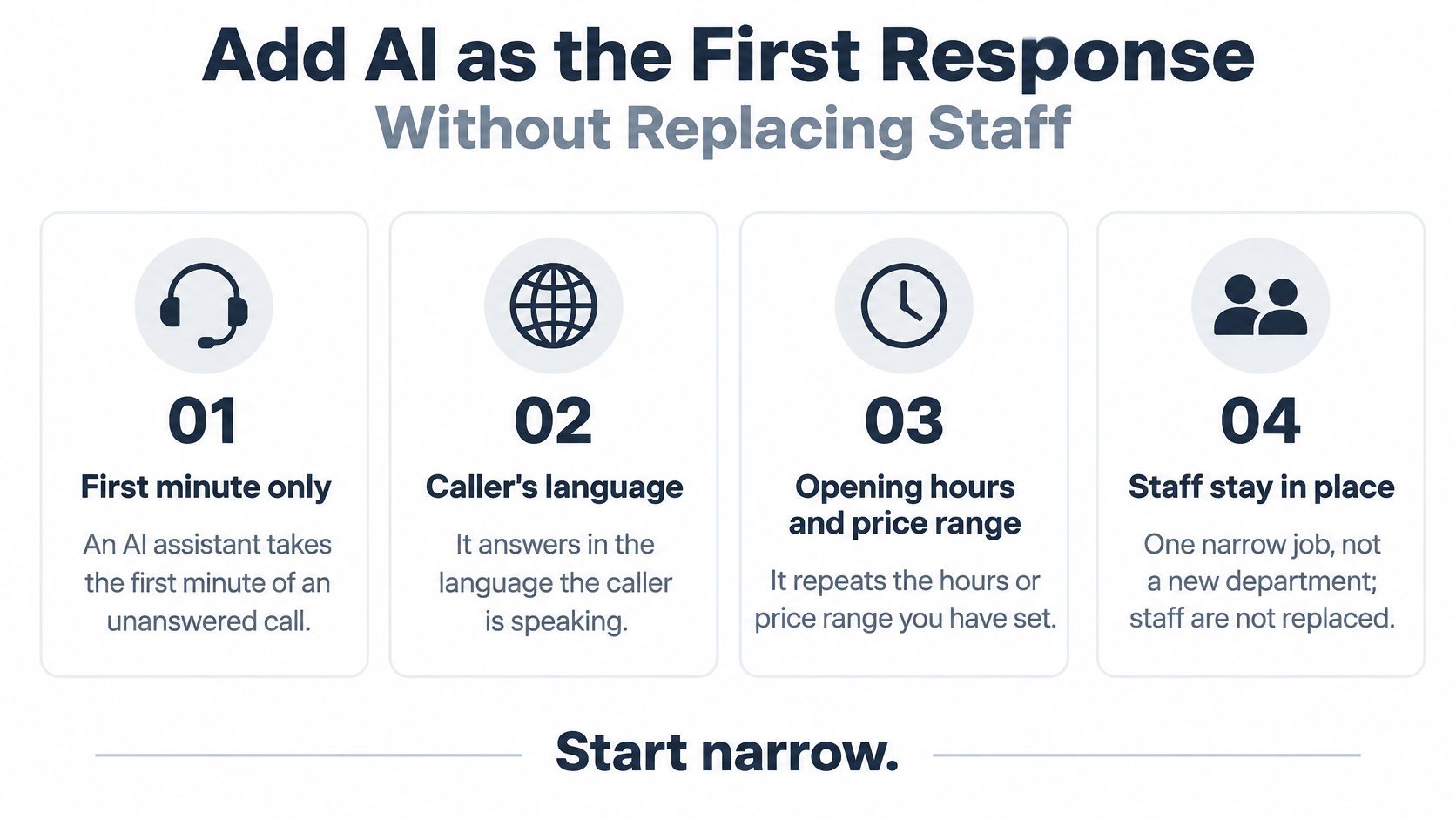
A missed call does not have to become a missed customer. When a small team is busy with a job, an AI phone assistant can answer the first ring, greet the caller with the business's name, and capture what they need. People keep control of decisions and take over when the conversation calls for judgment.
A 2025 Verizon survey of 600 U.S. small and medium-sized businesses found 38% using AI in at least one business function and 24% using AI-powered digital personal assistants for customer service. Those figures suggest these tools are already part of how some smaller businesses handle work.
Give the assistant a clear first-minute role
Write down the questions callers ask every day, then set approved answers, service areas, appointment types, and boundaries. The assistant can answer routine questions and capture a request, but it should not guess at a price that depends on inspecting the job.
Set escalation rules before forwarding calls. Decide which calls need a person, who receives them, and what happens if that person is unavailable. Complaints, safety issues, clinical questions, legal judgment, and unusual pricing are examples of conversations that may need human attention.
Test the assistant directly on its rednea number before forwarding calls. Try routine requests, interruptions, unclear addresses, and requests for a person. If the assistant cannot answer, it can take a message or forward the call according to the business's settings.
Keep your existing number. With unanswered-call forwarding enabled, rednea takes over if nobody picks up after around 20 seconds. Forwarding can be turned off again in seconds.
Make the handoff useful
If the right person is unavailable, the assistant notes a callback request unless it can handle the inquiry itself. After each call, the business receives an email with the caller's name, cell phone number, address, problem, and what was booked or promised. That gives the team a starting point rather than a bare missed-call notification.
For an urgent call, the assistant can capture the address and callback number, then transfer the caller to the technician on call, following the business's rules. If a transfer fails or the technician cannot answer, the team can use the summary to return the call and continue from the caller's request.
Review the summaries and adjust unclear answers or routing rules. A guide to answering your phone can help define which conversations belong with the team. The assistant handles the first response; people remain responsible for judgment and follow-up.
Try rednea, no strings attached
AI phone assistant for business. Hear a live demo in your browser, book a call with our team, or get started — from £90/month, cancel monthly, no minimum term.
GDPR-compliant · EU & UK GDPR · Multilingual