Missed Call Auto Reply: How Small Teams Catch Leads


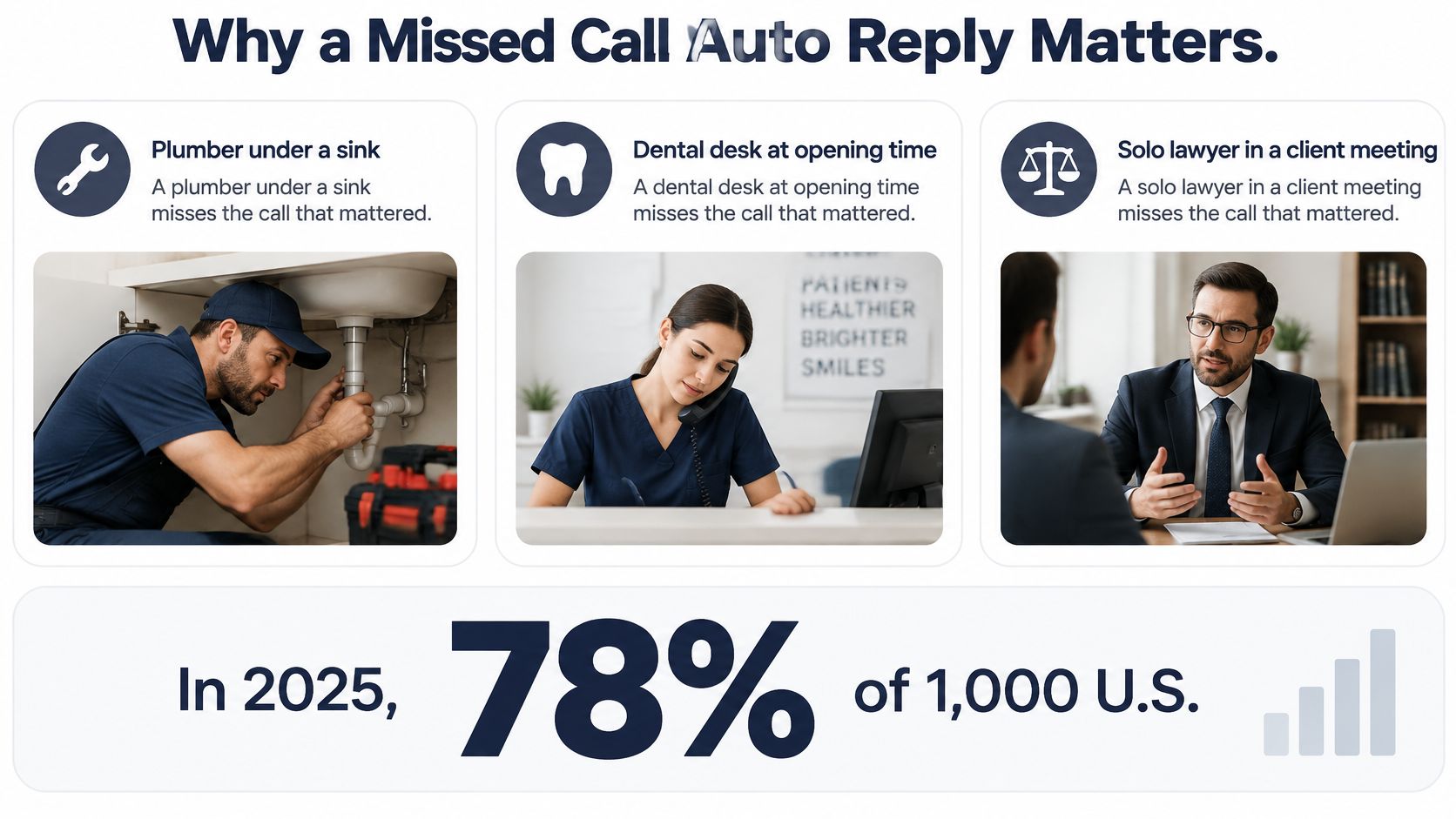
A plumber under a sink hears the phone but can't reach it. A dental receptionist opens the desk to a waiting patient and a ringing line. A solo lawyer stays focused on a client while another caller gives up. Each misses the call that mattered, not because they don't care, but because they're already working.
Why a Missed Call Auto Reply Matters
A missed call auto reply is an automatic text or spoken response that starts when nobody picks up, names the business, and turns the miss into a reply, a booking, or a callback request.
Think of it as the night bell outside a shop door. It doesn't run the shop. It makes sure someone knows a customer is there and gives that customer a useful next step.
In 2025, 78% of 1,000 U.S. consumers surveyed by CallRail said they had abandoned a business after an unanswered call, according to the survey summary published by MyLocalVoice. That's stated behaviour, not proof that every unanswered call becomes lost revenue. It does explain why leaving callers with silence is a poor default.
Give the caller a next step
For the plumber, that might mean identifying a routine quote rather than an active flood. For the dental desk, it might mean offering a check-up slot while sending an urgent concern to a person. For the lawyer, it means collecting a callback request without inviting confidential case details.
- Choose the response: Use a text acknowledgement or a spoken conversation.
- Set the operating rules: Decide how quickly it starts, what counts as urgent, and who receives the handover.
- Test the wording: Make sure the caller understands what happens next.
If your existing phone arrangement makes forwarding difficult, CloudOrbis Inc.’s guide can help you compare business VoIP costs for SMBs before changing the underlying service.
AI can already handle that initial exchange, including supported caller languages. People still own emergencies, complaints, and judgement calls. You can start with one unanswered-call rule, rather than replacing how your whole team uses the phone.
Voicemail Text Back or an AI Answer
Four ways to answer a missed call
| Method | Caller gets | You learn | Best when | Weak spot |
|---|---|---|---|---|
| Voicemail only | Greeting and a beep | A message only if they stay on the line | Low volume and clients who already know you | About 69% hung up without a message in the study below |
| SMS text-back | A text within about a minute that names the business | Their number and whatever they type back | Field teams who can reply between jobs | Basic templates can't book, hear spoken urgency, or ensure engagement |
| AI spoken reply | A conversation in seconds in the caller's supported language | Name, number, reason, urgency, and any booking | After hours, overflow, and while staff are on a job | Must escalate instead of guessing on sensitive calls |
| Human callback only | Silence until someone is free | Nothing until you dial back | Calls you already know are sensitive | The caller may contact another business first |
A 2016 study of 300 microbusinesses, supplemented by call data from 10,000 businesses, found approximately one-third of incoming business calls went unanswered and 69% of callers reaching voicemail hung up without leaving a message, according to Klevere's account of the study. These are historical findings, not a forecast for your particular office. They show why a greeting and a beep shouldn't be mistaken for successful lead capture.
Voicemail still suits established clients who know what information to leave. Its weakness is the work it asks the caller to do: listen, wait, explain, and trust that someone will respond.
Pick the smallest useful upgrade
A basic SMS text-back is useful when your real problem is late acknowledgement. Configure it to arrive within about a minute, name the business, and ask a simple question. A tradesperson can read the answer between jobs without replaying a recording.
A plain template doesn't inspect a calendar or complete a booking. A connected messaging workflow can do more, but that's a different setup from sending the same acknowledgement to every missed caller. Text also can't hear hesitation, distress, or confusion in someone's voice.
A spoken assistant can ask a follow-up question while the caller is still engaged. Our assistant answers in seconds, detects the caller's language, and can take a complete request or book a routine appointment. Two simultaneous callers are both answered, rather than forcing one to encounter a busy line.
Selection rule: Choose text-back for an acknowledgement gap. Choose a spoken assistant when callers need an exchange while your team is occupied.
A human callback remains essential for matters that need discretion or professional judgement. As the only fallback, though, it leaves an avoidable gap after hours and during site work. Let automation cover repetitive questions and unattended periods, then hand over anything it can't safely finish.
How Fast the First Reply Must Land
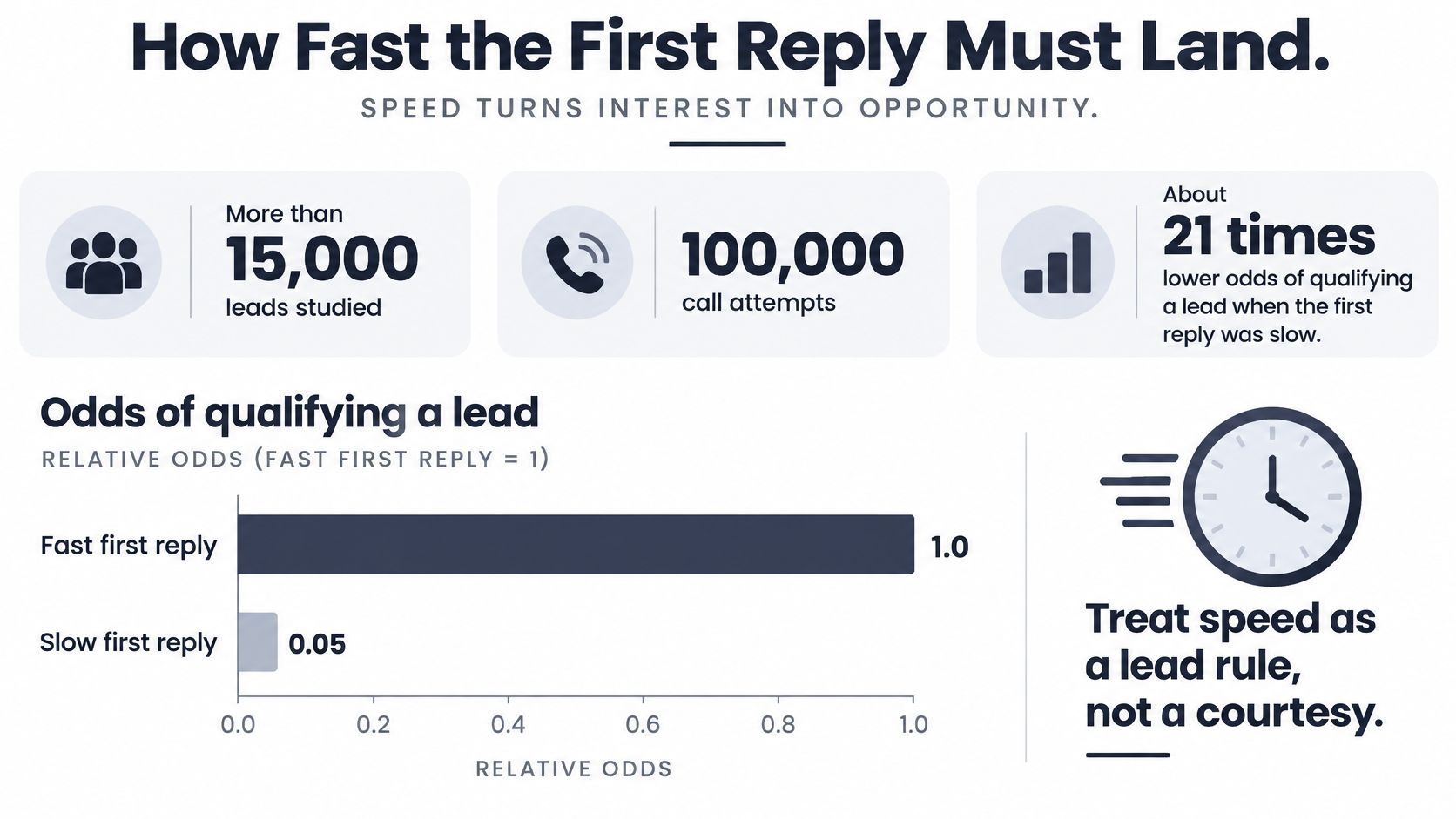
Delaying the first response from 5 to 30 minutes reduced the odds of qualifying a lead by approximately 21 times in a study involving more than 15,000 leads and 100,000 call attempts, described by Vida's lead-response guide; contact success also declined by more than 10 times during the first hour. That study concerns lead response, not a guaranteed result for every missed-call text. It supports treating speed as an operating rule rather than a courtesy.
Start the clock at the carrier's unanswered-call timestamp. Don't wait for someone to open the customer record or finish listening to voicemail before triggering the acknowledgement.
Set a response target you can operate
Use roughly 60 to 90 seconds as your practical acknowledgement target. The message should name the business, acknowledge the missed call, and invite a reply. Don't promise an exact callback minute unless someone has responsibility and capacity to meet it.
Offer self-service booking only when the link leads to real availability. A spoken assistant should confirm a slot only after the connected calendar accepts it. During opening hours, send high-intent requests to a person within minutes rather than leaving them in the general inbox.
For coordinating acknowledgement, task assignment, and later follow-up, Starward Navigators on automated client follow-up offers useful workflow context. Keep the immediate response separate from the longer follow-up sequence so one doesn't wait for the other.
Measure the slow cases too
Track the median delay and the 90th-percentile delay, meaning the point below which most responses fall. A good average can conceal a queue that stalls after closing time.
- Missed-call-to-message time: Measure from the unanswered event to submission and delivery.
- Reply and booking rates: Count whether callers continue and complete a useful next step.
- Escalation and unresolved rates: Check whether requests reach a person or remain unfinished.
- Time and language: Separate results by opening hours, after hours, and supported language.
Our guide to customer service response time helps connect these measures to team ownership. Suppress duplicate acknowledgements when the same number calls again, and stop automated outreach after an opt-out or successful live conversation.
Sort Emergencies from Routine Calls
A generic promise that someone will call back isn't enough when the caller describes danger. A plumber's active flood, a dental check-up request, and a sales robocall need different outcomes, not different versions of the same holding message.
How to triage a missed call
| Call type | Signals | Auto reply does | Person needed |
|---|---|---|---|
| Emergency | Flooding, gas smell, severe pain, break-in, safety words | Give the appropriate emergency-service instruction and alert the on-call person; don't promise a fix | Yes, immediately |
| Same-day request | Today, leaking, locked out, pain just started | Offer the next real slot or a callback window the diary can keep | Yes, within minutes in opening hours |
| Routine enquiry | Hours, price range, check-up, standard booking | Answer approved facts and book if the calendar is connected | Only if booking fails or the request exceeds approved facts |
| Sensitive matter | Complaint, legal detail, diagnosis, payment dispute | Collect callback number, language, broad reason, and urgency only | Yes, before any advice |
| Likely spam | No clear request, repeated sales pitch, robocall pattern | Short close and no callback chase | No |
Make urgency a routing decision
Emergency signals require an immediate safety route. A gas smell needs appropriate local emergency guidance, not an appointment offer. Severe pain should reach a qualified person or urgent-care pathway, not an automated diagnosis.
The reply may acknowledge and route, but it may not reassure someone that a dangerous situation is under control.
For a same-day request, ask whether the situation is happening now and whether immediate safety concerns exist. Then offer actual availability or a callback window the diary can support. The word urgent alone shouldn't make the assistant promise a technician, clinician, or lawyer is available.
A routine enquiry can stay with automation when the answer comes from approved information. Opening hours and standard booking rules are suitable. Unpublished prices, exceptions, or uncertain eligibility need a person.
Keep sensitive calls short
A complaint or payment dispute shouldn't become a lengthy automated interview. Ask for a broad category and a callback route, then hand it to the responsible person. Don't ask callers to explain symptoms, case facts, or card numbers to a bot.
Privacy and urgency overlap here: more detail doesn't necessarily produce a safer decision. The AI voice privacy guidance from Pulsify supports collecting only what's necessary and providing a human route.
Use a short close for clear spam, but don't reject someone merely because their speech is hesitant or their request is unfamiliar. Our escalation call-handling guide can help turn ambiguous cases into explicit handover rules.
Write these outcomes into the settings before switching forwarding on. If our assistant can't answer, it takes a message or forwards to a human according to your settings, so the call isn't lost.
Record Only What the Reply Needs
Treat each missed call as a request with a recorded outcome, not a text you hope someone read. An analysis of 16.7 million missed calls found 69% received no business callback within 48 hours, while 31% received one, with nearly all callbacks occurring within 24 hours, according to Quo's callback analysis.
Give every missed call an auditable disposition. That makes it possible to find unfinished work without asking staff to reconstruct the conversation.
Keep a small, useful record
- Disposition: SMS delivered, SMS failed, caller replied, appointment booked, escalated, opted out, or unresolved.
- Contact route: The number already on the line, plus a different callback number if the caller provides one.
- Language and purpose: Preferred language, broad reason for calling, and urgency.
- Commitment: What was booked or promised, who owns the next action, and whether it remains open.
Delivery isn't engagement. A delivery receipt indicates routing through the handset network, not that the caller read, understood, or answered the message. Keep a delivered-but-unanswered request separate from a conversation that progressed.
A failed message needs its own fallback. A temporary delivery failure might justify a controlled retry; a non-text-capable number needs another route. Don't keep resending the same message without checking the failure reason.
Avoid collecting detail just because you can
Skip recording and full transcripts when a short structured record is sufficient. Don't collect symptom lists, legal case facts, card numbers, or a precise address when all you need is a callback window.
Caller numbers, recordings, and transcripts can be personal data. Identify the automated assistant, explain why contact details are being kept, and establish a documented retention period for unresolved logs. If a host keeps audio, address processor terms, access, and deletion before enabling recording.
Our customer data protection guide is a useful starting point for translating those decisions into daily handling rules. Make sure staff can find the summary without spreading sensitive information through unnecessary inboxes.
When the assistant is uncertain, escalate rather than collect more detail to support a guess. A short, accurate callback request is better than a detailed but misleading account.
How to Set Up a Missed Call Auto Reply
Keep your existing number and decide when another answering route should take over. The first setup should solve a specific gap, such as a busy reception line, rather than automate every possible conversation.
Configure the handover
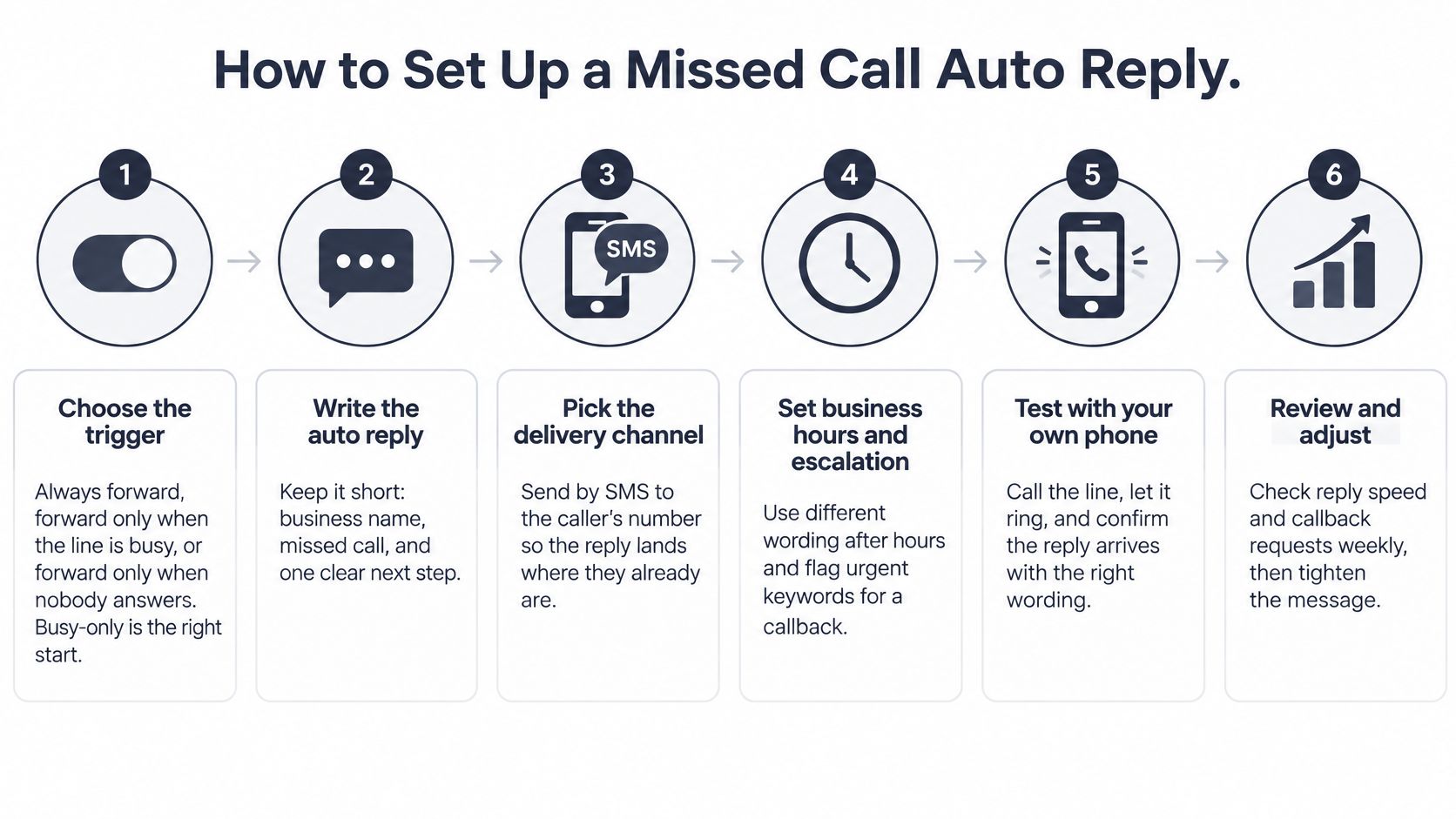
- Choose the trigger. You can always forward, forward only when the line is busy, or forward only when nobody answers. Busy-only is a sensible start for a reception desk that still wants the first chance to answer. Don't choose unconditional forwarding accidentally and wonder why the desk phone has stopped ringing.
- Set unanswered forwarding. When this option is configured, our assistant takes over if nobody picks up after around 20 seconds. The standard GSM code is
*61*NUMBER*11*20#, where NUMBER is the rednea number. Confirm the code with your carrier before dialling it, because the carrier must support the forwarding command.
- Write the opening line. Include your company name, say the caller is speaking with an automated assistant, and ask why they called. For example, introduce the business and ask whether they need an appointment, a callback, or urgent help. Don't begin with a long menu that makes the caller listen before they can explain.
Test the trigger itself before refining conversational wording. A good greeting won't help if calls still end at the old voicemail box.
Make the result actionable
- Load the triage outcomes. Set explicit destinations for emergency escalation, same-day requests, routine bookings, sensitive matters, and likely spam. Assign a named owner or on-call destination rather than a general instruction to notify someone. The original caller's number stays visible to our assistant, so the handover doesn't become anonymous.
- Route the summary to the working inbox. Our call summaries are structured emails covering who called, what they wanted, and what was booked or promised, in the language your business configures. Make the callback number easy to spot. A summary that lands in an unattended mailbox is still unfinished customer service.
- Test before widening the rules. Make a routine call, an urgent call, and a call in another supported language. Check the greeting, routing, booking result, and summary, then monitor missed-call-to-first-response time during your first week. Change one rule at a time so you can identify what improved or broke the workflow.
A hosted assistant can sit behind this forwarding arrangement for a trade, clinic, or small office without replacing the main number. The owner's job is to define availability and boundaries; the assistant's job is to follow them.
Before launch: Have someone outside the setup read the summary and explain what they would do next. If they can't tell, fix the handover.
Sample Replies for Real Businesses
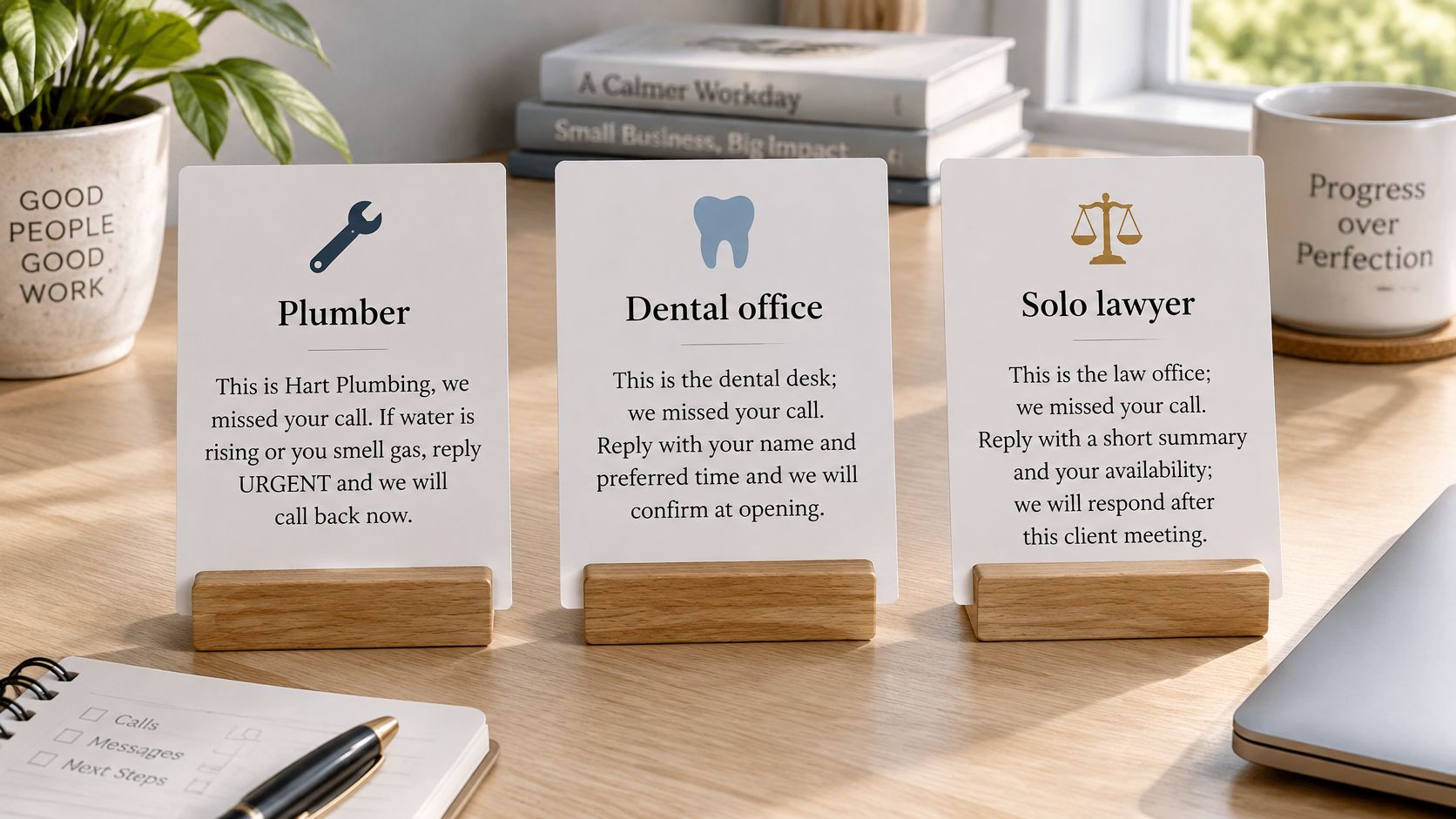
A useful script sounds like your business and gives the caller a manageable next action. The examples below are adaptable wording, not claims about real businesses. Use the safety instructions appropriate to your location and only offer booking when your calendar is connected.
A plumber between jobs
*This is Hart Plumbing's automated assistant. We missed your call. If water is rising or you smell gas, contact the appropriate emergency service now and don't wait for our callback. I'll flag your request to the on-call person. Otherwise, reply with your postcode and whether the job can wait until tomorrow, or say book to check the next available slot.*
The postcode helps establish the service area without asking for a full address immediately. Only include the on-call sentence when someone receives that alert. An automated promise to call straight back is inappropriate if nobody is covering the phone.
A dental practice at opening time
*You've reached the practice's automated answering service. For severe swelling, bleeding, or trouble breathing, seek urgent care; don't wait for an appointment response. For a check-up, say morning or afternoon and I'll check available times. We won't ask for medical details on this line.*
The distinction is between administration and clinical judgement. The assistant can arrange an appointment, but a clinician or appropriate urgent-care service must assess symptoms. Don't let a booking confirmation sound like reassurance that waiting is medically safe.
An estate agent or small office
*This is Calder and Co.’s automated assistant. Are you calling about a viewing, a valuation, or something urgent? Please leave the best callback number. I can continue in your language when it's supported, or arrange a callback with someone who can help.*
A multilingual-support report cited by Stealth Agents states that 73% of respondents reported better customer-satisfaction scores when support was delivered in the customer's native language. Start with the languages your team serves and can support through handover, rather than promising every language at once.
- Shared limit: Never invent a price, a diagnosis, or a legal outcome.
- Language fallback: Hand over when terminology is unclear or the caller needs a fluent specialist.
- Final edit: Read the script aloud and remove any callback promise your team can't keep.
For more adaptable wording, use our customer service scripts guide. Keep the tone natural, but make the operational promise exact.
Let AI Cover the Phone Beside Your Team
A dataset of 22 million customer-service conversations reported a 57% resolution rate for human-plus-bot interactions, compared with 29% for bots alone, according to Tidio's customer-service statistics report. That supports a first line beside your team, not an empty office. It isn't a forecast of your own booking or resolution rate.
Make the first week a limited trial
For seven days, forward only busy or unanswered calls. Keep floods, severe pain, complaints, and payment disputes with people, and assess the trial through replies, bookings, and unfinished requests.
Our assistant handles calls around the clock, books routine appointments, answers simple questions, captures enquiries, and sends summaries. It detects English, Spanish, French, German, and Italian.
- Start with the essentials: rednea's Basic plan includes 24/7 answering, calendar-integrated appointment booking, email notifications, website chat, 10+ voices, and no setup fee; the Missed call calculator and Voicemail greeting generator can help with preparation.
- Delay optional changes: Don't add voices, another language, or another automated text until the trial's dispositions show useful replies and bookings.
- Check the handover: Look for caller name or number, callback number, reason, and a next step someone can finish.
Place an after-hours test call tonight and open the summary in the morning. If a field is missing, fix the capture or routing rule before expanding coverage. Your first milestone is a request your team can act on, not a longer automated conversation.
---
Visit rednea to set up an AI first line that answers missed calls, books routine appointments, and sends your team actionable summaries. Start with busy or unanswered calls, define the human escalation route, and test an after-hours call before widening the rules.
Try rednea, no strings attached
AI phone assistant for business. Hear a live demo in your browser, book a call with our team, or get started — from £90/month, cancel monthly, no minimum term.
GDPR-compliant · EU & UK GDPR · Multilingual