Answering Your Phone Reliably: A Step-by-Step Guide

You're halfway through a job, the phone buzzes in your pocket, and by the time you can wipe your hands it's already gone to voicemail. That's how most small firms lose the next booking. Not because the roster is thin, but because the call landed when you couldn't show who you are or how soon you'd ring back.
Answering your phone reliably is a trust and timing problem. Callers decide in the first few seconds whether you're a real business or another unknown number. An AI assistant is good enough to cover the predictable first layer, the greeting, the intake, the booking, and the routine answers, in the language the caller is already using. You keep the judgement calls.
I would start with the cheapest fix. Log what you miss this week, then set a handover so those calls still leave with a name, a job type, and a path back to you.
Why Unanswered Calls Turn Into Lost Jobs
Say an electrician is up a ladder when a homeowner rings about a dead socket. The phone hits voicemail. The homeowner doesn't wait. They call the next firm on the list, and that job is gone before you climb down.
Three windows swallow most of those calls.
- On a job or driving: your hands aren't free, and the line rings out.
- After hours: nobody is rostered, so the caller hears a recording and moves on.
- Two callers at once: the second person gets a busy tone and assumes you're closed.
There's a trust gap on top of the timing. Ofcom's UK research on suspicious calls found that more than 90% of mobile users decide whether to answer based on the number shown at least some of the time. An unfamiliar number is screened before anyone speaks. In 2024, 74% of surveyed U.S. consumers said they do not answer calls from unknown numbers because they fear the calls may be scams, in TransUnion's survey of 1,556 consumers. Check those US figures against local behaviour before you treat them as your market.
In practice the first few seconds decide whether a caller stays. A business name, spoken immediately, is what turns a screened number into a conversation. The money side of that gap is laid out in the cost of missed calls.
Run a one-week log. Every call you don't answer gets a time, a reason, and a note on whether the caller rang back.
You'll finish with a measured gap, not a hunch, and a clear reason to fix the windows that lose work.
Target Speeds Every Business Phone Should Hit
These are the floors I check before I change anything else. If a line misses them, more staff won't hide it.
| Target | Benchmark | How to measure it |
|---|---|---|
| Calls answered within 20 seconds | At least 80% | Share of inbound calls picked up in the first 20 seconds, including after-hours calls |
| Average speed of answer | About 15 seconds | Average wait from first ring to pickup, split by hour of day |
| Abandonment rate | Below 2% | (Calls offered minus calls handled) divided by calls offered, times 100 |
| First-call resolution | At least 85% | Share of calls closed without a transfer or a callback |
| High-intent first attempt | Within 5 minutes | Minutes from missed call to first attempt, logged with timestamp |
| Missed-call follow-up | Within 1 hour | Share of missed calls with a contact attempt inside one hour |
| Never contacted | Track by source and hour | Leads with no contact attempt after the final try |
Answer at least 80% of calls within 20 seconds. That's the point where a caller feels handled rather than queued. Keep average speed of answer near 15 seconds. The U.S. government's telephone-service benchmark sets a 15-second maximum queue and ties waits approaching one minute to lost opportunities and dissatisfaction. It also calls for first-call resolution of at least 85% and round-the-clock availability.
How to count abandonment
Keep abandonment below 2%. Measure it as calls offered minus calls handled, divided by calls offered, then times 100. Callers who hang up in a menu still count. If you only count people who reached a person, the rate looks healthier than the diary is.
Speed on leads, not just pickup
An audit of 1.25 million sales leads across 42 companies found that organisations attempting contact within one hour were nearly seven times more likely to qualify a lead than later responders, and more than 60 times more likely than those waiting at least 24 hours. For a quote or an emergency, I want the first attempt inside five minutes. Track the never-contacted rate by source and hour so a quiet evening doesn't hide a dead channel.
Two errors wreck the numbers. Counting voicemail as contact, and cutting handle time while resolution falls. Each week, check three figures only: answer rate within 20 seconds, abandonment, and high-intent first-attempt time.
How to Set Up Call Routing Step by Step
Your phone is ringing while you are on a job. A caller needs an answer, and the routing choice determines whether your phone keeps ringing, the assistant picks up, or the caller waits. Set the mode to protect the calls you can handle yourself while covering the ones you cannot.
| Forwarding mode | Best for | Trade-off |
|---|---|---|
| Always forward | Closed days or site work when nobody can answer | Your phone does not ring, so you cannot pick up live |
| Forward when busy | Overflow when your line is engaged | Calls missed while your line is free still ring until the no-answer timer runs |
| Forward when unanswered | Keeping your own pickup while covering calls you miss | The assistant takes over after around 20 seconds |
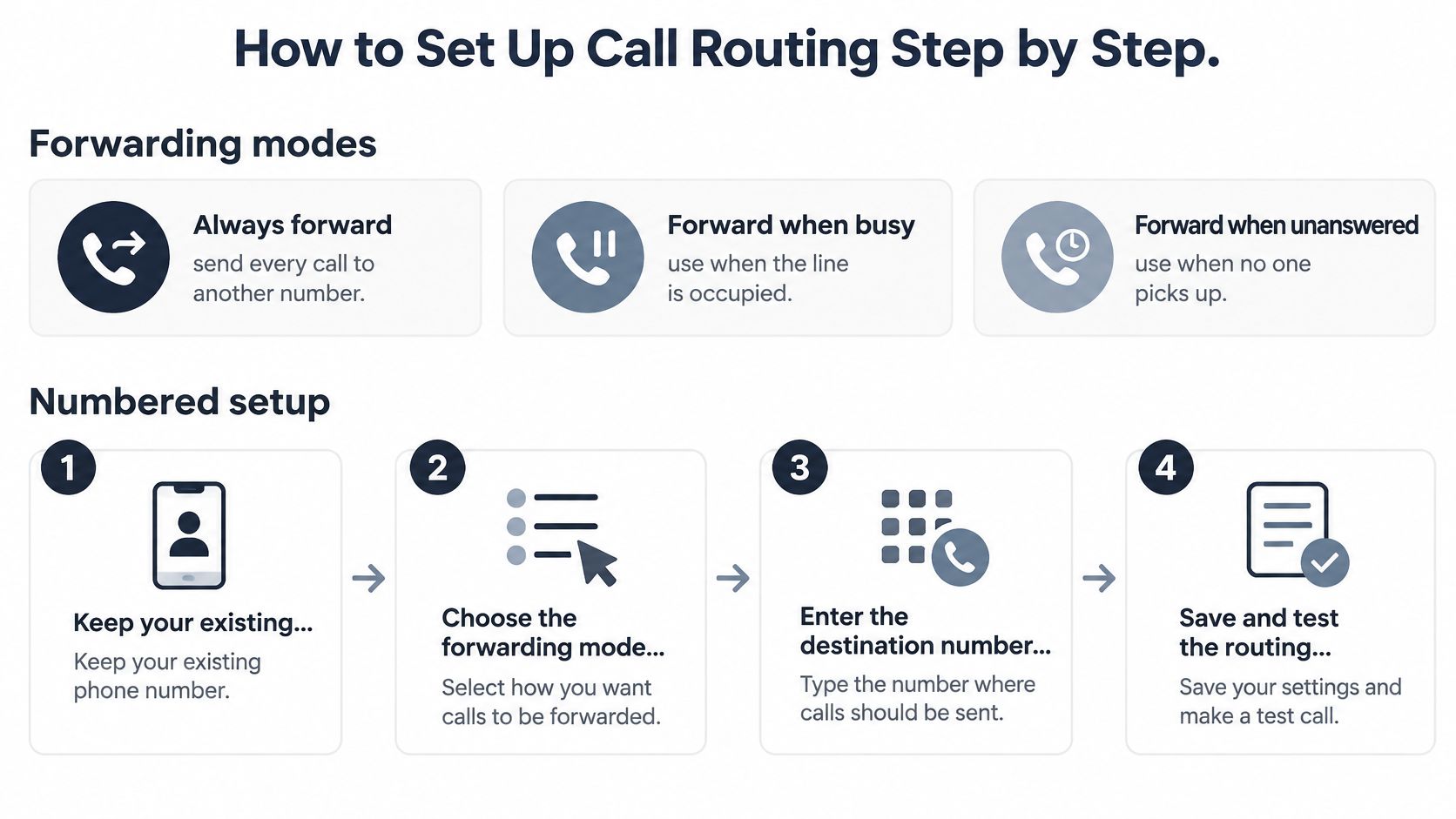
Keep your existing number and forward calls to rednea, either all the time, when the line is busy, or only when nobody answers. Owners who still take most calls can choose forward when unanswered to keep their own pickup, with the assistant taking over after around 20 seconds. For more detail on choosing and configuring a call routing system, consider how each mode fits your working day.
Numbered setup
- Keep your existing number. Customers already use it to reach your business. Forwarding lets you keep that number while changing who answers.
- Choose the forwarding mode. Use unanswered if you want your phone to ring first. Use busy for overflow when you are already on another call, or always forward when you do not want your phone to ring.
- Set up forwarding. On a mobile, the standard GSM code for unanswered calls is
*61*NUMBER*11*20#, where NUMBER is the rednea number. Setting up forwarding on a mobile takes about 10 seconds. Codes can vary by carrier, and some landlines use the provider's own menu. Confirm the setup with a call from a second phone. - Configure the emergency list. Set out which callers, situations or job types count as urgent. This lets the assistant follow your rules and forward urgent calls to you.
- Enter your service area, job types and job durations. Clear durations help the assistant book appointments without clashing with work already scheduled.
- Add answers to everyday questions. Include details such as opening hours and the postcodes you cover. The assistant can answer straightforward questions and take a message or forward the call to a person when it cannot answer.
The assistant handles predictable steps, while your rules determine which calls need human judgement. Before relying on the setup, let a call go unanswered, place a call while the line is busy, and check that messages or transfers reach the right place. If one route fails, adjust the forwarding settings before using it for customers.
Greetings and Scripts That Make Callers Stay on the Line
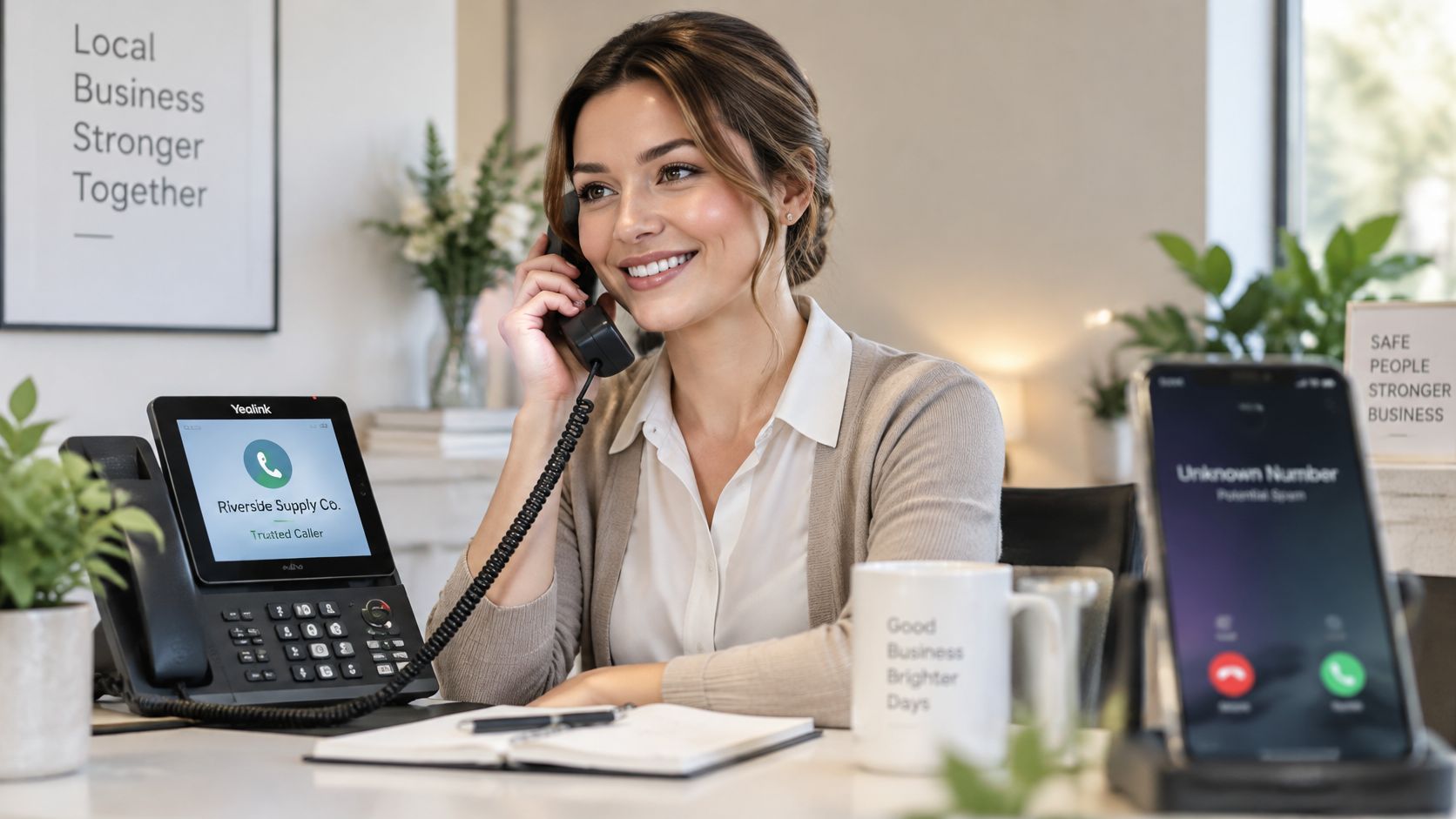
The greeting is a verification step, not a welcome mat. In 2024, 70% of surveyed U.S. consumers reported that they had not answered a call because of safety or fraud concerns and later learned it came from a legitimate caller, according to TransUnion. Legitimate firms lose reach when they sound like a robocall.
The greeting formula
Business name, one line of purpose, then a single question. We answer on the first ring, and the caller hears the business name before anyone decides whether the call is an emergency or a routine request.
"Hi, you've reached Carter Electrical. Are you calling about an existing job, a quote, or an emergency?"
That works because the name and the purpose arrive before the caller has to commit. A script library for phone greetings for business is worth adapting, then cutting until it fits one breath.
Intake in a fixed order
Ask at most five questions, and only after the previous answer earns the next one.
- Name. You need a person to call back, not a household.
- Phone number. Read it back. A wrong digit wastes the whole call.
- Address or postcode. This filters jobs outside your area before you promise a time.
- Job type. Burst pipe, consumer unit, or a quote. The type picks the handler.
- Preferred time. Only now, once you know the job fits.
The assistant replies in the caller's language, so write the script in every language your customers use. Cut filler such as "your call is important to us." It adds seconds and no proof.
Show your registered business name on outbound and callback numbers. State the callback number in the greeting so callers can verify it, then send a confirmation text or email with the business name after each booking. Call your own line, time the first answer, and read the script aloud. If you stumble, the caller will too.
Deciding Which Calls a Person Must Take
Set the handoff by the decision the caller needs, not by whether a call is easy to answer. Predictable requests can be handled without delay; safety concerns, disputes and cases that need judgement should reach a person.
| Call type | Who handles it | Why |
|---|---|---|
| Emergency such as a burst pipe or no power | Transferred to the on-call person at once | Delay can increase damage or risk |
| Booking or rescheduling | Assistant books into your calendar | Routine requests can be completed without judgement |
| Routine question on hours or service area | Assistant answers from approved information | The answer is predictable |
| Complaint or payment dispute | Person calls back using the summary | Needs judgement and trust |
| Large quote or complex job | Assistant captures the details; a person follows up | Needs site details and a human decision |
| Wrong number or spam | Assistant ends the call politely | It is not a lead requiring staff time |
The 2024 survey of 4,000 consumers in the United States and United Kingdom reported that 75% preferred speaking with a real person in person or by phone for customer support, while 48% did not trust information from AI-powered customer-service bots and 56% were often frustrated by them. Use that preference to shape the handoff, not to send every caller to staff. The assistant owns predictable steps and people own judgement.
The handoff rule
If the assistant cannot answer a query, it takes a message or forwards the call according to your settings. Include the caller's answers and a short summary so the person handling it has context and the caller does not need to repeat the address.
Route safety concerns, money disputes, and medical or legal details to a person. Let the assistant complete routine requests, such as booking or answering an approved question. For other important calls, set the rules for forwarding to the right person or taking a callback message. Urgent calls should be transferred to the business.
Check that the on-call number is correct and that the person can take transferred calls. If nobody answers, the assistant should take a message and send the summary. Keep escalation focused on calls that need human judgement; sending every routine request to staff defeats the purpose of having the assistant handle the first layer.
Covering After-Hours, Busy Lines and Other Languages
After hours
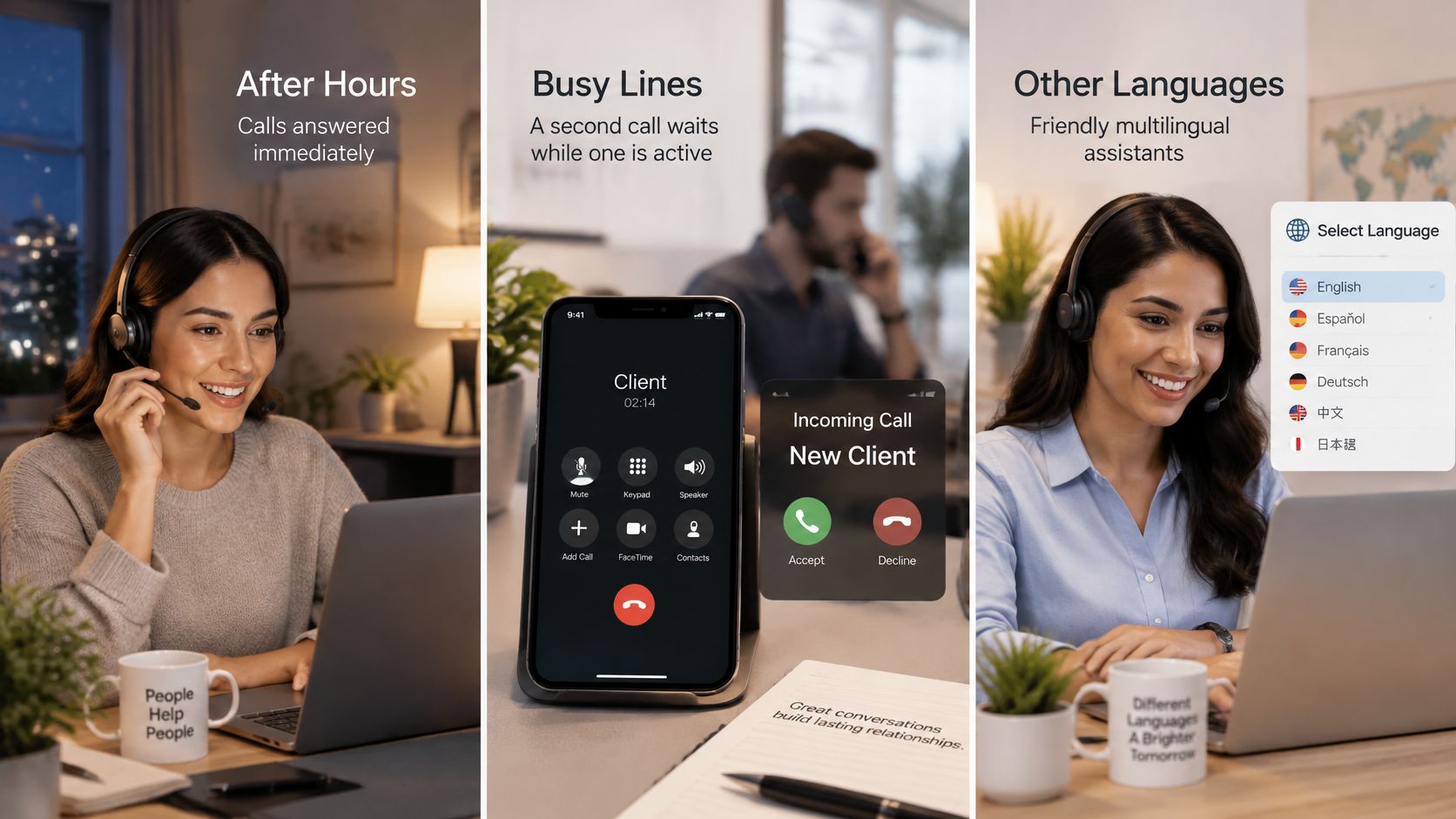
A leak reported at 7pm is a timing and trust problem before it is a staffing problem. The caller expects the same first response they would get on a Tuesday afternoon, at the same price. The assistant answers on the first ring while you are closed, captures the job, and pulls you in only if the call is urgent.
Busy lines
Two callers at once are both answered on every plan. Overflow is the narrower setting: the assistant answers only when your line is already busy, so you still take the calls you can reach. I would use overflow when you are often on another call, and unanswered-forward when you are often away from the handset. Running both at once can hand the same caller to you and the assistant.
Other languages
The assistant detects the caller's language and replies in it. Coverage is six: English, Spanish, Catalan, German, French, and Italian. List the languages your customers used over the last three months and confirm each one is supported before you rely on it. A caller forced to switch language mid-booking will often hang up and try a firm that kept the conversation in their language. If you serve bilingual areas, a bilingual answering service setup is the practical check. A translated voicemail greeting still leaves the booking in the wrong language.
Use vendor figures as a prompt to measure, then track your own after-hours calls, bookings, escalations, and callbacks before and after you go live.
Say a plumber is on a job at 7pm. The assistant takes the booking, records the job type and address, and the morning list shows the lead without a voicemail to decode.
Test Your Setup Before the Next Missed Call
You can be live within 24 hours by keeping your existing number and setting forwarding with your phone provider. Spend the next day proving the path, not assuming the code worked.
- Set forwarding and wait for it to take effect. Some providers apply it in minutes, and you should still allow up to 24 hours before you judge a failure.
- Call from a mobile you don't normally use. Confirm the assistant answers and says the business name.
- Call while the line is busy. Confirm overflow or the busy rule fires.
- Let the line ring out and time the handover. It should land at about 20 seconds.
- Ask a routine question. The answer must match your approved FAQs, not a guess.
- Request a booking. Confirm it lands in your calendar with the right duration.
- Confirm the summary. Email or SMS should arrive with name, number, job type, and what happens next.
Log each test with the time and the result. After the first week, compare answer rate, abandonment, and callback times with the floors in the benchmark table. If escalation is slow, fix the emergency list before you trust it on a real no-power call.
Our Basic plan includes 24/7 answering, appointment booking with calendar integration, email notifications, web chat, a choice of 10+ voices, and no setup fee. Setup is handled for you and ready in about 30 minutes.
---
rednea answers around the clock, books appointments into your calendar, and hands you a summary so a missed ring doesn't become a lost job. If you're ready to put a first layer on the calls you can't take while you're on a ladder or on the road, visit rednea and we'll set the forwarding with you.
Try rednea, no strings attached
AI phone assistant for business. Hear a live demo in your browser, book a call with our team, or get started — from £90/month, cancel monthly, no minimum term.
GDPR-compliant · EU & UK GDPR · Multilingual