How to Reduce Call Handling Time Without Losing Callers

The most popular advice on how to reduce call handling time is also the worst: tell staff to get off the phone faster. That shortens conversations, not workload. Callers who feel rushed call back, repeat themselves, and need more follow-up than if you'd resolved the issue properly the first time.
I would flip the target. Make resolved calls the goal and treat shorter calls as a side effect. Remove searching, retyping, misrouting, and repeat questions, and handle time falls without anyone talking faster. Keep complex, sensitive, and high-value calls with people. Let an AI phone assistant absorb the routine calls that don't need human judgment, in the caller's own language, at any hour.
Measure Where Your Call Time Really Goes
Handle time isn't talk time. The IRS Taxpayer Advocate Service definition defines average handle time (AHT) as agent talk time plus hold time and after-call work, beginning when the agent answers and ending when post-call tasks are complete. That last part is where small teams lose the most time and measure the least.
Cutting hold time does little if someone still types the caller's details into a calendar and a CRM after hanging up. The conversation looks shorter. The total work barely moves.
Split the total before you try to shrink it
| Component | What it includes | Where to find it | What to check first |
|---|---|---|---|
| Talk time | Live conversation from answer to hang-up | Phone system call log | Repeated questions that could be answered faster |
| Hold time | Silence while staff search for information or wait for a transfer | Hold timer in the phone system | Searches that a prepared answer sheet would remove |
| Transfers | Calls passed to another person | Transfer log or call notes | Call types that go to the wrong person most often |
| After-call work | Notes, CRM entry, booking and follow-up tasks | Manual timing or CRM timestamps | Details collected more than once |
| Total AHT | Sum of the four parts above | Calculated for each call reason | Gap between your baseline and your target |
Good call reporting software makes this split automatic, but you don't need software to start. Take an afternoon and time 20 calls for one call reason across different days. Record talk, hold, transfers, and wrap-up separately.
Write your baseline in one line, by call reason, not as one blended average. Published averages from other industries won't tell you what's normal for a dental practice, a plumber, or a law firm.
Compare against your own baseline, and look at the median plus the slowest tenth of calls. A handful of very long calls can hide the everyday pattern.
How to Cut Handling Time Step by Step
Teams often try to fix every call at once and end up fixing none of them. Work on one reason, prove the change, then move on.
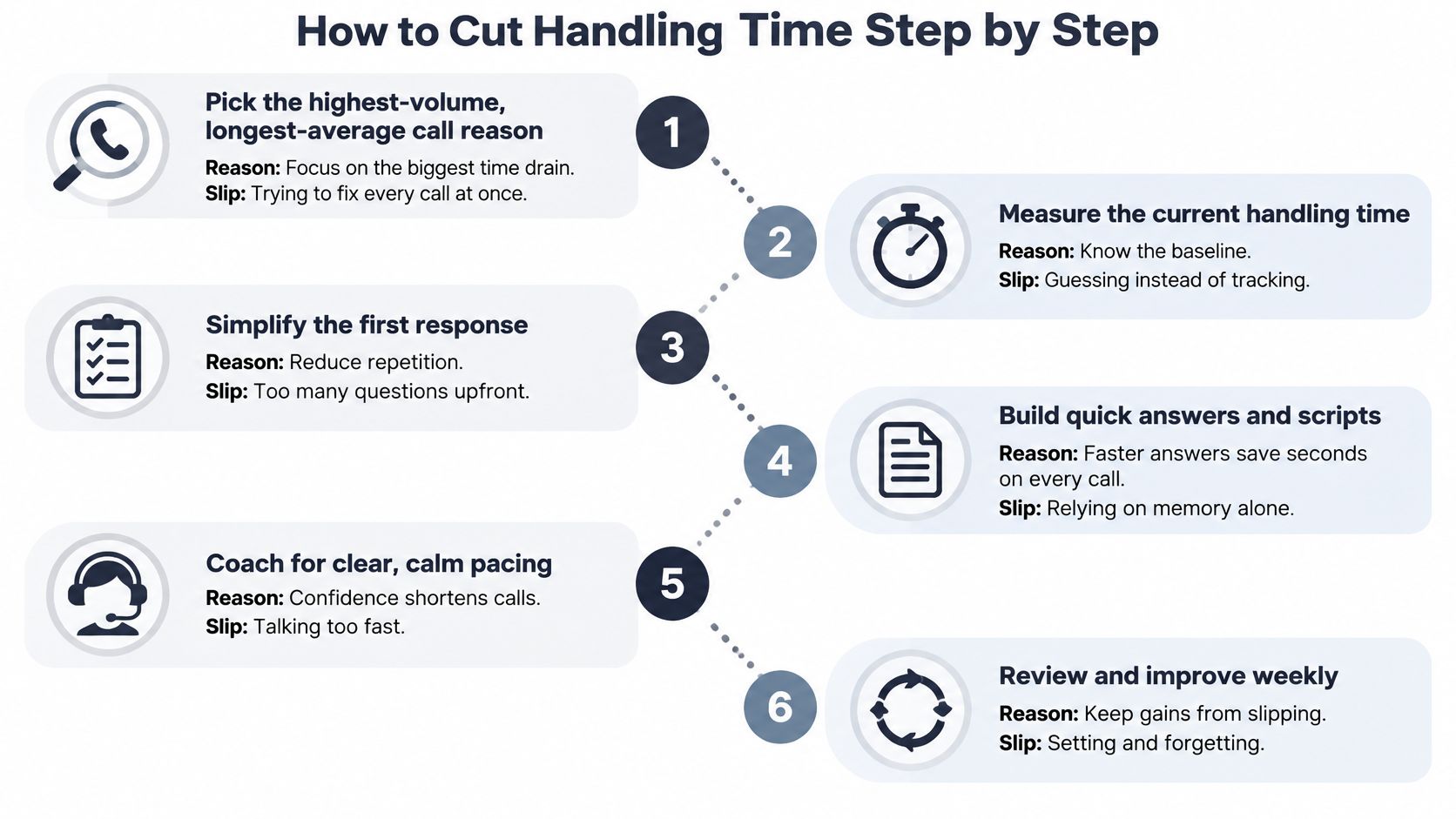
- Pick the highest-volume, longest-average call reason. Booking requests and price questions are common starting points because a small saving there repeats all day. The usual slip is choosing the most annoying call type instead of the most frequent one.
- Write the shortest correct path. List the questions to ask, the answer to give, and the next action, such as booking a slot or sending a quote. Cut any question whose answer you already hold, like asking a returning customer for an address that's already on file.
- Collect caller details once. Put name, number, job address, and preferred time into one note template or CRM record during the call. If a second person has to ask again later, your process failed, not your staff.
- Remove screen switching. Put saved replies, the price list, and the calendar on one screen. Every switch between systems adds hold time and dead air without adding any information for the caller.
- Route that reason correctly from the first answer. A booking call that passes through two people before reaching the calendar has already doubled its handling cost. The slip here is routing by who's free rather than by who can finish the call.
- Pilot for two weeks against matched calls. Compare the same call reason, at similar times, before and after. Keep the change only if handle time falls and repeat calls don't rise.
Three quick wins this week
You don't need a project plan to start. These take an hour combined and they expose where time leaks.
- Answer card by the phone: Put your three most-asked answers on one card beside every phone.
- After-hours message template: Keep a standard template ready so nobody writes one from scratch at closing time.
- Bookings first: Move booking requests to the top of your call-type list so they get a clear route before anything else.
How do you know it's working? The path feels short, the note is complete when the call ends, and the caller never repeats their question. If any of those three fails, the saving is probably cosmetic.
Routing and Scripts for Common Call Types
Routing is where handle time is won or lost before anyone says hello. Give each common call type one route, one opening line, and one clear trigger for handing off to a person.
| Call type | First route | Opening line | Hand off to a person when |
|---|---|---|---|
| Booking or appointment request | Scheduling step | I can book that now. Which day suits you? | Slots are full or the request needs a decision |
| Price or opening hours question | Saved answer | Here is the answer, and I can book you in if you want | The price depends on details the caller cannot give |
| Urgent or safety issue | On-call person | I am passing this to our technician now | Immediately |
| Complaint or refund request | Owner or manager | I want to get this right, so let me take your details | Immediately |
| New job or sales lead | Qualifying questions, then booking | Tell me about the job and when you need it | Scope or budget is unclear |
Treat those openers as starting points, not scripts to read word for word. Staff who rephrase in their own words sound natural and finish faster, because they aren't hunting for the next line.
Choose a forwarding mode that matches how you lose calls
Smart call routing software only helps if the forwarding rules fit your working day. Call forwarding can be set to always forward, to forward only when the line is busy, or to forward only when nobody answers.
- Forward when unanswered: The assistant takes over if nobody picks up after around 20 seconds. That's long enough for a technician to get off a ladder and reach the phone, and short enough that the caller doesn't hang up.
- Overflow: Calls are answered only when your main line is already busy. This suits a team of three where one person is always out on a job and the other two can't both stop.
- Always forward: Every call hits the assistant first, which fits solo operators who rarely answer live at all.
Practical rule: Fast routing protects the caller's time, but a wrong route turns one call into two. One accurate route beats three fast guesses.
After one week, count transfers by call type. Any type that transfers often needs a clearer route or a better opener, not faster staff. Say your price questions keep landing with the technician. That's a routing defect you can fix in minutes, and it costs you far more than a slow talker ever will.
Build an Answer Library and Coach Your Team
Shorter calls usually come from faster answers. When someone puts a caller on hold, they're rarely thinking. They're searching.
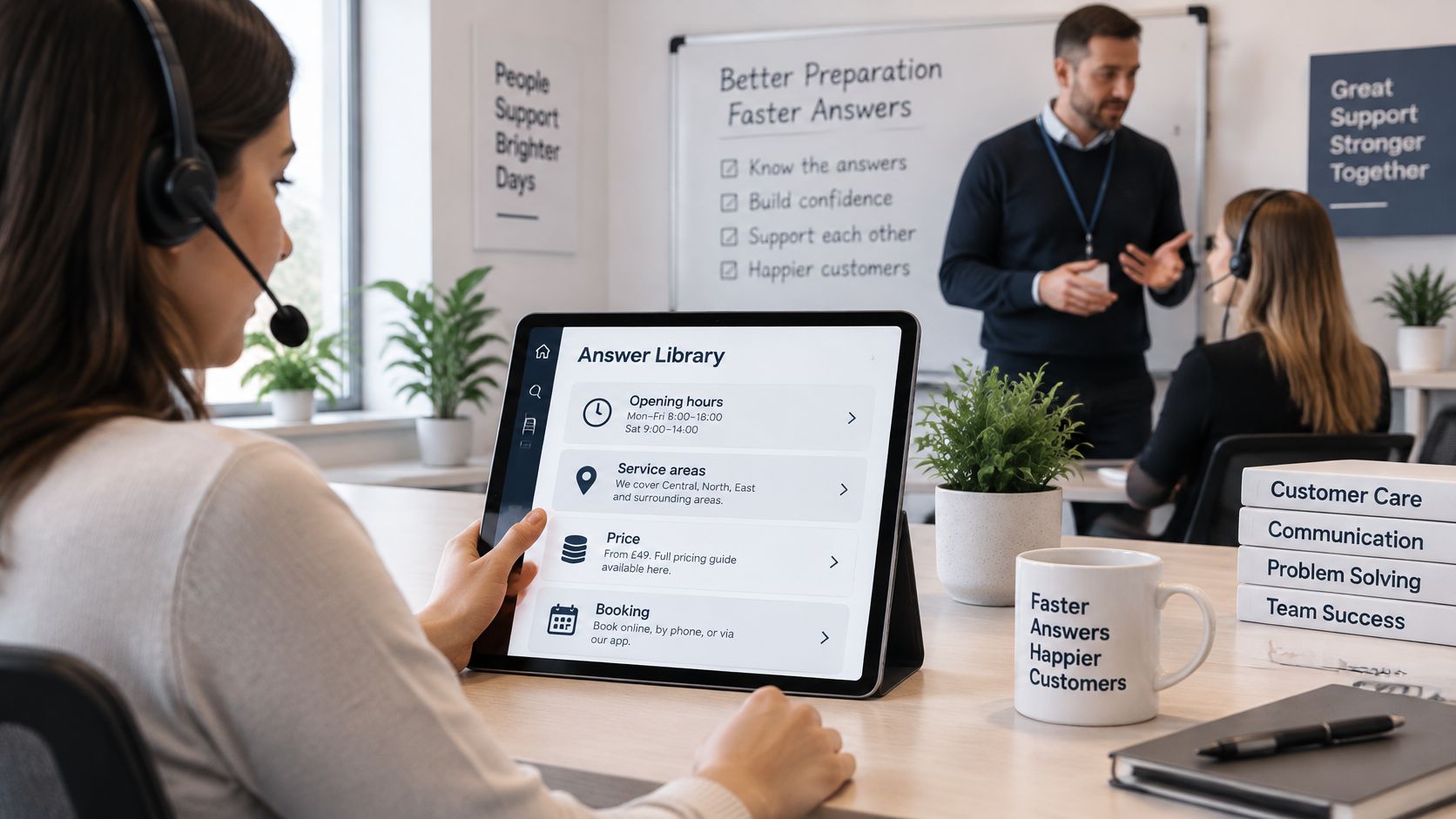
Build a one-page answer library for the questions you get every day: opening hours, service areas, price ranges, booking rules, warranty terms, and escalation contacts. Keep each answer to two or three lines so staff can scan it while the caller is still talking. Write entries in the caller's words, not internal jargon. I'd also name one owner and give them a monthly review slot; a library with no owner becomes a museum of last year's prices.
An answer that arrives during the call removes the hold. An AI copilot that searches internal knowledge for an agent does this by surfacing the right passage while the caller waits. You don't need that tooling to get most of the gain. A shared, searchable document gets you the first step. Solid customer service knowledge management is mostly discipline: one place for answers, short entries, and an owner who updates them when prices or policies change.
Coach on the slowest tenth, not the average
Review the slowest tenth of calls each week. Play one call back with the person who handled it and agree on exactly one change. One change is enough for a week. Pair newer staff with a strong handler for a week. Newer staff gain the most from a prepared answer sheet because their delays come from uncertainty, and uncertainty is fixable with information. Experienced staff usually know the answers already, so their long calls tend to be complex ones. That distinction matters: coach the missing answer, not the person's speaking speed.
- Listen for the stall point: Note the moment the call stops moving forward, then check whether an answer in the library would have prevented it.
- Fix the library first: If three people stalled on the same question, that's a missing entry, not a coaching problem.
Measure before and after you publish the library. If hold time drops but after-call work climbs, you've moved the time to a colleague rather than removing it.
Let AI Handle Routine Calls Around the Clock
AI takes the first answer so your staff keep the calls that need judgment. The opening-hours question, the "are you free Thursday", the postcode check: those go to a system with no queue. People handle the calls where the caller is upset, undecided, or describing a job nobody has priced yet.
Speed is where the money shows. One reported local-service benchmark, published in AI Strategy Partners' research, found that businesses responding to inbound leads within two minutes converted 62% into appointments, against 28% at an average response time of 42 minutes. That comes from an industry site rather than an independent academic study, so read it as direction rather than a promise. The direction holds up either way.
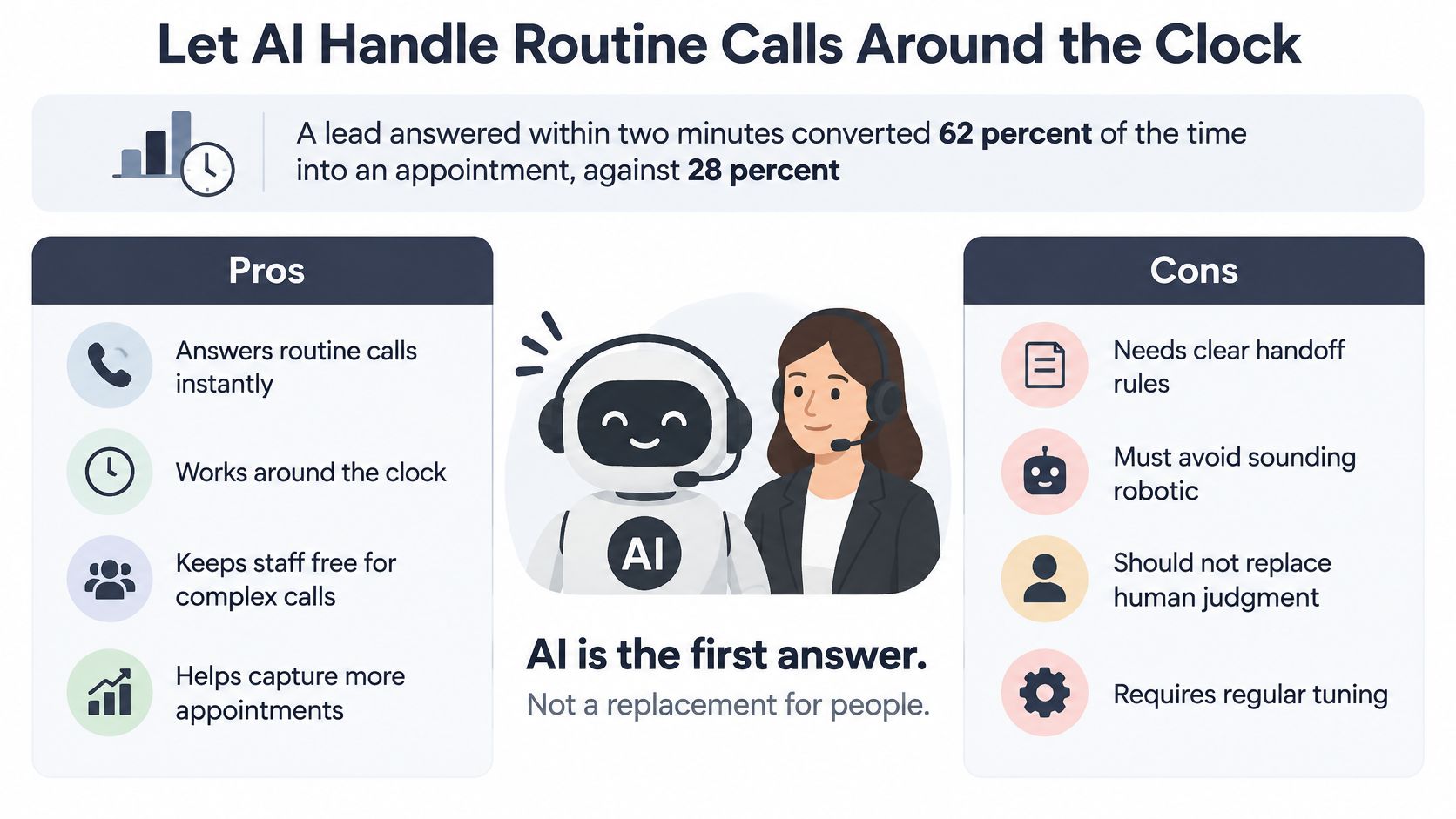
An assistant such as rednea answers every call in seconds, including evenings and weekends, and it can handle multiple callers at the same time with no waiting times. It answers in the caller's own language, which matters if you serve a mixed-language area and your team doesn't cover every language your customers speak. AI agent assist covers the layer underneath: routine calls get collected and booked, your staff keep the ones needing a decision.
| Call type | Handled by the assistant | Handed to a person |
|---|---|---|
| Booking an appointment or visit | Yes, checks the calendar and books the slot | Only when the slot needs a decision |
| Opening hours and service area | Yes, answers from the approved information | No |
| New job or lead details | Yes, captures job, location and timing | Owner or technician calls back with a quote |
| Urgent or emergency call | Takes details and transfers at once | Yes, immediately |
| Complaint or upset caller | Takes a full message | Yes, forwarded to whoever you nominate |
| Question the assistant cannot answer | Takes a message or forwards the call | Yes, with the message attached |
Following your rules, the assistant forwards important calls to the right person or takes down a callback, and urgent calls reach you right away. If it can't answer a query, it takes a message or forwards the call to a human depending on your settings, so no call is lost.
The trade-off worth watching: a shorter call that leaves the caller unsure buys you a repeat call next week. Push routine traffic to the assistant and watch whether resolution holds, because a fast answer that doesn't resolve anything is just a faster failure.
Test One Change for Thirty Days
Don't overhaul your phone handling in a weekend. Pick one call reason, record a two-week baseline, change one thing, and review weekly.
Use first-contact resolution as your guardrail. Count a call as resolved only when the caller's stated need is completed with no repeat contact for the same issue inside a set window, and check your automated counts against a short follow-up survey. SQM's FCR metric guidance reports an industry-average FCR of about 70–71%, and only about 5% of more than 500 benchmarked North American contact centers reached the 80%+ world-class level. Aim to beat your own baseline, not that top tier.
| Measure | What it counts | Decision rule |
|---|---|---|
| Average handle time | Talk, hold and after-call work per call | Lower, without losing quality |
| First-contact resolution | Need met with no repeat contact in the set window | Holds at or above baseline |
| Transfers | Calls passed to another person | Fewer for each call type |
| Repeat calls | Same caller returns about the same issue | Fewer or unchanged |
A falling handle time with falling resolution is a loss, however good the chart looks. Scale the change only when handle time falls and resolution holds.
When repeat calls appear, classify them by cause: missing information, incomplete fulfillment, transfer failure, disconnection, or knowledge gap. Fix the dominant cause first. Rewarding low handle time on its own invites premature transfers and rushed closures, which push work into callbacks.
Start simple and keep the exit easy. Keep your existing number, set up call forwarding, then configure the emergency list, service area, job types and durations, and the questions callers ask every day. Turning call forwarding back off takes seconds.
---
Start with one call type this week: let rednea answer your booking and opening-hours calls around the clock in your callers' own languages, book straight into your calendar, and send you a concise summary, while urgent and sensitive calls go straight to you. Visit rednea to set it up on your existing number and see your handle time fall because calls get resolved, not rushed.
Try rednea, no strings attached
AI phone assistant for business. Hear a live demo in your browser, book a call with our team, or get started — from £90/month, cancel monthly, no minimum term.
GDPR-compliant · EU & UK GDPR · Multilingual