Spanish Language Support: A Practical Guide for 2026


At 9:14 a.m., a two-location dental clinic is already under pressure. The front desk is juggling two English-speaking callers when a Spanish-speaking patient calls to reschedule an appointment before a work shift. The IVR says, “Press 12 for billing,” offers no useful Spanish path, and the caller hangs up.
That patient doesn't experience the problem as a translation preference. They experience it as a closed door. The clinic may never see the failed attempt clearly in its missed-call report, yet the patient may call another practice, miss the appointment, or stop trying altogether.
Spanish language support is therefore an access and retention issue, not a website feature. Spanish has more than 635 million potential users worldwide, including about 519 million native speakers, according to recent Spanish-language reach data. A small business doesn't need a massive international operation to feel that demand. It may be sitting in its own missed calls.
The Caller You Cannot Afford to Lose
The clinic's website might say “Se habla español.” A sign near reception might say the same. But if the only Spanish-speaking employee works weekday mornings, the promise disappears during lunch, late afternoons, evenings, and busy periods.
That gap matters because callers judge service by the first few seconds. They don't know whether the business has a bilingual employee scheduled later. They only know whether someone can understand why they're calling now. If the answer is no, the caller has no reason to keep explaining, wait on hold, or leave a voicemail in a language they may not use comfortably.

The same pattern appears in a plumbing company, law office, estate agency, medical practice, and any service business where the phone is part of the sales process. A Spanish-speaking customer may need an appointment, a quote, an update, or urgent clarification. If the business can't capture the request and preserve its meaning, the customer has to repeat the story, find an interpreter, or start again with someone else.
Practical rule: If your public message promises Spanish service, your main phone number needs a Spanish path at the moment the caller uses it.
Start by looking beyond your website analytics. Review abandoned calls, voicemails, call notes, and staff recollections. Ask a simple question: How many Spanish-speaking callers disappear before anyone records their language or intent?
The answer should shape your first investment. You may not need a fully staffed Spanish department. You do need a reliable first response, a clear route to a person, and a way to give that person enough context to help without making the caller start over. A useful starting point is a service continuity approach, where the business plans for coverage gaps instead of treating each missed call as an isolated incident.
What Spanish Language Support Actually Means for Voice
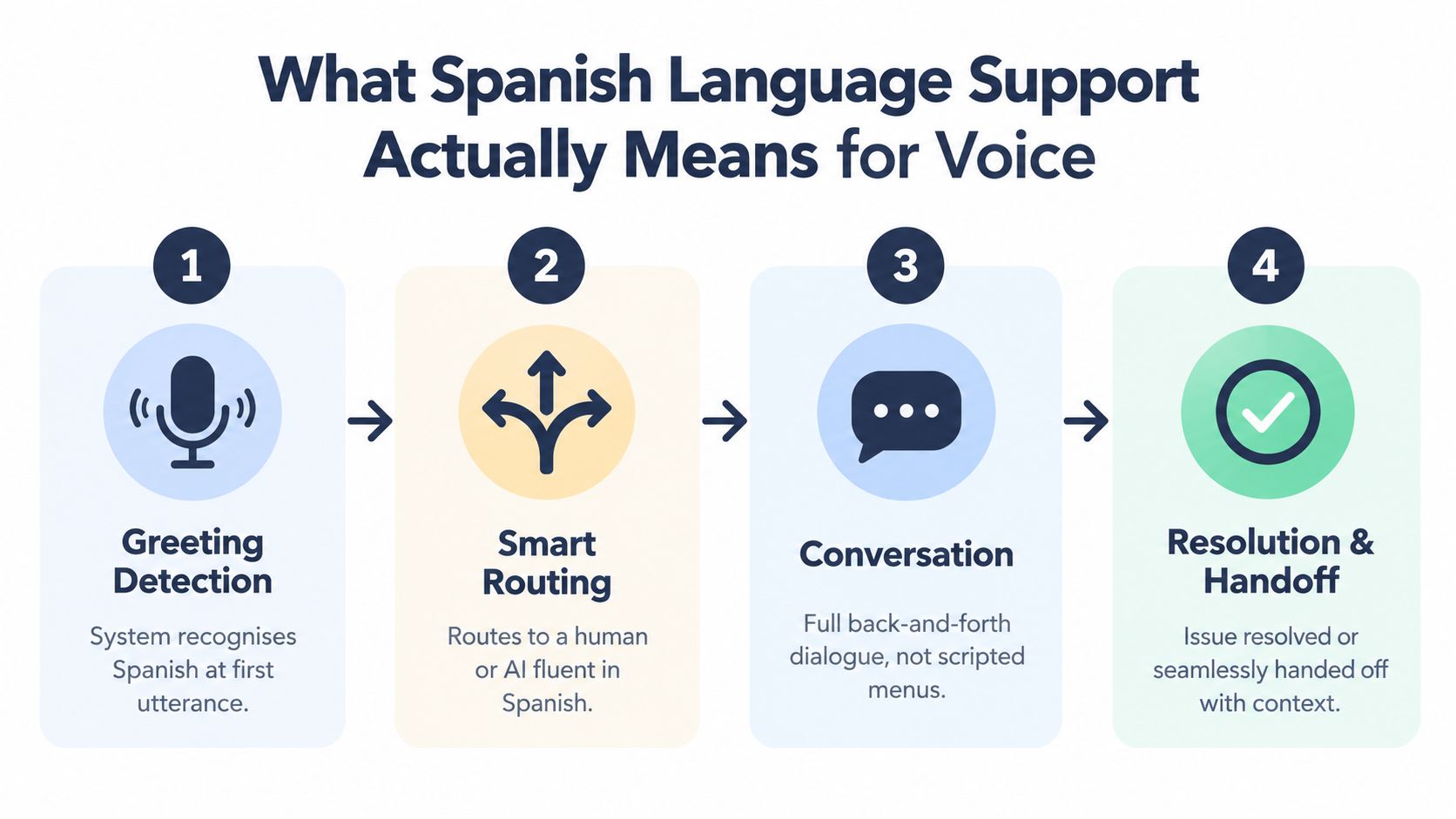
Spanish language support for voice channels means the caller can complete a useful interaction in Spanish from the first greeting through resolution or handoff. It isn't the same as translating a website, and it isn't the same as having one bilingual employee somewhere in the organisation.
A functional voice setup should handle four jobs:
1. Recognise or offer Spanish immediately. The system can detect Spanish from the first utterance or present a short, natural choice at the beginning of the call. The caller shouldn't have to work through an English-only menu to reach the language they need.
2. Route intelligently. The request should go to a Spanish-capable AI receptionist, a bilingual employee, or a defined callback queue. Routing must reflect actual availability, not merely the fact that somebody in the company speaks Spanish.
3. Hold a real conversation. The system should understand requests such as booking, pricing, opening hours, service status, or address changes. A translated script with rigid menu branches won't handle the way people naturally speak.
4. Resolve or hand off with context. If a human takes over, staff should receive the caller's reason for calling, relevant details, and any promised next step. The caller shouldn't repeat their name, appointment details, or problem because the handoff discarded the conversation.
The phone stack needs more than translated prompts
Your IVR prompts, queue rules, scheduling workflow, CRM notes, and escalation logic all need to work together. A Spanish greeting that ends in an English-only queue isn't support. Neither is a Spanish conversation that creates incomplete notes your team can't use later.
The system should also allow a controlled return to English when the caller requests it or when a bilingual human needs to take over. That fallback shouldn't feel like failure. It should feel like a deliberate transfer with the information already captured.
Actual telephone audio creates another requirement. A multilingual phone benchmark built from 4,270 human-annotated utterances across 250 real customer-service calls found that evaluation on real telephony audio exposes consequential errors that formatting-focused tests can miss, as described in the MU-Bench benchmark overview. Test Spanish with background noise, accents, interruptions, short answers, and callers who switch between Spanish and English.
Speech quality also depends on the model, training data, accent, and recording conditions. A comparative Spanish ASR evaluation found meaningful differences between systems, including a Spanish-finetuned variant with the lowest character error rate but the slowest performance, while another open model recorded a Spanish WER of 3.99 on its evaluation set, according to the Spanish ASR comparison. The practical conclusion is simple: test your calls, not a product demo.
Why the Business Case Goes Beyond Translation
A Spanish-speaking caller who reaches your number has already shown intent. If your team cannot support the conversation, that demand may go to a business that can explain the service, schedule the appointment, and answer questions in the caller's preferred language. Spanish support protects access to revenue. It is not a translation feature added after the phone process is finished.
Spanish is a major digital and service language across the Americas and Europe. One source places Spanish at about 6.0% of the web, while another cites 7.9% of internet users communicating in Spanish, making it the second most used language on digital platforms after English, as summarised in the Spanish-language market overview.
A small business does not need every caller to complete a fully Spanish interaction. It does need a reliable way to serve people who cannot confidently handle a complicated issue in English. That means supporting bilingual conversations, code-switching, regional vocabulary, and callers who understand English but explain important details more clearly in Spanish.
The access gap is substantial. In the United States, 44,867,699 people age five and over speak Spanish at home, and 18,432,221 speak English less than very well, according to data on the Spanish-language service gap. Those figures make language access an operating decision, not a marketing extra.
Retention follows from a better first interaction. A caller who can explain a problem without strain is more likely to understand the next step, complete the process, and return when help is needed again. If your business advertises Spanish service, the phone experience must deliver it.
| Driver | What it means for the business | Signal to watch |
|---|---|---|
| Business access | Qualified callers can reach the service instead of leaving at the first language obstacle. | Spanish call attempts, abandoned calls, and missed opportunities |
| Practical accessibility | Customers can explain needs, appointments, and problems with confidence. | Repeated explanations, incomplete intake, and avoidable transfers |
| Retention | Consistent language access gives customers a reason to stay rather than restart elsewhere. | Repeat bookings, callbacks, referrals, and communication complaints |
| Promise delivery | “Se habla español” becomes an operating commitment, not a homepage phrase. | Spanish coverage after hours and during peak demand |
Build the system around bilingual staff, then use AI to extend their capacity. AI can handle routine intake, capture caller details, and keep a conversation moving until a bilingual human takes over. It should not replace judgment on sensitive or complex calls. A practical setup protects English coverage while giving Spanish-speaking callers a clear route to help.
Track more than successful bookings. Review where callers exit, how often staff requests a repeat explanation, whether Spanish calls receive the same follow-up as English calls, and how often human escalation is needed. Those signals show whether language access is improving retention.
Comparing the Three Ways to Cover Spanish Calls
There are three practical coverage models: bilingual staff, third-party live services, and AI or virtual receptionists. None wins in every situation. The right choice depends on the type of call, the hours you need covered, and how much unpredictability your team can absorb.
| Approach | Coverage hours | Cost model | Peak handling | Quality trade-off |
|---|---|---|---|---|
| Bilingual staff | Limited by employee schedules and availability | Employment cost, training, and coverage overhead | Strong when the person is available, fragile during simultaneous demand | Best for nuanced, sensitive, and relationship-driven conversations |
| Third-party live service | Can extend coverage beyond your office hours | Often tied to usage, minutes, or service volume | Useful for overflow and surges | Human interaction is available, but handoff and brand consistency need careful management |
| AI or virtual receptionist | Always-on coverage when configured correctly | Can be structured around per-call or flat plans | Handles routine demand without asking your team to stop active work | Needs testing, clear boundaries, and human escalation for complex or emotional matters |
Bilingual staff
A bilingual employee usually delivers the strongest understanding on nuanced calls. They know your services, recognise customer history, and can handle emotion or ambiguity without waiting for a transfer. The weakness is availability. One person cannot cover every shift, location, lunch break, holiday, and demand spike.
Make this model stronger by defining a Spanish coverage schedule rather than relying on informal availability. Give the employee a structured intake form, escalation authority, and protected time for callbacks. If callers wait until the one bilingual person is free, your business still has a coverage problem.
Third-party live services
A live answering service can absorb calls when your team is busy or closed. It can work well when the goal is to capture a name, intent, urgency, and callback request. The risks are less predictable usage costs, inconsistent phrasing, and a handoff that leaves your staff without enough context.
Before choosing this route, listen to calls and test difficult scenarios. Ask how the service handles regional Spanish, bilingual callers, complaints, payment questions, and appointments that require access to your live calendar. A Spanish answering service model can be useful, but the workflow matters more than the label.
AI and virtual receptionists
AI is strongest when the request is repeatable. It can greet callers, answer approved questions, capture lead details, schedule within defined rules, and route important calls. It can also cover nights, weekends, and overflow without pulling a field technician, receptionist, or practitioner away from active work.
It shouldn't pretend to be the right person for every issue. Give humans the calls involving distress, unclear intent, complaints, account changes, payment decisions, or professional judgment. Most mature setups combine two models, such as in-house bilingual staff during the day with AI coverage after hours, or a bilingual core with live-service overflow.
A Practical Path to Add Spanish Support This Week
You can add useful Spanish coverage without rebuilding your phone system or taking English service offline. Start with the smallest workflow that prevents a dead end, then expand after you see what callers need.
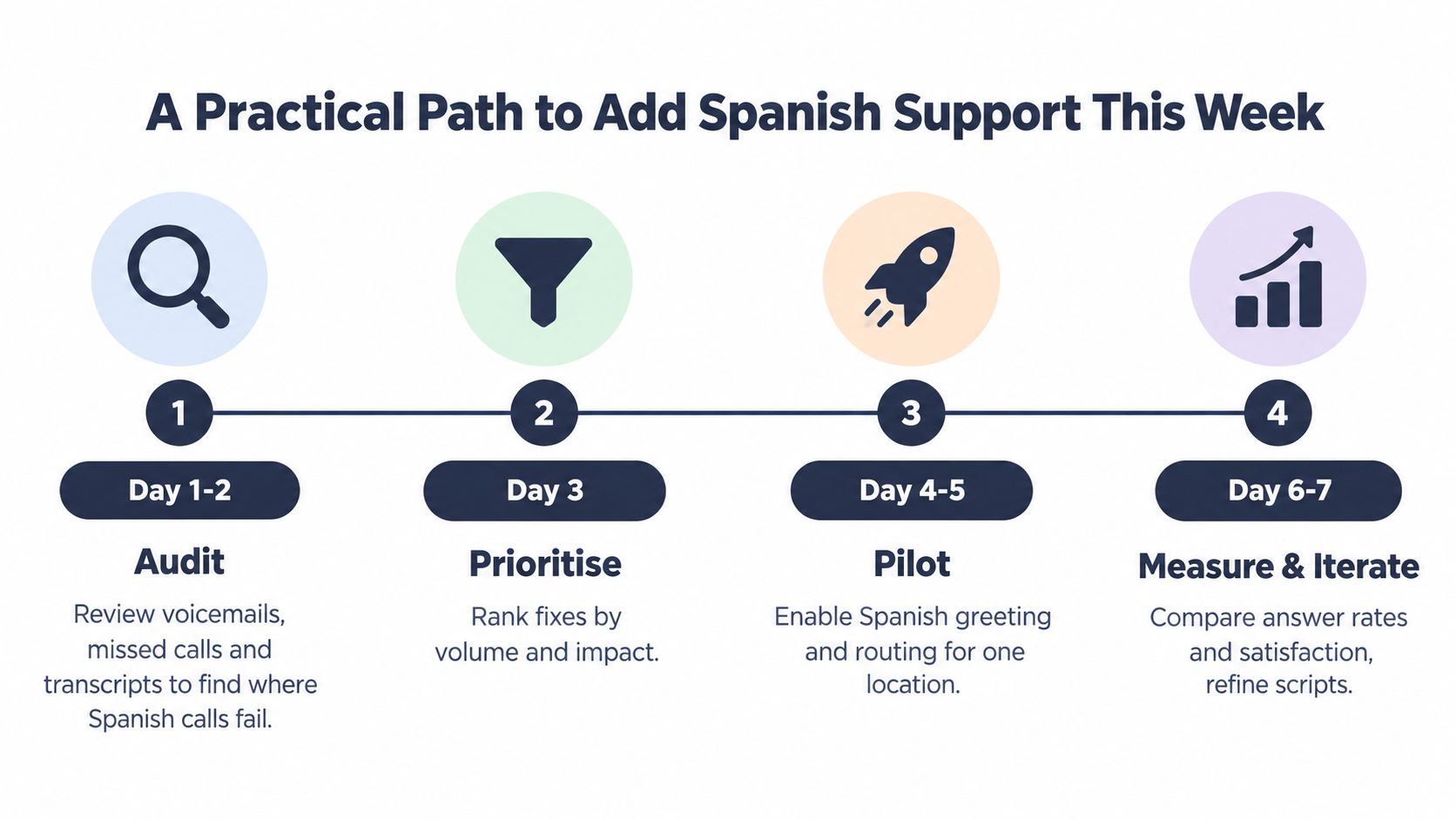
Days one and two
Audit the calls you're already losing. Review voicemails, missed calls, call logs, and any available transcripts. Mark Spanish-language attempts and record the reason for each call where you can identify it.
Start with five practical intents:
- Booking: appointments, estimates, consultations, or service visits
- Pricing: basic cost questions and quote requests
- Status: order, repair, application, or appointment updates
- Complaint: a dissatisfied customer who needs a person quickly
- Hours: opening times, location, parking, and availability
Don't wait for perfect data. A rough map is enough to decide which responses deserve automation and which require a bilingual employee.
Days three and four
Add a short Spanish greeting to the main number. It should acknowledge the caller and explain what happens next. If you don't yet have live Spanish coverage, offer a callback process that captures the caller's name, number, reason, and preferred time.
That simple change is better than forcing a caller through an English-only menu. Make sure the greeting routes Spanish requests somewhere monitored. A promise without an owner creates a new failure point.
Days five and six
Brief one bilingual employee or contractor to take transfers during a defined schedule. Write a one-page Spanish script for the five intents, including what the person may promise, what they must escalate, and how they should document the conversation.
Keep the script operational, not literary. Include the exact service names your staff uses, appointment requirements, payment boundaries, and the questions needed to complete intake.
From week two onward
Layer an AI receptionist over the workflow for nights, weekends, and overflow. Set explicit handoff rules. The AI should transfer or request human follow-up when the caller is upset, the intent is unclear, the issue involves payment or account changes, or the caller asks for a person.
Measure answer rate, abandoned calls, completed bookings, callback completion, and staff corrections. Refine one intent at a time. This is an expansion of your team's capacity, not a day-one replacement plan.
Quality Cost and Compliance Without the Guesswork
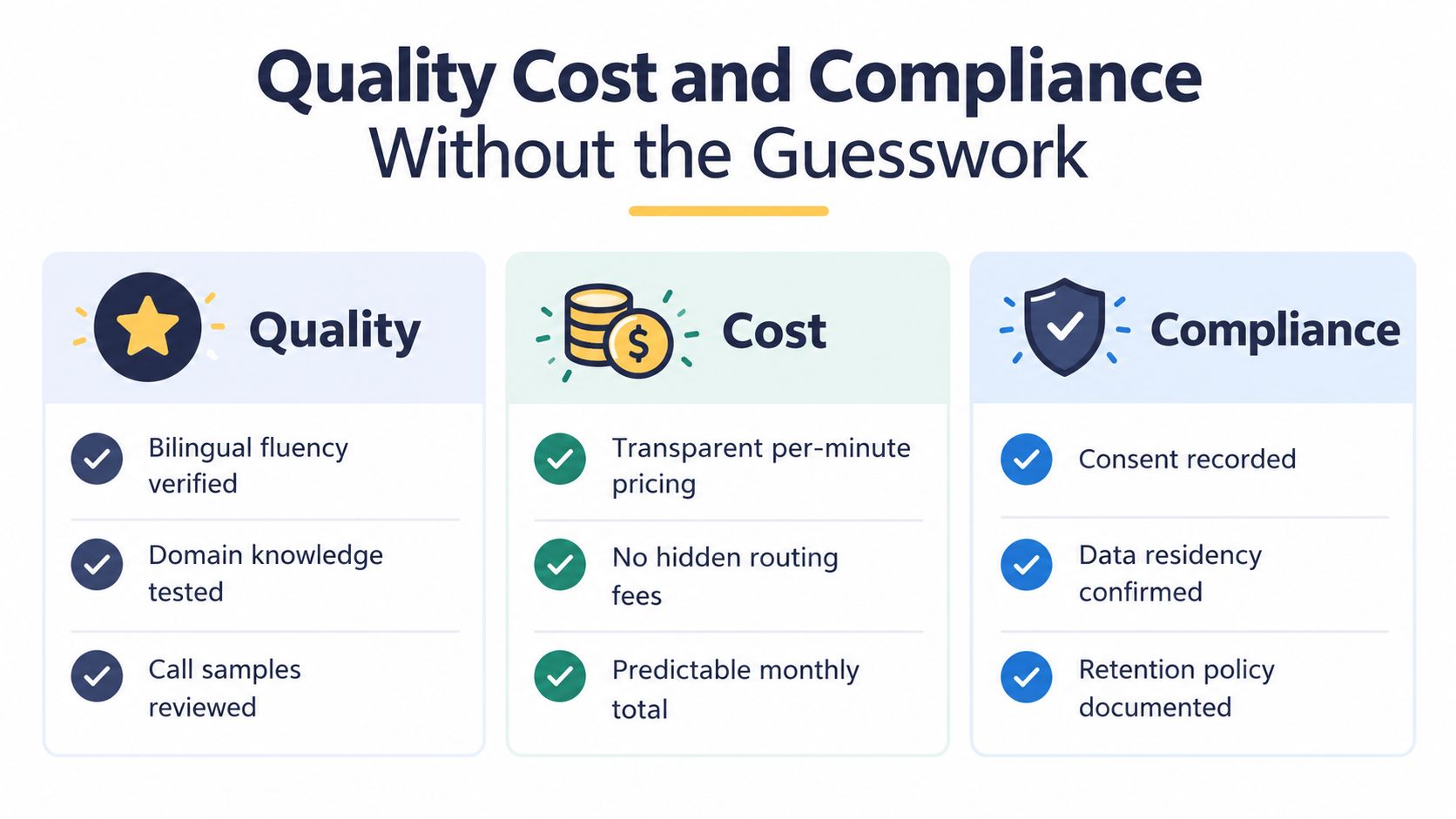
A Spanish voice system can sound fluent and still produce poor service. Evaluate the complete interaction, including what the system understands, what it records, what it promises, and what your employee receives after handoff.
Quality
Test bilingual fluency with your actual terminology. A conversational system may handle greetings but struggle with product names, medical terms, legal language, trade vocabulary, addresses, or regional phrasing. Run recorded test calls with interruptions, accents, background noise, code-switching, and callers who change their request halfway through.
Require human takeover for billing disputes, complaints, clinical matters, legal matters, and any request where an incorrect answer can create material harm. The handoff should include a concise summary, not just a caller ID.
Cost
Model the whole operation. Include employee coverage, training, live-service usage, AI subscription or call charges, implementation, and the hidden cost of missed calls. If volume varies, a pure per-minute model may be difficult to forecast. Ask for a clear explanation of routing fees, transfers, recording, integrations, and overage charges.
Compliance
Check that consent language works in Spanish and that callers understand when the call is recorded. Confirm where transcripts and recordings are stored, how payment data is redacted, how long records are retained, and whether you can export or delete conversation data when required.
Use a GDPR compliance checklist for voice workflows when reviewing vendors and internal processes. The details depend on your business and jurisdiction, but the control principle is universal:
A human must be able to take over when the system reaches the edge of its competence.
Write that requirement into your workflow. Define who receives the escalation, what information they get, and how quickly they must respond. Spanish support is only reliable when the fallback is as deliberate as the first greeting.
Where AI Fits and Your Next Steps
AI belongs at the front of the queue, not at the top of every decision. It can greet Spanish callers, identify intent, answer approved questions, schedule routine appointments, collect lead information, and keep the conversation moving while your staff is busy. Humans should take over when the issue is emotional, ambiguous, sensitive, or consequential.
That hybrid model reflects how support teams already use AI. A 2026 survey of 300 U.S. customer support and CX software decision-makers found that 76% of customer conversations were handled by humans and AI together, with 35% handled collaboratively and 41% handled by human agents with behind-the-scenes AI assistance. Only 9% were fully handled by AI without human involvement, according to the contact-centre AI survey.
Human review remains essential. In a 2026 survey of 250 U.S.-based frontline contact-centre agents, 93% said they needed to double-check AI-provided information before using it with customers, while nearly 7 in 10 said AI reduced after-call work such as note-taking and data verification, as reported in the agent verification survey. That is the sensible model for a small business. Let AI handle repetition, while people retain judgment.
Use this rollout sequence
1. Audit current Spanish calls. Establish where callers abandon, which requests repeat, and when bilingual coverage is missing.
2. Add live bilingual coverage during business hours. Give a staff member or contractor a defined schedule and clear escalation rules.
3. Add an AI receptionist for first touch. Cover after-hours calls, peak periods, basic questions, lead qualification, and scheduling. Keep human transfer available.
4. Measure the workflow. Review answered calls, completed requests, transfer quality, corrections, callbacks, and customer feedback.
For small and mid-sized service businesses, rednea fits this model when you need predictable monthly planning, Spanish voice conversations, and a clean handoff to your existing number and staff. Its natural-language-understanding layer should be evaluated against your own call types and terminology, not just a scripted demonstration. You can learn more about what natural language understanding means for phone support before testing a workflow.
Take one action this week: keep a Spanish call log for seven days. Record every missed or abandoned Spanish-language call, the likely intent, the time it arrived, and whether anyone followed up. That baseline will tell you whether your first investment should be a bilingual shift, an overflow process, an AI receptionist, or a combination.
---
rednea helps small businesses answer calls around the clock, detect Spanish automatically, handle routine requests, book appointments, and send clear summaries to your team for follow-up. Visit rednea to see how you can add Spanish first-touch coverage without removing humans from the conversations that need them most.
Try rednea, no strings attached
AI phone assistant for business. Hear a live demo in your browser, book a call with our team, or get started — from £90/month, cancel monthly, no minimum term.
GDPR-compliant · EU & UK GDPR · Multilingual