Best AI Receptionist for Small Business in 2026

You're under a sink, in a treatment room, or halfway through a client meeting when the phone starts ringing in your pocket. You can't answer without stopping paid work. The caller won't wait. That gap, not a love of new technology, is why most owners start looking for the best AI receptionist for small business use. You don't need a robot to replace your team. You need the call answered now, handled politely, and passed to a person when it matters.
Why the Best AI Receptionist Answers First
A plumber hears the phone while both hands are on a pipe. A dentist hears it through a closed door while a patient is in the chair. A solo consultant watches it light up mid-presentation and lets it go, because picking up would be rude and ignoring it feels costly. All three will mean to call back. By the time they do, the caller has often tried the next name on the list.
An AI receptionist is software that holds a spoken conversation with a caller. It greets them, answers routine questions from information you've approved, books or requests an appointment, captures a message, and sends you a summary. That's different from voicemail, which asks the caller to do the work and hope. It's also different from a press-1 menu, which forces people to guess which button matches their problem.
What the missed call problem actually looks like
This isn't a feeling you have to take on trust. In a 30-day observational study of 85 businesses across 58 industries, only 37.8% of incoming calls were answered by a live person, another 37.8% went to voicemail, and 24.3% received no response at all. Combined, about 62.1% of calls never became an immediate human conversation.
That number doesn't prove every missed call was lost revenue. Some callers were existing customers who'd ring again. Some were spam. But roughly three in five callers didn't reach a person, and for a new enquiry with no loyalty to you yet, no answer usually means no second chance.
Practical rule: judge coverage by what lands in your inbox after the call, not by how impressive the voice sounds in a demo.
The operational win is simple. A caller gets greeted straight away, at lunch, after hours, or while you're driving between jobs. The assistant learns why they rang, takes a name and number, and notes urgency. You get a short summary you can act on between appointments instead of a voicemail you have to listen to twice. Immediate coverage beats a perfect voice, because the caller's first question isn't whether the greeting sounds flawless. It's whether anyone is there.
What Good Enough Means Beside Your Team
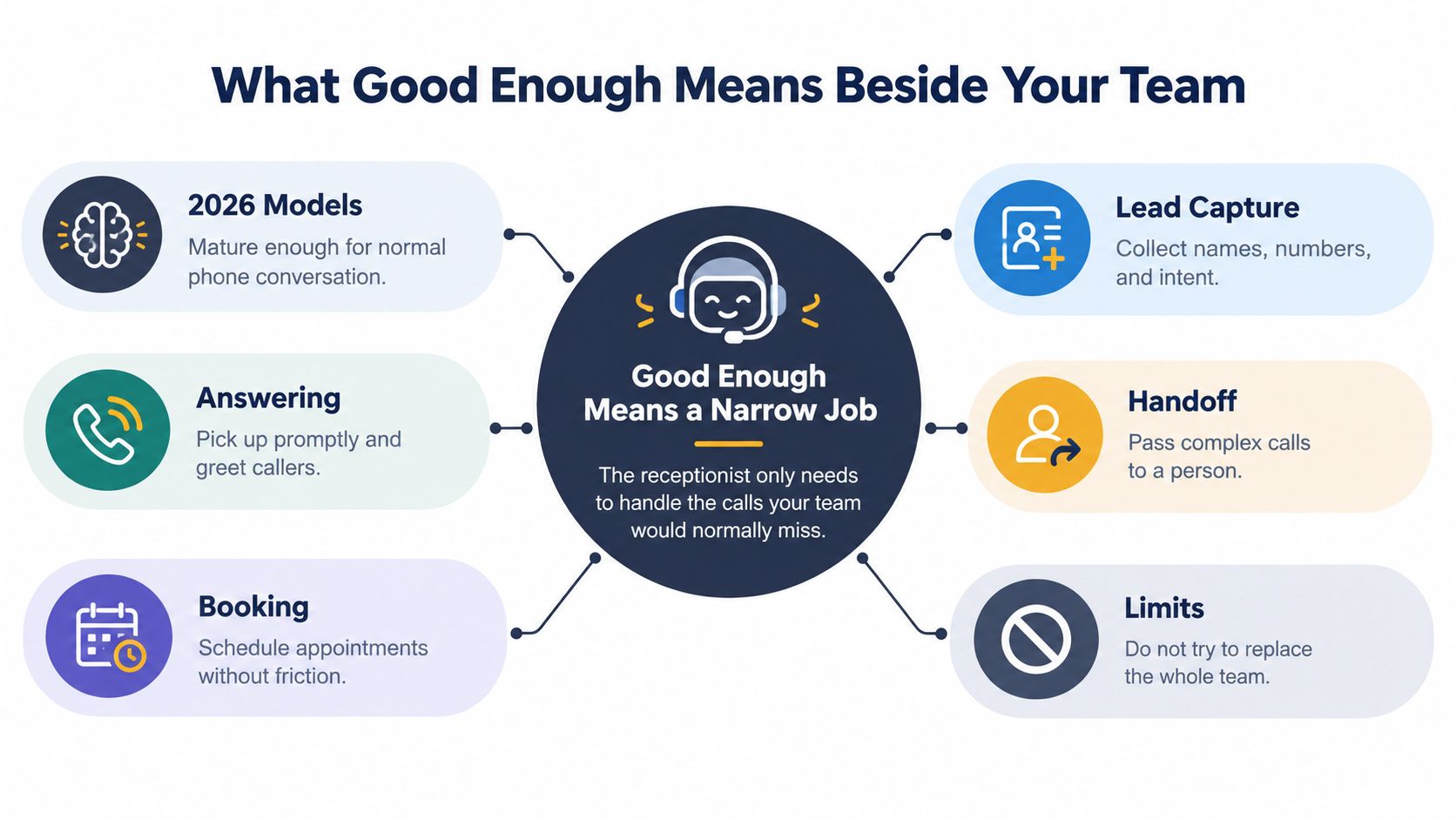
Callers don't need a flawless imitation of a person. They need a clear answer, a booked slot, or a message that reaches the right human. Current models handle normal phone conversation well enough for that job, provided you keep the job narrow. Problems start when owners ask the assistant to improvise like a senior employee.
Work the assistant should take first
- Opening hours and location: fixed facts you've supplied, answered the same way every time.
- Services and service area: what you do, where you cover, and what you don't offer.
- Booking or requesting appointments: checking the calendar you already use, or capturing a preferred time for confirmation.
- Lead qualification: name, contact details, job type or reason for calling, and how urgent it is.
- Follow-up summary: a short written record so a person can act without replaying the call.
Work that stays with people
Emergencies stay human. So do clinical or legal judgment, distressed callers, complaints that need discretion, price negotiations, and anything the assistant isn't sure about. A good setup says this in advance, in routing rules, not after a bad call forces the conversation.
This narrow approach also fits how smaller firms adopt technology. The U.S. Small Business Administration's Office of Advocacy reported that 6.3% of firms with fewer than 250 employees used AI compared with 11.1% of large firms, then small-business use rose to 8.8% in a six-month update, with small firms roughly one year behind. You don't have a spare IT department. Setup effort, clear pricing, privacy safeguards, and fit with your calendar matter more than novelty.
So measure what the narrow job produces: answer rate, appointments booked or requested, escalation accuracy, and calls resolved without staff intervention. If those improve, the assistant is complementing your team. If staff keep redoing its work, it isn't, however natural it sounds.
How to Compare AI Receptionists for Small Business
A missed call can mean a missed booking, an unqualified lead, or a question your staff must answer later. Use real examples from your call log to judge whether an assistant handles each situation clearly and passes along the details your team needs.
The checks that decide it
Start with availability and disclosure. Does the assistant answer promptly, including after hours, and tell callers they are speaking with AI? Then test booking: can it confirm an available slot, or only record a request? Either can fit, as long as callers and staff know what to expect.
Check lead qualification by giving it a few typical enquiries. It should ask your required questions in order and say when it lacks an answer. For language support, test a real conversation in each language your callers use. Detection alone is not enough; check whether the assistant can continue confidently and hand off when it cannot.
Review where call summaries go, what information they contain, and who can access them. Confirm that calendar or customer-management connections fit your workflow, and that billing and setup requirements are clear. Then test the handoff: what happens when a caller asks for a person, the assistant is uncertain, or a transfer goes unanswered?
If you are deciding between automated coverage and a human answering service, compare how AI receptionists and answering services handle calls.
What to Check Before You Route Calls
| Caller situation | Assistant should do | Person should take over | rednea reference |
|---|---|---|---|
| Routine hours or services question | Answer from approved information | If the caller asks | Answers routine questions |
| New appointment request | Check availability and book or record a request | Complex scheduling conflicts | Books into connected calendars |
| New lead with incomplete details | Collect name, need, and urgency | Pricing judgment and negotiation | Qualifies leads, sends summary |
| Urgent or safety-related call | Escalate promptly without improvising | Take over the call | Escalates important calls |
| Caller speaking another language | Confirm the language and continue if confident | Low-confidence conversations | English, Spanish, French, German, Italian |
| Assistant is unsure | Say so and capture a message or transfer | Handle the uncertain issue | Escalation over guessing |
Against these checks, rednea answers callers, handles conversations in English, Spanish, French, German, and Italian, books appointments, qualifies leads, and routes calls for escalation. It connects with calendar and customer-management tools, then sends concise email summaries and optional SMS updates. Setup is handled for the business, with per-minute billing and privacy controls that include European infrastructure and deletion on request. The trade-off to assess is fit: confirm that its call handling, routing, and data practices match your workflow before directing callers to it.
Matching Coverage to the Calls You Actually Get
The same assistant should behave differently on a building site than in a dental practice. What changes isn't the voice. It's which details get captured, and where the handoff point sits.
For electricians, plumbers, and contractors, the valuable call usually arrives while someone is driving or on site with tools in hand. The assistant should take the address, job type, urgency, and a realistic callback window, then send that through straight away. Anything involving safety, such as a smell of gas or exposed wiring, escalates immediately rather than being triaged by software. A freelancer needs something quieter: enquiries answered during client work, with a summary waiting afterward so no lead depends on you checking voicemail between meetings.
Dental and healthcare practices can automate routine booking, rescheduling, and opening-hours questions. Symptoms, emergencies, and sensitive personal details belong with a person, and privacy handling needs to be stricter from the first call. Law firms and estate agents get value from qualification and appointment requests, because intake details are structured and repeatable. Advice, negotiations, and vulnerable callers aren't repeatable, and they shouldn't be automated.
Keeping expectations honest
Voice AI is growing, but it's still a narrower slice of customer service automation, and owners are treating it as a supervised tool. In a 2025 Talkdesk-commissioned Pollfish survey of 400 U.S. small-business owners, 51% had integrated AI into customer service and, within that group, 32% used voice AI or interactive voice-response solutions. Among AI-using businesses, 65% reported faster resolution times, 60% round-the-clock support, and 40% higher customer satisfaction, while 43% said human oversight was a priority.
The handoff point is the product. If you can't say in one sentence when a person takes over, you aren't ready to route calls.
Read those numbers as permission to be selective, not as a promise. For questions about volume, an explanation of how many calls an AI receptionist can handle covers capacity separately. Your job here is smaller: pick one primary call intent to automate first, the one you miss most often, and leave the rest human until that path works.
Disclosure Privacy and Language You Can Trust
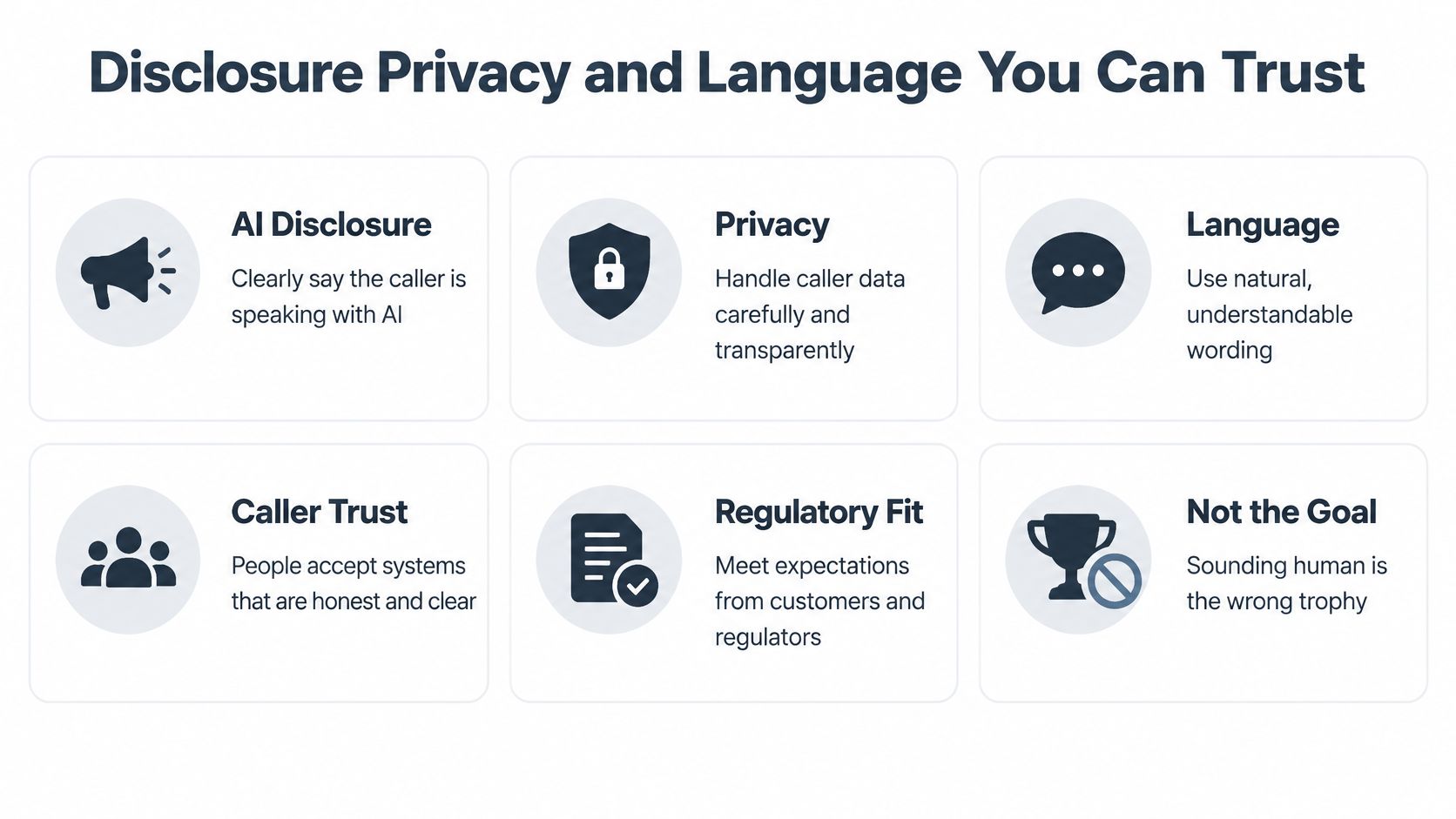
Sounding human is the wrong trophy. A receptionist callers trust does three unglamorous things: it says it's AI, it lets people ask for a person, and it transfers when it's uncertain or when the call turns urgent, medical, legal, safety-related, or emotional.
The evidence supports being upfront. A large call analysis reported that greetings identifying the agent as AI were associated with about 20% fewer hang-ups, and 80% of callers wanted to be told at the beginning of the call. Disclosure alone doesn't settle it, though, since only 43% of surveyed consumers said they were comfortable with a small business using an AI receptionist. The stronger lever is the exit: 68% of UK consumers said always-available human handoff would make AI phone service acceptable. Transparency plus an escape route beats a convincing performance.
Privacy questions to ask before you route a call
- What's stored: recordings, transcripts, summaries, or only the details needed for follow-up?
- Where processing happens: which region, and does that match your obligations?
- How deletion works: can a caller's data be removed on request, and how quickly?
- Access requests: who on your team can see call records, and is that logged?
- Model training: are your customer conversations used to train models, yes or no?
These aren't niche concerns for practices and trades holding addresses, access codes, or details about vulnerable customers. If you want the storage picture in plain terms, read where your AI receptionist data is stored before you sign anything.
Language support needs the same skepticism. Detecting Spanish or German isn't the same as handling a booking accurately in it, with an accent, background noise, and trade terminology. Ask for confidence thresholds and confirmation prompts, where the assistant repeats a date, name, or address back before acting. A confident wrong answer in a caller's second language is worse than a polite transfer, every time.
Starting Simple on the Calls You Already Miss
Start with one path, not your whole phone system. The safest first step is after-hours and unanswered calls, because those callers currently get nothing. The second safest is routine questions and booking requests during the day, while your team keeps everything else.
A narrow first rollout
- Write the allowed knowledge: hours, services, service area, and the questions the assistant must never answer.
- Script the disclosure: one sentence at the start saying the caller is speaking with an AI assistant.
- Set routing rules: urgent or sensitive intents transfer, and uncertainty triggers a handoff rather than a guess.
- Connect one calendar: the scheduling tool you already use, not a new one nobody checks.
- Send every call a summary: name, reason, urgency, and preferred callback time, by email or optional SMS.
For a business choosing rednea, setup is handled and can be ready in about 30 minutes, with per-minute billing, so the first trial doesn't become a technology project. Before you start, run your recent missed calls through the missed call calculator so you know what the gap is worth addressing.
Then review after two weeks, with numbers you already have. Check answer rate, appointments requested, escalations that were correct, and calls a person still had to redo because details were missing. Fix the worst gap first. Usually it's one unclear service description or one routing rule, not the voice.
This isn't an experiment for its own sake. SMB research indicating that 39% already use AI in customer service and another 40% plan to adopt it within a year suggests a narrow phone workflow is now an operational step. You're not betting the business on it. You're answering calls that currently ring out.
Choosing rednea for the Coverage Gap
Buy an AI receptionist when the bottleneck is clear: missed and after-hours calls, routine questions and booking dominating the line, and a person available for urgent or uncertain cases. That's a coverage problem, and coverage is what this software does well.
Wait when most of your calls need professional judgment from the first sentence. Wait if you can't yet describe your services, prices, or service area clearly enough for a new employee to follow, because the assistant will inherit that confusion. Wait if you can't support disclosure and deletion properly. A human-first process is the honest answer there, and forcing automation will cost you trust you can't easily win back.
Who the fit tends to suit
- Trades and field service: calls answered on site, job details captured, safety issues escalated.
- Freelancers and solo professionals: no enquiry lost during client work, summaries waiting afterward.
- Clinics and dental practices: booking and hours handled, sensitive calls kept with staff.
- Law firms and estate agents: structured intake and qualification, with advice and negotiation left to people.
For businesses matching that first pattern, rednea is a concrete option to evaluate because it's built for small companies. It answers in five languages, books and qualifies, escalates what matters, writes follow-up summaries, and connects to calendars and CRMs. European infrastructure, GDPR-oriented storage, and on-request deletion give a privacy-sensitive practice something specific to review, rather than a blanket security promise.
Next step: list one week of missed-call reasons before you look at any pricing page. The pattern in that list tells you what to automate.
Pick the three intents you'd allow an assistant to handle, and the ones you'd never delegate. Then review rednea against that list, including the per-minute billing and handled setup, and test it with your own callers' questions. If it answers the calls you're losing and hands over the rest cleanly, it's doing the job you bought it for.
---
If missed and after-hours calls are where enquiries disappear, rednea answers them around the clock in English, Spanish, French, German, and Italian, books appointments into your calendar, and sends you a summary for every call. Setup is handled for you, so you can start with the calls you're already missing and keep a person in charge of everything else. Visit the site, check the per-minute plans against your own missed-call list, and put coverage on the line this week.
Try rednea, no strings attached
AI phone assistant for business. Hear a live demo in your browser, book a call with our team, or get started — from £90/month, cancel monthly, no minimum term.
GDPR-compliant · EU & UK GDPR · Multilingual