What Is Natural Language Understanding for SMBs

Natural language understanding is the AI capability that grasps the intent and context behind human speech, so software can book appointments and answer questions like a human receptionist. Its roots reach back to early systems such as STUDENT in 1964 and ELIZA in 1965, while modern NLU turns everyday language into structured actions that a customer service system can execute.
You might be under a sink when a new customer calls, treating a patient when someone needs to reschedule, or driving between jobs while a promising lead listens to your voicemail greeting. The caller often won't wait. They may contact the next business instead, even if your team could have solved the problem quickly.
For small and medium-sized businesses, NLU is no longer an abstract AI research topic. It can help an assistant recognize what a caller wants, identify the language they're using, answer routine questions, schedule appointments, collect essential details, and pass urgent or unusual requests to a person. The practical question isn't whether AI can sound conversational. It's whether it can understand enough to protect the calls that lead to revenue.
The Missing Link in Small Business Customer Service
A plumber is working under a sink when the phone rings. A dentist is with a patient when another caller needs to move an appointment. A solo consultant is in a meeting while a new prospect calls to ask whether there's availability next week.
In each case, the business has a straightforward problem. The customer needs an answer now, but the person who should provide it can't pick up. A voicemail system records the call, if the caller leaves a message. Many won't. They hang up and keep searching.
Natural language understanding is the part of AI that closes this gap. It lets software interpret the caller's meaning instead of reacting only to a fixed menu choice or a matching keyword. The assistant can distinguish between “I need someone to look at a leaking pipe” and “Can you send me the invoice from the last visit,” even though both calls might mention the same business and service.
From ringing phone to useful action
A traditional phone menu asks customers to adapt to the system. Press one for sales. Press two for support. Press three to change an appointment. That approach can work for narrow workflows, but it becomes frustrating when a caller has a question that doesn't fit neatly into one option.
An NLU-powered assistant starts with the customer's words. It can recognize an appointment request, identify a preferred day, ask for missing information, and check the appropriate scheduling system. It can also detect whether the caller is speaking English, Spanish, French, German, or Italian, then continue in that language when the service supports it.
Practical rule: Judge an AI phone assistant by the action it completes, not by how impressive its greeting sounds.
For a tradesperson, that action might be capturing the address, service type, and preferred appointment window. For a dental practice, it might be rescheduling a visit and escalating a clinical question. For a professional service firm, it might be recording the reason for the call and sending a concise summary to the right employee.
Why this matters at the point of purchase
Customer service is often treated as an overhead function, but an inbound call can be the final step before someone books. If the business misses that conversation, the opportunity can disappear before a human ever sees it. A practical overview of immediate availability for customer calls shows why instant access matters when customers are ready to act.
NLU doesn't remove the need for staff. It gives staff a filter and a faster starting point. The assistant handles repeatable requests, gathers context, and routes exceptions, while people deal with judgment, empathy, negotiation, and work that requires their expertise.
That makes the technology accessible to a small business with one line and a busy owner. You don't need to automate every conversation. You need to make sure routine calls are handled consistently and important calls reach a person with enough context to respond well.
Clearing Up the AI Alphabet Soup
The terms NLP, NLU, and NLG often appear together, which makes them easy to confuse. They describe related parts of a language system, but they don't perform the same job.
Think of a postal service. Natural language processing, or NLP, is the overall postal system. It covers the technology used to receive, transform, analyze, and work with human language. Speech recognition, text analysis, language detection, and other operations can all sit inside that broad category.
Natural language understanding, or NLU, is the clerk who reads the letter and figures out what it means. The clerk identifies the customer's goal, extracts useful details, and resolves context. “Move my visit with Dr. Smith to next Tuesday” contains an action, a person, and a date. NLU turns those details into information that another system can use.
Natural language generation, or NLG, is the clerk writing the reply. It produces a spoken or written response such as, “I can check next Tuesday for you.” The response may sound natural, but it still depends on the earlier interpretation being correct.
Why comprehension is the bottleneck
A fluent response doesn't prove that an AI understood the caller. If the caller says, “I don't need to cancel, I need to move it to Friday,” an assistant that detects only the word “cancel” may take the wrong action. The generated sentence could be perfectly polite and still create a bad customer experience.
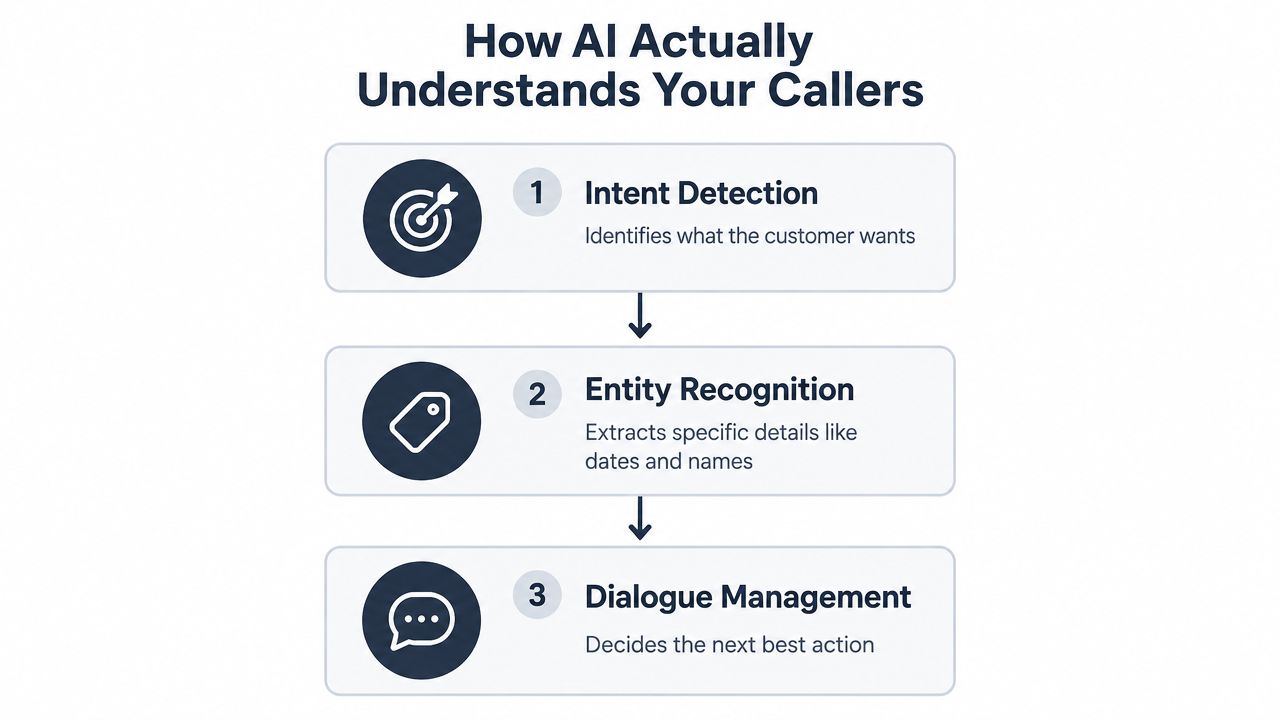
NLU typically performs three connected jobs:
- Intent detection: Identifies the outcome the caller wants, such as booking, changing, cancelling, asking a question, or reporting a problem.
- Entity recognition: Extracts details such as a date, name, location, service, reference number, or preferred time.
- Context handling: Uses earlier turns in the conversation to interpret short replies such as “yes,” “the afternoon one,” or “next week.”
The technical definition is useful because NLU converts unstructured language into structured meaning through syntactic and semantic analysis. In an operational setting, that means the system can map a conversation to an intent, slots, and a next action rather than just searching for familiar words. A technical discussion of meaning representation and intent resolution explains why context, not word recognition alone, determines whether downstream automation is reliable.
This distinction helps you evaluate vendors. Ask what happens after the system hears the caller. Can it update a calendar, collect missing details, and transfer an exception, or does it only generate a plausible reply?
How AI Actually Understands Your Callers
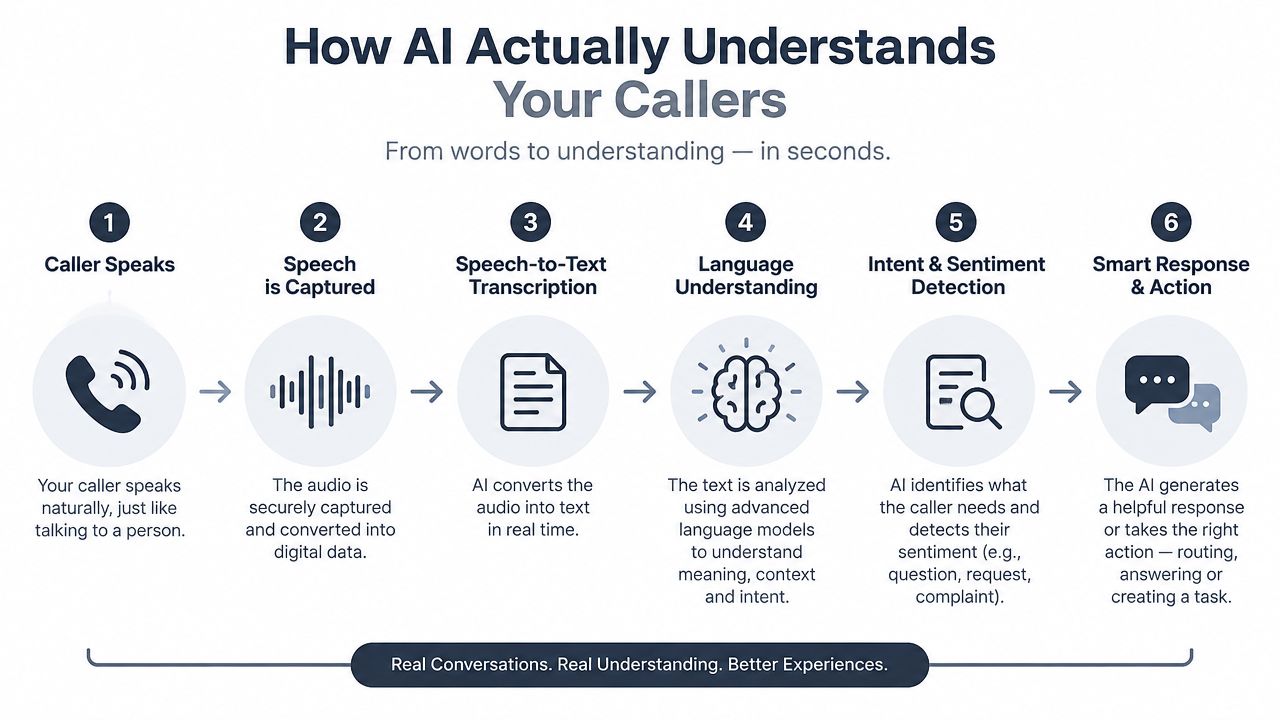
Suppose a customer calls a plumbing company and says, “I need to move the appointment for the boiler inspection. Could we do next Tuesday with Alex instead?”
The assistant doesn't need to match that sentence against one exact training phrase. It needs to convert the request into a structured representation that the scheduling workflow can use.
First, identify the intent
The main intent is reschedule appointment. The caller isn't asking for a new quote, reporting an emergency, or requesting an invoice. Words such as “move the appointment” help, but the system should interpret the whole request rather than depend on one phrase.
Modern systems differ from simple keyword rules. “Can Alex come next Tuesday instead?” may express the same goal without using the word “reschedule.” NLU maps the language to the underlying purpose.
Next, extract the entities
The request contains several details:
- Appointment type: Boiler inspection
- Preferred date: Next Tuesday
- Preferred staff member: Alex
- Requested action: Change an existing booking
These details are often called entities or slots. A calendar workflow may need additional information, such as the customer's name or address. If the caller's account identifies the existing appointment, the assistant may not need to ask for everything again.
The value of this step is practical. A human employee doesn't have to listen to the full recording and reconstruct the request from scratch. They can receive a structured summary and focus on resolving the part that needs judgment.
Then, manage the dialogue
Suppose Alex isn't available next Tuesday, but another qualified technician is. A capable assistant should not reject the request or book the wrong person. It can say that Alex isn't available, offer the available alternative, or ask whether the customer would prefer another date.
Dialogue management controls that next move. It remembers what the caller already said, asks only for missing information, and keeps the conversation aligned with the original goal. When a customer replies “the afternoon,” the assistant should connect that answer to the date and appointment being discussed.
For a deeper explanation of the components behind an AI phone interaction, see how AI assistants work.
A useful test: Give the assistant an incomplete request, a correction, and a short follow-up answer. A system that understands context should recover without forcing the caller to start over.
The same pattern works for a dental practice, estate agent, electrician, law firm, or independent consultant. The business defines the actions the assistant may take, the information required for each action, and the conditions that require human involvement.
From Brittle Rules to Fluent Conversations
Early NLU systems were narrow by design. STUDENT was built in 1964, ELIZA followed in 1965, conceptual dependency appeared in 1969, augmented transition networks in 1970, and SHRDLU in 1971. Together, these systems show the shift from simple pattern matching toward programs that could parse meaning and follow instructions inside tightly bounded domains, as described in this history of natural language understanding.
Those early approaches worked only when the language stayed close to what the system expected. A caller who used an unexpected phrase, changed the subject, left out a detail, or asked the same thing in a different way could break the flow. For a business, that meant writing and maintaining many rules by hand, and every new service or policy added more upkeep.
The move toward statistical language models
The field changed substantially in the 1980s and 1990s. Stanford's overview of NLP history notes that researchers increasingly focused on empiricism and probabilistic models from 1983 to 1993, and that probabilistic and statistical methods had become the most common NLP models by 1993.
The key shift was learning patterns from language data instead of writing every response rule by hand. Later neural approaches improved how systems represent relationships across a sentence and across turns in a conversation. A modern assistant can often connect “I need a pipe fix,” “water is coming through the wall,” and “can you send a plumber?” to the same kind of service request, even though the wording is different.
That still falls short of human understanding. It means the system can generalize beyond a fixed list of approved phrases. A business still needs clear workflows, accurate service information, and safe escalation rules so the assistant knows when to hand off to staff.
Why maturity matters to an SMB
A small business does not need an AI assistant to solve every language problem. It needs reliable performance on a defined set of customer tasks. Booking, rescheduling, answering opening-hour questions, collecting lead details, and routing urgent matters are practical starting points because the outcome is clear.
Smooth speech is not enough if the assistant misses the request. Look for evidence that it can handle paraphrases, multi-turn corrections, domain vocabulary, and uncertainty without taking an unsafe action.
A good test is simple. Give the assistant an incomplete request, a correction, and a short follow-up answer. A system that understands context should recover without forcing the caller to start over. For a business owner, that matters more than a polished demo because it shows whether the assistant can support real conversations instead of just scripted ones.
Real-World Impact on Multilingual Support Teams
A caller's language is part of the context. If the assistant detects the language early and continues naturally, the business can offer a more accessible first response without requiring every employee to speak every language.
This matters for local businesses that serve multilingual communities and for companies operating across regions. A customer may know enough English to complete a transaction but still prefer to explain a scheduling problem in their native language. In a CSA Research survey of 8,709 consumers across 29 countries, 75% said they were more likely to repurchase from a brand when customer care was delivered in their own language, while 60% of consumers confident in English still preferred support in their native language. These figures are reported in the survey coverage on multilingual customer service.
Routine work stays with the assistant
An NLU phone assistant can answer frequently asked questions, collect a caller's details, schedule within defined rules, and send a summary to the team. It can also route a request when the customer mentions an issue that requires professional judgment or a person with account access.
| Task Type | AI Phone Assistant (NLU) | Human Staff |
|---|---|---|
| Common questions | Answers from approved business information | Updates information and handles unusual questions |
| Appointment booking | Collects details and books within configured availability | Manages exceptions, conflicts, and special requests |
| Lead intake | Identifies service need, location, urgency, and contact details | Assesses fit and follows up personally |
| Language support | Detects supported languages and continues the conversation | Handles nuance, reassurance, and sensitive situations |
| Escalation | Routes important calls with conversation context | Makes judgments and resolves complex cases |
This division is complementary, not competitive. A large field study of 5,179 customer service agents found that access to a conversational AI assistant increased productivity by 14% on average, with novice or low-skilled workers improving by 34%. The Stanford summary of the field study presents the findings as evidence that AI can support frontline workers rather than just replace them.
Capacity during busy periods
Customer care leaders also face rising demand. In a 2025 McKinsey survey of 348 customer care leaders, 57% expected call volumes to increase over the following one or two years, according to McKinsey's contact center analysis.
For an SMB, the response doesn't have to be a large call center. It can be a clear division of labor. The assistant handles simultaneous routine calls, while the team receives qualified requests and spends its time on jobs, patients, clients, and exceptions.
Businesses that need German-language conversations can review German language support for customer calls when planning their coverage. The key question is whether the language workflow works for the actual services, policies, and customer vocabulary your team uses.
Navigating Challenges and Measuring Success
A customer says, “the unit is tripping,” and the system hears a routine service note. Another caller changes a date, corrects a name, then refers to “that other appointment.” These are the moments that show whether NLU is doing useful work or just producing polished guesses.
Accents, background noise, incomplete sentences, industry jargon, code-switching, and regional expressions all raise the risk of error. A trustworthy assistant should ask for confirmation when the meaning is unclear, rather than act certain and send the wrong job into the queue. That matters even more in multilingual support, where one phrase can carry a different business meaning depending on the language, region, or service line.
Test beyond the happy path
A demo can look strong and still fail in real calls. GLUE bundles nine diverse NLU tasks plus an auxiliary probing dataset, which helps show whether a system can generalize across different language patterns instead of performing well on only one classification task. The benchmark's standardized online leaderboard also made model comparisons and training approaches more reproducible, as explained in IBM's overview of NLU.
Research points in the same direction. A 2026 survey in Natural Language Engineering examines methods for revealing and overcoming weaknesses in data-driven NLU, particularly for English. The practical lesson is simple, a system that performs well in a controlled test can still struggle with messy, domain-specific conversations. See the survey of weaknesses in data-driven NLU.
Before deployment, test the phrases your customers use:
- Paraphrases: Compare formal requests with the language callers use on the phone.
- Corrections: Check whether the assistant updates a date or name after the caller changes it.
- Ambiguity: See what happens when one request could belong to more than one workflow.
- Language variation: Test supported languages, accents, mixed-language phrases, and local terminology.
- Escalation: Confirm that sensitive, urgent, or uncertain requests reach a human.
Measure business outcomes
Technical confidence scores help engineers, but owners need operational measures. Track whether the assistant captures a usable lead, books the right appointment, records the correct contact details, and routes exceptions to staff who can finish the job.
A useful review dashboard can include:
- Lead capture: How often does an inbound opportunity produce complete follow-up information?
- Booking quality: Are appointments created with the correct service, date, customer, and location?
- Human handoff: Do staff receive enough context to continue without making the caller repeat everything?
- Customer experience: Do callers complete the conversation, or do they leave before it ends?
- Language coverage: Which languages and phrases cause confusion or escalation?
Ask vendors how they handle domain vocabulary, review failed conversations, protect recordings and transcripts, and delete data when required. Domain-specific models and privacy-preserving edge AI are increasingly discussed as adoption drivers, while market coverage estimates the NLU market at USD 25.88 billion in 2025 and projects USD 73.29 billion by 2030, at a 23.14% CAGR. Those figures are a market projection, not a guarantee for one business, and are reported in the NLU market analysis.
Deploying Your First AI Phone Assistant
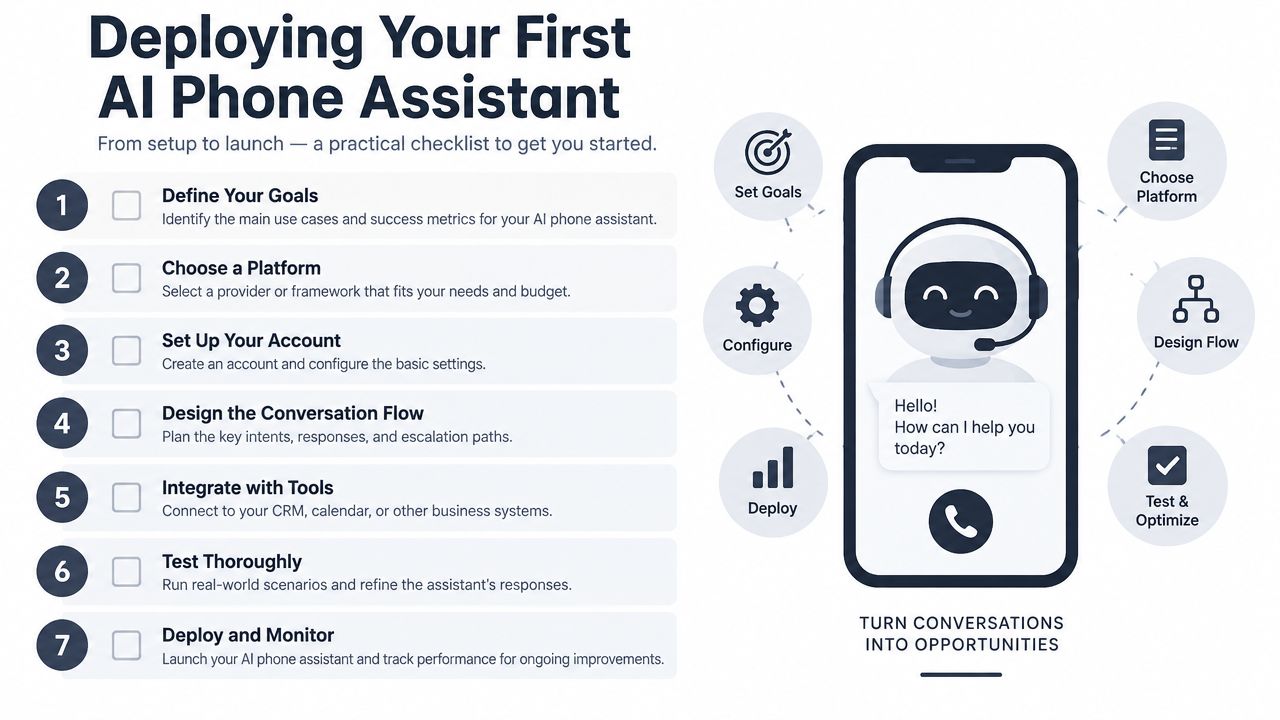
Start with one business problem, not a grand automation program. Appointment booking and routine question handling are usually easier to control than complex quoting, complaints, or advice that depends on professional judgment.
A practical setup sequence
1. Choose the first call types. List the requests your team hears repeatedly, such as opening hours, availability, booking, rescheduling, and service areas. 2. Write the business rules. Define what the assistant may say, what information it must collect, and which requests always require a person. 3. Connect scheduling and customer records. Use the calendar and CRM systems your team already relies on, rather than creating a separate process that staff won't maintain. 4. Prepare supported languages. Translate approved answers and test real customer phrasing. Don't assume that a direct translation preserves the right tone or business meaning. 5. Test with realistic calls. Include interruptions, corrections, background noise, incomplete details, and callers who change their minds. 6. Set escalation conditions. Route urgent issues, sensitive matters, uncertainty, and requests outside the assistant's authority to a human. 7. Review the first conversations. Look for missed intents, incorrect details, unnecessary questions, and handoffs that lack context.
For many small companies, the first implementation can be planned in a short working session. Confirm the phone number, business information, calendar permissions, escalation destination, and summary format. A managed AI answering service can reduce the technical work when you want the assistant configured around your existing process.
Protect customer information
Privacy belongs in the buying decision from the beginning. Ask where data is processed, what gets stored, how long recordings and transcripts remain available, who can access them, and how deletion requests work. For businesses serving customers in Europe or the UK, a system built around EU and UK GDPR, European server infrastructure, and minimal data retention is a sensible baseline to examine.
The assistant should also be transparent about its role. It mustn't claim to be a human or provide professional advice outside its configured scope. Give callers a straightforward path to a person when automation isn't appropriate.
rednea offers an AI phone assistant that detects supported caller languages, answers routine questions, books appointments, qualifies leads, escalates important calls, and connects with calendars and CRMs. Visit rednea to see how a multilingual NLU phone assistant can help your business capture more inbound opportunities while keeping human staff focused on the conversations that need them.
Try rednea, no strings attached
AI phone assistant for business. Hear a live demo in your browser, book a call with our team, or get started — from £90/month, cancel monthly, no minimum term.
GDPR-compliant · EU & UK GDPR · Multilingual