AI Phone Answering Service: What It Is and How to Choose


You're under a sink, mid repair, when your phone rings for the third time this morning. You can't answer, the customer beside you is watching, and the caller probably won't leave a message. That pattern, repeated through the day, is where an AI phone answering service earns its place. It doesn't replace your judgement. It handles the predictable first line of calls so you and your team can take the ones that need a person, and it proves its value in booked and completed jobs, not just calls answered.
What an AI Phone Answering Service Does for Missed Calls
Say a plumber misses four calls a day while on jobs. Say a dental reception loses new patients at 9 a.m. because both lines are busy and one receptionist is checking someone in. In both cases the caller needs an answer now, not a callback hours later.
An AI phone answering service is software that picks up every call, holds a spoken conversation, answers routine questions, books appointments into your calendar, captures enquiries and passes urgent calls to a person. It's not a recorded menu that makes callers press keys, and it isn't a replacement for staff who handle complaints, clinical questions or pricing disputes.
Why the Phone Still Carries the Urgent Work
People still call when the matter feels urgent, emotional or complicated. In 2024, 49% of US consumers surveyed by ContactBabel selected telephony as their first-choice channel for high-emotion, urgent, or complex interactions, according to ICMI reporting on customer channel preferences. That's why a missed call isn't like a missed email. The caller often needs reassurance, a booking or a clear next step within minutes.
The practical question isn't whether to answer. It's which option answers reliably, understands what the caller said, and turns the right calls into work you can fulfil.
Answering Options Compared on the Same Criteria
| Option | Answers 24/7 | Understands spoken requests | Books into calendar | Typical cost |
|---|---|---|---|---|
| Voicemail | Yes | No | No | Usually included in phone plan |
| Phone menu (IVR) | Yes | No, keypress only | Rarely | System licence plus set-up fee |
| In-house receptionist | No, office hours only | Yes | Yes | Salary plus benefits |
| Human answering service | Often | Yes | Sometimes | Per-minute or per-call charge |
| AI phone answering service | Yes | Yes, in several languages | Yes, with live calendar sync | Per-minute, monthly plan or top-up credit |
Voicemail records intent but doesn't act on it. A receptionist acts well but can't cover evenings, peaks and sick days alone. Human answering services bridge the gap, though booking access and scripts limit what they can finish.
Practical rule: Choose the option that books the routine job without losing the urgent call. Coverage alone isn't enough if the appointment, address and callback never reach the right person.
How a Single Call Moves Through the Service
Follow one call from ring to follow-up. Each step exists for a reason, and you can test every one before a real customer hears it.
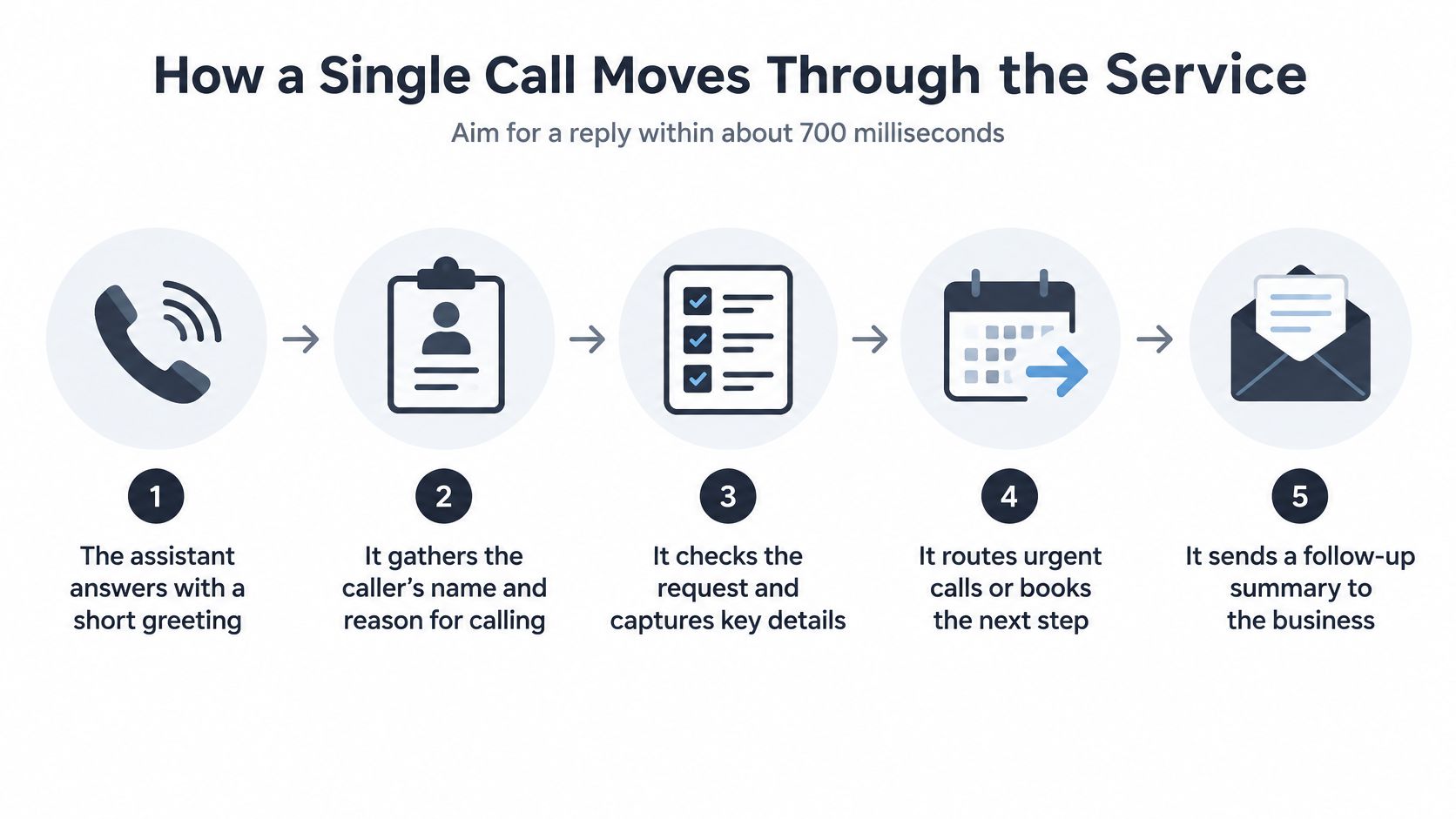
The Sequence From Ring to Summary
- The assistant answers with a short greeting. Speed matters because long silence makes callers repeat themselves or speak over the reply. Engineering guidance places the conversationally natural target at roughly 700 milliseconds for a complete round trip, according to engineering guidance on sub-second latency in real-time voice AI agents.
- It detects the caller's language. From the first words it can continue in English, Spanish, French, German or Italian, and it should offer to switch if it guessed wrong, because names and place names are weak language clues.
- It states that it's an AI assistant and offers a route to a person. Disclosure is commercially important, since research in the Journal of Consumer Research notes that service evaluations can be more negative when customers believe they're dealing with a bot, even when the service delivered is identical to that provided by a human.
- It identifies intent. The caller may want a booking, a quote, a routine answer, or help with a complaint or emergency. Sorting intent early decides whether the assistant continues or steps aside.
- For a booking, it checks live availability. It then reads back the phone number, date and address for confirmation, because one wrong digit can turn a booked job into a wasted trip.
- Urgent words trigger escalation. Phrases such as gas smell, flooding or no heating prompt a transfer or immediate callback to the on-call person. If the transfer fails, the call is logged as urgent and the caller is told exactly what happens next and when.
- You receive a concise summary. An email, with optional SMS, should arrive within minutes with the caller's name, number, request, urgency and any booking made, so follow-up doesn't depend on listening to a recording.
A Quick Exercise Before You Configure Anything
List your five most common calls from the past two weeks. Mark which steps the assistant can own completely, which need confirmation, and which should go straight to a person. That short list becomes your call flow, your escalation rules and your test script later.
If a step can't be described in plain language to a new employee, don't hand it to automation yet. Start with greetings, opening hours, booking and message capture. Add complexity only after those work on noisy, real calls.
Where AI Phone Answering Fits in Your Industry
The pattern is the same across sectors. The assistant takes predictable first-line work, captures structured details and passes exceptions to people who can exercise judgement. What changes is where you draw that line.
Consider tradespeople first. An electrician on a ladder can't discuss a consumer unit replacement, but the assistant can book a call-out, capture the address and job type, and send a text asking for a photo of the board. An active leak, total power loss or gas smell shouldn't stay in that flow. It goes to the on-call person, or the caller is directed to emergency services where appropriate. Owners planning cover for field teams can see how this split applies in an example of AI reception for HVAC businesses.
Typical Calls and the Split Between AI and People
| Sector | Typical inbound calls | AI handles | Passes to a person |
|---|---|---|---|
| Tradespeople (electricians, plumbers, contractors) | Call-out requests, quotes, reschedules | Booking, address and job type capture, photo-request text | Active leaks, power loss, gas smells |
| Small retail and salons | Opening hours, prices, appointment changes | FAQ answers, booking, waitlist sign-up | Complaints, refunds, disputes |
| Dental and healthcare practices | New-patient enquiries, reschedules, reminders | Booking, reminders, intake questions | Symptoms, clinical questions, urgent care |
| Law firms | New client enquiries, consultation requests | Intake fields, consultation booking, office hours | Legal advice, deadlines, opposing parties |
| Estate agents | Viewing requests, valuation enquiries | Viewing bookings, property details | Offers, negotiation, pricing questions |
One Example Call Per Sector
- Salon: A caller asks for a Saturday colour appointment. The assistant checks stylist availability, books it, and sends a confirmation, while a complaint about a previous treatment goes to the manager.
- Dental practice: A new patient wants a check-up next week. The assistant captures contact details and books the slot, but pain, swelling or a broken tooth is passed to clinical staff for triage.
- Law firm: A prospective client asks for a first consultation. The assistant records the matter type and contact details, and it never offers legal advice or comments on a deadline.
- Estate agent: A buyer requests a viewing for a listed flat. The assistant books the time and confirms the address, while an offer goes directly to a negotiator.
- Freelancer: A consultant in a client workshop misses a prospect's call. The assistant captures the project outline and preferred callback time instead of letting the enquiry cool in voicemail.
The same split works in every supported language. A Spanish-speaking caller booking a viewing and a German-speaking caller rescheduling a dental appointment get the same confirmations and escalation options, so you don't need multilingual reception staff just to cover routine calls.
What It Costs and How Pricing Models Differ
Judge any plan against what a missed call costs you. Use this formula with your own numbers: missed calls per day × share that were real opportunities × conversion rate × average job value.
Say you miss 4 calls a day, half are real opportunities, you convert 30%, and your average job is £200. That is 2 × 0.3 × £200, or £120 a day, roughly £2,640 over 22 working days. Treat it as a rough estimate, and let it show you which price range deserves a trial.
Measure the return in booked-and-completed jobs rather than calls answered. A service that picks up every call yet leaves the diary empty saves nothing.
Missed calls carry a cost because callers who cannot get through tend to move on quickly, whether they ring a competitor, send a message elsewhere, or give up entirely. The faster your line answers, the more of those enquiries stay yours.
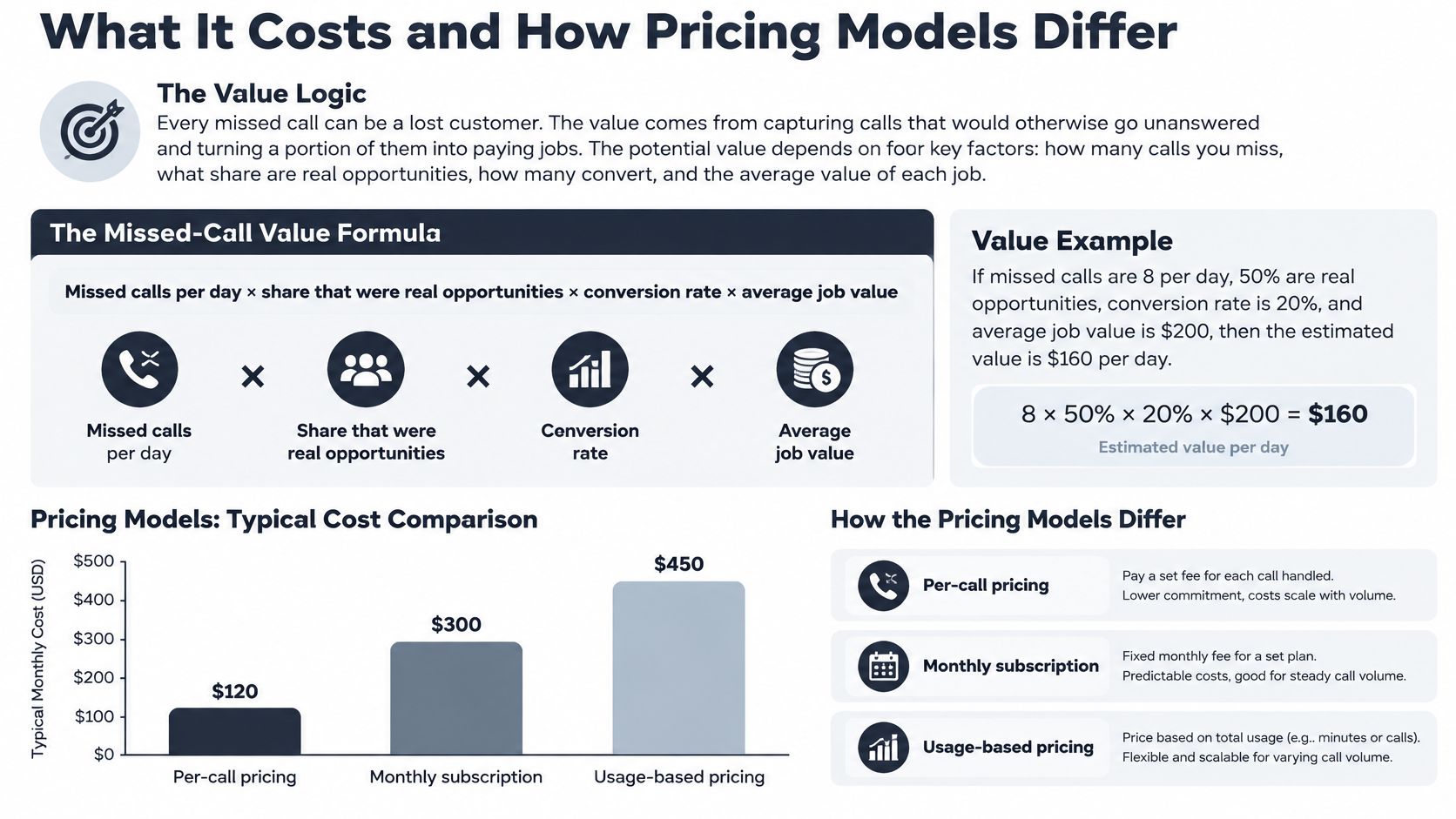
Pricing Models and When Each Makes Sense
| Pricing model | How you pay | Fits best when | Watch for |
|---|---|---|---|
| Per-minute billing | Pay for talk time used | Low or uneven call volume | Long calls and spam calls add cost |
| Monthly plan | Fixed fee with included minutes | Steady, predictable call volume | Overage rates above the included minutes |
| Per-call pricing | Fixed price per answered call | Short, simple enquiries | Spam and abandoned calls may be billed |
| Top-up credit | Prepaid balance, topped up as needed | Seasonal or variable businesses | Expiry rules and minimum top-up amounts |
Before you compare headline prices, work through how the models behave at your volume in this guide to AI voice agent pricing. Then run a break-even check. At 300 minutes a month, per-minute billing wins while your per-minute rate times 300 stays below the fixed plan fee. Once your minutes pass the plan's included amount plus overage, the fixed plan usually wins. Do that arithmetic with your busiest month, since that is where overage charges do the damage.
Hidden Costs to Check in Writing
- Minutes beyond the plan: Confirm the overage rate and whether partial minutes round up.
- Set-up and number porting: Ask what's charged to configure call flows and keep your existing number.
- SMS charges: Check whether summaries, confirmations and photo-request texts are included.
- Spam calls: Ask whether robocalls and wrong numbers are billed as handled calls.
Answering more calls only helps if you have the diary space and staff to fulfil them. Profitable availability beats 100% automation.
Privacy, Consent and Data Rules to Check
Automation isn't compliant by default. If you operate in the UK or EU, GDPR applies to call recording and AI call handling, including transcripts, summaries and the personal data inside them. You're responsible for what your service collects, even when a vendor operates the technology.
The European Data Protection Board guidance for SMEs says callers must be informed about the purposes of recording, the recipients of recordings, their right to object, and their right to access the recordings. That isn't fine print for a website. Your callers need a concise notice they can understand at the start of the call, in the language they're speaking.
A Checklist You Can Run This Week
- Recording notice: Play a short notice at the start of each call that states why the call is recorded or transcribed and who can access it.
- Retention period: Document how long you keep recordings and transcripts, and why. Don't keep every call indefinitely because storage is cheap.
- Restricted access: Limit recordings, transcripts and summaries to staff and processors who need them for booking, follow-up or quality checks.
- Deletion workflow: Name who handles an erasure request, how they find one caller's data, and how deletion is confirmed to the caller.
Timing matters. The same guidance notes that a controller generally must respond to an erasure request without undue delay and no later than one month after receiving it, with an extension of up to two additional months for complex requests only if the person is informed within the first month. Erasure isn't absolute where the law requires retention or the data is needed for legal claims, so record that reason rather than refusing without explanation.
Where the Data Lives and Who Can Use It
Ask where recordings are stored, whether European server infrastructure is used, and whether you'll sign a data processing agreement. Ask directly whether your callers' data trains the vendor's models. A clear no, written into the contract, is the answer you want. For a plain-language walkthrough of these duties, see this overview of customer data protection.
Put three questions to every vendor in writing before you sign. What is kept? Where is it kept, and for how long? How is one call deleted on request? If the answers are vague, treat that as a product fault, not a sales delay.
How to Evaluate Vendors Before You Buy
A demo can sound fluent while your real callers are ringing from a van, a stairwell or a noisy shop floor. Run your own calls before you read the claims: peak and quiet times, every language you serve, mobiles on busy streets and speakerphones in vans. Score what happened to the job, not how polished the greeting sounded.
Telephone speech is the hard case. The NIST speaker recognition evaluation plan evaluates conversational telephone speech across handset types and acoustic conditions such as noisy cafés and quiet offices, which is why a quiet-room demo proves little. Because recognition can fail under noise, accents and weak signals, make each service show its recovery behaviour: repeat back phone numbers, dates, email addresses and property locations, and hand the call to a person when confidence is low instead of guessing.
What to Measure on Your Test Calls
Use a small set of scripted calls as the core of any timed trial, then change one variable at a time: language, noise, caller intent and urgency. Time the first reply and record the slowest replies, since occasional long pauses make callers repeat themselves, hang up or talk over the assistant. Score word accuracy, language identification and task completion separately for each condition; a service that books cleanly in quiet English but loses Spanish street names still needs work.
- Book, move and cancel: Make a real appointment, reschedule it, then cancel it, and check that each change appears once in your calendar with the right time, name and contact details.
- Interrupt mid-sentence: Correct a date while the assistant is speaking and see whether it recovers without restarting the whole call.
- Ask something it shouldn't answer: Request advice outside its remit and confirm it declines and offers a person.
- Trigger an escalation at night: Use your urgent keywords and confirm the on-call person is reached, or a logged callback is promised with a time.
Vendor Evaluation Criteria and Red Flags
| Criterion | What to test | Red flag |
|---|---|---|
| Language coverage | Call in each language you serve, with accents and local place names | English only, or a language menu before the greeting |
| Response speed | Time the first reply at peak and quiet times | Pauses long enough that callers start repeating themselves |
| Calendar and CRM integration | Book, move and cancel an appointment; check the record appears in your calendar | Email-only summaries with no live calendar sync |
| Escalation | Trigger a transfer at night and confirm the caller reaches a person or a callback | Caller trapped in a loop with no route to a human |
| Data handling | Ask for the data processing agreement, server location and deletion process | Vague answers on storage or model training |
| Pricing transparency | Calculate the monthly total at your real call volume | Undisclosed overage, set-up or SMS charges |
| Reporting | Check for booked-and-completed rate, escalation rate and no-show rate | Only a count of calls answered |
Settle integration before signing. Confirm which calendar, scheduling tool and CRM the assistant writes to, whether bookings appear live, whether you keep your existing number, and whether SMS summaries are included. Include rednea in that same test if it is on your shortlist, and check its claims on European hosting, languages, calendar connections and billing against your own calls and the contract rather than taking them from its materials.
On reporting: If a vendor can only tell you how many calls it answered, it can't tell you whether those calls became completed jobs.
Confirm Your Missed-Call Numbers Before You Sign
A sound decision takes about a week and needs only two things: your own call data and a short, disciplined trial.
- Pull two weeks of missed-call data. Use your phone log or carrier report and count calls outside hours plus calls that arrived while you were busy.
- Calculate the weekly loss. Apply your own conversion rate and average job value, or run the figures through the missed-call calculator to sense-check the result.
- Shortlist two or three vendors. Keep only those that pass the criteria table, and include one per-minute option and one fixed plan so you can compare billing behaviour on the same call volume.
- Run 20 test calls. Reuse the scenarios from the evaluation table above, then widen the mix: spread the calls across peak and quiet hours, and put some through your real phone line rather than a demo number, so no single easy call carries the verdict.
- Rank vendors on outcomes. Score each one on booked-and-completed appointments and escalation rate, because an answered call that never became a job is still a missed call.
Set the go or no-go threshold before the trial starts, while the figures in front of you are still your own. A workable threshold sounds like this: the service pays for itself if it produces, say, five completed bookings a week, or at least enough completed jobs to cover the weekly loss from step 2. Write the number down before any sales call, so the trial is judged against your figure and not against a persuasive demo.
If you're ready to test that split on your own calls, rednea offers an AI phone assistant that answers 24/7 in English, Spanish, French, German and Italian, books into your calendar, and escalates only the calls that need a person. Set-up is handled for you, billing is per-minute with transparent plans and top-ups, and concise summaries land by email and optional SMS for fast follow-up.
Try rednea, no strings attached
AI phone assistant for business. Hear a live demo in your browser, book a call with our team, or get started — from £90/month, cancel monthly, no minimum term.
GDPR-compliant · EU & UK GDPR · Multilingual