24/7 Call Answering for Small Business: A Practical Guide

You're under a sink with both hands occupied when the phone starts ringing. The caller needs a repair, but you can't safely stop work to answer. By the time you call back, they may have already booked someone else. A dentist handling a patient or a solo lawyer in a meeting faces the same operational problem: customers call when the business is busy, closed, or unreachable.
24/7 call answering for small business is useful when it does more than catch calls. It should identify what the caller needs, book the right appointments, route urgent issues, and pass a person only the conversations that need human judgment. The aim isn't to answer every call at any cost. It's to make sure the right calls get a useful response and a clear next step.
Why Missed Calls Cost Small Businesses More Than They Think
A missed call often looks like a small interruption in the day. But for a plumber working on-site, a dentist with patients in the chair, or a solo lawyer in a confidential meeting, it's a predictable result of limited capacity, not a failure to try hard enough.
A 30-day observational study covering 85 small businesses across 58 industries found that 37.8% of inbound calls were answered live, 37.8% reached voicemail, and 24.3% received no response. The study isn't a universal benchmark, but it illustrates a common coverage problem: a substantial share of callers don't reach a person or a working voicemail system (small-business call-answering findings).
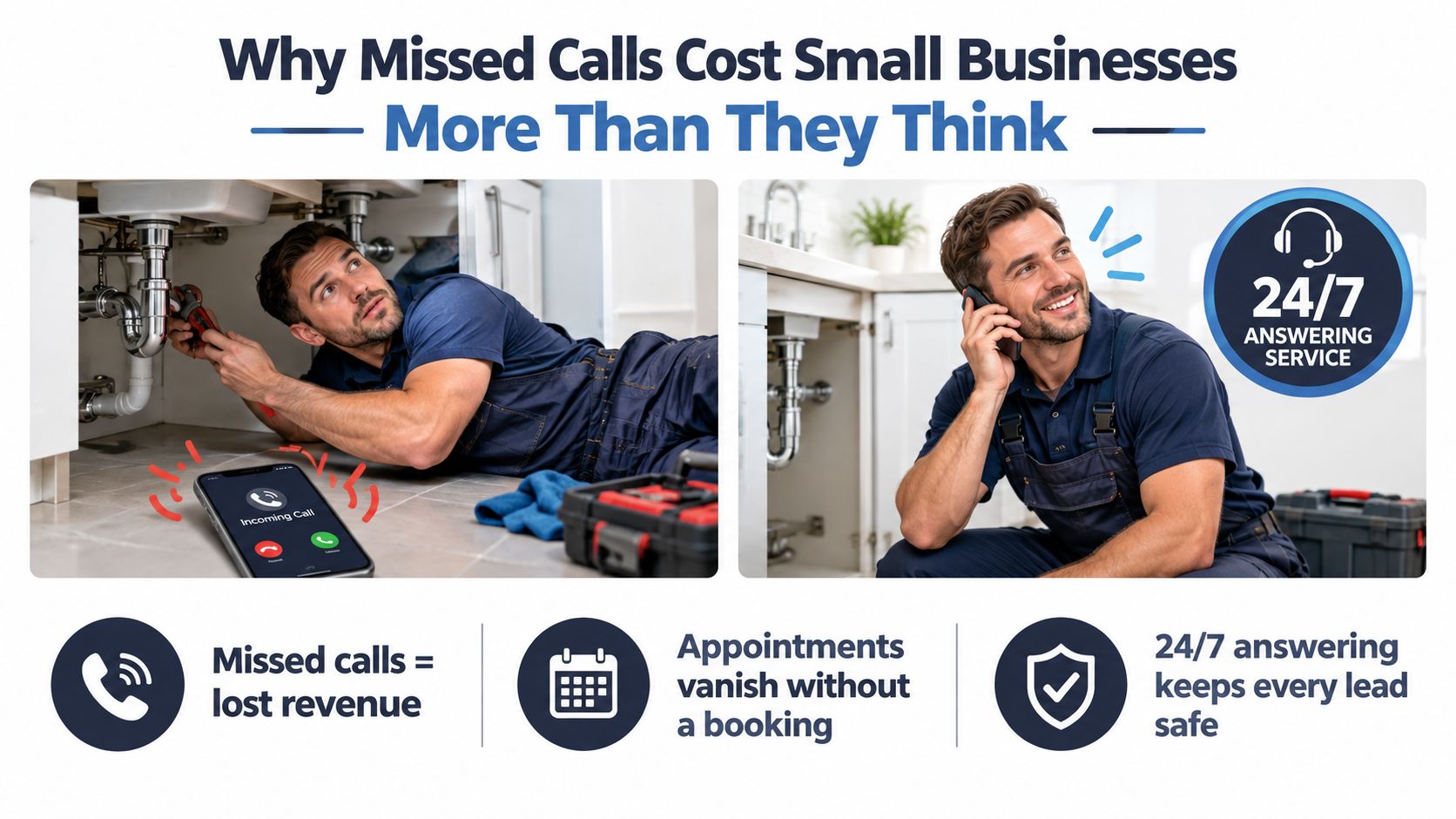
The underlying issue is operational. Staff can be serving customers, driving between jobs, dealing with paperwork, or taking another call. Voicemail gives the caller a task instead: explain the problem after a beep, then wait and hope for a callback. Some callers will do that. Others will call a different business.
Most owners estimate missed-call costs from memory. They remember the urgent job they didn't get, but don't know how many calls came in, which ones were qualified, or which became appointments. An answering layer makes those interactions visible by recording the caller's reason for calling, capturing useful details, and assigning a next action.
Practical rule: Treat missed calls as a coverage problem to solve with a process, not a motivation problem to solve by telling staff to try harder.
The difference between an unanswered call and a recovered opportunity is whether someone can move the caller forward while the team is unavailable. For a closer look at how unanswered calls affect businesses, see this guide to the cost of missed calls.
What 24/7 Call Answering Actually Does
A 24/7 answering setup is an operating layer for inbound calls. It answers, works out what the caller needs, and takes an agreed action: provide a routine answer, collect information, book an appointment, route an urgent call, or arrange follow-up.
There are three practical ways to provide that coverage:
- AI assistant: Handles routine questions and structured intake, can work outside office hours, and can collect details or book from an available calendar. It needs clear boundaries for uncertainty and sensitive conversations.
- Human receptionist: Offers human judgment and a personal conversation, but may require scheduled coverage or an answering service. It's a stronger fit when calls often involve distress, negotiation, or complicated context.
- Hybrid setup: Lets automation handle predictable calls and directs exceptions to a person. For many small businesses, this is the sensible starting point because it extends coverage without pretending every call is routine.
Voicemail isn't a full answering strategy. It records a message only if a caller chooses to leave one, and it doesn't qualify the request or set an expectation for when the business will respond. A menu that asks callers to select from rigid options may route some calls, but it can still leave them stuck when their need doesn't fit the menu.
A capable answering workflow should collect only what the business needs to act: caller identity, reason for calling, service location if relevant, urgency, preferred appointment time, and permission for follow-up. It should then place the information where the team already works, such as a calendar or customer record, and alert the responsible person.
The system shouldn't just “pick up.” It should help decide what happens next, then make that decision easy for staff to review.
Where 24/7 Answering Pays Off the Fastest
The strongest early use cases are calls with a clear next action. A dental practice may need to capture appointment requests; a contractor may need to identify whether an inquiry fits the service area; a plumber may need to distinguish an emergency from a routine repair.
Appointment booking works well when callers ask for availability, rescheduling, or a first visit. A useful outcome is a confirmed slot in the practice calendar, along with the caller's contact details and any intake information the practice is authorized to collect. Track completed bookings and the share of answered appointment calls that turn into appointments.
For trades and contractors, the first task is often lead qualification. Capture the job type, location, urgency, and the caller's preferred time for a response. The team can then prioritize work it can serve, rather than returning a bare voicemail with no context.
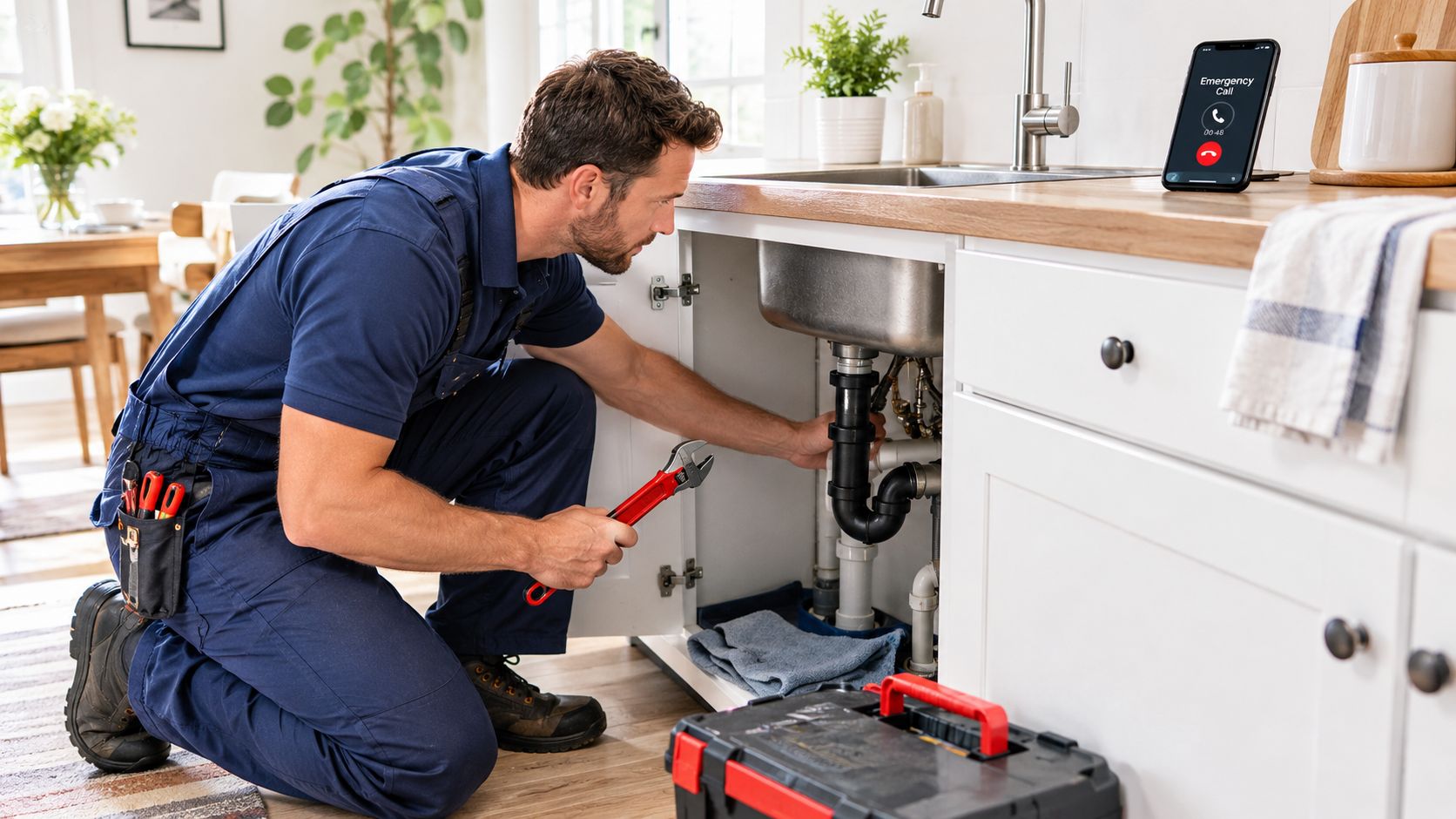
Emergency routing needs especially clear rules. A caller reporting a safety issue or urgent leak shouldn't be left in the same queue as someone asking about routine availability. Define which calls trigger an immediate transfer, which can be booked for the next available appointment, and which can be answered with approved information.
Speed matters when the caller is actively seeking a provider. Lead-response research covering more than 15,000 leads and 100,000-plus call attempts found that the odds of successfully contacting a lead fell 100-fold when the first call came 30 minutes after inquiry instead of within 5 minutes; the odds of qualifying the lead fell 21-fold over the same interval (lead response research). That's a strong reason to answer immediately when staff can't, rather than relying on a next-day callback.
After-hours overflow is a straightforward place to start. Keep the business's normal number, but let the answering layer take calls when the office is closed or the team is occupied. Watch whether callers receive an answer, whether the system routes urgent requests correctly, and whether the next morning's follow-up is actionable. For trade businesses, these HVAC call-answering considerations offer a practical reference point.
AI vs Human Receptionist vs a Hybrid Setup
Choose the model based on the calls your business receives, not on whether automation sounds fashionable. AI is efficient for repeatable intake and routine questions. People are better when the caller is distressed, the request is complicated, or the conversation needs discretion and judgment.
| Dimension | AI assistant | Human receptionist | Hybrid |
|---|---|---|---|
| Cost pattern | Can suit steady routine call volume; check whether billing is per minute, per call, or subscription-based | Pays for human coverage, including scheduled availability | Uses automation for routine calls and reserves human time for exceptions |
| Availability | Can answer outside office hours and during busy periods | Depends on the coverage arrangement | Extends coverage while preserving a human escalation path |
| Consistency | Follows configured scripts and routing rules | Can adapt to context, but service varies by person and workload | Consistent first response with human judgment for exceptions |
| Language coverage | Can support multiple languages if configured and tested | Depends on the receptionist's language skills | Automates common multilingual intake and routes language-sensitive cases |
| Best-fit calls | FAQs, appointment requests, structured lead intake | Distress, complex negotiation, sensitive or ambiguous needs | Mixed call volume where routine calls are common but exceptions matter |
| Main risk | Misunderstanding or overstepping its limits | Unavailable coverage or higher staffing demands | Poorly designed handoff rules can frustrate callers |
A 2025 multilingual NLP study reported average query resolution of 13.7 seconds for its AI system, compared with 22.1 seconds for a standard transformer baseline and 28.9 seconds for a rule-based system. It also reported that the system escalated unresolved or high-sentiment cases at roughly a third of the rate of baseline systems (multilingual NLP study). Those findings are not a guarantee that a particular phone setup will perform the same way. The practical lesson is to automate clear, repeatable tasks and make escalation part of the design.
For most small businesses, hybrid is the right default. Let AI answer predictable questions, collect the details needed for a booking, and identify urgency. Give callers a clear route to a person when the situation is sensitive, uncertain, or outside the system's authority.
A dentist might automate appointment requests while transferring a caller with a complex clinical concern. A solo lawyer might collect a potential client's contact details and general reason for calling, but leave legal assessment to the lawyer. This AI receptionist versus answering service comparison can help clarify which coverage model fits your calls.
Setting Up 24/7 Answering Without Disrupting the Business
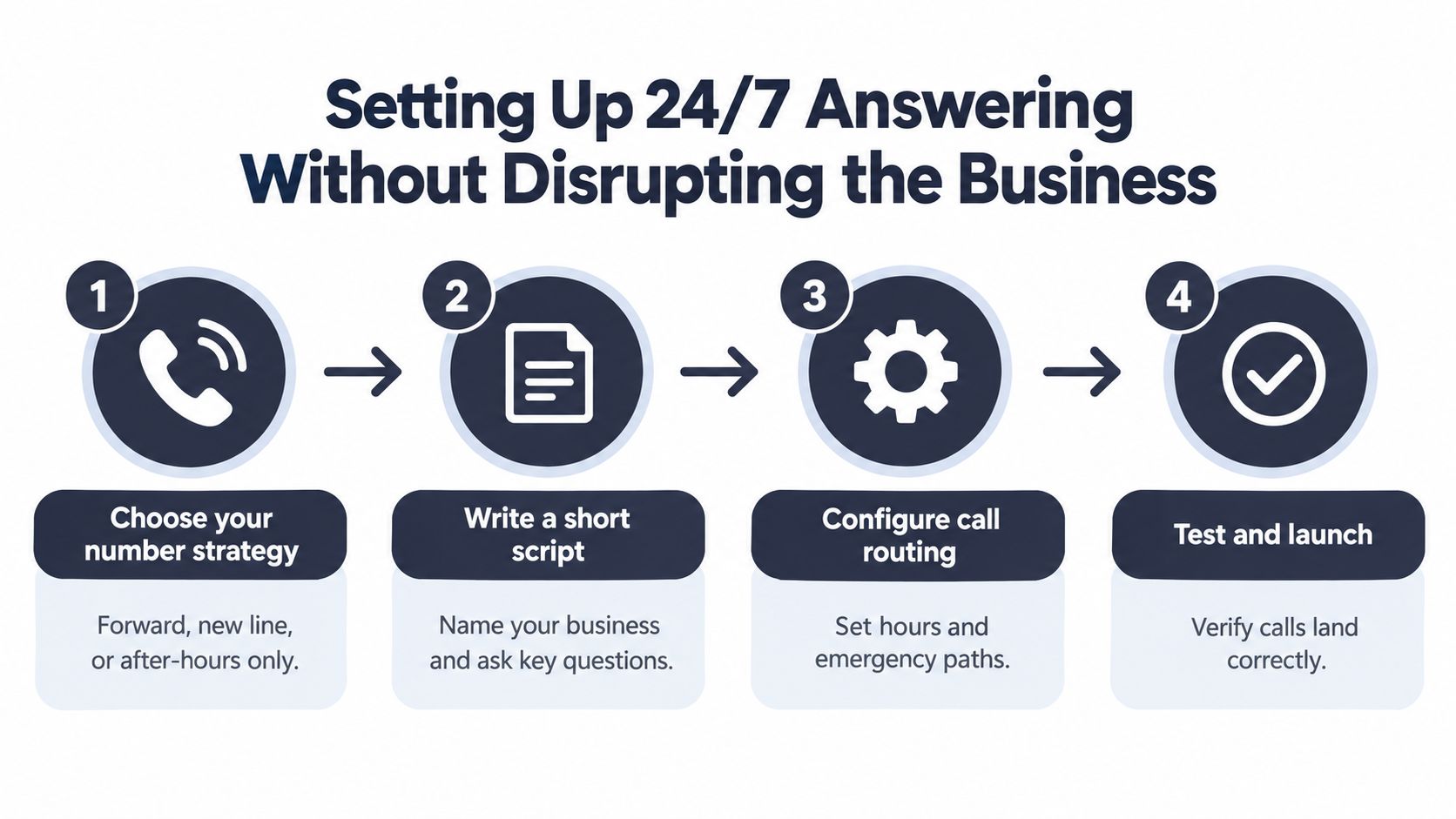
Start with the smallest change that catches the calls you currently miss. Don't redesign the whole phone operation before you know which calls need help.
Choose how calls reach the system
Decide whether to forward your existing number, use a separate line, or turn on coverage only after hours. After-hours coverage is often the least disruptive first test. It lets the team keep its daytime habits while testing whether callers get a useful answer when the office is closed.
Write a short, accurate script
The greeting should identify the business and say plainly that the caller is speaking with an automated assistant if that's the case. Then ask what the caller needs. Keep the approved answers current: stale opening hours, service areas, or prices create more work than they save.
Connect the calendar and customer records
Make bookings land in the calendar staff already use. Send call summaries to the place where the team tracks follow-up, rather than creating a separate inbox nobody checks. Verify that the summary includes the caller's need, urgency, and agreed next step.
Write the handoff rules before launch
Mark which cases transfer immediately, which receive a callback request, and which the assistant can handle. Include emergencies, complaints, payment disputes, accessibility needs, and situations the system can't answer confidently. A 7-day silent test gives staff a chance to review sample calls, check routing, and fix confusing responses before callers rely on the system.
During the test, listen for mistakes that could affect a booking or a safety decision. Confirm that messages reach the right person and that the system doesn't promise something the business can't deliver. A cited survey of 1,000 U.S. consumers found that 82% would call a competitor after an unanswered business call, 78% had abandoned a business because a call wasn't answered, and more than 55% of home-service customers expected a response within one hour (consumer call-answering survey). Treat those results as a reason to improve coverage, not as a promise that every caller will book.
Calculating the Real ROI of a 24/7 Answering Service
The useful question isn't “How many calls did it answer?” It's “How many qualified bookings or valuable next steps did it create that we would otherwise have lost?” An answer rate is a coverage metric, not proof that the system earns its cost.
Measure a baseline before you change anything. Record missed calls, the reason for each call where known, how many inquiries qualify for your services, and how many turn into bookings. Then compare the same call categories after launch, separating urgent jobs, routine appointments, out-of-area requests, and calls that don't fit your service.
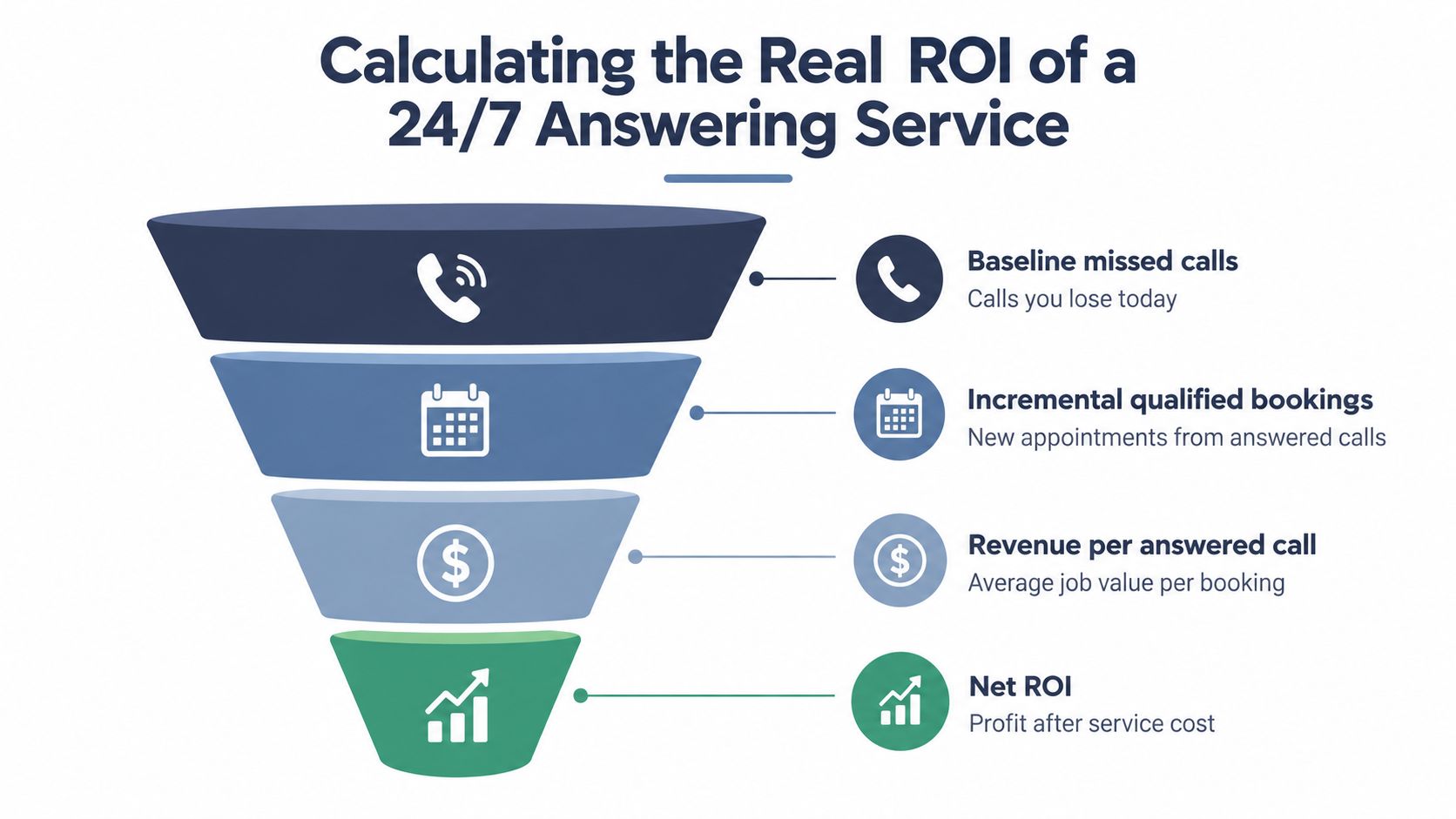
A simple calculation is:
- Count the baseline missed calls that could plausibly be served.
- Track incremental qualified bookings after answering coverage begins.
- Estimate revenue per booking using your own job or appointment records.
- Subtract the answering cost to estimate the net contribution.
Don't treat an estimate of missed revenue as booked revenue. A March 2025 survey of 320 small-business owners and managers found that 55% received 10–100 or more customer calls per day, while 42% estimated losing at least $500 per month from missed calls. Those figures are self-reported and don't distinguish completed jobs from low-value inquiries (SMB missed-call survey). Use them as context, not as a forecast for your business.
Attribute outcomes carefully. Record which calls became qualified bookings, whether the appointment was completed, and whether it came from an AI-handled interaction, a human conversation, or a voicemail callback. Review cost per qualified appointment alongside booking completion, escalation accuracy, and callback time.
Universal answering can also be the wrong economic choice. A plumber with limited capacity shouldn't accept every job if some are outside the service area or low-margin; a dentist may need to prioritize suitable appointment requests over general questions. The best system filters toward work the business can serve and routes the rest appropriately.
Privacy, GDPR, and Caller Trust in an AI-First Setup
Privacy and trust belong in the call flow, not just in a policy document. Decide what information the system needs to handle a call, why it needs it, who can access it, and how the business will delete it when it's no longer required. If you serve callers in the UK or EU, ask the provider how its data handling supports your privacy obligations, and confirm that your own process matches the information you collect.
A practical checklist for a vendor conversation:
- Minimize collection: Ask only for details needed to answer, book, or route the call.
- Explain retention: Find out what call information is stored, for how long, and who can access it.
- Support deletion requests: Confirm how the business can remove stored caller data when appropriate.
- Record follow-up consent: Make sure callers understand when the business will contact them again.
- Plan for escalation: Define when a person takes over, and how the handoff information reaches them.
Be transparent about automation at the start of the conversation. Consumer research reported that 80% of Americans wanted to know whether they were speaking with a human or AI, 22% would end the call immediately after discovering it was AI, and 37% would lose trust if AI use were concealed (AI transparency consumer research). Hiding the assistant's identity risks damaging trust; a plain disclosure lets callers decide how they want to proceed.
Give callers a clear human or callback option early, especially for complaints, distress, complex legal or medical questions, payment disputes, or accessibility needs. In multilingual calls, check that names, addresses, prices, and critical instructions are understood before taking action.
The best system isn't the one that keeps a caller talking. It's the one that recognizes uncertainty, respects the caller's choices, and transfers the conversation when it can't handle it safely. Review your approach against this AI receptionist privacy and GDPR guidance.
Your Decision Checklist for Choosing a 24/7 Answering Solution
Answering every call is the wrong target. Pick the setup that turns the right calls into bookings and routes the rest with clear rules.
Take these questions into a vendor call:
- Which caller languages can it handle, and how do we test them live before signing?
- Can it book into our calendar and write call outcomes to our customer records?
- What exact conditions trigger an immediate human handoff, and what details travel with that handoff?
- Is pricing per minute, per call, or by subscription, and what does each charge include?
- Where is caller data stored, how long is it retained, and how do we delete it?
- How does it disclose AI and offer a person early enough to protect trust?
Start narrow. During days 1–30, cover one line or after-hours calls and review every outcome. During days 31–60, tighten scripts, routing, and booking rules based on real calls. During days 61–90, expand only if the numbers say daytime overflow or another call type will pay.
Track live-answer rate, missed calls, qualified bookings, completed appointments, escalation accuracy, callback latency, and cost per qualified appointment. For multilingual service, ask each vendor for a live test in the languages your callers use, and record how often the assistant transfers a call it cannot handle confidently. Reported multilingual deployments have cut resolution time significantly, but treat any single case as context, not a forecast.
Start this week with one line, one accurate script, and a weekly review of what callers needed and what happened next.
---
rednea provides a 24/7 AI phone assistant that answers routine questions, books appointments, qualifies inquiries, and escalates calls that need a person. If you want to test that workflow, visit rednea.
Try rednea, no strings attached
AI phone assistant for business. Hear a live demo in your browser, book a call with our team, or get started — from £90/month, cancel monthly, no minimum term.
GDPR-compliant · EU & UK GDPR · Multilingual