A Telephone Call Summary You Can Act On

A telephone call summary is a short structured note of who called, what they wanted and the next action, not a transcript.
Your phone rings while you're under a sink, finishing a consultation or helping someone at the counter. By the time you can look at it, another customer is waiting and you can't remember whether the earlier caller needed a booking, a quote or urgent help.
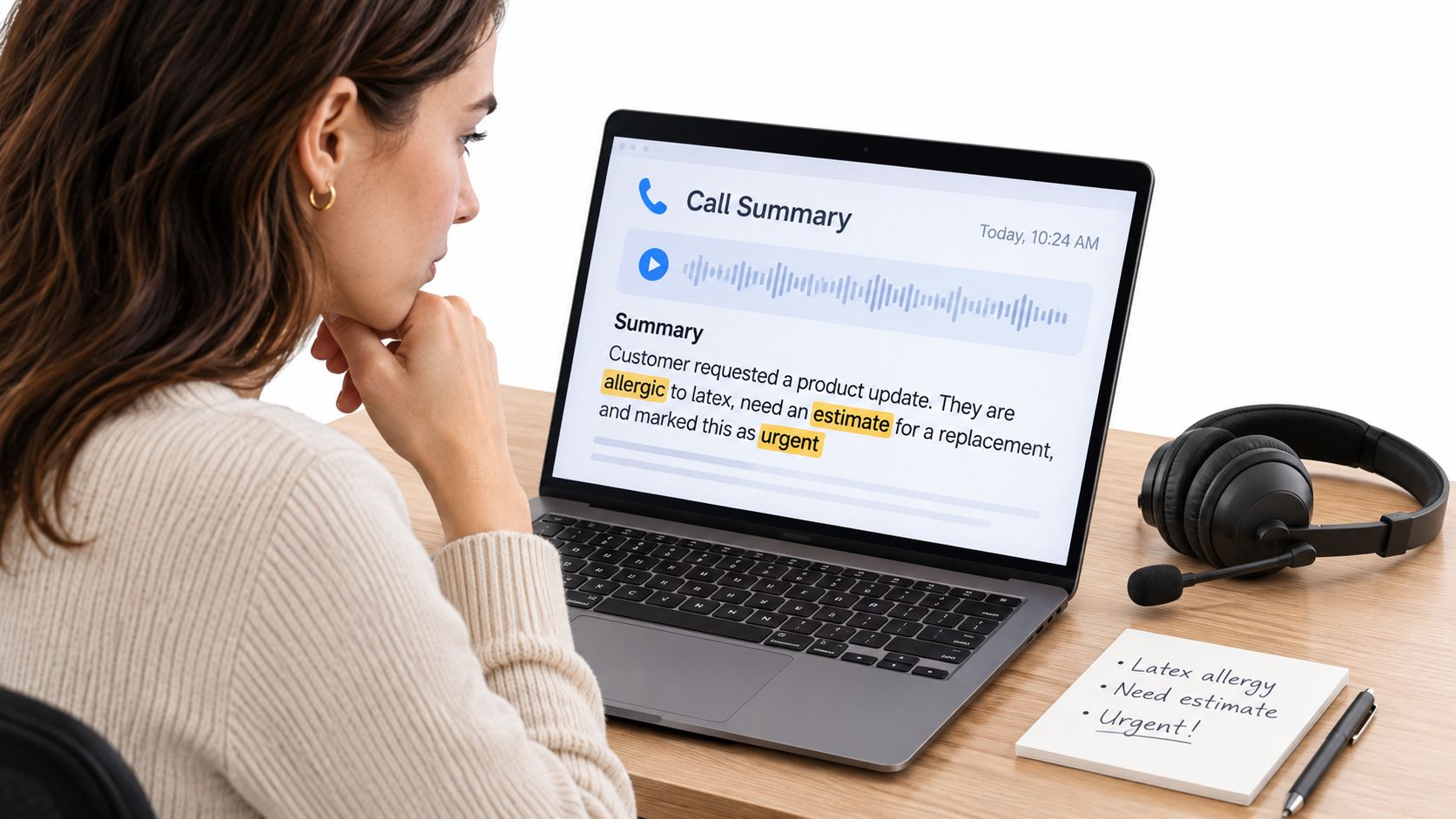
The useful record isn't a page of conversation. It's a job card you can read between tasks, with enough detail to act without replaying the call. AI can collect those details and draft the card for routine enquiries, while your team keeps responsibility for exceptions.
The Fields a Telephone Call Summary Must Hold
A telephone call summary should let a colleague who never heard the conversation take the right next step. Think of it as a job card on a van dashboard: the worker needs the destination, the problem and the next action, not every sentence the customer spoke.
Use about ten seconds as a practical reading target, not a reason to remove important details. A short note that leaves out an address or makes an unconfirmed visit look booked isn't finished.
Nine fields in a telephone call summary
The following is a hypothetical electrician enquiry. The callback number belongs in the actual record, but there's no need to invent one for the example.
| Field | What to write | Example |
|---|---|---|
| Identity | Name and callback number | Alex Morgan, callback number captured and read back |
| Language | Language the caller used | English |
| Intent | One sentence in their words | No power in the kitchen, wants someone today |
| Urgency | Routine, same day or emergency | Same day |
| Place | Address, access note, in area or not | 14 Oak Lane, inside service area, consumer unit access unclear |
| Timing | Date and window requested | Today, 2-4pm |
| Promise | Booked or quoted versus only suggested | Callback offered, visit not booked |
| Owner | Who acts and by when | Sam calls back by 5pm |
| Status | Confirmed, unclear or needs a person | Unclear on consumer unit access |
Identity and language make the reply possible. Keep the language spoken separate from the language your team uses internally, so an employee doesn't return an Italian-language enquiry expecting an English conversation.
Intent, urgency and place explain the work. Don't diagnose a fault from a vague description. Record what the caller reports, then apply your emergency rules rather than treating every request for today as an emergency.
Timing and promise prevent accidental commitments. In this example, the caller requested an afternoon visit, but the business offered only a callback. Sam's deadline doesn't satisfy the requested visit window, so that mismatch needs attention.
Keep uncertainty visible
Telephone speech includes background noise, accents and overlapping voices. The recognition evidence discussed alongside NIST's conversational telephone speech evaluation includes an independent English benchmark with approximately 5.8% to 11.0% recognition error for advanced systems, compared with 5.9% to 11.3% for human transcription, depending on the dataset.
Those are transcription results, not a guarantee of summary accuracy. An incorrectly recognised address can still become a confidently written instruction, so uncertain names, prices and times must remain flagged.
For Alex's call, the on-call transfer can carry the reported loss of power and the captured callback details, while clearly marking consumer unit access as unresolved. Paste these nine fields into the note you use after every call, and leave missing information visibly missing.
What an Unanswered Call Costs Before Anyone Writes It Down
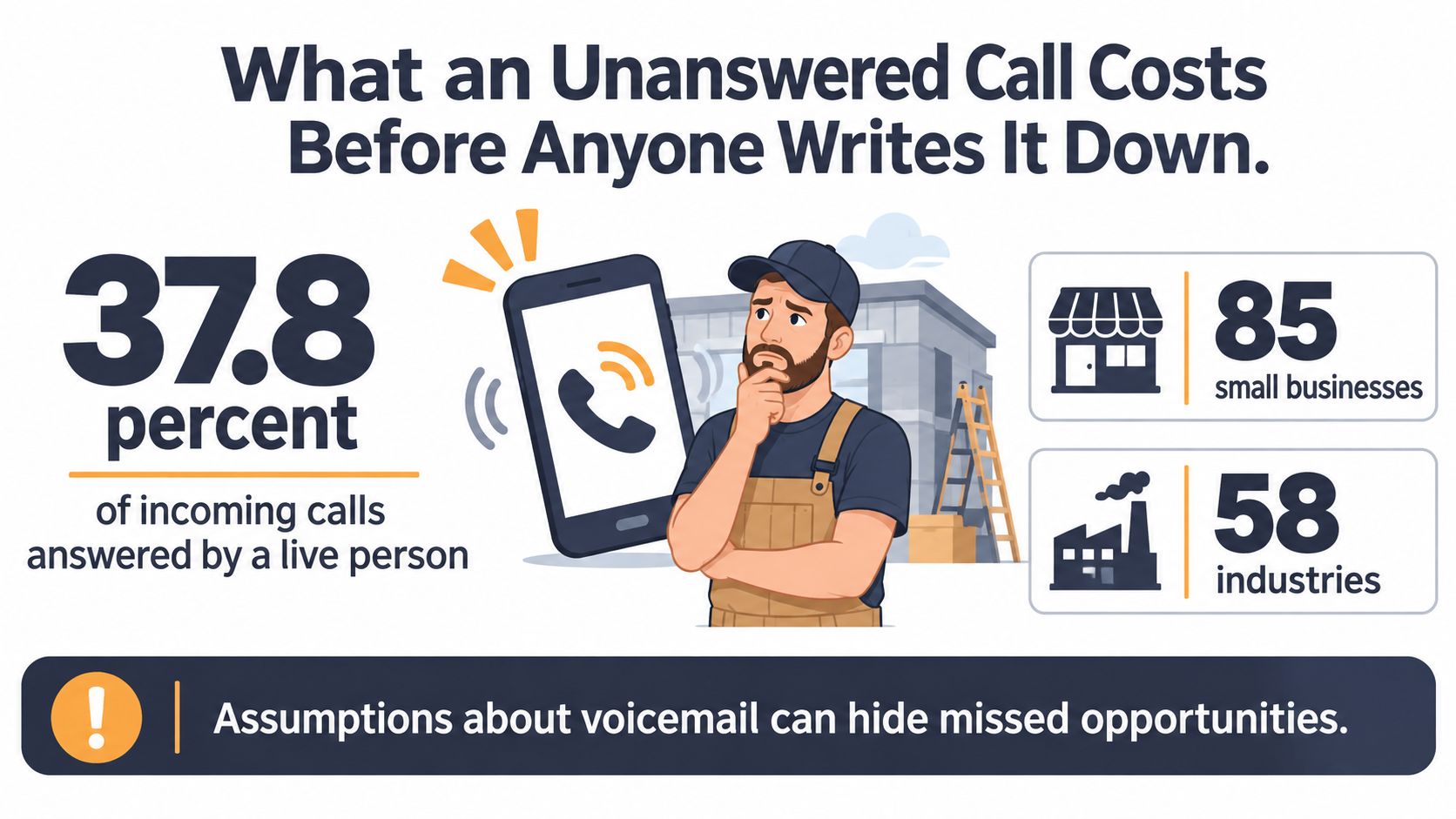
In 2024, only 37.8% of incoming calls to 85 small businesses across 58 industries were answered by a live person, according to 411 Locals' findings on small-business calls. An owner working on a job may assume the caller will leave a message, but answering coverage and usable follow-up are separate problems.
For the same sample, 24.3% of calls received no answer and no voicemail option, according to this account of the 411 Locals findings. These figures describe that sample, not every small business, but they give an owner a concrete reason to check their own line.
The gap between a ring and a task
Say a plumber is under a sink when a landlord calls about another property. The call ends without an answer, nobody captures the address, and the landlord contacts another business before the plumber checks the phone.
Even when something remains, it may not support a callback:
- A full transcript requires the owner to search for the request and deadline.
- A voicemail without a name or callback number may leave no reliable way to continue.
- A vague quote note can omit the location, job type and date the customer needs the work completed.
A note can therefore be present without being useful. If an employee writes only that someone called about a quote, the owner still has to reconstruct the enquiry before deciding whether to accept it.
Operational check: A call isn't ready for follow-up until someone can identify the request and take an assigned next step.
Measure your own missing next steps
Start with your call log, not an assumed revenue figure. Separate unanswered calls from answered calls that produced incomplete notes, then check whether either group received a useful response.
When assessing the cost of missed calls, distinguish a potential enquiry from a confirmed lost job. You won't know what every silent caller wanted, and you shouldn't count every missed ring as a sale.
For one working week, log every unanswered call and mark whether it left a usable next step. That simple review tells you whether you need better answering coverage, better note-taking or both.
How to Write the Summary in Under a Minute
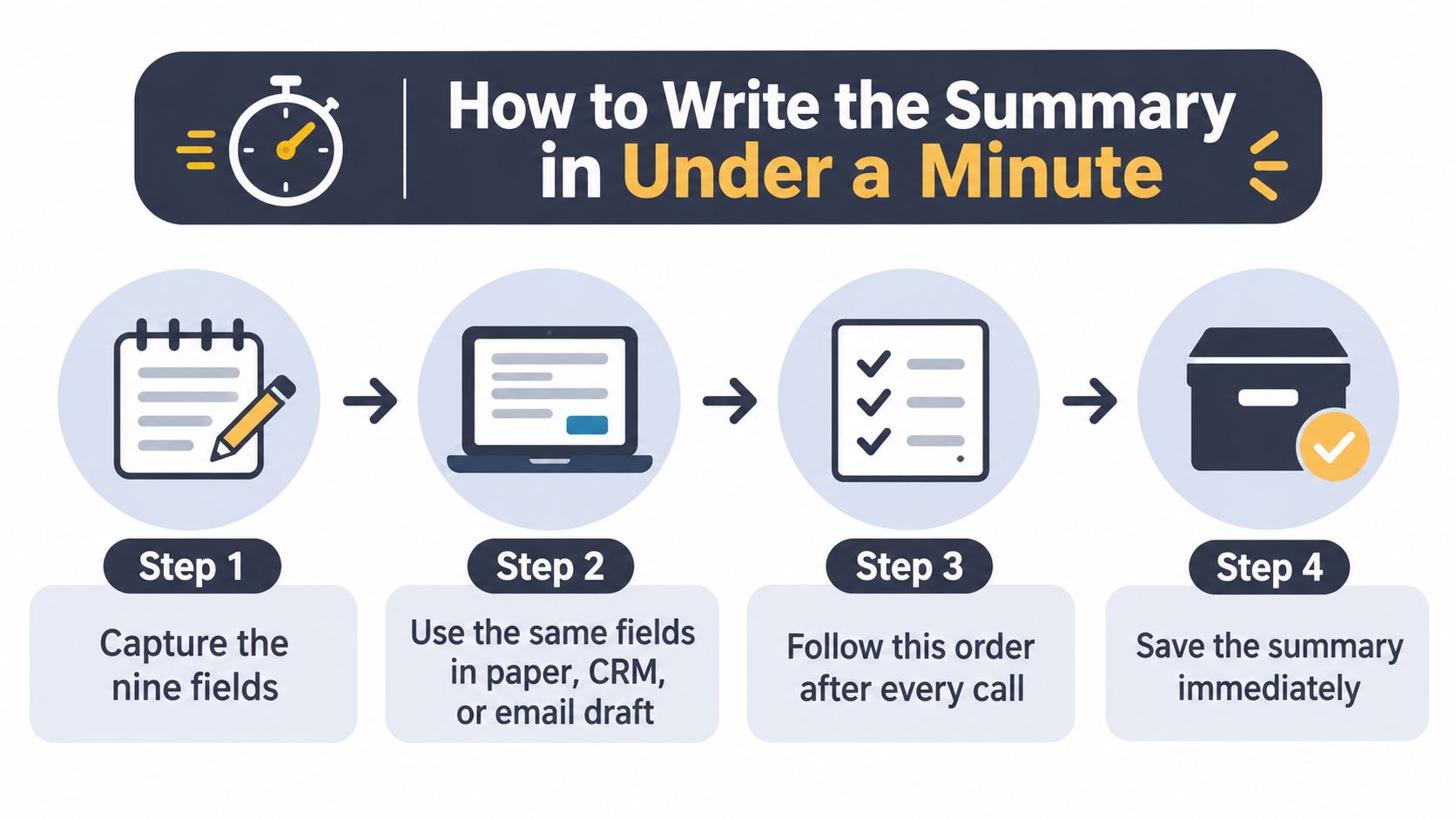
Use the same routine whether you write on paper, in a customer record or in an email draft. Under a minute is a working target for routine calls, not a deadline that overrides accuracy or safety.
Capture details during the conversation, then finish the note immediately afterward. If you wait until the end of a busy shift, you'll have to separate similar enquiries from memory.
Follow the same writing order
- Capture the callback first. Take the number, then the name, and read both back before ending the conversation. Ask for spelling rather than guessing an unfamiliar name.
- Record the spoken language. This tells the next employee how to continue the conversation, even if the internal note is written in another language.
- Use the caller's action verb. Book, move, quote and complain describe different tasks. Write the intent as a direct request rather than a general topic.
- Get the location before troubleshooting. For trades, an address establishes where help is needed and whether the job falls inside your service area.
- Keep the requested window. Write when the caller wants help, not merely when your diary has space. Record any alternative separately.
- Separate commitments from possibilities. Label a booking, quotation or suggestion accurately. Don't turn an amount described as about 200 into a fixed price, or remove qualifiers such as estimate and not confirmed.
- Assign an owner and clock time. A named employee with a callback deadline is actionable. Someone will call isn't.
- Set the verification status. Mark critical details confirmed only after the caller agrees them. Otherwise use unclear, and keep healthcare, legal and safety matters marked needs a person until a human checks them.
- Send or save the note immediately. Put it where the responsible employee works, before another conversation displaces the details.
The promise step prevents overcommitting. The status step prevents uncertainty from disappearing beneath tidy wording. Neither requires a long paragraph.
Copy a compact working template
Callback | Name | Language | Intent | Urgency | Address | Window | Promise | Owner and time | Status
This layout splits identity into name and number and keeps the owner's deadline alongside the owner. It still captures the same information without asking staff to write prose.
A call transcription workflow can supply the words behind the note, but don't paste the whole conversation into the task. Extract the decision-relevant details and preserve access to supporting context only where your retention policy permits it.
Finish with a ten-second read-aloud test. A colleague hearing the note should be able to say who called, where help is needed and what happens next without asking you to explain the conversation.
Sample Summaries for Appointments Leads and Support
Lucia Rossi wants her dental cleaning moved. A freelancer's phone rings with a kitchen rewire. Order 4412 arrived cracked. Water is coming through a ceiling on Mill Road. Four different calls, and each one has to land on a card a colleague can act on in ten seconds.
The volume behind those cards is real. A 2025 survey of 320 SMB owners and managers published through PR Newswire found 55% received between 10 and 100 or more customer calls daily, while 42% estimated losing at least $500 per month from missed calls. Those are respondents' estimates, not audited losses.
Every card below keeps the caller's ask on one line and the business's commitment on another.
Appointment change for a dental practice
Who: Lucia Rossi, Italian, callback confirmed. Ask: Move a cleaning from Tuesday at 9am to Thursday after 3pm, no pain reported. Promise: Alternative slot offered, not booked. Next owner: Receptionist confirms availability and replies by noon.
The requested window decides the whole card. Keep Tuesday's slot until the new one is confirmed, and record "no pain reported" as the caller's own words. Clinical judgment belongs to the practice.
Sales lead for a freelancer
Who: Jordan Hale, callback and email confirmed, postcode inside service area. Ask: Kitchen rewire quote, budget around 2,000 in the caller's stated currency, not confirmed. Promise: Caller will send photos, no binding quotation issued. Next owner: Business owner reviews the photos and emails a preliminary range today.
Treat the budget as context for the quote. Where the currency stays unclear, flag it. Guessing a symbol makes the card look firmer than the call was.
Support complaint for a small shop
Who: Caller for order 4412, callback confirmed. Ask: Item arrived cracked, wants a replacement rather than a refund discussion, caller is calm. Promise: Callback today, replacement not yet authorised. Next owner: Shop manager reviews the complaint, status needs a person.
Calm delivery still earns the complaint flag. The manager needs the requested remedy, a replacement, more than a description of the caller's mood.
Emergency repair for a plumber
Who: Caller at 8 Mill Road, callback captured first. Ask: Water coming through the ceiling, matches the business's emergency list. Promise: Transfer to the technician on call, no arrival time promised. Next owner: On-call technician takes over immediately, side-gate access remains unclear.
Address and callback come first because they make the transfer usable. The active leak leads the card. Greetings, background history and the unverified side-gate detail follow it.
A short note fails when it turns an estimate into a price or hides an emergency.
Sample call summaries by job type
The same format stretches to the calls the cards above leave out:
| Call type | Lock in | Sample outcome | Hand to a person when |
|---|---|---|---|
| New booking | Name, service, preferred window, address | Leak repair slotted for Friday morning | The slot needs a quote or a schedule exception |
| Callback request | Number, best time, subject | Supplier question logged, callback promised before close | The answer is a decision only the owner can make |
| Routine question | What was asked, the approved answer | Opening hours and service area confirmed, no follow-up | The caller disputes the answer or asks about policy |
| After-hours message | Address, callback, urgency check | Job details parked in the morning queue | Anything on the emergency list |
Pick the row nearest your everyday calls and swap the sample details for last week's real enquiry. A colleague should be able to run with the card without ringing the person who took the call.
Let AI Draft the Note and Keep the Hard Calls Human
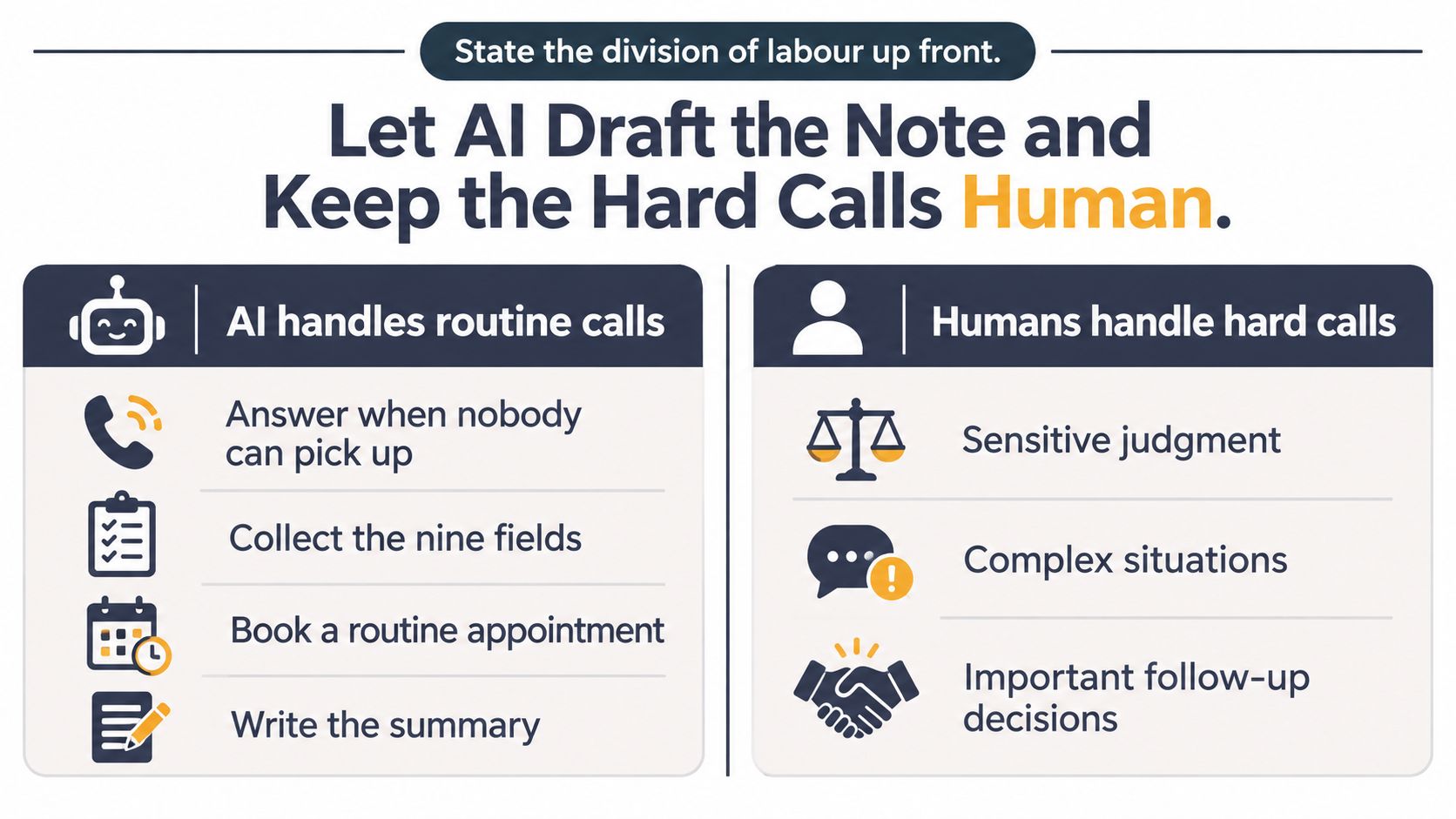
AI is good enough to complement a small team on routine calls. Give it approved information, booking permissions and explicit transfer rules. Keep sensitive judgment, unusual requests and unresolved misunderstandings with a person.
That division respects what callers want. In Intradiem's 2024 survey of approximately 1,100 U.S. customers, 92% considered human agents more helpful than AI agents; respondents primarily wanted shorter waits, faster resolution and access to a person.
Give routine calls a clear finish line
Let an assistant complete tasks within approved boundaries:
- Business information: Explain opening hours and service areas.
- Pricing guidance: Give an approved range without inventing a binding quote.
- Standard appointments: Book permitted slots using the configured calendar rules.
- Callback requests: Collect the details and assign the next step.
A separate 2024 consumer survey reported by Statista found 82% would use a chatbot rather than wait for a representative to take their call. That concerns chatbots, not proof that callers prefer automated voice service, but it supports using automation where the alternative is waiting without help.
Our operating rule is straightforward: the assistant handles the business's common calls and books appointments, and transfers the calls the business has told it to transfer.
Make escalation easy in every supported language
Hand over with the summary attached when the call involves:
- Complaints or refunds: A person checks the remedy and authority to offer it.
- Anger, distress or repeated misunderstanding: Stop repeating the same automated response.
- Medical, legal, payment or safety matters: Apply the business's specialist review rules.
- A request for a person: Follow the configured transfer or callback route.
Use a written sensitive-call handoff policy so employees and the assistant apply the same boundaries. Survey evidence summarised by Unity Connect indicates that more than half of customers support AI detecting frustration and routing complex issues to human agents.
Language support also needs a fallback. In a 2024 survey across selected countries reported by Statista, 59% of Italian shoppers preferred a customer-service agent over an AI assistant, compared with 52% of UK shoppers.
Reply in the caller's supported language, confirm critical names, addresses and times, and write the internal card in the business's configured language. Don't promise reliable handling in any language without testing it; when understanding drops, transfer.
The summary travels with the transfer, or the handoff failed.
Keep the Action and Drop the Rest of the Call
A live conversation, stored audio, a transcript and a summary sent by email or SMS are different records. Turning one off doesn't necessarily stop the others, and a shorter record isn't automatically safer.
Compression can remove an important qualifier or make an incorrect interpretation harder to detect. Keep the context someone needs to act safely, but don't retain unrelated personal conversation because the system captured it.
Separate permission from storage settings
The European Data Protection Board's guidance for small businesses says callers must be informed about recording purposes, recipients, objection rights and access rights when conversations are recorded. Explain the processing you use rather than treating a recording notice as permission for every later use.
If someone refuses recording, don't store the audio. Use an appropriate alternative, such as a human taking a minimal note of information the caller agrees to share, and check the lawful basis for any continued transcription.
Our recording switches control stored audio only: turning off recording doesn't stop the transcript or call summary. Staff need to understand that distinction before answering a privacy question.
What the durable record keeps and what expires
NIST's Privacy Framework recommends incorporating data minimization into audit and log records. Put that principle into a written retention schedule rather than relying on employees to delete records individually.
| Record | What it holds | Retention |
|---|---|---|
| Event record | Timestamp, caller reference, language, outcome, extracted fields, confirmed or unclear flag, edit log | Only for the documented business and legal need, set by your policy |
| Task record | Owner, due time, status, escalation reason | Until the job closes |
| Raw audio | Recording of the call | Delete on a short fixed schedule |
| Long transcript text | Verbose call text | Delete on a set schedule, keep the summary |
Treat these as operating defaults to review against applicable legal obligations, not universal retention rules. Preserve the original event and log corrections rather than replacing disputed details without notice.
Restrict health, legal and payment information to the people who need it. A CRM and phone integration should place the task with its owner without distributing sensitive details to everyone.
Retention rule: Keep information because someone needs it for a defined purpose, not because storage is available.
Sample summaries against permitted source records each month, without restoring audio you've deleted. Choose a documented window for deleting audio, and keep the action note only as long as the open job and any applicable obligations require.
Start Summaries on Calls You Cannot Answer
Start with busy-line and after-hours calls rather than changing every customer interaction at once. You can improve capture without hiring another person, while keeping your existing number and familiar working routine.
Prepare the information the assistant needs before forwarding real enquiries. An empty template won't compensate for unclear service boundaries or an emergency list nobody has written down.
Set up the unanswered-call route
- Keep your current number. Configure forwarding when you're busy, closed or unable to answer on a job.
- Write the operating answers. Set the service area, job types, durations, emergency list and everyday questions.
- Choose the working language. Have the internal note written in the language your team uses, while preserving the caller's language for replies.
- Apply transfer rules first. Name the person responsible for urgent calls and define the fallback when they're unavailable.
rednea provides this handoff for trades, freelancers and small practices: it answers around the clock, handles two callers at once and supports conversations in English, Spanish, French, German and Italian. Every call comes back as a structured email with the caller's name, cell phone number, address and problem description, plus what was booked or promised; the business immediately receives the outcome and next steps.
Test the email before expanding coverage
Place three test calls this week: an appointment request, a quote enquiry and an emergency from your configured list. Ask a colleague to read each resulting email and explain the next action without opening the transcript.
Use the ten-second job-card target to spot clutter, not to excuse omissions. If a field is vague, improve the question list and repeat the test before adding more call volume; test calls count toward your plan's minutes.
---
rednea turns routine telephone enquiries into structured email summaries your team can act on, with appointment booking and rule-based transfers when a person needs to take over. Visit rednea to set up your unanswered-call workflow, then test an appointment, a quote and an emergency before forwarding everyday calls.
Try rednea, no strings attached
AI phone assistant for business. Hear a live demo in your browser, book a call with our team, or get started — from £90/month, cancel monthly, no minimum term.
GDPR-compliant · EU & UK GDPR · Multilingual