Emergency Call Routing Explained: A Practical Guide

A pipe bursts in a bakery at 6am. The owner is in the kitchen, covered in flour, while the phone sends every caller to voicemail. A customer keeps trying, then finally reaches a human at 8:42am, after the worst of the damage has already spread.
That isn't only a missed-call problem. It's a business continuity and customer-trust problem. People need different paths for a genuine 911, 999, or 112 emergency, an urgent property or service issue, and a routine call that arrives after closing. If those paths blend together, callers can face delays, confusing menus, or the wrong person entirely.
The stakes are larger in public safety. The FCC has documented historical cases where wireless 911 calls were routed according to the serving cell tower rather than the caller's exact location, placing calls from several hundred feet to several miles away from the correct jurisdiction. Its record also noted that location needed to reach the network in about five seconds or less, while some wireless technologies took around 15 to 23 seconds to calculate a fix. The IETF emergency-routing record preserves that history.
What Emergency Call Routing Really Means for Your Business
Emergency call routing is the behind-the-scenes process that takes an urgent call, identifies where help is needed, and sends the call to the Public Safety Answering Point, or PSAP, responsible for that location. In plain terms, it's the plumbing that connects the right caller with the right responder without relying on guesswork.
For a small business, three types of calls often get confused.
Three calls that need different treatment
A genuine 999, 112, or 911 emergency involves immediate danger, such as fire, serious injury, violence, or a direct threat. That call shouldn't be trapped in a business menu, interpreted by an automated assistant, or sent to an employee who may be off duty.
An urgent but non-life-threatening call has a different destination. A bakery owner reporting a burst pipe, a tenant locked out of a property, or a customer reporting a failed refrigeration unit may need your on-call person quickly, but not a public-safety dispatcher. A well-configured business phone system can collect the address and problem, then alert the right human.
After-hours overflow is the third path. It includes appointment requests, delivery questions, service updates, and callers who only need a person when the office is closed. The objective is reliable coverage, not treating every missed call as an emergency.
A useful overview of the broader mechanics is this guide to call routing. The important distinction is that ordinary business routing decides which employee or team should answer, while emergency call routing decides which legally responsible public-safety center should receive the call.
One widely cited emergency communications case study reported that about 12% of 192 million annual U.S. 9-1-1 calls were initially routed to the wrong jurisdictional PSAP, with each misrouted call adding an average of 40 seconds to emergency response. The same source reported that location-based routing in Utah from January through March 2023 reduced transfers by nearly 50%, with at least 1,000 fewer transfers per month despite higher call volume. The IETF case study offers a useful historical benchmark.
The two practical questions are simple: what technically happens to the call, and what are you responsible for as the business owner?
The Key Components Behind Every Emergency Call
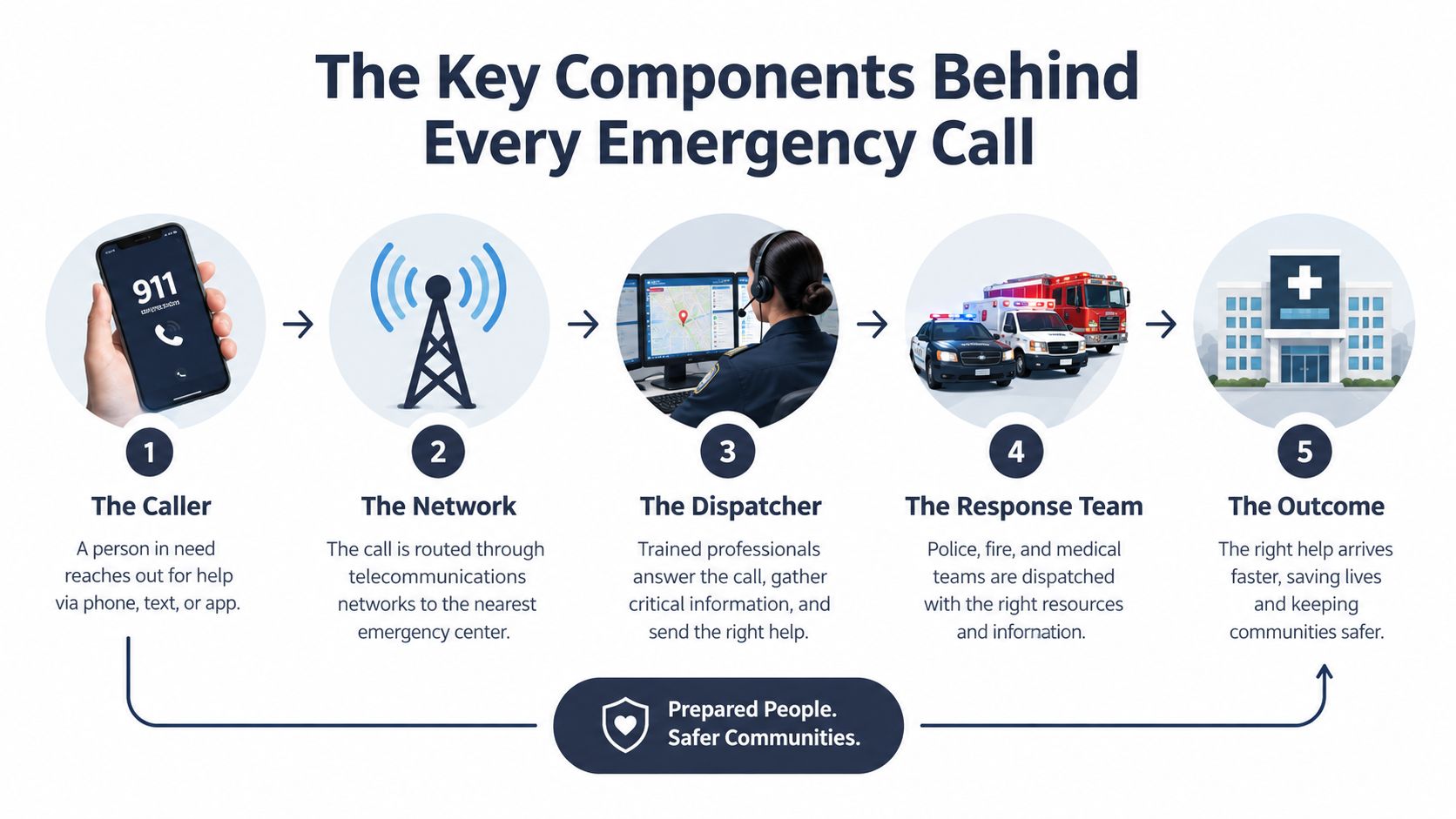
Think of an emergency call as a letter. The caller is the sender, the phone or business network is the post office, the routing database is the sorting system, and the PSAP is the local depot that sends the letter to the right responder.
The process has several roles, but each has a clear job.
1. The caller's device starts the call and may provide location information. A mobile phone can supply network-derived or device-derived location, while a fixed business line usually relies on a registered address.
2. The originating carrier or VoIP provider accepts the call and provides the network connection. For a business, this is the provider that must know which emergency address belongs to each number, device, or location.
3. The location database turns a technical signal into a usable location. A Location Information Server, or LIS, stores or retrieves location information associated with the caller. For a VoIP line, that may be a dispatchable address such as a building, floor, suite, or warehouse.
4. The routing lookup asks which emergency service covers that location. The Emergency Call Routing Function, or ECRF, answers that question by mapping civic or geographic location to the correct PSAP address.
5. The delivery proxy forwards the call. An Emergency Services Routing Proxy, or ESRP, acts as the incoming network proxy for a group of PSAPs and sends the call to the selected center.
6. The terminating PSAP receives the call, confirms the incident, and coordinates the relevant police, fire, or medical response.
Why the ECRF and LIS matter
The LIS and ECRF are the critical pairing. The LIS supplies the location, and the ECRF uses that location to identify the responsible emergency service. The nearest PSAP isn't always the correct PSAP. Jurisdiction, service boundaries, and the registered address determine responsibility.
The IETF framework describes this location-to-service process and also allows a default PSAP URI when location isn't available, helping preserve service continuity rather than dropping the call. RFC 6443 explains the architecture in technical detail.
European guidance separates the same responsibilities. The ESRP forwards the call, while the ECRF determines which service is available at a given location and supports routing to the appropriate responder organization. ETSI's NG112 guidance also makes clear why accurate location records matter.
For most SMBs, the provider owns and operates the ESRP, ECRF, and LIS. Your responsibility is to supply accurate locations and verify that the provider has configured them correctly.
How a Call Actually Travels From Phone to Responder
The same basic decision appears across mobile, landline, and VoIP calls. The network receives the call, obtains or looks up location, and uses that location to select the responsible PSAP.
Mobile caller
A mobile call starts with the device and carrier. The network receives available location information, such as a network estimate or location data delivered through the emergency framework.
The location service then provides that information to the routing function. The ECRF maps the location to the PSAP jurisdiction, and the network delivers the voice call with the available location data attached.
Landline caller
A fixed line usually has a registered civic address associated with the number. The routing process can therefore work like a database lookup, provided the address is current and the line is still installed at that location.
That simplicity can be deceptive. If a business moves the line, changes rooms, or uses a number at a second site without updating its emergency record, the database may still point responders to the old address.
VoIP or hosted PBX caller
A VoIP provider needs a registered dispatchable location for the number or endpoint. The ECRF uses that location to select the PSAP. It does not rely solely on the area code, nor does it assume that the nearest call center is legally responsible.
| Step | Mobile caller | Landline caller | VoIP / hosted PBX caller |
|---|---|---|---|
| Location source | Device and network location | Address linked to the fixed line | Registered dispatchable location |
| Routing lookup | Coordinates or location record are mapped | Address record is mapped | Provider location is mapped |
| PSAP choice | Location determines jurisdiction | Registered address determines jurisdiction | Dispatchable address determines jurisdiction |
| Main business risk | Weak or unavailable location data | Stale address records | Unregistered site, floor, or endpoint |
The decision point is the ECRF choosing the PSAP. In a properly functioning system, that lookup is designed to happen rapidly, but a business shouldn't treat speed as proof that the configuration is correct.
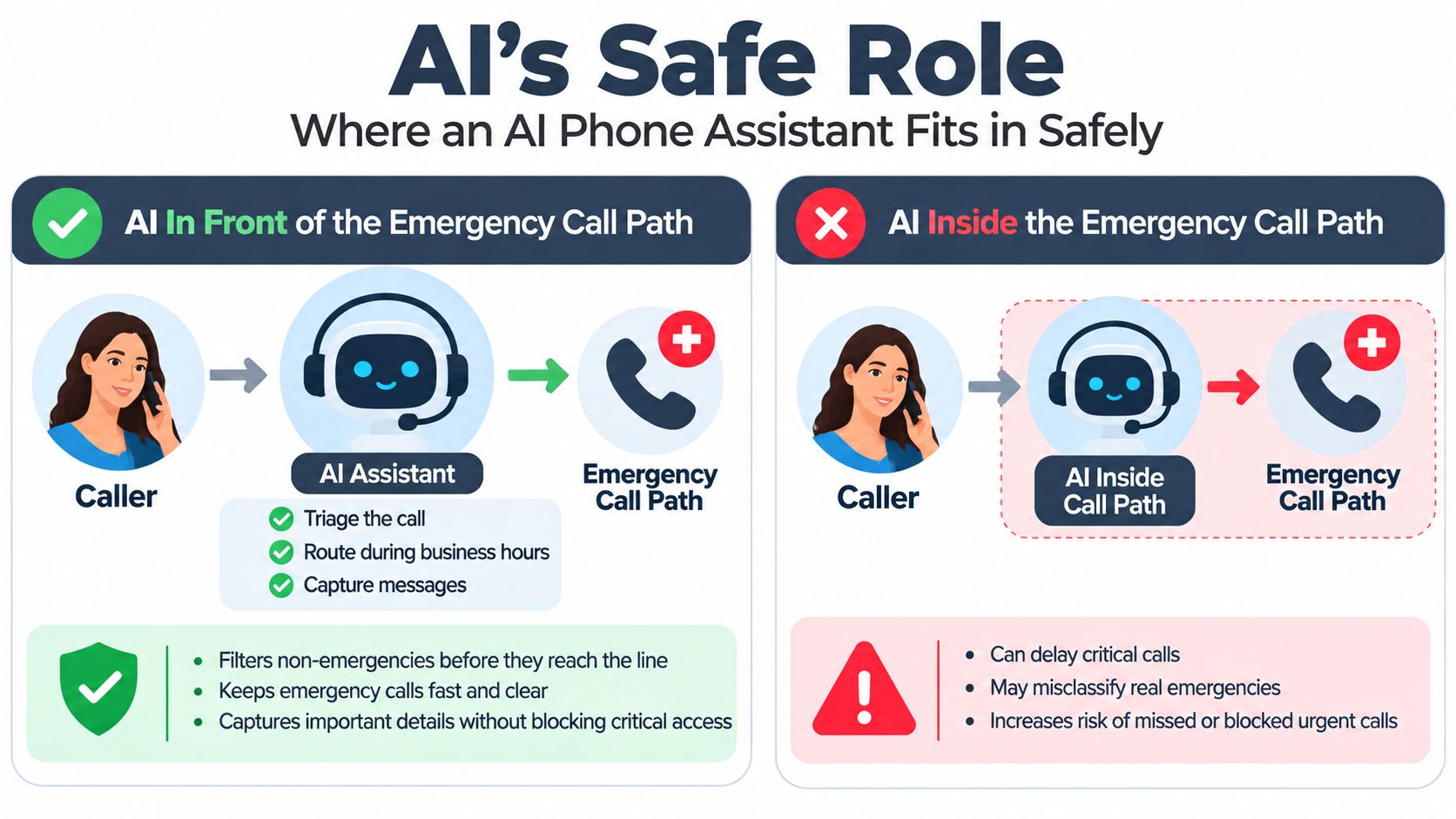
An AI assistant or auto-attendant belongs outside this emergency path. It can route ordinary incoming calls, but it must hand off a genuine emergency before the call is intercepted by menus or business logic. For a broader explanation of business-side routing, see this introduction to incoming call routing. For readers evaluating mobile dispatch tools, 3rd-i's explanation of dispatch app limits provides useful context on why an app doesn't replace the underlying emergency network.
The Rules and Regulations Businesses Need to Know
Emergency rules aren't one single checklist. They divide responsibilities among the communications provider, public-safety authority, and business using the phone system. Your exact duties depend on the country, state, building type, provider, and whether the system is fixed, mobile, VoIP, or a multi-line telephone system.
Four responsibility lanes
Carriers and mobile operators handle network delivery and location mechanisms within their regulated role. Their systems must support emergency access and cooperate with the public-safety routing environment.
VoIP and unified communications providers handle emergency enablement, address registration, location delivery, and provider-side routing. Businesses should ask how the provider validates a new site, how it handles multiple floors or buildings, and what happens if location is unavailable.
PSAPs and public-safety authorities receive emergency calls, verify the incident, and coordinate responders. Their boundaries and service rules determine which center is responsible for a location.
The business maintains the information that providers rely on. That includes new office addresses, warehouse locations, dispatchable details, on-site notification contacts, and staff training.
In the United States, owners and IT teams commonly encounter Kari's Law, RAY BAUM's Act, FCC 988 requirements, and state-level rules for multi-line telephone systems. Kari's Law is associated with direct emergency dialing, while RAY BAUM's Act is associated with dispatchable location. In Europe, useful reference points include E112, ETSI TS 103 479, and the European Electronic Communications Code provisions concerning handset-derived location.
| Player | Main obligation | Key rule or standard |
|---|---|---|
| Carrier or mobile operator | Carry emergency traffic and support location delivery | National emergency communications rules |
| VoIP or UCaaS provider | Enable emergency calling and map registered locations | E911, E112, and provider obligations |
| PSAP or public-safety authority | Receive calls for its jurisdiction and dispatch responders | Local PSAP boundaries and procedures |
| Business owner | Maintain addresses, notifications, and staff readiness | Kari's Law, RAY BAUM's Act, state or national rules |
A practical technical overview of E911 VoIP needs can help an owner prepare questions for a provider. Privacy also matters because location and call records can identify people and workplaces. Keep emergency records controlled and documented, using a GDPR compliance checklist where European data protection obligations apply.
Rules differ by country and state, so a quick check with your telephony provider is the fastest way to confirm local duties.
Where Emergency Call Routing Goes Wrong
Most failures aren't exotic. They happen when a small configuration change doesn't reach the person or system responsible for updating emergency information.
Five ordinary failure stories
A plumbing company opens a warehouse and keeps the same hosted phone system. Nobody tells the provider about the new address, so a call from the warehouse still points toward the original office.
Root cause: the registered emergency location is stale. Fix: assign an owner for every location record and update it before staff use the new site.
A receptionist dials 911 from a desk phone, but the PBX treats the number as an outside call requiring an extra prefix. The emergency call never enters the correct route.
Root cause: the dial plan blocks or misroutes direct emergency dialing. Fix: verify direct dialing on every relevant phone and test the exact desk-phone experience.
A worker calls from a warehouse extension. The system sends the company's head-office address, not the warehouse's dispatchable location. Responders reach the right business but the wrong building.
Root cause: the endpoint and emergency location aren't mapped together. Fix: link each site, floor, suite, or operational area to the correct emergency record.
A carrier trunk fails during a maintenance incident. The business line produces a busy signal, and the caller assumes help is on the way.
Root cause: no tested failover path exists. Fix: ask the provider what happens during an outage and document the backup calling method.
An AI auto-attendant hears words such as “fire” or “police” while screening spam. It keeps asking questions instead of transferring the caller.
Root cause: automation has been placed inside the emergency path or given unclear escalation rules. Fix: create an immediate emergency bypass with no menu loop, interpretation delay, or silent queue.
Practical rule: Treat every address change, phone-system change, and AI prompt change as an emergency-routing change until someone verifies otherwise.
Routine drills expose these problems while the consequences are still manageable. A test should include the physical location, the exact number or extension used, the provider's approved test method, and the people who need to receive an internal alert.
A Practical Implementation Checklist for SMBs
Start with a policy your team can understand and paste into its runbook:
Any caller reporting fire, medical danger, crime, or an immediate threat is transferred directly to 112, 999, or 911, with no menu, IVR loop, or AI interpretation delay.
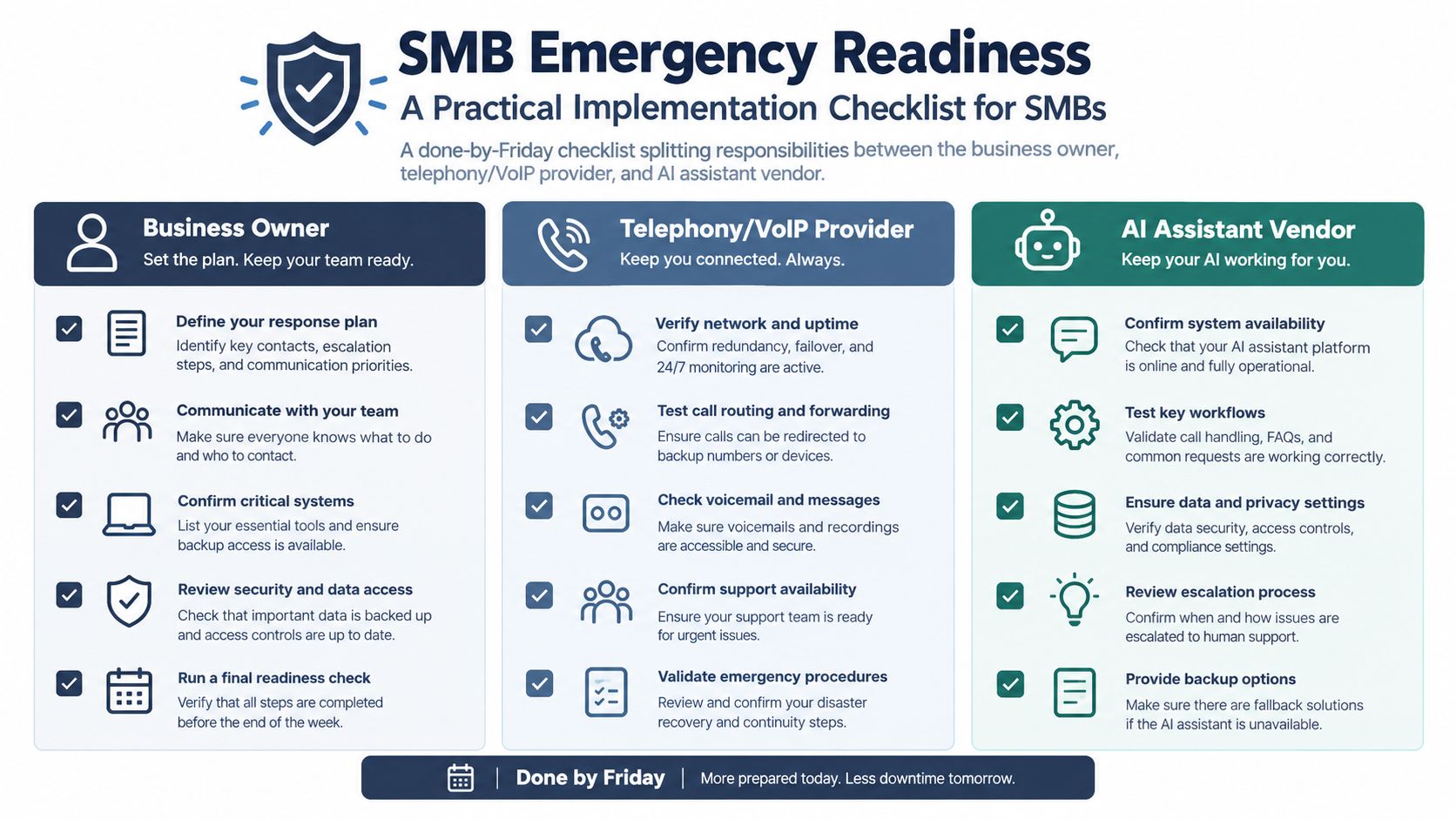
The policy is only useful when each party knows what it owns.
Business owner actions
- Map every location: Record the civic address and dispatchable details for each office, shop, warehouse, clinic, or remote site.
- Keep the address visible: Post the civic address where staff can read it quickly, especially near desk phones and shared work areas.
- Train employees: Show staff what happens when emergency services are dialled from a desk phone, including how to state the site, floor, suite, and callback number.
- Control changes: Make address, number, endpoint, and call-flow changes subject to a named review.
Provider actions
Ask the telephony or VoIP provider to confirm that emergency calling is enabled on every relevant DID, extension, and site. Request validation of the emergency response location with the appropriate PSAP or approved test process.
Use the provider's test number or test procedure, not a live emergency call. Ask what information reaches the PSAP, how failover works, and how the provider handles an unavailable location record.
AI vendor actions
The AI vendor should publish the exact handoff logic, document which words or phrases trigger immediate transfer, and explain whether emergency calls are recorded. The vendor should also state whether it can pass the caller's name, callback number, address, and problem description to an on-call person without delaying public-safety access.
A practical schedule keeps the work alive:
1. Run a provider-approved call test quarterly. 2. Run a full staff and escalation drill annually. 3. Repeat verification whenever a number, address, endpoint, carrier route, or AI prompt changes.
The safest design places AI before ordinary business routing, not inside the public-safety route. It can help a team handle urgent service calls, but it can't turn a business assistant into a substitute for emergency infrastructure.
Where an AI Phone Assistant Fits in Safely
An AI phone assistant should sit in front of the business call flow, never inside the emergency call path. That position lets it answer routine calls, collect information, and escalate business urgency without becoming a gatekeeper between a genuine emergency caller and public-safety services.
It can handle a burst pipe, a locked-out tenant, an urgent appointment request, or a refrigeration failure. It can ask for the site address, identify the caller's language, notify the on-call employee, and send a concise summary. It must detect language indicating fire, serious injury, violence, or an immediate threat and transfer immediately to a human or dial 112, 999, or 911 according to the approved workflow.
Guardrails that should be visible
- Emergency bypass: Known emergency numbers and emergency phrases skip normal menus.
- Voice and keypad triggers: The caller can say an emergency phrase or use a DTMF option without waiting through a long prompt.
- Clear disclosure: The caller knows they're speaking with an automated system.
- Continuous supervision: Someone responsible for the business can review escalations and failed handoffs.
- Location confirmation: The assistant can confirm a business address, but it mustn't pretend that confirmation replaces provider-side dispatchable location.
- Human fallback: If the system can't classify the call confidently, it escalates rather than guessing.
For a plain-language overview of this category, see what an AI phone assistant does.
AI is already being used mainly as a complement to people. A 2026 roundup reports that 72% of companies worldwide use some form of AI in customer service, compared with 58% in Europe. It also reports that 64% of companies using AI rely on generative AI to draft responses and 57% use automated ticket routing. The customer-service statistics roundup supports a practical conclusion for SMBs: start with triage, drafting, routing, and escalation before attempting full automation.
A separate 2026 report says 75% of consumers support agents using AI to draft responses, while 74% expect service to be available around the clock. The customer-service statistics article also describes projections around autonomous resolution of common issues. Those figures don't justify removing humans from emergency decisions. They support using AI for coverage and preparation while keeping a real person and public-safety route available.
Next Steps and What to Verify This Week
Start on Monday with the records, not the software.
Verify that the registered emergency address matches the physical location for every number, extension, and site. Check whether the VoIP provider passes caller location through to the emergency network, confirm that on-call escalation numbers are current, and review the AI assistant's rules for words associated with fire, medical danger, crime, and threats.
Then replay at least one missed or after-hours call from the prior week. Ask whether the caller reached a person, whether the message contained enough context, and whether the escalation went to the right employee. That exercise often reveals ordinary business-routing gaps before they become customer-trust problems.
Use this short action list:
- Address check: Assign one person to own each emergency location record.
- Provider check: Arrange an approved test of the outbound emergency route.
- AI check: Read the actual emergency handoff logic, including fallback behavior.
- Escalation check: Call the on-call numbers and confirm that someone answers.
- Staff check: Give employees a printed fallback contact list and site-address instructions.
- Drill check: Schedule quarterly tests with staff and the telephony or AI vendor.
AI can make a small company more reachable in every language customers use. It can detect language, answer routine questions, draft useful summaries, and alert the right person. It can't compensate for a stale address, an untested provider route, or an assistant that delays a genuine emergency.
Make emergency call routing a named operational responsibility this week. Then use AI for the calls it can safely improve, while preserving a direct, tested path to real people and public-safety services.
---
rednea helps small businesses stay reachable around the clock with an AI phone assistant that answers routine calls, identifies urgency, supports English, Spanish, French, German, and Italian, and escalates important calls to the right person. Review how it can fit beside your emergency call-routing safeguards and visit rednea to get started.
Try rednea, no strings attached
AI phone assistant for business. Hear a live demo in your browser, book a call with our team, or get started — from £90/month, cancel monthly, no minimum term.
GDPR-compliant · EU & UK GDPR · Multilingual