Answering Service for Electricians: 2026 Guide


You're halfway through a consumer-unit change when your phone starts ringing. You can't safely stop, answer questions about another property, and check the diary while you're working. By the time you're free, the caller may have found someone else.
An answering service for electricians should cover that gap without pretending to be an electrician. AI can greet the caller immediately, work in a supported language, collect useful details, and book routine work. A person still owns hazards, diagnosis, quotes, and anything the software doesn't understand.
What Missed Calls Cost an Electrical Business
A missed call never appears as a line item in your accounts. It appears later, as a gap in next week's diary and a customer who has already phoned someone else. Answering live means breaking off safe work, so the practical response is to give every caller a useful first contact while your hands and attention stay on the task.
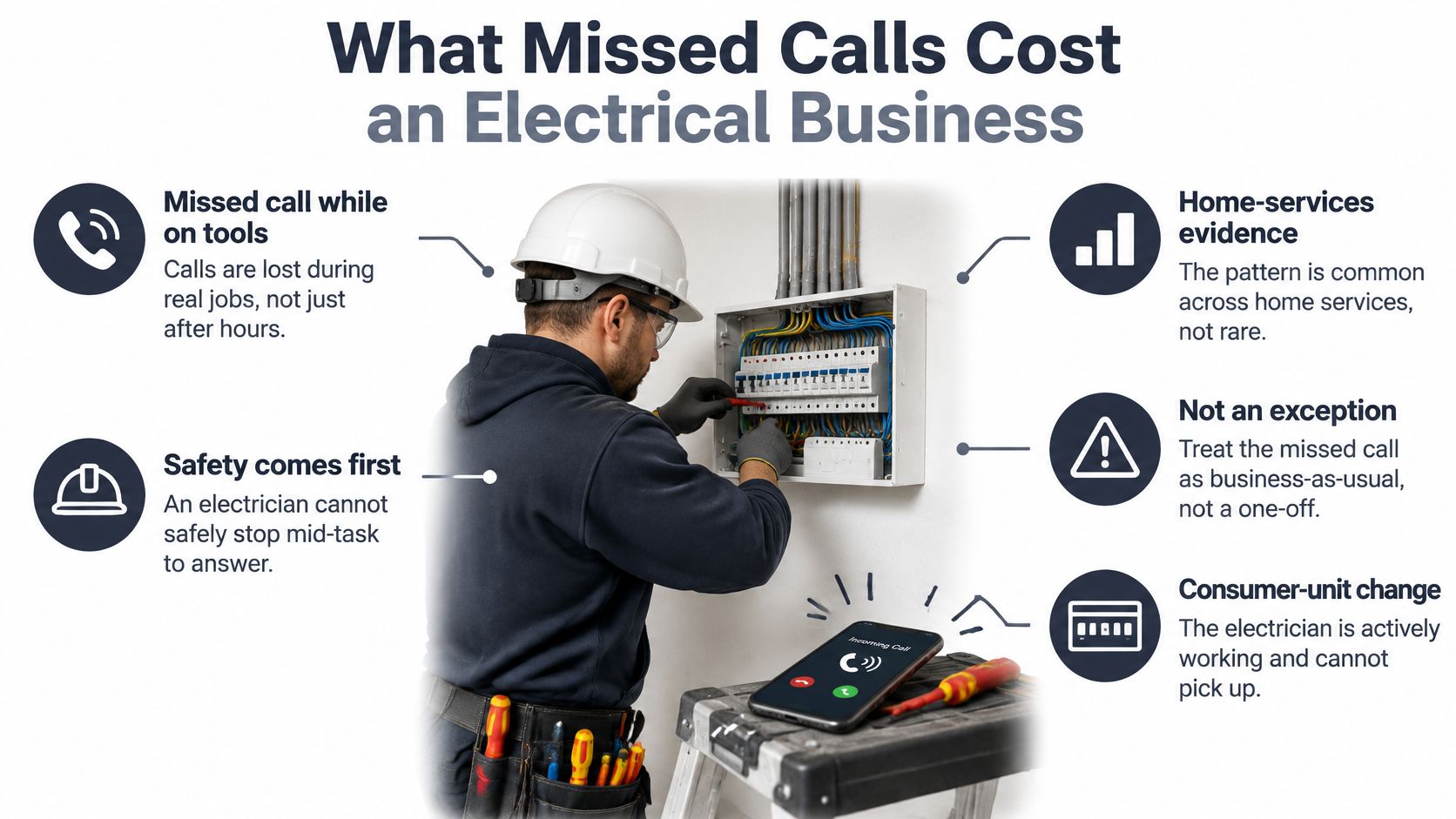
What callers do when nobody answers
Unanswered calls and caller behaviour track like this across the published home-services benchmarks.
What happens when a home-services call is not answered, per Centro CDX's home-services missed-call analysis of Invoca and CallRail data
| Benchmark | Figure | What it covers | Source |
|---|---|---|---|
| Calls not answered | 27% | Calls to home-service businesses | Invoca, 2024 |
| Missed-call rate | 14% | Benchmark covering 1.1 million leads across seven industries; rate shown for home services | CallRail, 2025 |
| Took business elsewhere after no answer | 78% | 1,000 U.S. consumers | CallRail, 2025 |
| Would call a competitor if unanswered | 82% | Same U.S. consumer survey | CallRail, 2025 |
| Would leave a voicemail | 42% | Same U.S. consumer survey | CallRail, 2025 |
These are home-services and consumer benchmarks, not an electrician-only conversion forecast. The two missed-call figures come from different datasets measured a year apart, so they shouldn't be combined into a single expected rate for your firm.
The narrower conclusion is what matters day to day: voicemail is not a dependable recovery plan. Fewer than half of the consumers in CallRail's survey said they would leave a message, so an intake built on callbacks loses most of the people who couldn't get through.
Put your own job values against the gap
Start with your call log rather than an industry revenue estimate.
Missed calls in a typical week × share that were genuine job enquiries × your average job value = potential job value exposed.
Each factor comes from your own records. The call log supplies the missed calls. Quote and invoice history supplies the average job value. Your recovered callbacks and completed jobs show how many enquirers were real, since some will try again, some sit outside your territory, and some would have gone to a competitor anyway. Treat the result as exposure, not guaranteed lost revenue.
Keep repeat calls from the same customer separate so you don't count one opportunity twice. The cost of missed calls for UK businesses works as a budgeting lens, and your own call history decides the purchase.
Owner-operators and small crews feel this gap most directly. You are driving, working at height, or inside a customer's property rather than sitting beside a switchboard. The job of coverage is to answer immediately in the caller's language and book the routine work, then hand hazards, diagnosis and quotes to the person qualified to do it.
Which Answering Model Fits a Small Crew
For a small electrical firm, AI first with an on-call electrician behind it is a sensible default. Routine callers get an answer without hiring a receptionist, while technical judgement stays with your team.
Judge the service by whether it treats a lighting enquiry differently from a report of smoke near a panel. That split, routine work booked automatically and hazards passed to a person, is what makes coverage safe rather than fast.
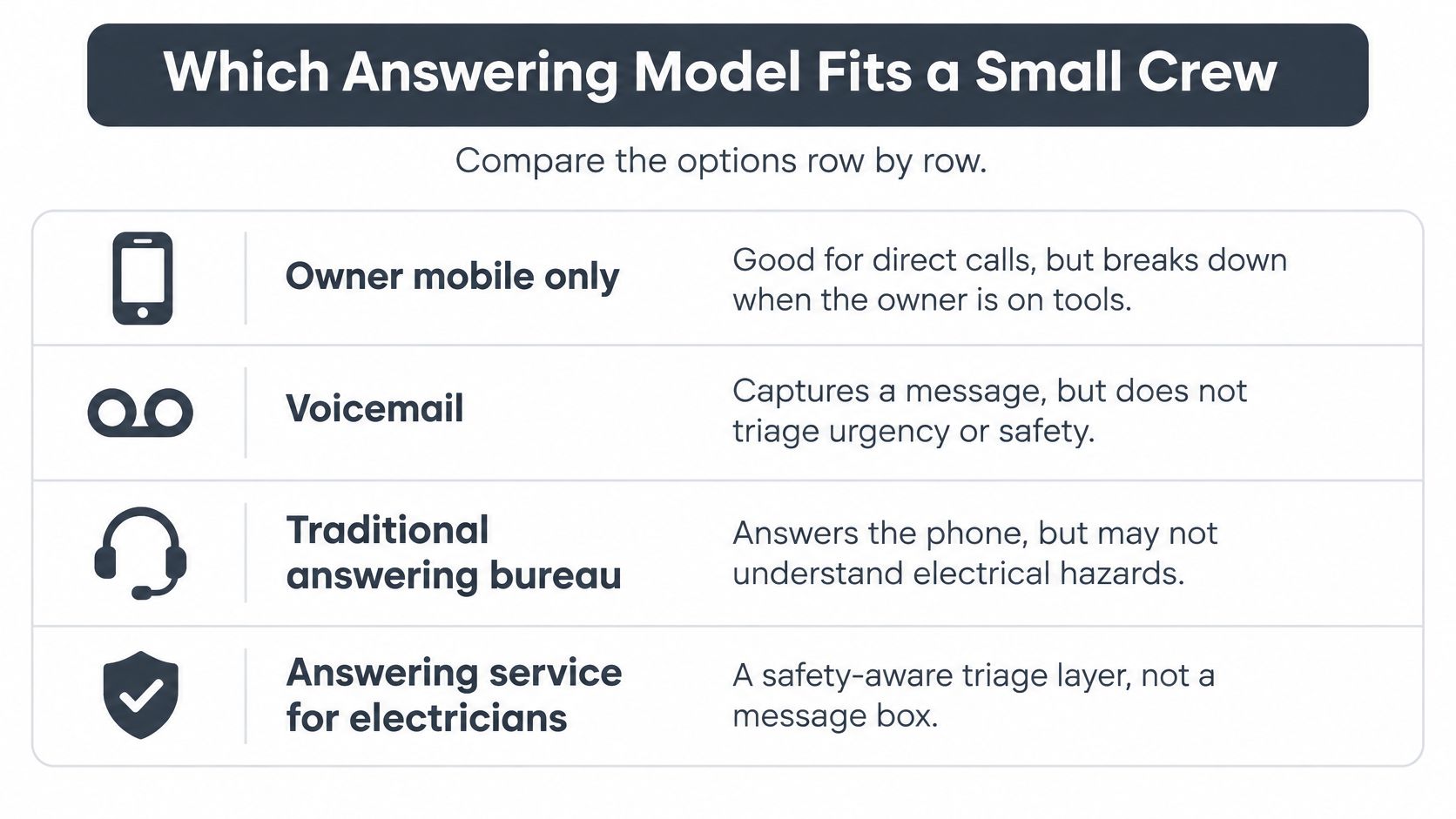
Compare the work each model actually does
Answering models for a small electrical firm
| Model | Who answers | Job booking | Emergency path |
|---|---|---|---|
| Owner mobile only | The electrician, if free and safe | Only when they can stop work | Only if they pick up |
| Voicemail | Nobody on the live call | No | Delayed, if a message exists |
| Traditional answering bureau | A human agent following a script | Message, or basic booking if scripted | Scripted transfer to on-call |
| AI phone assistant | Software with human escalation | Yes, into open calendar slots | Immediate triage, then transfer; no remote diagnosis |
| Hybrid AI plus on-call electrician | AI first; a person for hazards, quotes, and exceptions | Yes for routine work | Human for smoke, sparks, burning smell, water near electrics, exposed conductors, or medical power loss |
The owner's mobile offers direct expertise but no dependable coverage while you're on tools. Voicemail records whatever the caller chooses to leave, without asking follow-up questions, so a caller who says "the lights are flickering" gets the same treatment as one who says "the fuse box is hot."
A bureau adds a live person, but that person still needs an electrical intake script. An AI assistant can follow the same approved intake consistently and write bookings into open slots, provided its calendar permissions and escalation rules are configured. The difference shows up at 9pm on a Sunday: scripted agents take messages, while a configured assistant can complete the booking and send a summary for morning follow-up.
The hybrid adds the missing decision-maker. It doesn't require the electrician to handle every routine question.
Separate intake from technical judgement
A safety-aware service should distinguish routine work from urgent symptoms before offering an appointment, then escalate rather than diagnose remotely. The service's job is to capture what the caller observed in their own words and route it correctly. Whether a consumer unit is dangerous is a question for the electrician on site, never for software on the phone.
Configure routing around intent, severity, location, operating hours, technician availability, and service territory. A keyword alone isn't enough. A caller mentioning a spark yesterday needs follow-up questions about what's happening now, not an automatic promise of an emergency visit.
Software can greet callers, detect their language, and handle emergency requests, appointment bookings, or general policy questions. Confirm the provider's supported languages before promising service in any language.
Buying rule: Choose the service by its handoff behaviour. A natural-sounding greeting proves nothing about what happens when someone reports burning smells.
Use the answering service, virtual receptionist, and AI comparison to clarify responsibility before signing. Ask who receives an urgent transfer, what happens if they don't answer, and what the caller hears next.
Booking Dispatch and Messages That Matter
Start with three intents: emergency request, appointment booking, and general question. General questions should cover approved information such as service area, opening arrangements, and call-out policy, not improvised technical answers.
After-hours and weekend calls represent roughly 30% to 40% of inbound volume for service businesses, according to Writly's missed-call review. That's a broad service-business estimate, but it makes closed-office handling worth testing rather than treating it as an extra.
Give the installer this intake order
Run a brief hazard check before routine booking. Once the call is suitable for scheduling, collect:
- Caller name: Record who you're speaking to.
- Callback number: Confirm the number rather than relying solely on caller ID.
- Service address and postcode: Read them back.
- Territory check: Establish whether the property is inside your working area.
- Property type: Capture domestic, commercial, rented, or another relevant category.
- Observed problem: Save what the caller noticed in their own words.
- Urgency: Record the circumstances, not just their preferred appointment speed.
- Preferred window: Offer availability from the live diary.
- Access constraints: Include parking, locked gates, entry arrangements, or site contacts.
- Confirmation permission: Ask whether text or email is suitable.
Panel type, approximate property age, and photos can help prepare a visit. Collect them when the caller already knows the answer or the channel supports attachments. Don't ask someone to approach electrical equipment or refuse a booking because they don't know a panel brand.
Make the handoff readable
The calendar hold must make the slot unavailable to another caller. If the booking system can't confirm the hold, label it as a request awaiting confirmation rather than telling the customer it's booked.
Send a short email, with optional SMS notification, containing the intake fields and the caller's original symptom description. The electrician shouldn't have to replay a recording to find the address or discover that access requires a site manager.
For multilingual intake, continue in the detected language only when the assistant supports it reliably. Repeat the address and symptom before saving, preserve the original wording beside the summary, and transfer if regional terminology makes the meaning uncertain.
Offer text or email confirmation to callers who find voice calls difficult. Slow the read-back for hearing, speech, or cognitive-access needs. If read-backs disagree twice, stop guessing and transfer for human clarification.
Call Scripts for Hazards and Routine Jobs
A burning smell behind a consumer unit at 7pm leaves no time to improvise. A good script gives whoever answers fixed wording for the first minute and a hard rule for where it stops. Risk-aware intake means selective escalation and a written handoff: the script gathers facts and triggers the right response, while hazards, diagnosis and prices stay with a person.
Speed still decides whether the caller stays. In Scorpion's 2023 U.S. consumer survey, 90% of respondents expected a response to a home-services inquiry within 24 hours, and 52% expected a same-day response. Start the appropriate script as soon as the call is answered, because an acknowledged caller waits while an ignored one rings the next name on the list.
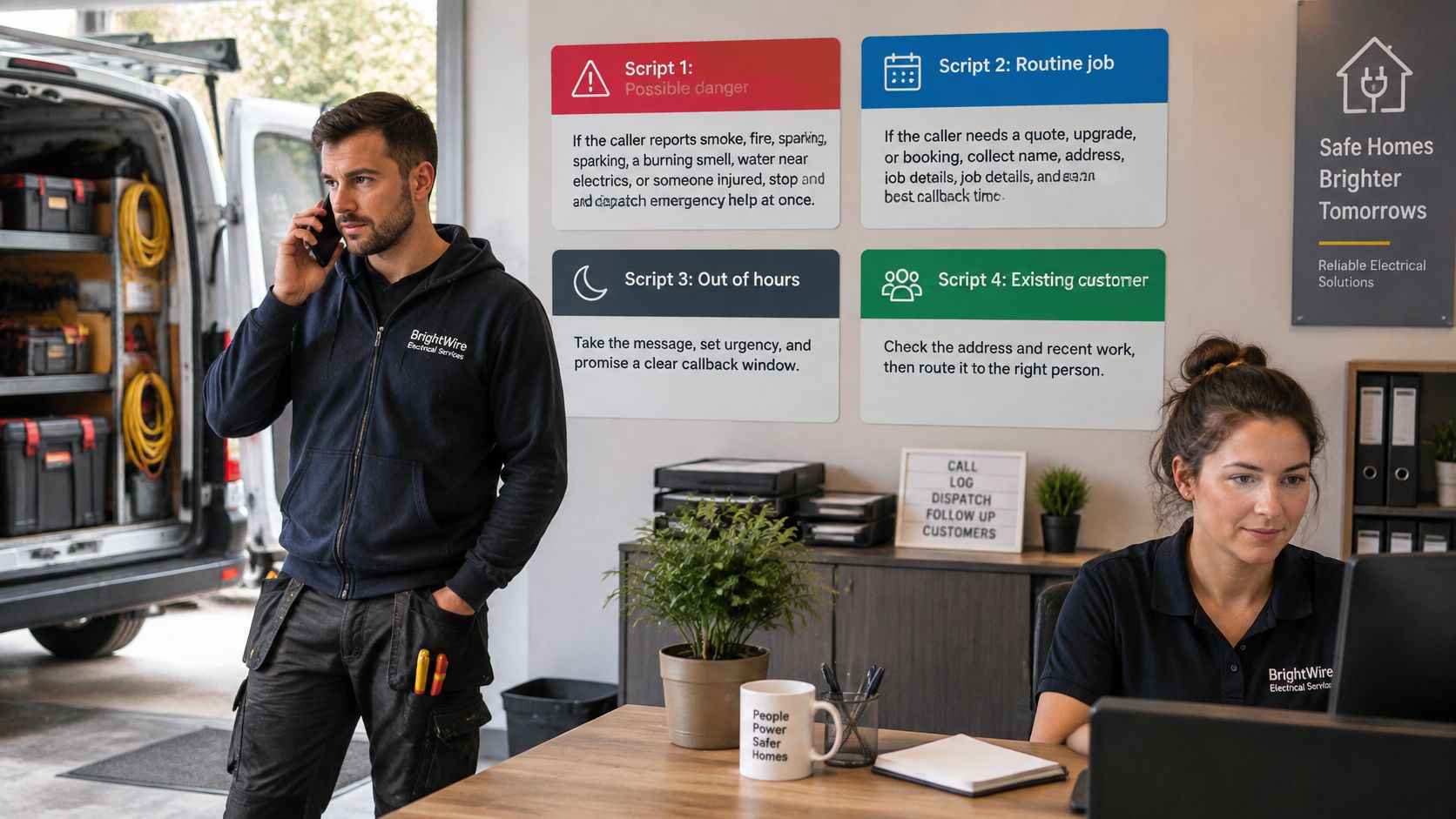
Possible danger
Use when the caller reports smoke, fire, sparking, a burning smell, water near electrics, a damaged utility line, or someone at immediate risk.
Suggested wording: There may be an immediate electrical danger. Keep clear of the affected equipment or line. Contact emergency services if anyone is at risk or there's fire or smoke; contact the utility provider for a damaged utility line. Don't delay that call while waiting for us. If it's safe to continue, what's the property location and your callback number?
Record the report and transfer to the on-call electrician. Never delay emergency contact to complete intake, and never offer troubleshooting on a hazard call.
Urgent without a reported active hazard
Use for repeated breaker trips or total power loss when no active hazard has been reported.
Suggested wording: I'll pass this to the on-call electrician for assessment. What's the address, what have you observed, who's on site, and which number should they call? Is anyone relying on powered medical equipment?
Escalate medical-equipment power loss as safety-sensitive. The script ends there: no likely-fault explanation, and no instruction to keep resetting a breaker.
Routine booking
Suggested wording: I can help arrange a visit. I'll collect the job details and access arrangements, then check an available window. Before confirming, I'll read back the address and appointment time.
The wording matters at the boundary. A quote visit fixes a time to inspect the work, and the price follows once the electrician has seen it. An appointment window sets the arrival target, so the caller knows what happens if the crew is running late.
Another language or uncertain meaning
Suggested wording, delivered in the supported language: I can continue in your preferred language. I'll repeat the address and what you've noticed so we can check the details. If I'm unsure, I'll connect you with a person.
Write each version in the languages your service supports and have a fluent speaker check them once. A translation that shifts the meaning of "sparking" or "burning" fails on the calls that matter most.
When the call is a hazard, automation stops and a person takes over. The useful behaviour is refusing remote diagnosis, escalating selectively, and leaving a written handoff the electrician can act on.
Set the backup path using a clear escalation call-handling process, so the script knows who receives a hazard call at 7pm and who covers when they are on a job. Read each script aloud once and cut any line that sounds like a diagnosis.
What Electricians Should Expect to Pay
You are halfway through a consumer unit when the phone rings. Budget for the calls you receive. A quiet installation business and a service crew handling outage enquiries will use different amounts of answering time.
A telephone invoice is only part of the cost. Answering calls yourself uses working or evening time. Outsourcing still leaves your team responsible for the calls that need judgement.
Compare payment patterns
Once you know which coverage model fits, ask the provider to price your estimated usage in writing. The important questions concern what the meter counts.
Ask whether transferred calls, hold time, setup, messages, and unused allowance affect the bill. Find out whether a call transferred to your on-call electrician is billed once, twice, or at a different rate. Those details change the cost more than the advertised entry price.
Build a usable minute estimate
- Count normal and busy-week calls. Separate a typical working week from a storm or outage week. Remove obvious spam and identify repeat callers.
- Multiply each call category by its realistic handling time. Start with three minutes per booking call and replace it with the average from your test calls. Allow longer for conversations involving transfer.
- Include closed-office demand. If your count covers daytime only, add evenings and weekends from your call log. Do not add them again if they are already in the total.
- Price human transfers separately. Hazards, technical questions, complaints, and quotes still consume somebody's time after the assistant finishes intake.
For a small or medium-sized firm, useful coverage means the assistant answers promptly, uses a supported caller language, books an available slot, explains approved policies, and sends a summary. The person taking over handles diagnosis, safety advice, prices, and exceptions.
Treat the split as risk-aware triage. Routine calls move quickly, while approved emergency-contact wording gives the software a boundary rather than permission to guide someone through a repair.
Budget test: If coverage costs less than the contribution from a genuinely recovered job, it can pay for itself. Compare profit after job costs, not just the invoice value.
Connecting the Phone to Calendars and CRMs
Connect the assistant to the diary your crew already uses, then test what happens when a booking fails. Answering the call is only half the job. The other half is making sure every held slot, job record, and cancellation lands where your electricians look.
Set up the working connection
- Choose one calendar of record. Use your existing shared business calendar or trade scheduling system. Decide whether the assistant can confirm appointments or only hold requests for review.
- Mark real availability. Block travel gaps, territory restrictions, and the on-call rota. An empty space in the diary isn't necessarily a reachable appointment.
- Map calls to existing job types. Use categories your team recognises, such as emergency, small works, quote visit, and inspection. Give each category an appropriate scheduling window rather than treating every enquiry as the same job.
- Send the structured record into your CRM or job system. Include name, callback number, address, symptoms in the caller's words, urgency, property type, and held time. Record whether the caller has authorised a visit rather than merely requested information.
- Set a prompt human follow-up target. The MIT/InsideSales study of more than 15,000 inbound leads and 100,000 call attempts found that contact within 5 minutes made qualification roughly 21 times more likely than waiting 30 minutes, as summarised in PipelineOn's lead-response guide. Treat that as a design benchmark, not an electrical-job conversion guarantee. AI acknowledges and handles routine booking immediately; aim for human follow-up within five minutes when judgement is required, without delaying emergency action.
- Test the paths that can break. Run a routine booking, an out-of-area enquiry, and a hazard that must transfer. Check the caller experience and the record arriving at the other end. Intentionally leave the first transfer unanswered to verify the backup path.
- Review the next morning's summaries. Fix blank fields, incorrect categories, and unclear confirmations. Check that cancelled or moved appointments also update the same diary.
Check the connection before adding features
Ask the provider to demonstrate compatibility with your existing calendar, industry scheduling tool, and CRM. During that demonstration, watch a held appointment appear, a usable job record arrive, and a cancellation take effect.
A CRM phone integration checklist can help you define those handoffs before access is granted. Give the assistant only the permissions needed for its role, and name who maintains availability.
The failure to avoid is two calendars accepting bookings independently. That's how you end up with two customers expecting the same electrician. Pick which system writes bookings before go-live, and let the others read from it.
Decide and Switch On This Week
You're halfway through a consumer unit swap when the phone in the van lights up again. Whether an assistant should start answering on Monday isn't a gut call. It comes down to a short readiness check, and every unticked box points to the job to finish first.
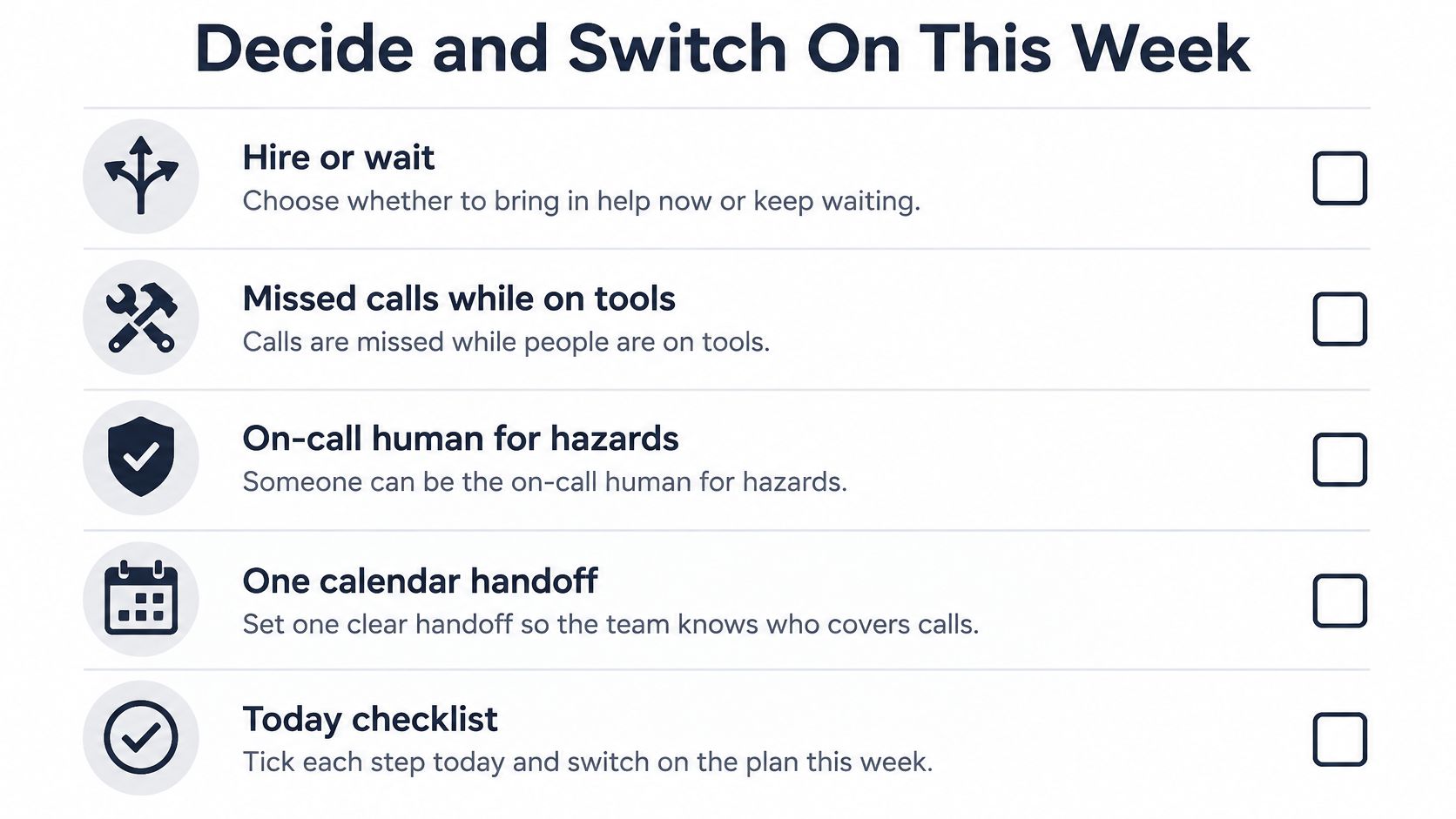
Make the hire-or-wait decision
Tick each item before any customer call is forwarded:
- There's a coverage gap: your call log shows enquiries arriving while the crew is on the tools or unavailable.
- A human owns urgent calls: the on-call electrician and a backup contact are named and reachable.
- One diary controls availability: everyone knows where bookings become official.
- The initial scope is agreed: emergency requests, routine bookings, and approved general questions each have a defined path.
- The hazard script is approved: it directs immediate danger appropriately and never attempts diagnosis.
- Summaries have a destination: a named person checks the chosen email inbox, with SMS alerts where useful.
- The limits are accepted: the assistant won't diagnose, invent prices, promise repairs, or hide uncertainty.
- Language coverage is verified: supported languages and the fallback for misunderstood speech have been tested.
Every box ticked means a controlled start this week. A missing on-call person changes the order: sort the rota and the emergency-contact message before anyone advertises automated dispatch.
Live booking is the last feature to switch on. Message-taking can run while the diary is being settled, so no caller gets a confirmation the crew can't honour.
Keep the launch narrow
Turn coverage on during the hours where calls are already being lost, whether that's while the crew is on the tools or after the office shuts. A narrow window produces a manageable set of summaries instead of a flood of recordings nobody opens.
Each morning, check the summaries and listen to the escalations. Look for failed transfers, vague symptom descriptions, and promises outside your policy, then correct that specific behaviour before widening coverage.
Expand in stages: add hours only after the current window runs clean.
---
For an AI phone assistant that answers around the clock, detects supported caller languages, books routine appointments, and escalates important calls, visit rednea. Bring your service area, diary rules, and on-call contact, then test a routine booking and a hazard handoff before forwarding your customer line.
Try rednea, no strings attached
AI phone assistant for business. Hear a live demo in your browser, book a call with our team, or get started — from £90/month, cancel monthly, no minimum term.
GDPR-compliant · EU & UK GDPR · Multilingual