Setup Time Reduction Playbook for SMBs

A lot of small businesses think setup time is a factory problem. It isn't. It's the dead space between showing up and getting paid.
You see it in the van that has to be unpacked before anyone can diagnose the fault. You see it in the salon chair that isn't reset for the next client. You see it on the phone when a missed call turns into three callbacks, two voicemails, and one annoyed customer who books somewhere else. For tradespeople, freelancers, and service teams, setup time reduction is often the shortest path to more billable work without hiring first.
What Setup Time Reduction Really Means for Small Businesses
On a Tuesday morning, a two-person HVAC crew pulls up to the first job. They don't start diagnosing right away. They unload. They sort. They look for the right meter, the right adapter, the right paperwork. By the time the first real diagnostic step starts, 47 minutes are gone.
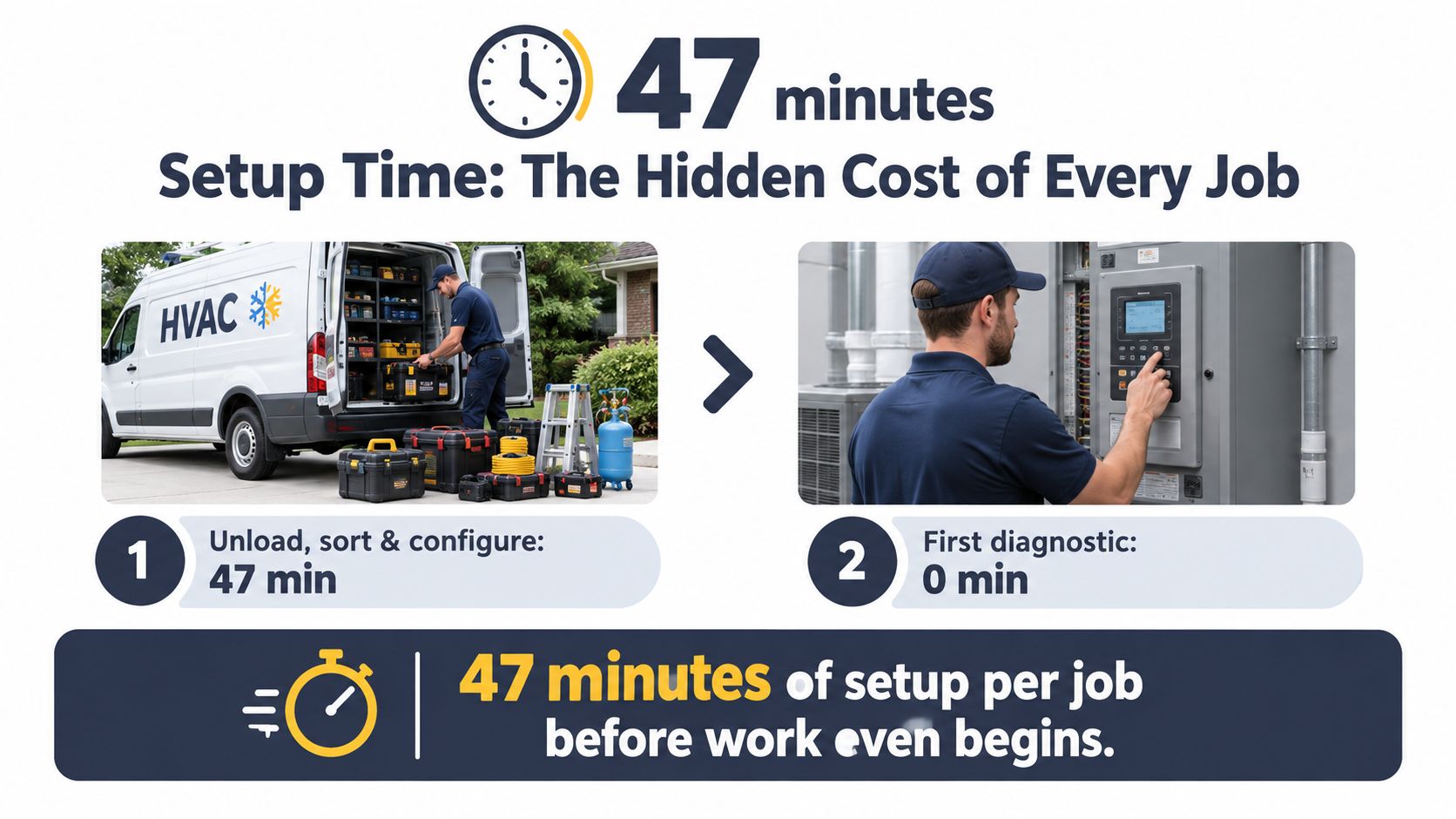
That's setup time. Not in the narrow plant-engineering sense, but in the cash-flow sense that matters to small businesses. It's the gap between arriving at work and producing billable output.
Setup happens in more places than most owners think
In a workshop, setup time is the changeover between one run and the next. In the field, it's van prep, tool staging, login time, paperwork, customer confirmation, and all the little resets between jobs. On the phone, it's the front-desk work that happens before anyone can act: who's calling, what's broken, where's the job, how urgent is it, and when can someone get there.
For a small company, that hidden setup work hurts more than it does in a large plant.
- There's no spare shift: Wasted minutes don't disappear into a bigger labor pool.
- The owner is usually inside the process: If calls stack up or jobs start late, the bottleneck often lands on one person.
- Every delay touches the customer: A slow setup doesn't just reduce output. It also makes response times feel sloppy.
Setup time reduction isn't about moving faster for its own sake. It's about removing the non-billable work that customers never wanted to pay for in the first place.
The manufacturing world has worked on this for decades. SMED, or Single-Minute Exchange of Die, was developed by Shigeo Shingo in the late 1950s and early 1960s. One widely cited milestone says Toyota cut press changeovers from four hours to three minutes in 1969, and historical summaries describe reductions from hours to about 15 minutes by the 1960s and to roughly three minutes by the 1970s (historical SMED summary). The lesson wasn't just speed. It was that long setup work could be broken apart, measured, and redesigned.
That same logic works for a machine shop, a dental office, a mobile mechanic, or a solo electrician. It also works at the front desk. If you want a useful frame for growing without adding chaos, this guide on scaling operations is worth keeping in mind while you tighten setups.
Define and Measure Your Setup the SMED Way
Most setup projects fail at the first step because nobody defines the setup clearly. People say things like “mornings are messy” or “changeovers take too long.” That isn't a baseline. That's a complaint.
Start with one recurring setup
Pick one repeatable event:
- a CNC job changeover
- a plumbing van restock
- a salon chair reset
- a photographer's lens and lighting swap
- a tax preparer's file setup between client appointments
Then define the setup window from end of the previous job to the moment the next job is producing. In a machine environment, that may be first good part. In a service business, it may be the first valid diagnostic step, the first haircut stroke, or the first minute of paid consulting.
Log each step, not just total time
Use a stopwatch and write down every action in order. Don't round. Don't summarize from memory afterward.
| Step # | Action Description | Time (sec) | Internal or External | Notes / Obstacles |
|---|---|---|---|---|
| 1 | ||||
| 2 | ||||
| 3 | ||||
| 4 |
Internal means the task can only happen while the machine, workspace, chair, vehicle, or job flow is effectively stopped.
External means the task could have happened before the stop.
A mobile mechanic can restock common parts after the last call instead of before the first one. A wedding photographer can pack the next lens kit the night before. A bookkeeper can preload client documents before the appointment starts. That distinction is the heart of setup time reduction.
Practical rule: If a task can be done earlier, elsewhere, or by someone else without stopping the job, treat it as external until proven otherwise.
A conference paper on SMED summarizes the method in four steps: analyze setup operations, separate internal and external activities, convert internal to external, and shorten both categories using standard times from repeated measurements. In electronics assembly, that approach reduced a high-speed placement machine's average internal setup to 31 minutes with an 8-minute standard deviation, and a 50-part/feeders standard job fell to 27 minutes from 128 minutes, with incremental feeder time dropping to 0.18 minutes, or about 11 seconds per feeder (SMED measurement and standardization study).
Don't trust one run
Run at least three cycles before you trust your average. One setup might be unusually smooth. Another might get interrupted. You need a pattern, not a story.
Once you have those three runs, add internal time and external time separately. That gives you a real baseline and shows where the waste sits. If you want cleaner visibility while you collect these logs, basic real-time analytics can help a small team spot drift before “one bad morning” becomes the normal process.
Separate Internal and External Setup Tasks
Most gains show up in the setup process, but teams usually attack the hardest internal step first because it feels important. Often that's the wrong move.
The better question is simpler: what are you still doing after the job has stopped that could have been done before?
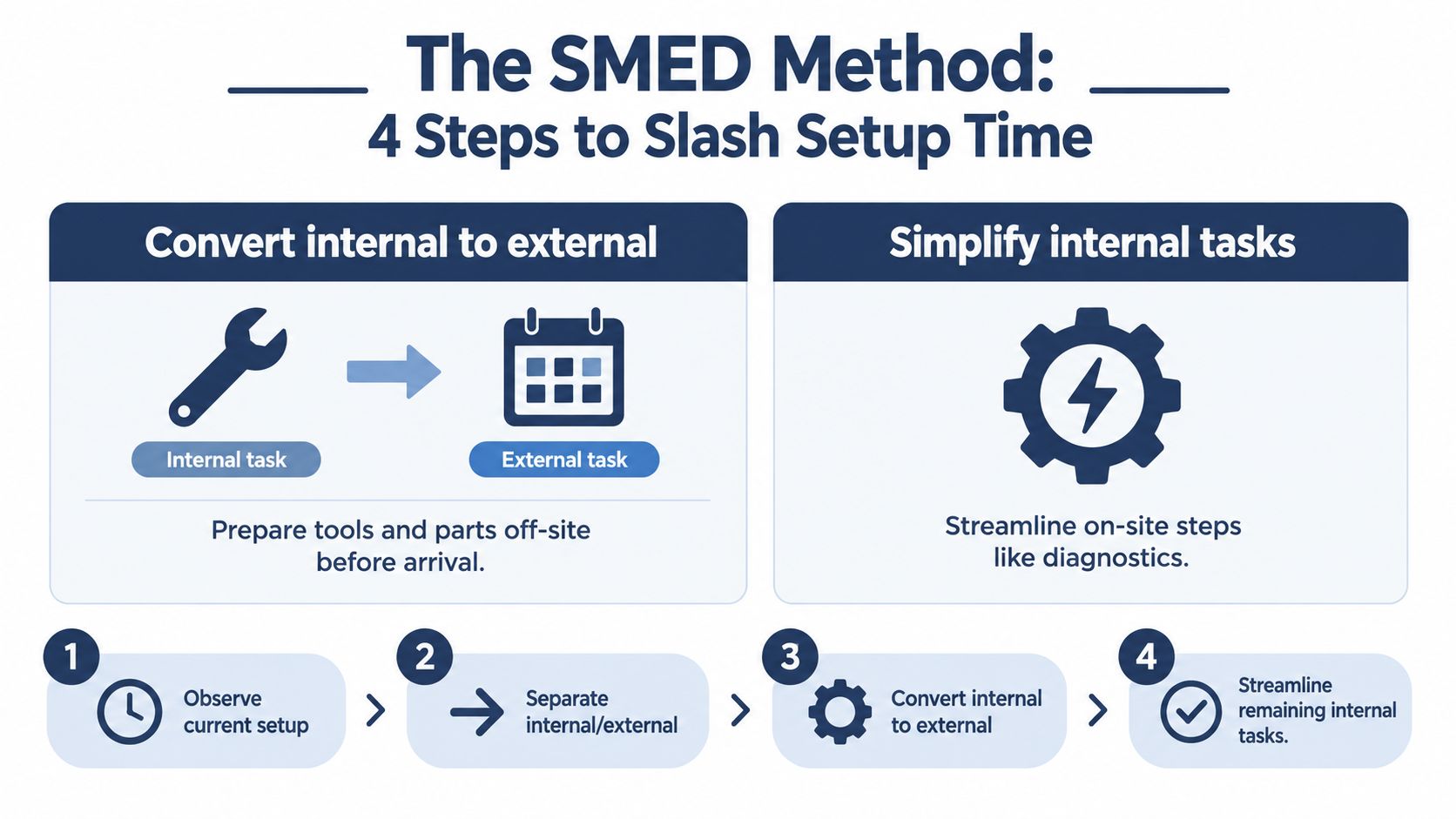
The four-step sequence in plain language
1. Observe the current setup Watch the full sequence without fixing anything yet. Write down every reach, walk, check, and wait.
2. Split internal from external Mark what requires the machine or workspace to be stopped, and what doesn't.
3. Convert internal work to external Pre-stage tooling. Print forms earlier. Build job kits. Confirm addresses before dispatch. Pre-call the customer. Queue the next file. Load the van tray before the day starts.
4. Simplify what remains internal Use color coding, fixed locations, one-motion fasteners, labeled trays, and fewer decisions at the point of work.
What the evidence says
Published SMED applications keep showing that this method works when teams measure and redesign the work. One turning-line study reported setup time dropping from 80.91 minutes to 65.36 minutes, a 19.22% reduction, and the same literature summary notes reduction ranges from 25% to 85%, with one review citing average gains around 50% in changeover steps and 60% in setup time (industrial engineering SMED review and case data).
Those are industrial examples, but the mechanism is the same in service businesses. If your technician starts printing work orders after arriving on site, that's the same mistake as a machine operator hunting for clamps after shutdown.
Two strategies, one common mistake
Converting internal tasks to external usually produces the first big win. Simplifying the internal tasks is what makes the win durable.
What doesn't work is skipping straight to clever optimization while obvious external work stays inside the stop window. I've seen teams debate tool layout while nobody has assigned who preps the next kit. They shave seconds off a wrench movement and ignore ten minutes of searching, waiting, or confirming details that should've been done earlier.
The easiest minutes to remove are usually hiding in preparation, not execution.
Try this tomorrow morning. Set a timer for ten minutes after the first job starts. Write down every action that happened after stop but could have happened before stop. Don't solve it yet. Just list it. Teams find more waste in that quick exercise than in a week of opinions.
Standardize, Pre-Stage, and Schedule for Repeatable Setups
A one-time improvement is nice. A repeatable setup is what changes margins.
The problem with many setup time reduction efforts is that they rely on memory. One strong operator figures out a faster method, everyone feels better for a week, and then the process slips back as staff rotate or the workload changes.
Build a setup sheet that someone else can follow
Keep it to one page. If it runs longer, people won't use it during real work.
Include the few items that prevent delay.
- Tools required: The exact set needed for this job family
- Critical settings: Torque values, measurements, or standard checks
- Material and part locations: Where items are stored, not just what they are
- Safety checks: Only the essential ones for that setup
- Expected stage times: A practical target for each step
Laminate it, pin it up, or store it where the job starts. Don't bury it in a shared drive no one opens in the field.
Pre-stage the next job before the current one finishes
Small firms gain ground quickly.
A one-person electrical contractor can keep separate trays for residential service, light commercial work, and inspection visits. The night before, they load the right tray, confirm consumables, print or save the day's checklists, and place permits or customer notes with the kit. That turns a chaotic morning into a repeatable launch.
Use simple controls:
- Numbered kits: Each kit matches a job type or route segment
- Labeled storage: Common items go back to the same place every time
- Visible replenishment signals: Color-coded cards or bins trigger restocking before stockouts
- Pre-approval checks: Confirm access details, documents, and customer contact before dispatch
Fast setups don't come from rushing. They come from reducing choices at the moment work begins.
Schedule for setup families, not just calendar slots
Most small businesses schedule for customer convenience alone and pay for it in repeated resets. Sometimes that's necessary. Often it isn't.
Group similar jobs when you can. Keep related service calls on the same day. Put equipment-intensive work back-to-back. Batch admin-heavy appointments together so the paperwork pattern stays consistent. If your business relies on bookings, an automated appointment booking system helps because it can steer customers into time windows that protect the flow instead of scattering changeovers all day.
A recent integrated lean and ERP case reported a 95.2% die changeover-time reduction and 88.9% downtime reduction, while also pointing to digital standardization and KPI tracking as part of sustaining gains, not just the initial workshop exercise (integrated lean and ERP case study). That matters for small businesses because sustainability is usually the hard part. The process has to survive real life, not just the improvement day.
How an AI Phone Assistant Removes Setup Work From Every Call
For a field service company, every inbound call is a setup event.
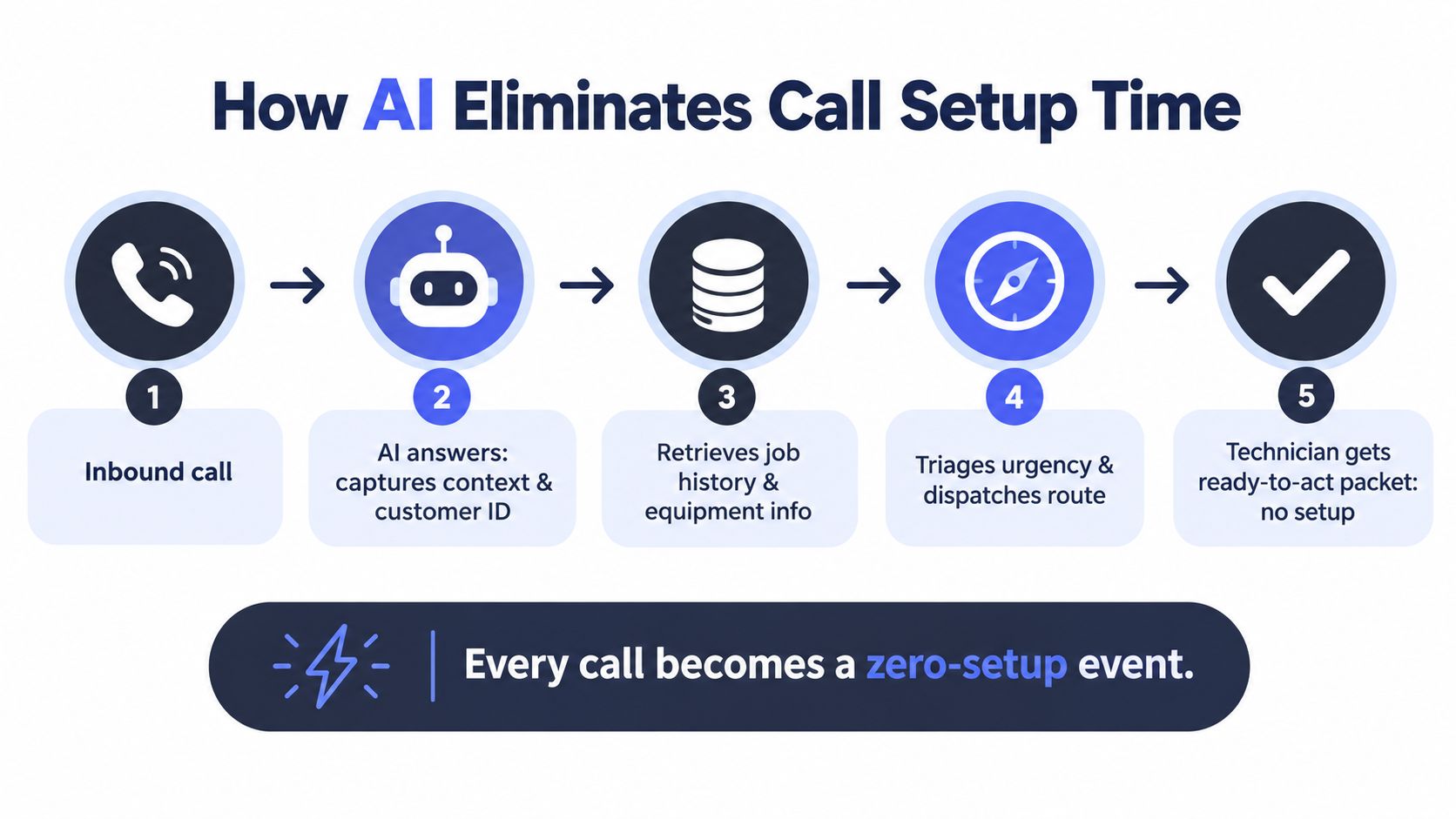
Before a technician can act, someone has to answer, figure out what the customer needs, confirm who they are, capture the address, understand urgency, check the schedule, and pass the details on cleanly. If that handoff is messy, the technician starts the physical job with missing context. That creates a second setup delay on site.
Treat the phone as part of your changeover process
A lightweight AI phone layer can remove a lot of that front-desk setup work.
Handled well, it does the same job a disciplined coordinator would do:
- Answer immediately: No missed call while the owner is on a ladder or under a sink
- Capture intent in natural language: Emergency, quote request, follow-up, booking, access issue
- Identify the caller: Existing customer or new lead
- Pull relevant context: Address, prior job notes, service history, time window
- Pass a clean summary to the human: So nobody starts from zero
This is practical, not theoretical. Half of small businesses in the United States have already integrated AI into customer service operations, with 74% using AI-powered chatbots, 51% using AI-driven knowledge bases or help centers, 39% equipping live agents with AI assistance, 38% using AI analytics, and 32% using voice AI or IVR solutions.
Start simple and let the AI handle the repeatable front desk work
For a small plumbing company, that might mean the AI answers after hours, collects the symptom description, confirms whether the issue is urgent, books the right slot, and sends the technician a concise summary. For a dental office, it might handle appointment requests, reschedules, and common pre-visit questions in multiple languages. For a freelancer, it can screen inbound calls while they're with a client and only escalate the ones that need judgment.
One option in this category is an AI answering service such as fonea, which can answer calls, detect language, book appointments, and send summaries into calendars or CRM workflows. The important part isn't the label. It's that the phone stops being the slowest setup in the business.
Multilingual handling matters more than many owners assume. In a 2026 analysis of 1,446,980 business calls across 2,074 businesses, 89.8% were in English, 8.0% in Spanish, and 1.7% in French. That doesn't mean every small company needs every language on day one. It means you can start with the few that show up most often and remove friction without hiring a full multilingual front desk.
If the AI can gather the basics correctly, your technician arrives ready to act instead of ready to investigate what the office forgot to ask.
That's setup time reduction. It just happens before the truck rolls.
Why AI Is Good Enough to Complement Humans Today
A lot of owners still hear “AI phone assistant” and think of a brittle menu tree that traps callers. That's old thinking. The useful version today isn't replacement. It's support.
The right model is hybrid
The AI handles the routine, structured, repeatable parts of the call. Humans handle exceptions, judgment, emotion, and revenue-critical conversations.
Across industries, AI chatbots fully resolved 44.8% of customer service conversations without human involvement, and bot-to-agent handoff satisfaction reached 92.6% in 2025. For teams with 1 to 5 agents, handoff satisfaction reached 99.4%. That should change how small businesses think about deployment. You don't need perfect automation. You need competent triage plus a clean escalation path.
For a solo plumber, that means the AI books the job while they're still working. For a two-truck HVAC firm, it means after-hours calls get sorted before anyone gets paged. For a legal or healthcare office, it means routine intake can happen consistently while staff focus on live cases or patients.
Where many systems still fail
The weak point isn't always the conversation. It's the handoff.
Contact center research found a sharp perception gap: 96% of CX business decision-makers said their organization preserves context effectively during AI-to-human handoffs, but 83% of consumers said they still have to repeat themselves after transfer, and 35% said this happens often or always.
That's why the process design matters more than the AI label. If the system doesn't collect the right details and pass them forward cleanly, you haven't removed setup work. You've just moved it to someone else.
| Factor | AI Phone Assistant | Part-Time Receptionist |
|---|---|---|
| Availability | Can answer 24/7 | Limited to staffed hours |
| Language handling | Can support multiple languages when configured | Depends on staff skills |
| Consistency | Follows the same intake flow every call | Varies by person, energy, and training |
| Escalation | Passes only calls that need judgment | May still interrupt field staff frequently |
| Setup impact | Reduces repeated intake and callback loops | Helps, but only while staffed |
The practical takeaway is simple. AI is already good enough to complement humans if you give it bounded work, clear escalation rules, and a proper summary handoff. Start there.
Quick-Win Templates and KPIs to Track This Month
Most setup time reduction efforts don't fail because the fix was wrong. They fail because nobody keeps score after the first burst of energy.
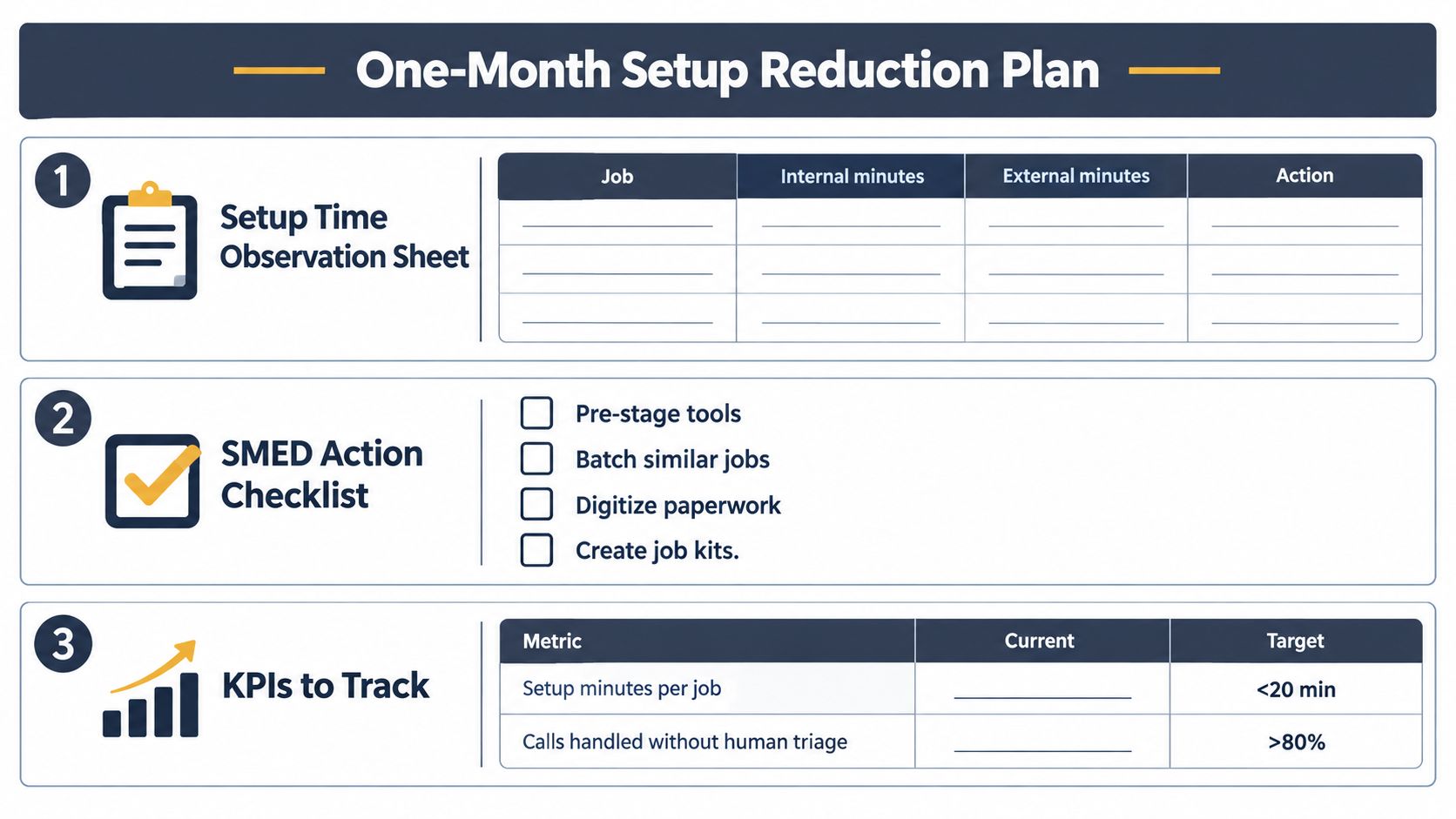
Three templates worth using right away
Keep them plain. Fancy templates don't survive busy weeks.
Setup Time Observation Sheet
- Job
- Internal minutes
- External minutes
- Main blocker
- Fix to test tomorrow
Pre-Stage Checklist
- Tools
- Materials
- Documents
- Approvals or access details
- Customer information
Daily 5-Minute Standup Log
- What setup slipped yesterday
- Why it slipped
- What gets pre-staged today
- Who owns the fix
Four KPIs that actually help
Don't flood a small team with metrics. Track the few that tell you whether setups are getting shorter and more reliable.
1. Average setup minutes per job Add total setup minutes for the week and divide by number of jobs observed.
2. Percentage of setups completed inside target Set a target time for each recurring setup family, then track how often you hit it.
3. First-time-right rate Count the jobs that started cleanly without missing parts, missing information, or rework-triggering setup errors.
4. Weekly hours reclaimed Compare current setup time against your baseline and convert the saved minutes into usable labor hours.
The point of the KPI isn't the spreadsheet. It's deciding what to fix before the same delay repeats ten more times.
Use target bands, not heroic goals
Set practical bands based on your own baseline. A small plumbing business, mobile detailer, or two-person studio doesn't need ambitious theater. It needs visible movement.
You can define bands like this without inventing false precision:
- On track: Setup time is falling and variability is narrowing
- Needs attention: Average time is improving, but misses are still frequent
- Off track: Setup time is flat or worsening, or the team stopped using the sheets
A recent review of setup-time reduction notes that poor preparation, non-standardized procedures, and waiting are major causes of delay, and that the biggest gains often come from separating internal and external work and redesigning the process around limited labor and low capital budgets (setup time reduction tradeoffs and constraints). That's exactly why these templates matter. They force the team to see where the delay starts.
For payback, keep the math simple. Multiply minutes saved per job by jobs per week, convert that to hours, then value those hours using your own billable rate or labor cost. If the reclaimed time covers the cost of staging materials, labeling storage, or adding an AI phone layer, the project is paying for itself. If the templates sit in a drawer, it won't.
---
fonea gives small businesses a practical way to remove phone setup work from every day. It answers calls around the clock, handles multiple languages, captures caller context, books appointments, and escalates only the calls that need a human, which fits directly into setup time reduction for field service and front-desk heavy teams. If that's the bottleneck in your operation, visit fonea.
Try rednea, no strings attached
AI phone assistant for business. Hear a live demo in your browser, book a call with our team, or get started — from £90/month, cancel monthly, no minimum term.
GDPR-compliant · EU & UK GDPR · Multilingual