English Language Support for SMB Calls: A Practical Guide

A plumber is on a roof when a new customer calls. The caller speaks English, but the pronunciation is unfamiliar, the explanation comes in fragments, and street names get repeated several times. The plumber misses the call, the voicemail captures only part of the address, and a booking that should have taken two minutes becomes a lost lead.
That problem isn't solved because an AI receptionist can speak English. Real customer calls include accents, background noise, nerves, incomplete sentences, code-switching, and callers who understand more English than they can comfortably speak. English language support is an operations problem, and its quality is revealed when communication becomes imperfect.
The Moment a Phone Call Goes Wrong

The missed call often starts with a reasonable assumption: “They speak English, so the assistant will understand them.” A caller may know exactly what they need, yet struggle to describe it under pressure. They might say, “The water is coming from the ceiling near the back room,” pause to find the right word, then give an address that speech recognition interprets incorrectly.
A clinic sees the same pattern. A patient can follow a written appointment message but find it difficult to explain symptoms over the phone. A professional-services firm may receive a caller who can answer simple questions but becomes uncertain when asked for a full name, company name, or preferred appointment time. Fluent conversation is not the same as reliable task completion.
Practical rule: Judge an assistant by what happens after it becomes uncertain, not by how polished its first greeting sounds.
The scale of English explains why this matters to businesses that serve international customers. The British Council reports that approximately 1.5 billion people speak English worldwide, across 101 countries, while its comparative figures identify about 527 million native speakers and around 1.5 billion people learning English. That reach comes largely from second-language use, not native fluency, as described in the British Council's overview of English worldwide.
For an SMB, the practical consequence is clear. Your caller may use English as a shared language with a different first language, and your system must support the exchange without making the caller perform perfect English. It should listen patiently, use plain language, confirm operational details, and offer a person when the conversation stops being dependable.
The question isn't whether the assistant can “do English.” Ask whether it can identify the caller's meaning, validate the booking information, recover from an error, and preserve the lead when the call gets difficult.
What English Language Support Actually Means for an AI Receptionist
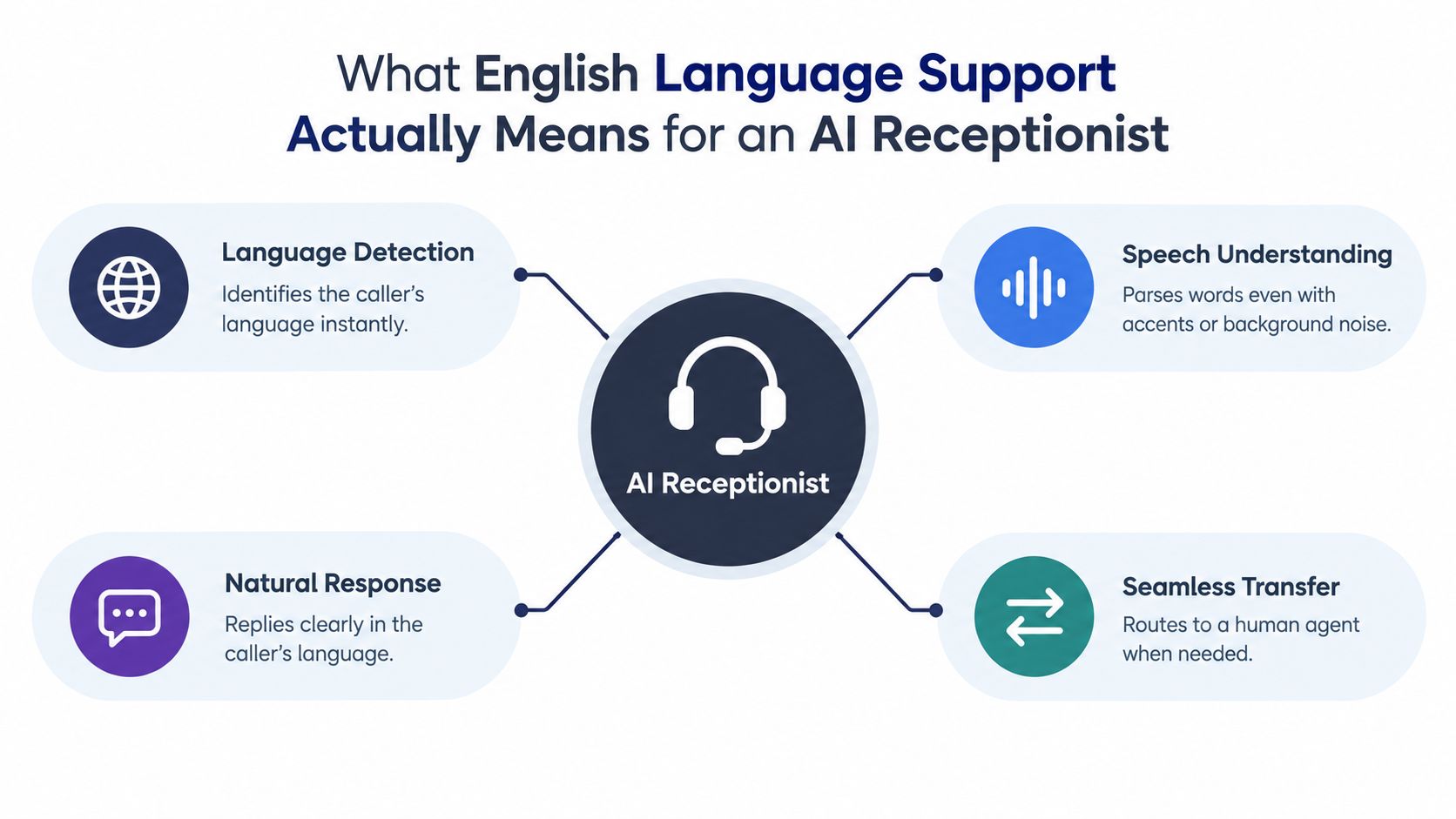
A dependable AI receptionist handles several connected jobs. First, it identifies the language being used. Then it turns speech into text, interprets the caller's intent, prepares a response, and speaks back at a pace the caller can follow. If confidence falls, it should clarify or transfer the call rather than guess.
Think of the system as a multilingual receptionist who listens, restates, and confirms. A caller says they need an electrician "tomorrow afternoon." The assistant shouldn't choose a time on its own. It should ask which afternoon window works, check availability, and repeat the selected appointment before saving it.
Speaking English isn't enough
An English-capable assistant may produce a natural greeting but still fail when a caller has a regional accent, speaks quickly, or uses a phrase outside the business's prepared answers. Reliable support connects speech recognition, intent understanding, response generation, and error recovery.
This is closely related to natural language understanding for phone assistants, because the system must interpret what the caller wants rather than match isolated keywords. “The boiler has stopped again” may be a repair request, a follow-up to an existing job, or an urgent situation. Context determines the next question.
The 2025 EF English Proficiency Index analysed results from 2.2 million adults across 123 countries and regions and found that speaking was the weakest English skill in more than half of the countries measured. The same source reports that younger adults under 25 didn't consistently outperform older groups, which reinforces the need to design for varied speaking ability rather than a single “typical” caller. See the 2025 EF English Proficiency Index for the full context.
The fallback is part of the product
When the assistant can't confidently capture an address, it can ask the caller to repeat it slowly, read the address back in parts, or offer a text confirmation. When the caller switches languages, it can ask which language they prefer instead of continuing with a flawed assumption.
That fallback should feel like normal service, not a technical failure. A good system makes uncertainty visible, protects important details, and transfers the interaction with enough context for the employee to help immediately.
The Four Pillars of Reliable English Support
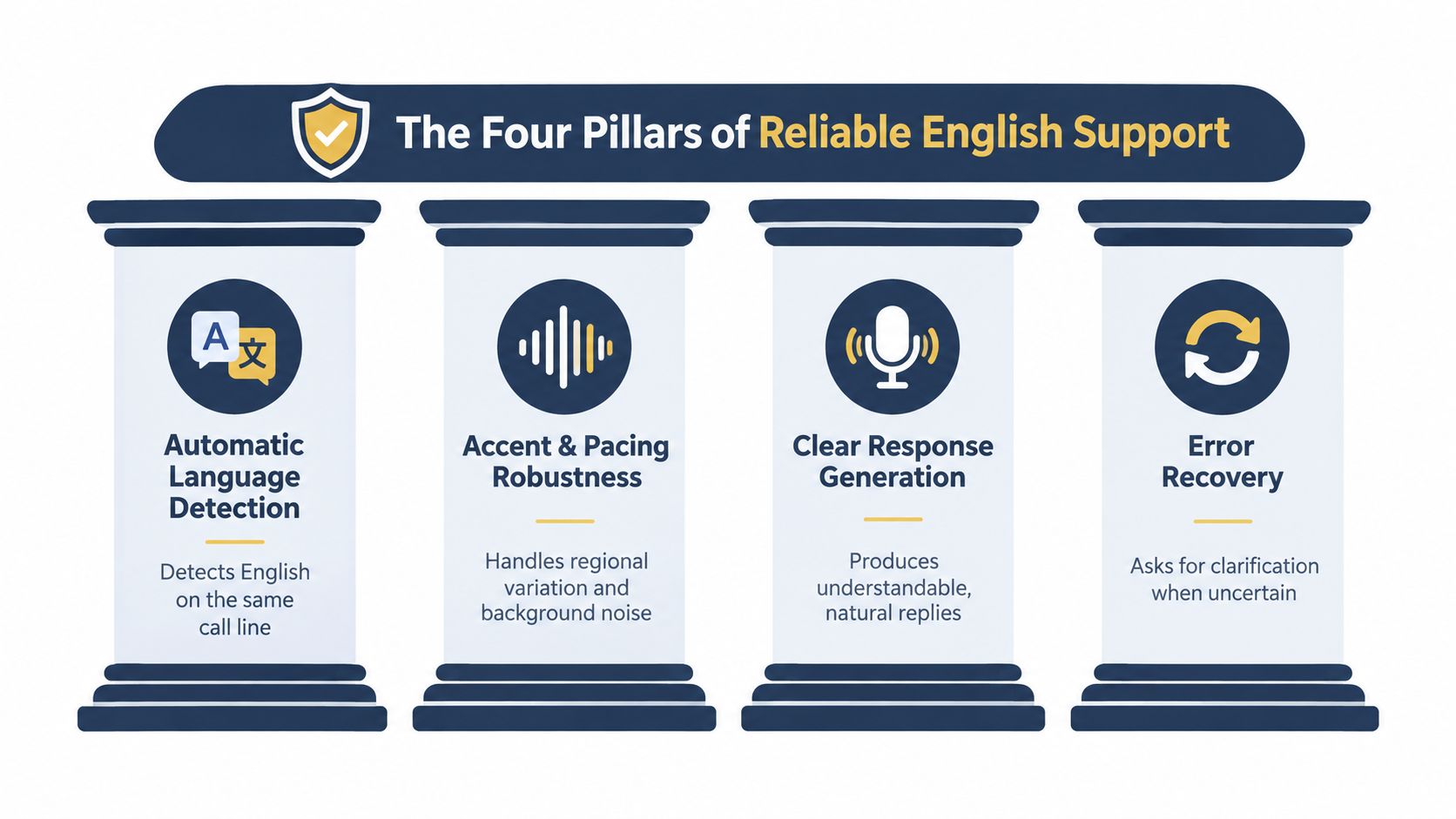
Reliable support rests on four operational checks. A provider that demonstrates only a list of supported languages hasn't answered the harder questions about accents, critical information, and recovery.
Automatic language detection
The assistant should detect that the caller prefers English without forcing them through a language menu. If the caller begins in another language and then switches to English, the system should follow the caller's current preference or ask directly.
For example, a caller might open with a greeting in one language, explain the plumbing problem in English, and use a local place name that doesn't sound English. The assistant should preserve the conversation instead of restarting it or routing the caller to the wrong queue.
Accent and pacing robustness
Speech recognition must cope with regional pronunciation, background noise, mobile connections, and uneven pacing. A clinic receptionist can't rely on a caller repeating a medical appointment detail several times, and a field-service company can't assume every address will be pronounced in the same way.
The practical test is not whether the assistant understands a carefully recorded demo. Ask how it handles a caller who speaks quickly, pauses often, or uses unfamiliar pronunciation. It should slow down its own response, ask one question at a time, and avoid long explanations.
Clear response generation
The assistant's spoken English should be natural but controlled. It should use short sentences, avoid unnecessary idioms, and make the next action obvious.
A professional-services caller asking about an initial consultation doesn't need a paragraph about the firm's process. They need to know what information is required, which times are available, and what happens next. Clarity beats performance.
Error recovery
Critical fields need explicit validation. Names, addresses, dates, appointment times, prices, service types, and callback numbers should not be accepted when recognition confidence is low.
A caller who says “forty” and an assistant that hears “fourteen” can create a costly booking error. The assistant should repeat the detail, invite correction, and escalate when the caller and system can't reach agreement.
A global employer study covering 5,373 organisations in 38 countries found that approximately 49% of English-dependent job tasks require advanced English, 33% intermediate English, 8% basic English, and 7% native-level ability, according to this Cambridge English executive summary. The distribution supports an intermediate-proficiency baseline for business communication, not a native-speaker assumption.
Language handling also has to respect privacy. Review your retention, consent, access, and deletion rules with a practical GDPR compliance checklist, especially when calls contain addresses, health information, payment questions, or legal details.
Phrasing and Patterns That Actually Help Callers
The assistant's wording affects whether callers can complete the task. Short sentences, one question at a time, and deliberate confirmation reduce the amount of information a caller must hold in memory.
Use these patterns in your configuration and test scripts:
- Ask one thing at a time: “What service do you need?” Then ask for the address.
- Use controlled pacing: Pause after important information instead of adding several questions together.
- Repeat consequential details: “I heard 18 King Street. Is that correct?”
- Offer a rephrase: “Do you mean the appointment is for Tuesday morning?”
- Invite correction: “If I got that wrong, please correct me.”
- Make repetition available: “I can repeat the appointment details.”
| Situation | Avoid | Better |
|---|---|---|
| The caller gives an unclear address | “I didn't understand anything you said.” | “I heard Oak Road. Could you say the house number again?” |
| The caller asks about timing | “We may have availability during our usual service window.” | “I can check morning or afternoon appointments. Which do you prefer?” |
| The caller sounds uncertain | “Please provide the required information.” | “I need your name and callback number first.” |
| The assistant mishears a number | “Your booking is confirmed.” | “I heard 14. Is that 14 or 40?” |
Here's a short example:
Caller: “I need someone at 18 King Street, near the old station.”
Assistant: “I heard 18 King Street. Is that correct?”
Caller: “No, 80 King Street.”
Assistant: “Thank you. I have 80 King Street, near the old station. What is the best callback number?”
The assistant doesn't pretend confidence. It exposes the uncertainty while the caller can still fix it. For more ready-to-adapt examples, use customer service scripts for common call situations.
Avoid overcorrecting into unnatural speech. Plain English doesn't mean childish English, and it doesn't mean removing every normal phrase. It means choosing words the caller can process quickly, especially when the call involves an unfamiliar accent, an urgent repair, or a noisy environment.
The Callers Behind the Label
“English-speaking customer” is too broad a category to guide a phone workflow. One caller may read English comfortably but stumble when speech comes fast. Another may understand the question and still answer indirectly because they are nervous or trying to be careful. A third may switch languages for a street name, a person's name, or a technical term.
That is an operations problem, not a language-label problem. The assistant has to handle what comes up on the call, not what a profile says on paper.
A second-language speaker who reads well may still need slower pacing and clean read-backs. The operational move is simple, keep sentences short and confirm key details out loud. A nervous caller often gives partial answers first, so the assistant should ask one focused follow-up at a time instead of waiting for a polished response. A code-switching caller may use another language for a location or name, which means the system needs to recognize those moments and preserve the exact term rather than forcing a rough paraphrase.
Native fluency versus task success
A design built around native fluency rewards speed, idioms, and conversational confidence. A design built around service calls rewards correct information capture and a completed next step.
| Native-fluency assumption | Operationally safer alternative |
|---|---|
| The caller will understand a long explanation | Use short sentences and pause |
| The caller will correct a mistake | Read back names, addresses, and times |
| Accent differences are unusual | Test varied pronunciation and noise |
| A smooth conversation means success | Measure booking completion and corrections |
Nerves widen the gap. Someone describing a leak, missed appointment, billing issue, or health concern may speak in fragments even if their English is strong. The assistant should stay patient and ask narrow follow-up questions.
The right question is not “Did the call sound fluent?” It is “Did the caller and business leave with the same understanding?”
Plain-language design outperforms native-fluency design in many SMB workflows. A concise assistant that confirms “Thursday at 3 p.m. at 80 King Street” is more useful than one that sounds polished but fails to verify the appointment.
Where AI Should Step Back and Hand Off
A caller asks for a refund after being charged twice, or starts describing a safety issue in the middle of a booking call. That is the point where English support stops being a language problem and becomes a routing problem.
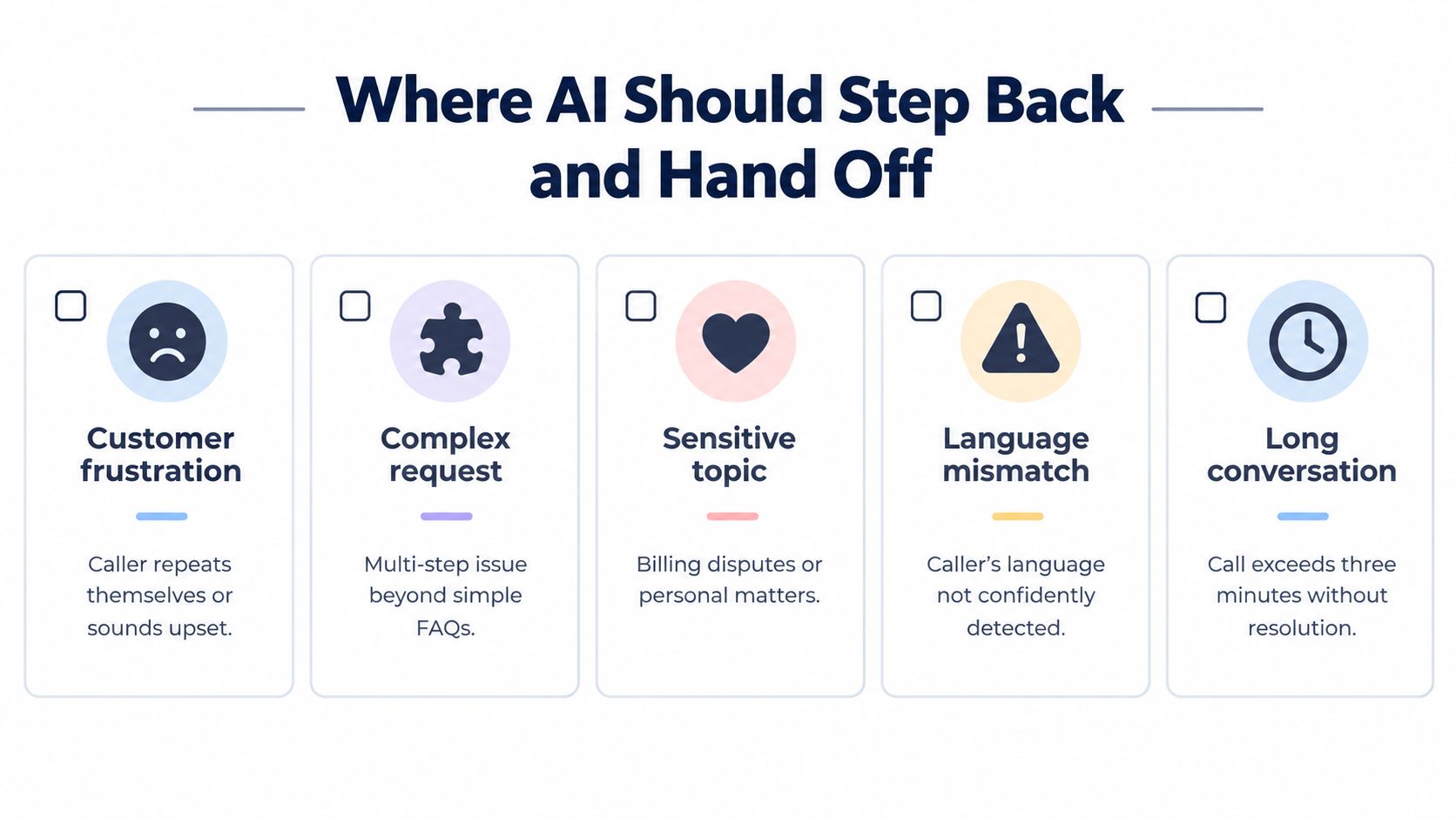
Set clear handoff triggers before launch:
- Customer frustration: The caller repeats themselves, sounds upset, or says the assistant is not helping.
- Repeated misunderstanding: The system fails to capture the same name, address, or request after clarification.
- Refunds and complaints: An employee needs authority to investigate, approve, or explain a decision.
- Safety concerns: The caller describes a dangerous situation, emergency risk, or potentially unsafe service.
- Regulated topics: Medical, legal, financial, or privacy-sensitive questions need human judgment.
- VIP or priority callers: The business has a defined reason to route the interaction immediately.
- A direct request for a person: The assistant should respect that request instead of arguing for automation.
The transfer package matters as much as the transfer decision. Send the employee the transcript, caller intent, verified facts, the unresolved question, and any promised follow-up. If the customer has already explained the issue, they should not have to start again.
For a practical comparison of sensitive calls, review the trade-offs in a comparison of sensitive calls: human vs AI receptionist. The point is not that AI should avoid these calls entirely. It should handle the routine part, then step aside when authority, judgment, or empathy takes over.
Analysts at McKinsey found that generative-AI assistance improved issue resolution and reduced handle time in contact-centre work, which supports a simple rule for smaller teams, let AI gather routine details and prepare the handoff.
Start with one workflow. IBM's contact-centre automation research reported that many organisations using conversational AI had deployed generative AI in only one to four customer-service use cases. That is a sensible shape for a small business too. A booking request, a routine estimate enquiry, or an appointment reschedule gives you a controlled place to define what the assistant can answer, what it must confirm, and when it should transfer.
Rednea can detect the caller's language, handle English and several other languages, answer routine questions, book appointments, send summaries, and escalate important calls. Set those rules around your actual call types, not around the idea that sounding native is the same as being safe.
A 30-Day Rollout for English Language Support
Use the first month to prove one useful workflow rather than launch a broad promise.
Days 1 to 5, establish a baseline. Record missed calls, after-hours demand, current booking completion, repeat contacts, and the points where staff usually correct caller information. Note the English call types that create the most interruptions.
Days 6 to 10, choose one workflow. Select a repetitive task such as collecting details, answering routine questions, or checking appointment availability. Write the approved answers, required fields, confirmation wording, and handoff triggers.
Days 11 to 20, test with real variation. Include different accents, speaking speeds, background noise, incomplete answers, and callers who ask for repetition. Review whether the system confirms names, addresses, dates, prices, service requirements, and callback numbers.
Days 21 to 30, review and adjust. Inspect escalated calls weekly. Track task completion, correction rate, escalation rate, successful handoff, repeat-contact rate, and time saved for employees. Don't use a vague conversational-quality score as your main decision rule.
Keep the rollout narrow until the evidence supports expansion. The aim is consistent first-line coverage with a real human safety net, not maximum automation. A small team can use AI to answer routine English calls while employees retain responsibility for exceptions, judgment, empathy, and sensitive decisions.
Before expanding, confirm that you can answer “yes” to each question:
- Does the assistant confirm critical details?
- Can callers request repetition?
- Are low-confidence calls transferred?
- Does the employee receive the conversation context?
- Can you review failed calls and change the workflow?
---
If missed English calls are costing your business bookings, rednea can answer your existing number, detect the caller's language, handle routine requests, and book appointments while passing important conversations to your team. Set up one workflow, define its confirmation and handoff rules, and visit rednea to see how AI phone support can complement your people this week.
Try rednea, no strings attached
AI phone assistant for business. Hear a live demo in your browser, book a call with our team, or get started — from £90/month, cancel monthly, no minimum term.
GDPR-compliant · EU & UK GDPR · Multilingual