How to Improve First Call Resolution for Small Teams

A plumber finishes a job, climbs into the van, and hears the phone ring. The caller wants an appointment, but the person answering misses the address, books the wrong slot, and forgets to record the problem description. The customer calls again, explains everything from the beginning, and starts wondering whether the company can be trusted with the actual work.
That isn't a call-handling problem. It's a first-contact workflow failure. The same pattern appears in dental practices, electricians' offices, legal firms, estate agencies, and solo businesses: the phone gets answered, but the customer's desired outcome doesn't get completed.
What First Call Resolution Really Means for a Small Business
First call resolution, or FCR, is the percentage of eligible customer issues fully resolved during the first interaction without a follow-up call or escalation. For an owner-operator, resolution means completing the customer's requested outcome. The appointment is booked, the service area is confirmed, the question is answered, the quote request is properly qualified, or the right professional receives a complete escalation.
A call has three possible outcomes:
- Resolved: The customer gets the requested result during that contact.
- Transferred: Another person takes over, but the result may still be incomplete.
- Deferred: Someone promises to call back, check a calendar, find a file, or obtain approval.
Only the first category is genuine FCR. A short call that creates another task is not a successful resolution. It just moves the work into a later interaction.
Practical rule: Measure the customer's completed outcome, not the moment the call disconnected.
FCR carries more weight in a small business because one missed callback can lose a booking, delay a job, or leave the owner rebuilding the story after hours. A solo operator may have one phone, one calendar, and little time between jobs. An AI phone assistant can handle routine requests such as bookings, basic service-area questions, and straightforward status updates, while a human handles judgment calls, sensitive complaints, safety concerns, and decisions requiring professional authority.
That division also matters for callers speaking English, Spanish, French, German, or Italian. Routine resolution should remain consistent across languages, with clear escalation when the assistant cannot understand the request or apply the correct rule.
The commonly cited contact-center FCR range is approximately 70% to 79%, while complaint-related calls have been reported at about 47%, according to Atlassian's overview of first-call resolution benchmarks. Use those figures for orientation, not as an enterprise target. A plumbing emergency, routine appointment request, and legal judgment need different resolution rules.
Use an internal definition you can audit:
“A call is resolved when the customer's requested outcome is completed during the initial contact, or when a qualified and necessary escalation is created with all information and ownership confirmed.”
This standard connects FCR to the wider systems and processes that support small businesses. It keeps attention on whether the request was completed, rather than blaming the person who answered. The goal is a useful first answer, not merely a higher call count.
Calculate Your FCR Baseline Before Changing Anything
Before changing scripts, adding an AI phone assistant, or coaching staff, establish a baseline you can audit. A weak denominator can make a failing process appear healthy.
Build an auditable call record
Create one row for every eligible first contact. Record:
- Customer identifier: Name, phone number, email, or customer reference.
- Call intent: New booking, reschedule, price question, status request, complaint, qualification, or another defined category.
- Outcome: Resolved, transferred, deferred, or escalated.
- Promised action: What someone agreed to do next.
- Appointment or job status: Booked, changed, pending, completed, or not applicable.
- Escalation reason: Safety, professional judgment, missing authority, unavailable information, or another reason.
- Language: English, Spanish, French, German, Italian, or another supported language.
- Repeat contact link: The original case identifier when the customer calls again.
Define exclusions before reviewing results. Exclude contacts that could not reasonably be resolved during the first interaction, such as an emergency-only handoff, a callback scheduled at the customer's request, or a job requiring physical inspection before an accurate quote. Do not use exclusions to hide avoidable failures.
Calculate FCR this way:
Eligible calls resolved on the first interaction ÷ all eligible first contacts × 100
For example, if your log contains 100 eligible first contacts and 70 end with the requested outcome completed, your FCR is 70%. This is an arithmetic example, not a benchmark. If the customer calls again about the same unresolved issue within your fixed repeat-contact window, connect that call to the original record.
Set one repeat-contact window and keep it unchanged. A practical phone measurement commonly uses 7 to 14 days, as described in MetricNet's contact-center measurement guidance. Consistency matters more than choosing a window that makes the result look better.
Segment before you set a target
One FCR number will not show where the operation breaks. Segment results by intent, employee, location, language, channel, and escalation reason. Appointment requests may resolve well while status calls fail because nobody can see job progress. French-language calls may perform differently from English calls when translated guidance is incomplete or the escalation route is unclear.
Use the segments to set targets by call intent, not to copy a broad industry benchmark. A routine booking should have a higher first-contact target than a complaint, safety concern, or request requiring professional judgment. Set a target only after you know the current result, the approved resolution path, and which cases must reach a human.
An AI phone assistant can handle routine questions in English, Spanish, French, German, and Italian when its approved answers and handoff rules are clear. Measure those calls separately from human-led judgment calls. If the assistant cannot understand the caller, apply the correct rule, or confirm the requested outcome, record a qualified escalation rather than forcing an automated resolution.
Survey-based and system-based measurements can produce different results. A system may mark a call closed while the customer remains dissatisfied, while a post-call question may show that the promised outcome never happened. Keep the measurement method consistent, then validate it with a direct question such as, “Was your issue fully resolved today?”
Use call reporting software and structured call data to identify which type of call fails at the first contact, and why? That operational answer matters more than a decorative dashboard.
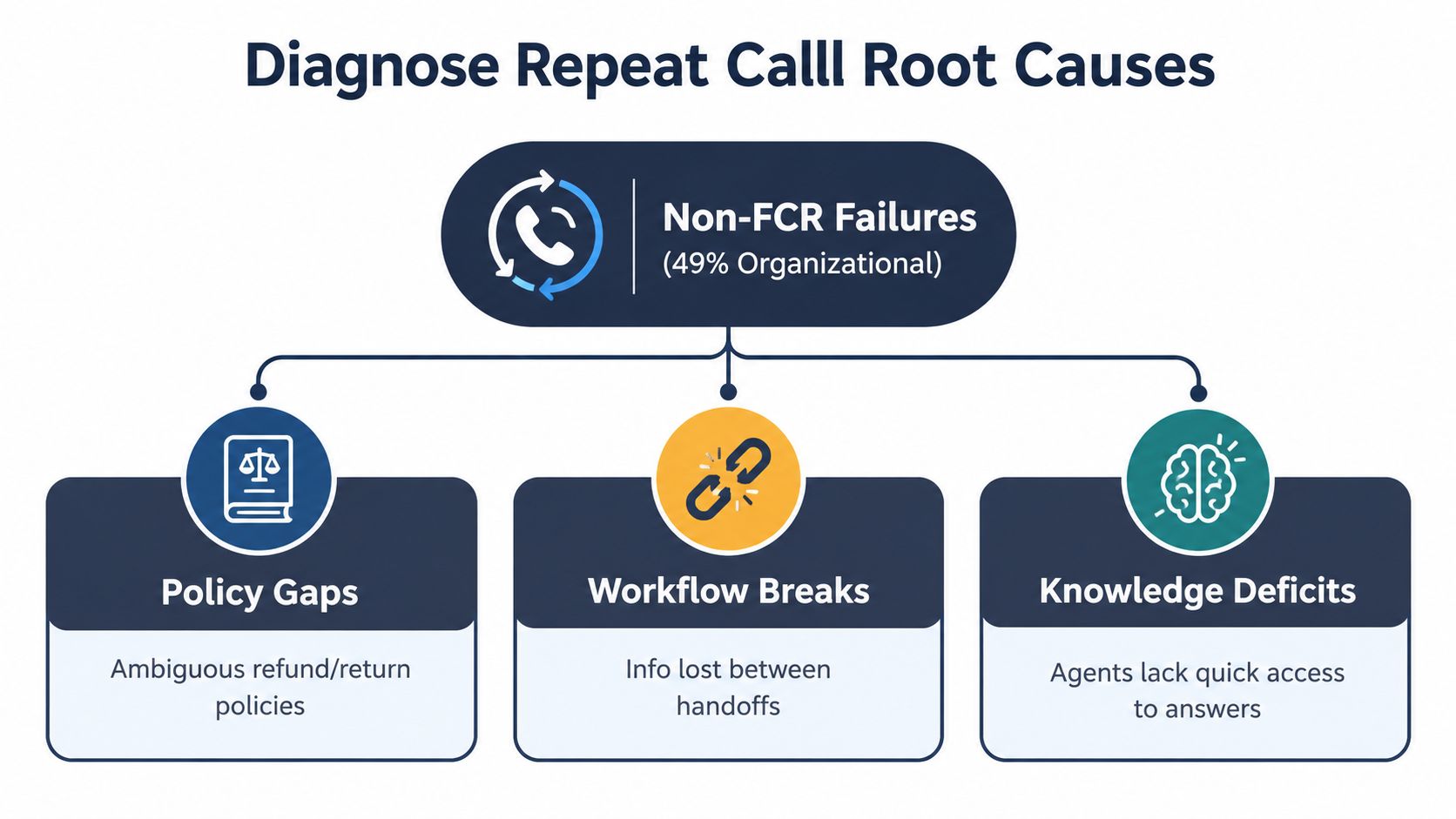
Diagnose the Repeat Calls That Are Killing Your FCR
A caller asks for a job update, but the receptionist cannot see the schedule. Another wants to move an appointment, yet nobody has authority to change it. A third asks about required paperwork and receives a callback instead of an answer. These are process failures before they are coaching failures.
In our experience auditing small-team call logs, most repeat contacts trace back to a blocked system rather than a careless employee. The problem may be missing access, unclear approval rules, disconnected records, or guidance that nobody maintains. Review the workflow before blaming the person who answered.
A field-service business creates repeat demand when staff cannot see the calendar, confirm the service area, quote within an approved range, or check job status. A practice creates it when reception can book a new patient but cannot explain the required paperwork. A professional firm creates it when intake notes sit separately from appointment availability.
Review the last 50 inbound calls
Pull the most recent 50 inbound calls and tag every repeat contact by its actual cause. Avoid labels such as “agent failed.” Use operational categories:
- Status check: The customer could not see whether work had started or a request was progressing.
- Scheduling break: The first responder lacked calendar access or authority to change the slot.
- Incomplete capture: The address, language, urgency, service type, or contact details were missing.
- Information gap: The answer was absent from a maintained knowledge base.
- Handoff failure: Notes disappeared between the phone, calendar, customer record, and field worker.
- Necessary escalation: A professional judgment, safety decision, or exception required another person.
Rank causes by volume, not by the employee with the lowest score. Fix the largest repeat source first.
A searchable knowledge base, accurate customer history, and a routing-aware AI phone assistant can handle routine questions, appointment requests, and qualification in English, Spanish, French, German, and Italian. Keep humans responsible for safety decisions, exceptions, complaints requiring judgment, and cases the assistant cannot understand or resolve confidently. AI can remove routine bottlenecks. It cannot repair an approval policy that nobody has defined.
Separate preventable from necessary repeat contacts. An ambiguous symptom, electrical safety concern, or legal judgment may require escalation. Opening hours, appointment availability, and other approved routine questions usually should not require a second interaction.
The largest bottleneck is often the missing completion path. Review your operational bottlenecks and answer one practical question: what must the first responder be able to access or authorize to finish this request?
Operational Fixes That Lift FCR This Week
You can improve FCR without replacing every system in the business. Start by making the first interaction structured, searchable, and finishable.
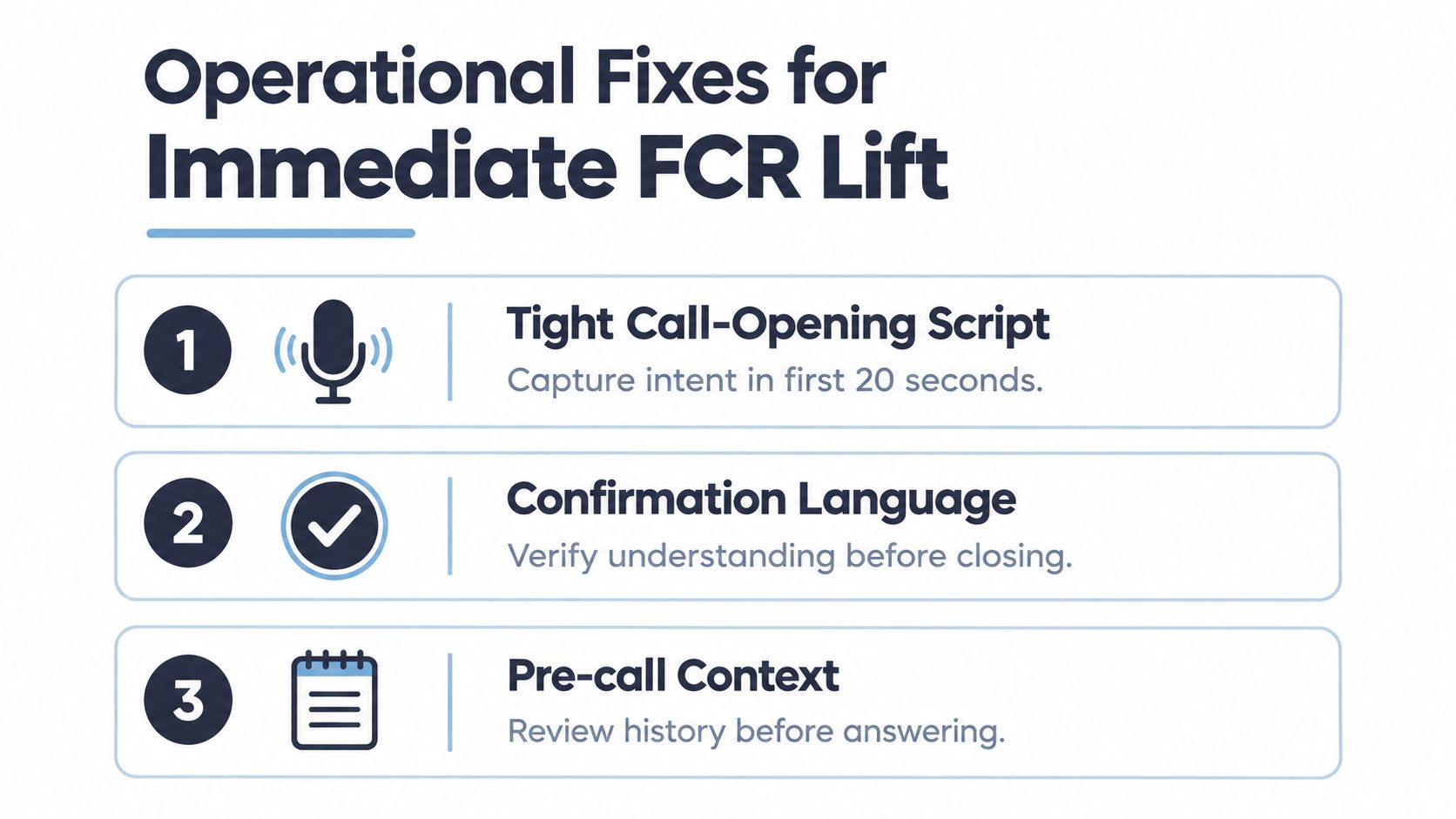
Open with intent, not “How can I help?”
A loose opening forces the caller to tell a long story before anyone identifies the job. Use a compact opener:
“Thanks for calling. Are you looking to book a service, change an existing appointment, check a job status, ask a routine question, or report an urgent issue?”
Then capture the minimum information needed for that intent. For a booking, that may be the service type, location, preferred time, caller name, phone number, and language. For a status request, find the existing customer record before asking the caller to repeat the history.
Your knowledge base should be short enough to use during a live call. Each entry needs:
1. Question or trigger: What the caller is likely to say. 2. Approved answer: The exact information staff or AI may provide. 3. Required details: What must be captured before completion. 4. Authority limit: What the responder may book, change, quote, or promise. 5. Escalation rule: When a human specialist must take over. 6. Last review date: Who owns accuracy.
Don't create a giant manual nobody opens. Build concise playbooks for the repeat causes you identified.
Give people permission to finish
A responder who can see an appointment but can't move it creates a callback. A responder who can explain pricing but can't quote within a defined range creates another conversation. Set explicit authority for routine actions such as booking, rescheduling, confirming service areas, and issuing approved information.
Reducing average handle time without increasing access or authority is a trap. A fast call that leaves the task unfinished produces another call.
Use a practical call-answering structure that moves from intent to required details, action, and confirmation. Before ending, apply this checklist:
- Restate the outcome: “Your appointment is booked for Tuesday morning.”
- Verify completion: “Have we resolved the reason you called today?”
- Confirm the next step: State what happens, when it happens, and who owns it.
- Send a written summary: Use email or SMS where appropriate.
- Record the case: Save the intent, action, status, and language in the customer record.
Closing rule: Never end with “someone will get back to you” unless the record names the owner, action, and deadline.
If a callback is unavoidable, make it a controlled escalation rather than an informal promise. The customer should know what happens next, and the next employee should have the full context.
Where an AI Phone Assistant Actually Helps FCR
AI is good enough today to handle routine phone work, but it isn't a substitute for judgment. The right division is simple: let AI collect, answer, book, summarize, and route. Keep people responsible for safety, exceptions, professional decisions, complaints, and emotionally sensitive cases.
A 2025 survey of 400 U.S. small-business owners found that 51% had integrated AI into customer-service operations, according to Talkdesk's small-business AI survey. Among those adopters, 65% reported faster resolution times, and 94% expected to maintain or grow their human customer-service teams. Those findings support augmentation, not blind automation.
Delegate routine work with clear limits
An AI phone assistant can:
- Greet callers and identify whether they're speaking English, Spanish, French, German, or Italian.
- Capture intent and collect the details required for a booking or lead.
- Answer approved questions about hours, locations, services, preparation, and availability.
- Book appointments through connected calendars or scheduling systems.
- Qualify leads while the owner is driving, on-site, or already helping another customer.
- Send a concise email or SMS summary after the call.
- Transfer an important call to the right person with its context attached.
That removes missed calls and repetitive explanations from the human queue. It also gives the human team more capacity for calls that require actual decision-making.
Start with one narrow workflow. Choose opening-hours questions, service-area checks, appointment requests, or lead qualification. Supply a small maintained knowledge base, require confirmation before booking or changing an appointment, and send a human-readable summary after every call. Measure answer accuracy, completed bookings, escalations, repeat contacts, and missed-call reduction before expanding.
The NFIB's 2025 technology survey found that 24% of U.S. small-business owners were using AI, while 76% were not. Among users, 30% reported increased productivity, 23% reported improved product or service quality, and 9% reported using AI for customer service, according to NFIB's technology and AI report. That gap is a reason to start narrowly, not to wait for a perfect transformation project.
For an owner who wants a managed option, rednea answers routine calls, detects caller language, books appointments, qualifies leads, and sends summaries while transferring cases that need a person. The important control isn't whether the voice sounds natural. It's whether the assistant follows your approved information, confirms actions, and hands off exceptions cleanly.
Designing an Escalation Workflow That Preserves Context
A transfer isn't automatically an FCR failure. A bad transfer is. If the customer must repeat the address, symptoms, job history, preferred language, and reason for calling, your workflow has only moved the frustration to another employee.
Set escalation triggers before deployment. Route the call to a person when the caller reports an emergency, describes an ambiguous symptom, raises a safety risk, requests a legal or compliance judgment, asks for a pricing exception, or specifically requests a named professional. Escalate when the system lacks reliable information rather than encouraging it to guess.
The handoff payload should include:
- Caller name and contact details
- Preferred language
- Original intent and exact requested outcome
- Key facts already collected
- Customer history and open requests
- Transcript or concise call summary
- Promised next step, owner, and deadline
- Reason for escalation
Use CRM matching to connect a new call with an existing open issue. The responder should see that the caller already reported a delayed job or requested a reschedule. That single context check prevents the customer from being treated as a new enquiry.
Call Type Routing for First Call Resolution
| Call type | Best resolved by | Escalate when |
|---|---|---|
| Opening hours, location, service area | AI using approved information | The knowledge base is incomplete or conflicting |
| Routine appointment request | AI or trained frontline staff | No suitable slot exists or the request needs special approval |
| Reschedule within policy | AI or frontline staff with calendar access | The change falls outside policy or affects a specialist |
| Job status request | Human or AI connected to current job data | The status is missing, delayed, or disputed |
| Complaint about service | Human owner or trained specialist | The caller alleges harm, misconduct, or a serious unresolved failure |
| Electrical, medical, or other safety concern | Qualified human | The caller describes immediate danger or ambiguous symptoms |
| Legal judgment or contractual exception | Appropriate professional | The answer requires discretion, interpretation, or formal approval |
Write the routing rules in plain language. Include trigger phrases in all supported languages, but don't rely only on keywords. A calm caller can describe a dangerous situation without using your preferred phrase.
The best escalation feels like continuity. The customer explains the problem once, the human sees the relevant facts, and the next action starts immediately.
Monitoring FCR and Improving It Week After Week
FCR needs a weekly operating rhythm, not a quarterly presentation. Track FCR, repeat-contact rate, transfers, escalations, average handle time, reopenings, complaints, and customer satisfaction together. A rising FCR with more complaints or rushed closures is a warning, not a win.
Customer satisfaction is especially important because each 1-percentage-point improvement in FCR is associated with approximately a 1-percentage-point improvement in customer satisfaction, while satisfaction reportedly falls by about 15% each time a customer calls back about the same issue, according to the FCR statistics summary from Ringly. Use those relationships as a reason to measure experience alongside completion, not as permission to force every call into one interaction.
Run this review every week:
1. Pull repeat contacts and group them by root cause. 2. Choose the highest-volume preventable cause. 3. Update one script, playbook, policy, or system permission. 4. Check whether the AI and human teams use the same approved answer. 5. Review escalations for missing context or unsafe automation. 6. Recalculate FCR using the same denominator and repeat window. 7. Ask a sample of customers whether the issue was fully resolved.
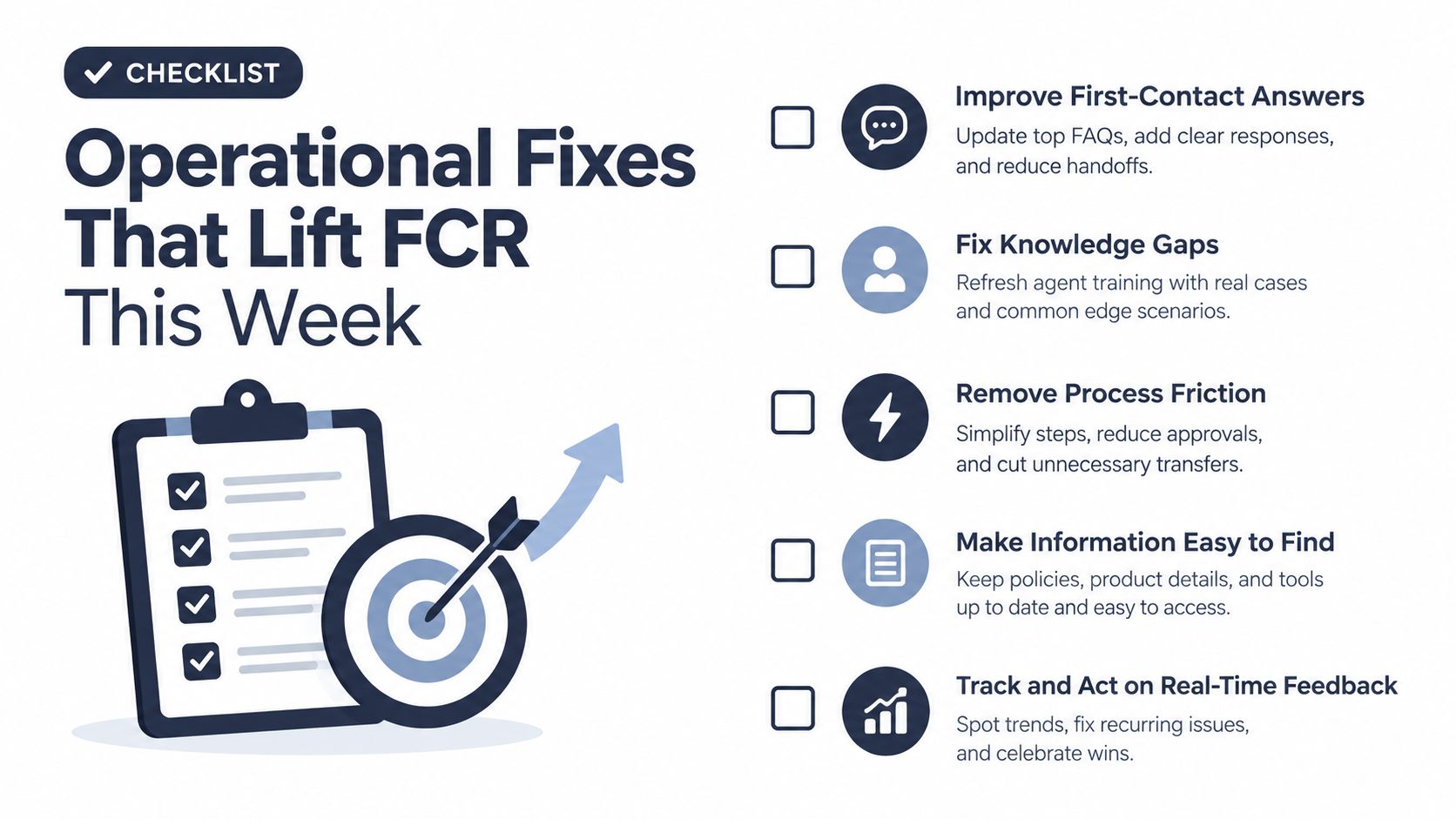
Your Monday checklist is short:
- Confirm the call-opening question.
- Confirm the required fields for each high-volume intent.
- Check calendar and customer-record access.
- Review the knowledge-base owner and latest changes.
- Test one English, Spanish, French, German, and Italian routine call.
- Verify the escalation summary reaches the human recipient.
- Review last week's repeat contacts before changing targets.
Use this confirmation script at the end of every eligible call:
“To confirm, we have [completed outcome]. The next step is [action], owned by [person or team], by [deadline]. Is there anything about this request that remains unresolved?”
The system should then record the answer, not rely on memory.
The practical model is straightforward. AI handles the routine calls it can complete. People handle judgment and exceptions with full context. The business improves the workflow that caused repeat demand. That is how FCR rises without sacrificing safety, trust, or service quality.
---
If missed calls, repetitive questions, and incomplete handoffs are holding your team back, visit rednea to see how an AI phone assistant can answer routine calls, support multiple languages, book appointments, and transfer complex cases with context. Start with one high-volume workflow and give your human team the information they need to finish the rest on the first contact.
Try rednea, no strings attached
AI phone assistant for business. Hear a live demo in your browser, book a call with our team, or get started — from £90/month, cancel monthly, no minimum term.
GDPR-compliant · EU & UK GDPR · Multilingual