Call Center Cost Reduction with AI Assistants

The phone rings while a plumber is under a sink, a dentist is with a patient, or a consultant is in a client meeting. The caller reaches voicemail, waits too long for a response, and contacts someone else. Meanwhile, the same team may spend paid time answering opening-hours questions, collecting appointment details, and repeating information that could have been handled consistently without a human.
That's the practical starting point for call center cost reduction in small and midsize businesses. The goal isn't to cut every conversation short. It's to protect revenue from missed calls, remove repetitive intake from skilled employees, and send important issues to a person with the right context.
The Hidden Cost Drivers in SMB Phone Operations
A caller reaches a small business while the owner is quoting a job, a technician is working on-site, or an administrator is helping another customer. The unanswered call may become a lost appointment, an unquoted job, or a customer who never explains what they need. That revenue risk sits beside the visible cost of answering phones.
Enterprise contact centers often track average handle time, occupancy, and staffing models. Those measures have value, but SMB phone operations face a different constraint: the person answering the phone may also deliver the service. Repetitive intake can pull skilled employees away from billable work, while multilingual callers may abandon the interaction if basic questions are not handled clearly.
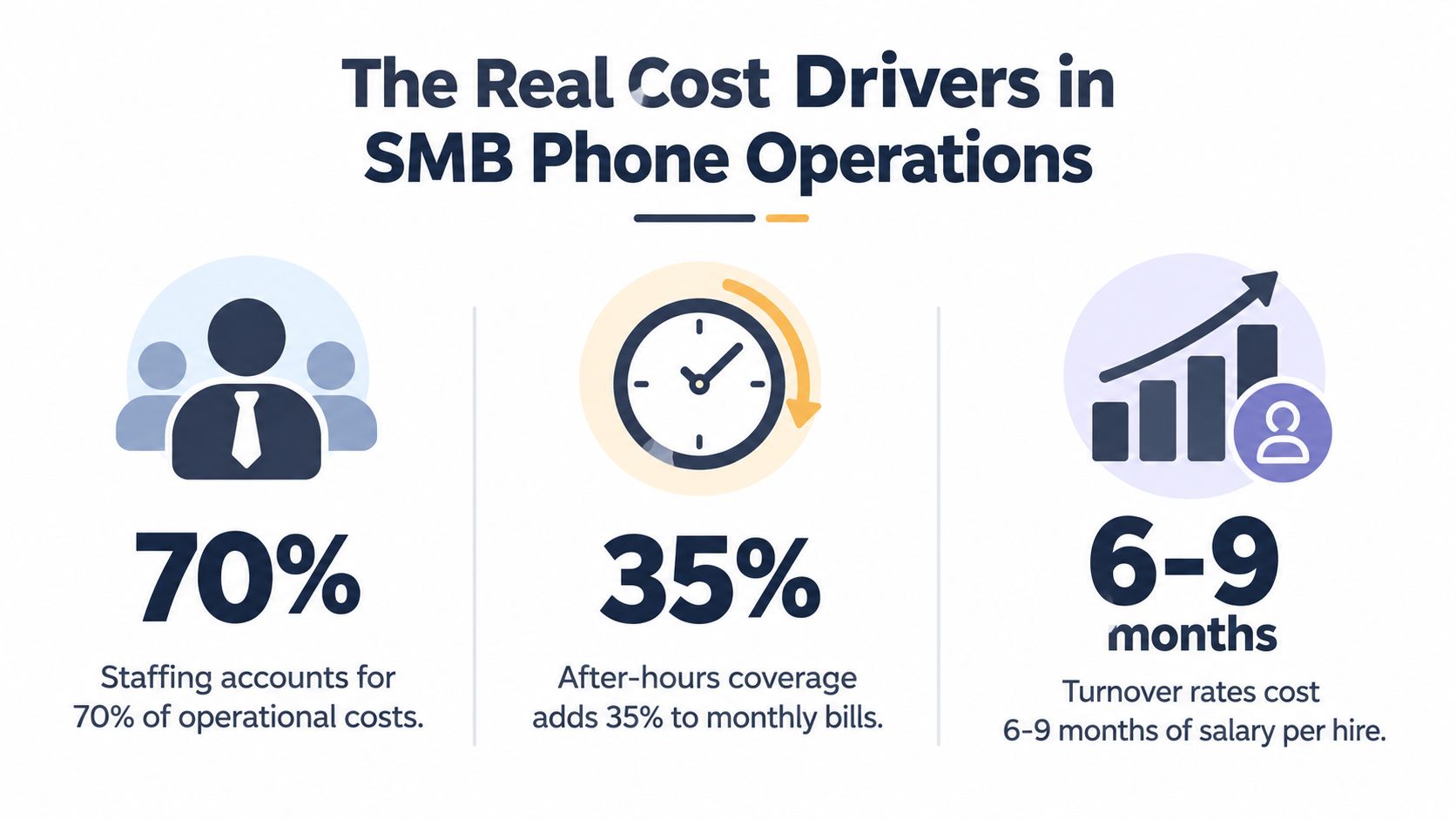
Labor is usually the largest controllable expense. Agent salaries, benefits, payroll taxes, supervision, recruiting, and training commonly represent roughly 75%–85% of total call-center operating costs, while agent labor alone can account for approximately 55%–65% in a representative budget, according to call-center cost benchmarks from JustCall. In a small company, that labor may appear as receptionist time, technician interruptions, owner availability, or administrative work rather than a formal contact-center budget.
Unanswered calls create an invisible operating cost
Small businesses may answer only 37.8% of inbound calls with a live person, according to the cited call-center finance benchmark. That finding changes the cost-reduction question. Owners need to measure both the cost of handling an answered call and the value lost before anyone answers.
A field-service company shows the trade-off. If a technician stops work for every call, productive time falls. If the technician ignores every call, new opportunities disappear. A full-time receptionist may improve peak coverage, yet create paid idle time in quieter periods and add recruiting, training, scheduling, and management work.
Why peripheral savings rarely solve the problem
Lower telecom or office costs can help, but labor utilization usually offers the larger opportunity. Practical levers include fewer avoidable contacts, better routing, improved schedule adherence, more accurate forecasting, and appropriate automation.
AI triage can handle structured, repetitive volume such as opening hours, service areas, appointment requests, basic pricing ranges, lead details, and status updates. Multilingual handling can keep those callers moving without forcing a human employee to repeat the same intake questions. Human agents still need to manage complex complaints, urgent matters, sensitive health or legal questions, and high-value negotiations where judgment affects trust and revenue.
An operational cost-reduction framework should measure both labor consumed and commercial opportunities captured. Cutting minutes while valuable calls disappear is cost transfer, not cost reduction.
Establishing Your Cost Per Contact Baseline
Before buying an AI assistant or changing schedules, build a baseline that reflects the whole interaction. Divide total operating expense by completed interactions, then segment the result by intent and outcome. Include frontline labor, overtime, telephony, software, training, quality management, overhead, and facilities.
Talk time alone produces a misleading number. Average handle time should include talk time, hold time, and after-call work, because an employee may spend as much effort recording details, updating a calendar, or preparing a callback as speaking with the caller.
Start with the calls you already receive
Export recent call logs or review a representative sample manually. Group calls into practical intents rather than vague categories such as “support” or “sales.”
| Call Intent | Volume Share | Human Value | Automation Potential |
|---|---|---|---|
| Opening hours and service area | Record from your logs | Low unless the question signals a purchase | High |
| Appointment requests | Record from your logs | Medium to high because booking creates a commercial outcome | High with calendar controls |
| Lead qualification | Record from your logs | High when budget, urgency, or scope requires judgment | Medium for structured intake |
| Status checks | Record from your logs | Low to medium, depending on account complexity | High when approved data is available |
| Complaints and urgent issues | Record from your logs | High because empathy and judgment matter | Low, with rapid escalation |
| Technical troubleshooting | Record from your logs | High when diagnosis affects safety or cost | Medium for basic triage |
Don't automate the most complicated call just because it takes the longest. Rank intents by volume, handle time, transfers, repeat contacts, and first-contact resolution. The best first candidate is usually high-volume, repetitive, and governed by clear escalation rules.
Build a control panel that catches false savings
Your baseline should show whether an interaction ended successfully, not merely whether it ended quickly. A practical control panel should include cost per contact, service level, occupancy, average handle time, transfer rate, repeat-contact rate, abandonment, escalation, and customer satisfaction, as recommended in contact-center cost-reduction guidance.
Track the outcome after automation. If AHT falls but transfers and repeat calls rise, the system hasn't reduced cost per resolution. It has moved work from the first interaction to the next one.
Use a simple review rhythm:
1. Measure intent volume: Count calls by reason, language, time of day, and outcome. 2. Estimate full interaction cost: Include staff time before, during, and after the call. 3. Identify revenue exposure: Record booked appointments, qualified leads, missed opportunities, and delayed callbacks. 4. Choose a narrow pilot: Start with two or three structured intents. 5. Compare matched periods: Review pre-pilot and pilot periods with similar demand, then inspect transcripts and escalations.
For missed-call analysis, use a missed-call calculator alongside your call logs. The purpose isn't to create a dramatic headline number. It's to decide whether capturing more opportunities is worth more than shaving time from calls that already reach your team.
Deploying Multilingual AI for Routine Triage
A useful AI phone assistant doesn't replace every employee. It removes the predictable first layer of work so people can concentrate on situations where judgment, empathy, or technical expertise affects the outcome.
For a multilingual SMB, that first layer can include detecting the caller's language, explaining opening hours, confirming service areas, collecting contact details, answering approved routine questions, requesting appointment preferences, and routing urgent matters. A multilingual customer-service study reported that real-time language support helped staff handle inquiries in multiple languages and improve response times, without requiring a separate employee for every language.

Start with a narrow conversation design
The safest deployment begins with a short approved knowledge base and a limited set of actions. For a dental practice, that might mean appointment requests, opening hours, location, new-patient intake, and language preference. For an electrician, it could mean service area, emergency classification, job type, address, and preferred callback window.
Write the assistant's boundaries as clearly as its answers:
- Approved answers: Only provide information the business has verified.
- Required fields: Capture the caller's name, contact details, intent, urgency, and relevant appointment information.
- No guessing: If the answer isn't in the approved knowledge base, the assistant should say it needs human help.
- Language continuity: Preserve the caller's language preference throughout the interaction and in the handoff.
- Calendar safeguards: Offer available slots only after checking the connected calendar or scheduling system.
AI is already good enough to complement humans. Structured calls don't require a person to improvise. They require accurate listening, consistent questions, and reliable routing.
Use automation to protect coverage, not just reduce payroll
The strongest business case often appears outside normal hours or during simultaneous calls. A solo professional can keep working while the assistant gathers a lead. A clinic can collect appointment requests while staff are with patients. A contractor can receive an urgent-call summary instead of interrupting a job to conduct a full intake.
Learn the underlying workflow in how AI assistants work, then test the exact conversations your customers have. Don't assume multilingual performance in one language proves quality in another. Review transcripts, pronunciation, intent capture, and escalation behavior separately for each language you support.
The aim is not maximum containment. It's lower labor pressure and higher revenue capture without making customers fight the system.
Designing Smart Escalation Rules for Human Handoffs
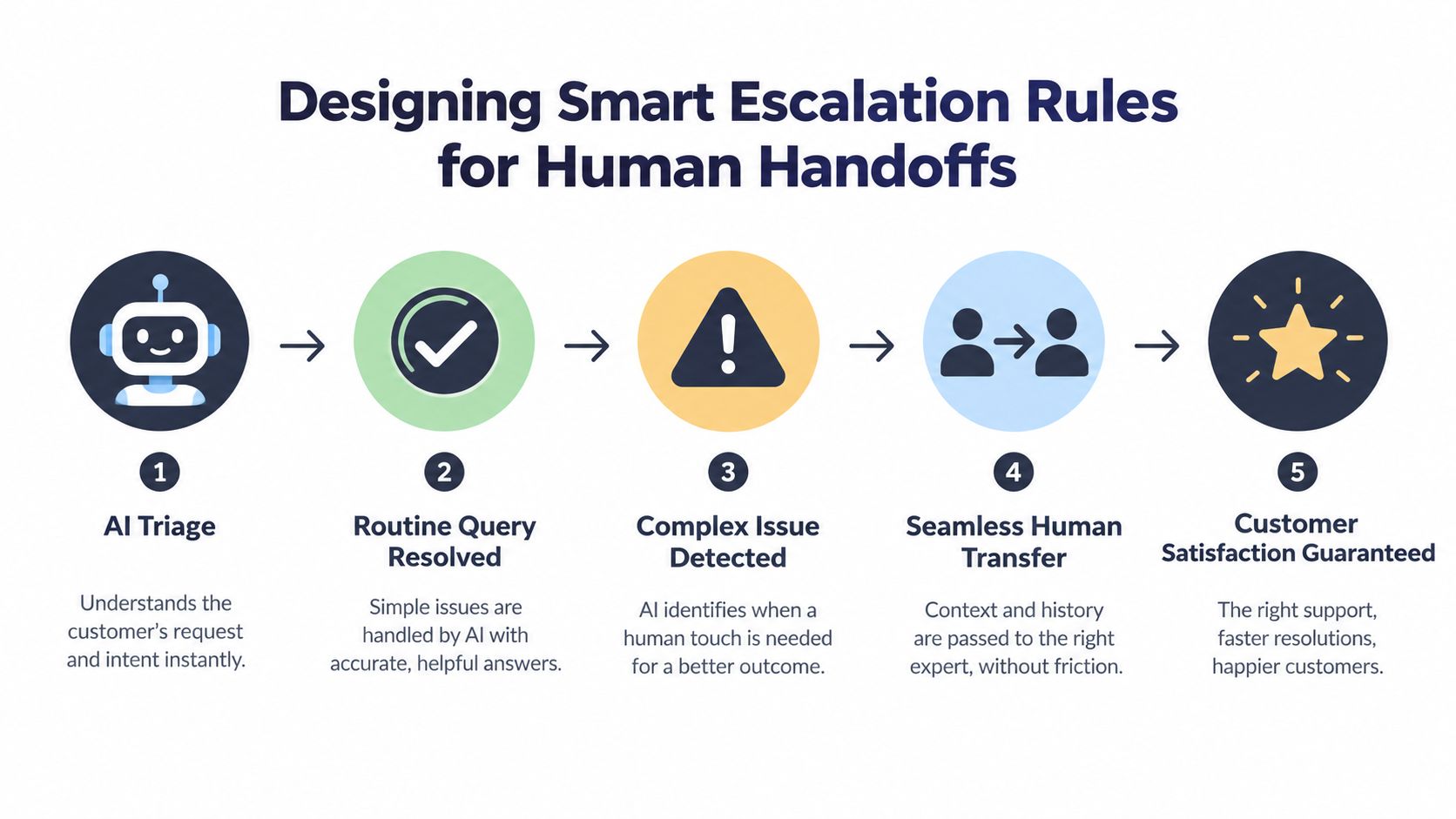
Automation becomes expensive when it creates a failed resolution. A caller who repeats the same information, gets transferred without context, or calls back because the assistant misunderstood the issue has generated more work, not less.
Define escalation before launch. The assistant should know which conditions require a person and how quickly that handoff must happen.
Set boundaries around risk and emotion
A sensible rule set includes:
1. Escalate urgent or safety-related language: Medical urgency, dangerous equipment, active property damage, threats, or other high-risk situations should reach the designated human or emergency process. 2. Escalate after repeated failure: Cap clarification attempts. If the assistant can't identify the caller's intent after two unsuccessful attempts, it should stop asking the same question and transfer or create a callback task. 3. Escalate emotional frustration: Detect rising anger, distress, or repeated objections. A dissatisfied caller often needs ownership and empathy, not another scripted response. 4. Escalate judgment-heavy requests: Legal interpretation, diagnosis, refunds outside policy, unusual pricing, and complex technical decisions belong with trained staff. 5. Escalate high-value opportunities: A large project or time-sensitive lead may justify immediate human attention even when the initial request sounds routine.
A 2025 emotion-aware NLP experiment reported that passing intent, sentiment trajectory, and dialogue history to a human reduced average human resolution time by 32% in the tested system, as described in the published experiment. Treat that result as evidence for a design pattern, not a guarantee for every business.
Make the handoff information-rich
The human should receive a compact summary before speaking with the caller. Include the caller's identity, preferred language, reason for contact, facts already confirmed, requested outcome, urgency, emotional signal, and any action the assistant attempted.
The transfer message should also identify uncertainty. “Caller wants an appointment for a leaking tap, address captured, emergency status unclear” is more useful than “incoming call from customer.”
Practical rule: A handoff that makes the caller repeat the entire conversation is not a handoff. It's a restart.
Test escalation with deliberately difficult calls. Switch languages mid-conversation, provide incomplete information, interrupt the assistant, describe an urgent issue, and express frustration. Review whether the assistant transfers early enough, preserves context, and routes the call to someone who can resolve it.
Measure cost per successfully resolved need, not cost per first interaction. Include transfers, repeat contacts, refunds, missed appointments, human review, and abandoned calls. A cheap first exchange can still produce an expensive customer outcome.
Comparing AI Assistants Against Traditional Hiring
A missed call from a ready-to-book customer can cost more than the minutes saved by a shorter interaction. For a small or midsize service business, hiring another receptionist may feel safer when volume rises. A person remains necessary for discretion, empathy, negotiation, diagnosis, and accountability. Yet one employee cannot cover every language, peak hour, absence, or seasonal surge.
Compare the full operating model
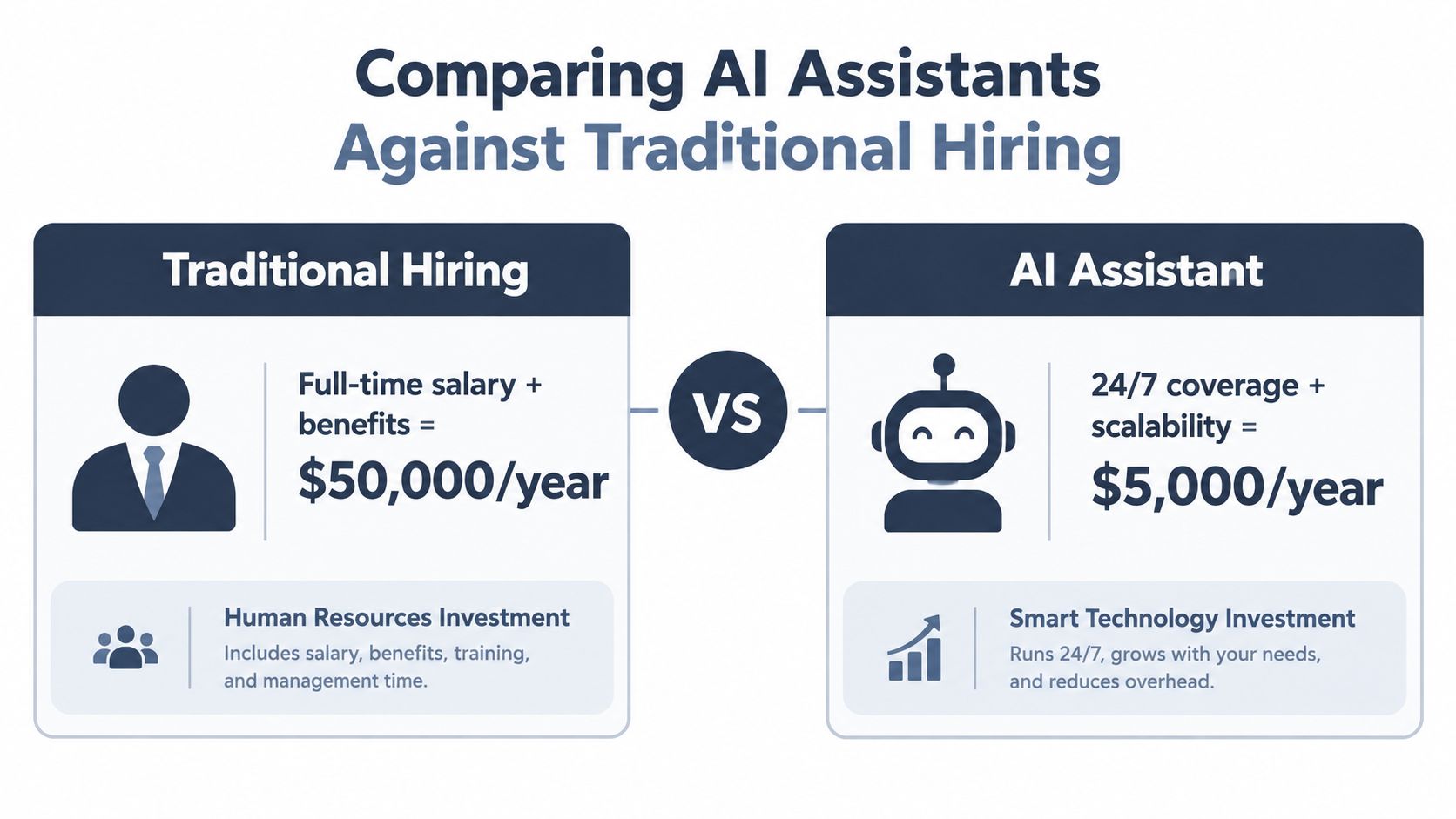
Traditional hiring costs more than wages. Include benefits, payroll, recruiting, training, supervision, paid idle time, absence coverage, scheduling, and replacement costs when someone leaves. For an AI assistant, count subscription or usage charges, integration, setup, monitoring, security, escalation handling, maintenance, and the human time required for exceptions.
Before comparing line items, understand what a modern AI answering service covers. Its cost profile differs sharply from a receptionist salary because it can handle structured calls across changing demand and languages. Compare total cost of ownership over at least three years, including implementation and human oversight, as advised in the cloud contact-center cost analysis. The useful measure is cost per successfully captured or resolved opportunity, including revenue that would otherwise be lost to missed calls.
Use each option where it performs best
| Decision factor | Additional human staff | AI phone assistant |
|---|---|---|
| Complex judgment | Strong | Escalate |
| Empathy and sensitive conversations | Strong | Detect and transfer |
| Repetitive intake | Costly use of skilled time | Strong fit |
| Variable hourly demand | Requires scheduling | Flexible coverage |
| Multilingual first response | Requires language staffing | Suitable for defined workflows |
| Relationship management | Strong | Supports, doesn't replace |
| Simultaneous routine calls | Capacity is limited | Can absorb structured volume |
| Exceptional cases | Strong | Route with context |
Workforce planning still affects the result. Historical benchmarks associate a 10% improvement in forecast accuracy with approximately 5%–8% lower labor costs, while moving from manual scheduling to automated systems has been associated with roughly 20%–30% lower overtime spending, according to workforce-management research. These ranges are benchmarks, not guarantees. They show why matching staffing to demand can matter as much as adding headcount.
Use an AI assistant as a variable first layer, not a barrier between callers and staff. For example, rednea answers routine calls, detects language, books appointments, qualifies leads, forwards important calls, and sends concise summaries for human follow-up. The business sets the escalation rules and response time.
Your 30-Day Implementation and Measurement Checklist
A controlled pilot can start small. Don't begin by automating the entire phone operation. Begin with the calls that are repetitive enough to describe, valuable enough to capture, and safe enough to escalate.
Days one through seven
Audit recent call records and mark each call by intent, language, time, outcome, and whether a human was necessary. Identify missed calls, abandoned calls, delayed callbacks, repeat contacts, and appointments that were requested but not booked.
Select two or three intents for the first pilot. Good candidates include opening hours, service-area questions, appointment requests, basic lead intake, and status checks. Write the approved answers, required fields, forbidden claims, escalation triggers, and human owner for each intent.
Days eight through fourteen
Connect the assistant to the calendar, CRM, scheduling workflow, and notification process. Confirm that the system records the caller's language, captures the required details, and sends a usable summary by email or another approved channel.
Run internal tests before exposing it to customers. Use ordinary calls and failure cases. Check accents, background noise, interruptions, incomplete answers, language changes, urgent requests, and callers who ask for a person immediately.
Days fifteen through twenty-one
Launch with a clear monitoring window and review conversations every day. Don't judge success by containment alone. Track:
- Cost per resolved case: Include AI usage, human review, transfers, and follow-up.
- Appointment-booking rate: Measure completed bookings, not merely booking conversations.
- Lead response time: Record how quickly a qualified opportunity reaches the right person.
- Missed-call recovery: Compare captured opportunities with the prior baseline.
- Repeat-contact rate: Look for callers who return because the first interaction failed.
- Escalation quality: Check whether the right calls reached the right human with context.
- Customer satisfaction: Collect direct feedback where practical.
A study summarized in the research on generative AI at work found that AI assistance increased customer-support issues resolved per hour by 14% on average, with the improvement reaching about 34% for less-experienced workers. Use that as directional evidence for agent assistance, not as a forecast. Your own cost per resolved case and service quality should determine expansion.
Days twenty-two through thirty
Compare matched pre-pilot and pilot periods. Listen to failed calls, inspect multilingual transcripts, review missed escalation triggers, and calculate whether the assistant reduced human workload without increasing repeat contacts or lost opportunities.
Document data retention, access permissions, recording notices, and deletion procedures. For businesses serving customers in the EU or UK, confirm that the workflow supports GDPR obligations and that sensitive information isn't collected unless it's necessary for the defined task.
Then make one of three decisions: expand to another routine intent, revise the current flow, or stop the pilot. Stage gates protect both cash and trust. If customers still need to repeat themselves, the next investment should improve handoff quality, not add more automation.
---
rednea provides an AI phone assistant for routine intake, appointment booking, lead qualification, multilingual first-line support, and human escalation, helping small teams reduce missed opportunities without removing people from complex conversations. Visit rednea to review how a controlled phone-operations pilot could fit your business.
Try rednea, no strings attached
AI phone assistant for business. Hear a live demo in your browser, book a call with our team, or get started — from £90/month, cancel monthly, no minimum term.
GDPR-compliant · EU & UK GDPR · Multilingual