Business Scalability for Small Teams: A Practical Guide

A two-person plumbing company can have more work than it can physically complete and still lose profitable jobs every week. The owner is on-site, hands wet, tools out, while a new customer calls twice, reaches voicemail, and hires the next company that answers. Nothing is wrong with demand. The bottleneck is the owner's attention.
That pattern appears in electrical work, dental practices, legal offices, property services, consulting, and almost every appointment-driven business. The company grows until the founder becomes the dispatcher, estimator, receptionist, complaint handler, and emergency contact at the same time. Business scalability starts when the company can absorb more demand without adding more owner hours.
The Moment a Small Business Hits Its Scaling Wall
The owner is halfway through a complicated installation when the phone rings. They can't answer without stopping the job, and nobody else can confidently discuss the service area, urgency, pricing range, or next available appointment. The caller leaves a voicemail, perhaps sends a form, and moves on before the owner can return the call.
This is the classic small-business scaling wall. Revenue may be rising, but capacity hasn't. Every new customer creates another interruption, another callback, another scheduling decision, and another piece of work that only the owner knows how to complete.
The problem is easy to misdiagnose. Owners often assume they need more advertising, a larger office, or another technician. Sometimes they do. But hiring before removing the communication bottleneck only gives the business more leads to mishandle and more people to coordinate.
Operator's rule: If the owner must personally answer every serious enquiry, the business hasn't built capacity. It has built dependence.
Scalability isn't a vanity revenue chart. It's the ability to preserve response speed, service quality, and operational control while demand increases. A company that adds jobs only by adding interruptions is growing, but it isn't scaling.
Start with the phone layer because it sits at the entrance to the entire operation. Review when calls arrive, which calls require the owner, how many callers abandon the process, and how much time disappears into phone tag. A useful framework for thinking about immediate response and availability is this guide to immediate availability.
The practical test is simple. Choose one recurring call type, such as appointment requests or service-area questions, and remove the owner from that step. If customers still receive a prompt, accurate answer and qualified requests still reach the calendar, you've found the first layer of scalable capacity.
What Business Scalability Actually Means for SMBs
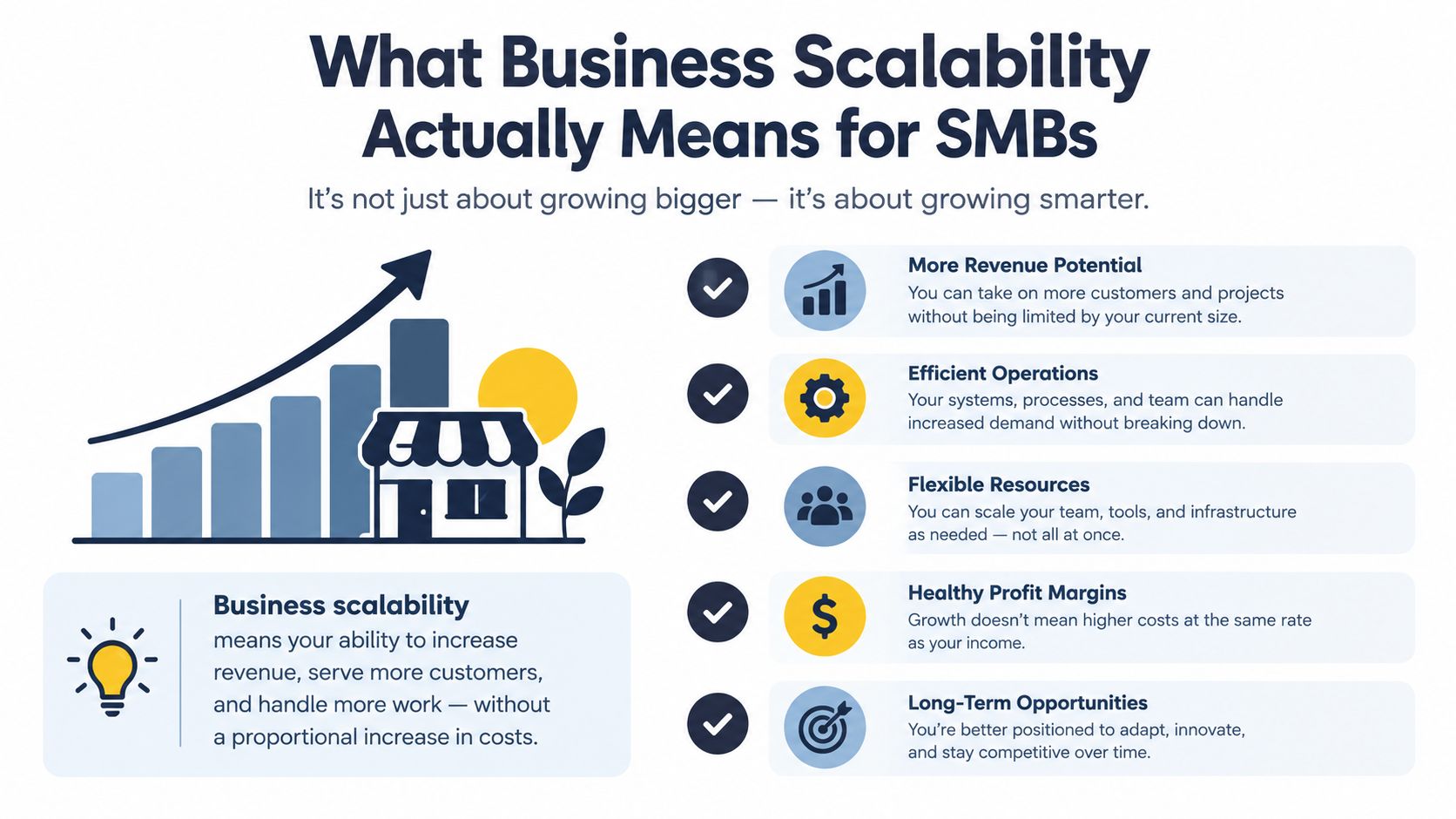
Business scalability means revenue can grow faster than the cost and attention required to deliver it. In a service business, that means the next booked job shouldn't automatically require another hour of owner involvement. A scalable operation uses repeatable processes, clear rules, and technology to absorb routine demand while humans focus on work that requires judgment.
Simple growth is different. A business adds a customer, then adds a proportional amount of labour, coordination, and stress. The owner may earn more, but the operating model becomes more fragile. One sick employee, busy afternoon, or missed call can expose the entire system.
The OECD benchmark provides a useful distinction. Across 16 OECD and candidate countries, SMEs with 10 to 249 employees created 16 additional jobs for every 10 jobs created by large firms, according to research summarized on business scalability. The same work defines “scalers” as firms growing at an average rate of at least 10% per year over three years in employment, turnover, or both. It found that 16% to 27% of SMEs qualify as scalers, making sustained, above-trend expansion relatively rare.
For a small company, don't copy the OECD definition mechanically. Translate it into an operating test:
Track productivity, not just headcount
Measure whether revenue per employee is holding or improving as the team grows. If adding a person only creates more coordination and no additional productive capacity, you're ramping up rather than scaling.
Separate owner-dependent revenue
Mark the share of revenue that can be generated, booked, delivered, and followed up without the founder personally intervening. A business becomes more resilient as that share rises.
Watch recurring and repeatable work
Recurring contracts, standard service packages, and repeatable appointment flows create more predictable capacity than a stream of highly customised jobs. Standardisation doesn't eliminate expertise. It reserves expertise for the exceptions.
Review these three indicators quarterly:
- Revenue per employee: Is each additional team member increasing productive output?
- Owner-independent revenue: Can customers buy and receive the service without the founder acting as the central switchboard?
- Process reliability: Do routine requests follow the same path every time?
Documenting those paths is the foundation of workflow optimization for growing businesses. The objective isn't automation for its own sake. It's to make the next unit of demand easier to serve than the last.
The Owner's Time as the Scaling Bottleneck
A small business can have more demand than its owner can handle. The owner delivers the service, answers enquiries, prepares quotes, reschedules appointments, gathers customer information, and calms existing clients. Each task competes for the same limited resource: the owner's attention. That workload creates a ceiling before the market runs out of opportunities.
Research from Simply Business found that 54% of owners said lack of time was their primary barrier to expansion, while 80% handled all administrative and financial tasks themselves and 90% still relied on personal funds to stay afloat. Those findings appear in the 2026 Small Business Growth Gap Report. Owner overload reaches sales, delivery, hiring, and cash flow at the same time.
A missed call carries a financial cost. An inbound enquiry might lead to a large repair, a recurring contract, or a professional-services relationship. The value varies by market, so calculate it from your own booked jobs and lost opportunities.
Owner Time as a Bottleneck: Cost of Missed Calls
| Trade | Average Job Value | Missed Calls / Week | Weekly Revenue at Risk |
|---|---|---|---|
| Plumbing | Calculate from closed jobs | Pull from call records | Average job value multiplied by lost qualified calls |
| HVAC | Calculate from closed jobs | Pull from call records | Average job value multiplied by lost qualified calls |
| Roofing | Calculate from closed jobs | Pull from call records | Average job value multiplied by lost qualified calls |
| Professional services | Calculate from signed matters or retainers | Pull from call records | Average initial value multiplied by lost qualified calls |
Use actual records instead of invented benchmarks. An observational study of 85 businesses across 58 industries found that only 37% responded within an hour, the average first response took 42 hours, and 23% never responded at all, according to missed-call response research.
Every delay makes the owner a single point of failure. A person cannot work on a roof and join a discovery call at the same time. Driving is a poor setting for accurate quoting, and routine questions interrupt billable production when they reach the owner directly.
The first hire shouldn't always be another technician. Removing the owner from repetitive customer-access tasks can produce more capacity before another technical employee is needed.
Turn the owner's experience into a repeatable operating asset. A practical resource on turning expertise into a playbook can help identify decisions that currently exist only in the founder's head. Document those rules, then assign predictable requests to an assistant, coordinator, or AI system while the owner retains complex work.
Protect billable time first. Make routine customer access reliable. Add people once the remaining workload requires human capacity. That sequence frees attention before payroll becomes the answer.
Hiring More People vs Extending the Team With AI
Hiring and AI solve different capacity problems. A person brings judgment, relationship skills, and the ability to manage ambiguity. An AI phone assistant brings continuous availability, consistent handling of repeatable requests, and fast deployment without waiting for recruitment and onboarding.
Don't choose based on enthusiasm for technology. Choose based on the type of work entering the business.
| Criterion | Hiring a Person | Extending With AI |
|---|---|---|
| Cost structure | Payroll, training, management, and absence coverage | Subscription or usage-based operating cost |
| Speed to coverage | Requires recruitment, selection, onboarding, and process training | Can be configured around existing FAQs and routing rules |
| Routine enquiries | Handles them well, but capacity depends on availability | Handles repeatable questions consistently |
| Complex conversations | Stronger at negotiation, empathy, and nuanced judgment | Should escalate when context or emotion exceeds its rules |
| After-hours coverage | Requires shifts, rota planning, or external coverage | Can provide continuous first response |
| Peak demand | Limited by the number of available people | Can absorb concurrent routine enquiries within configured capacity |
| Best use | Trust-heavy, complicated, or commercially sensitive calls | Scheduling, qualification, FAQs, routing, and overflow |
Cloud-based call systems can add virtual agent capacity during seasonal or campaign-driven spikes, use hybrid routing, and move complex calls to specialists. Industry guidance also reports that cloud-based inbound solutions can reduce total cost of ownership by 27% versus on-premises systems, as described in cloud inbound call centre guidance.
That doesn't make AI a replacement for staff. It makes AI a way to extend a lean team. A human receptionist may be the right choice when customers need reassurance, negotiation, or detailed case management. An AI assistant is often the better first layer when the queue consists of appointment requests, opening hours, service areas, status checks, and qualification questions.
For a grounded overview of practical automation choices, review these expert tips from MakeAutomation. The useful question isn't “Can AI do everything?” It's “Which part of the call can AI complete accurately before a human needs to step in?”
Use an AI receptionist when the business needs reliable first response but doesn't yet need a full additional employee. Keep human ownership of complaints, sensitive pricing discussions, safety issues, and high-value relationships.
How an AI Phone Assistant Scales Operations in Practice
A small service company doesn't need an elaborate transformation project. It needs a phone workflow that answers predictable questions, captures useful information, and hands the right calls to the right person.
Start with access
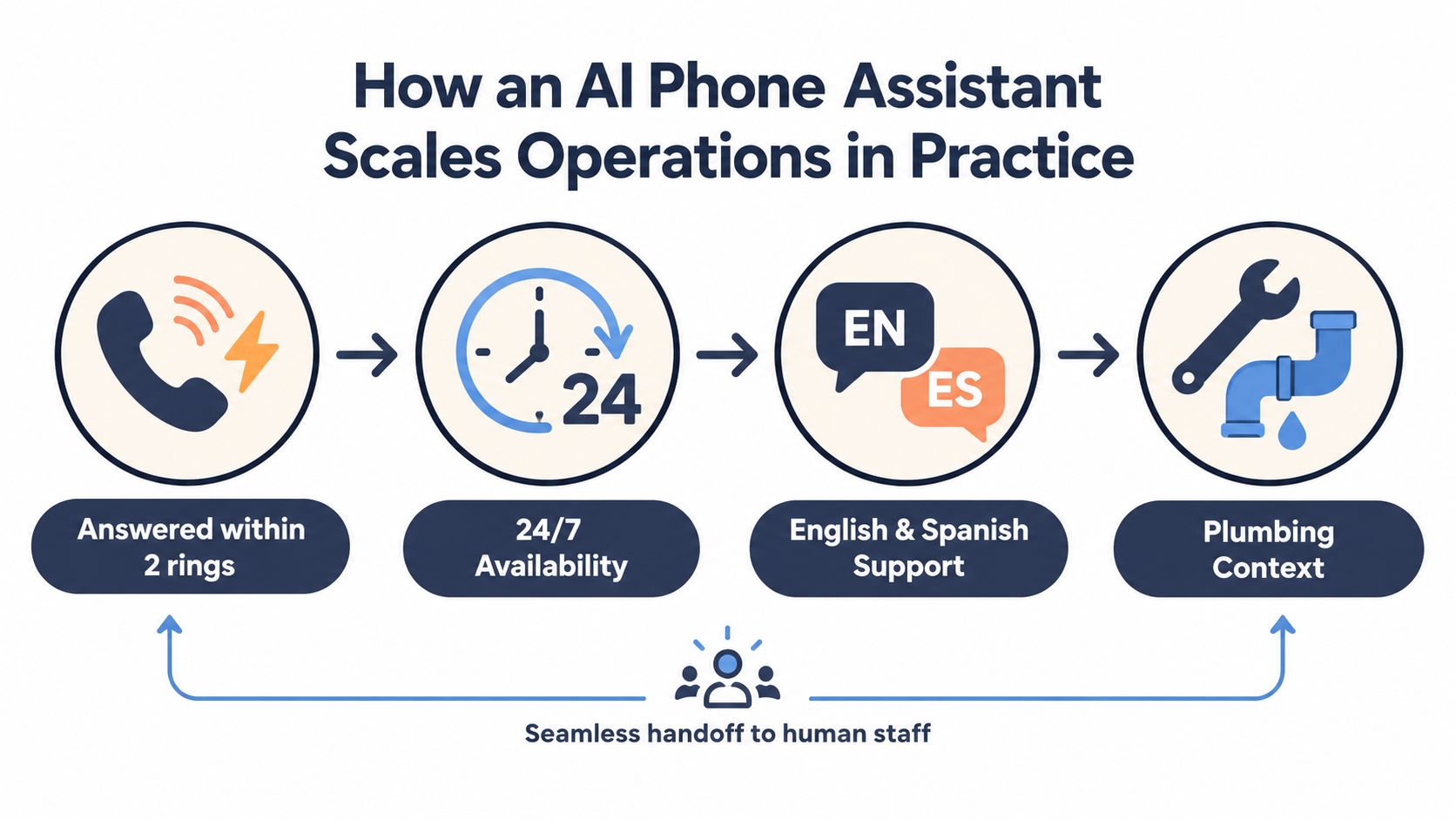
The first job is answering. A configured AI phone assistant can respond during working hours, evenings, weekends, and periods when the owner is already serving another customer. It can greet callers in the language they use, including English and Spanish, and continue with a structured conversation instead of sending every enquiry to voicemail.
That matters for emergency and appointment-driven work. A plumbing company can capture a weekend leak enquiry while technicians remain focused on jobs. A dental practice can collect appointment preferences while the front desk is occupied. A solo consultant can receive a complete intake summary without stopping a client meeting.
Automate the predictable layer
Routine requests make good first candidates:
- Scheduling: Offer available appointment windows and confirm the caller's preferred time.
- Service-area checks: Confirm whether the address falls within the operating area.
- Job qualification: Capture the type of work, urgency, location, and relevant context.
- Common questions: Explain service categories, preparation requirements, operating hours, and next steps.
- Status requests: Collect identifying information and route the enquiry to the person who can resolve it.
The assistant shouldn't improvise beyond the company's approved information. Give it clear boundaries, approved answers, and escalation rules. If the caller asks for a complex quote, disputes an invoice, reports a safety concern, or becomes upset, the system should transfer or create a priority follow-up rather than forcing an automated resolution.
Turn calls into scheduled work
The highest-value connection is usually the calendar or customer system. A qualified call should create a usable record, not just an audio file. Capture the caller's contact details, job type, urgency, location, requested service, and agreed next step.
For professional services, that might mean screening a new matter and presenting only qualified prospects to the founder. For field services, it might mean placing a job request into the dispatch queue with enough context for the team to act.
Confirmation and reminder messages can also reduce manual follow-up. Don't assume automation solves every attendance problem, but do remove the avoidable work of repeatedly confirming appointments and sending basic instructions.
Good automation ends with a clean handoff. The customer shouldn't have to repeat the entire story when a human joins.
An AI answering service can sit in front of the existing office line, handle overflow, and preserve the owner's attention for billable work. The result is not “AI replacing the team.” It's a clearer division of labour, with software handling speed and repetition while people handle judgment.
Why AI Is Good Enough to Complement Your Team
AI doesn't need to perform like a perfect human to create value. It needs to handle routine conversations consistently, respond quickly, capture accurate details, and recognise when a person should take over.
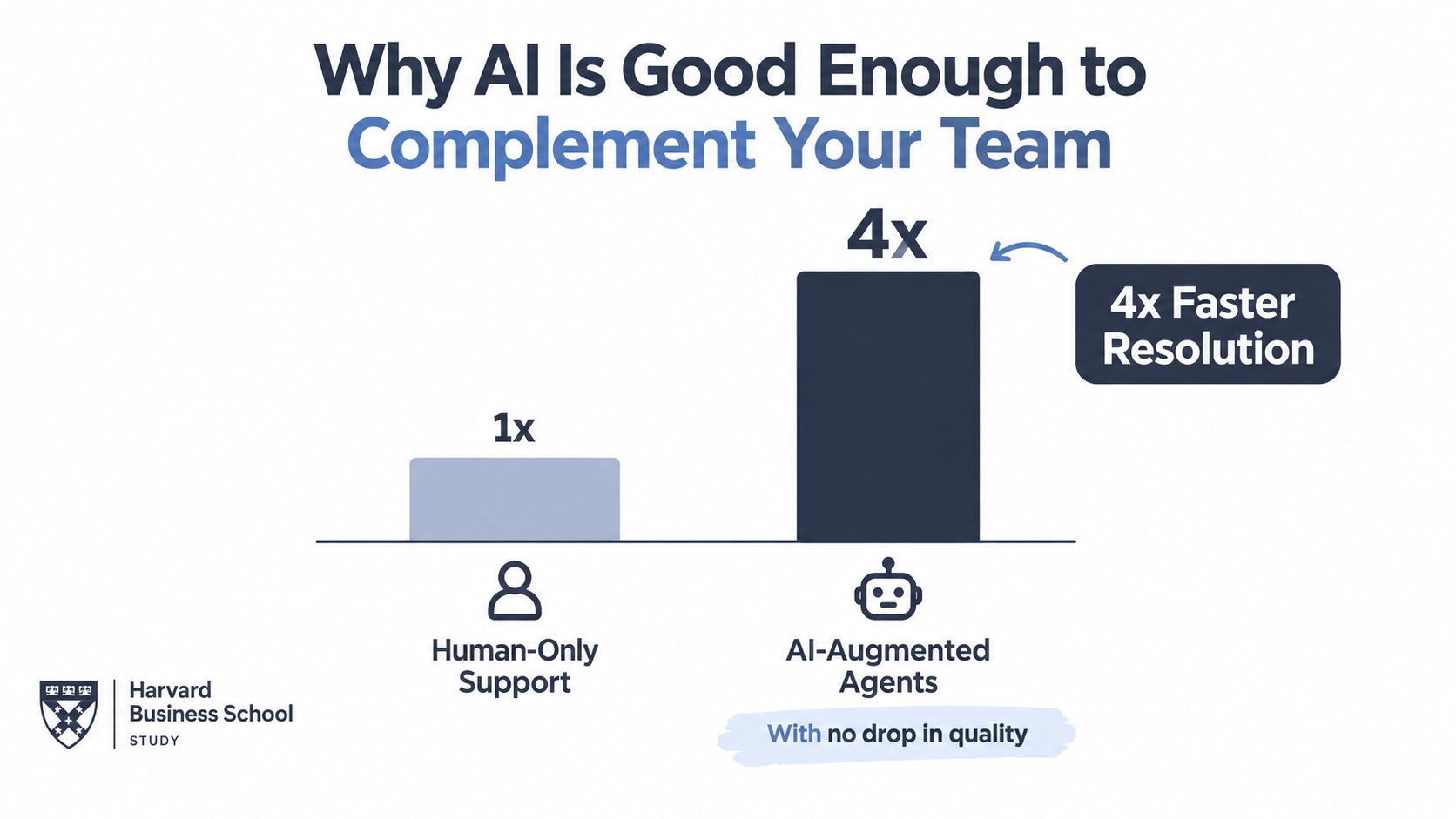
A Harvard Business School analysis of 256,934 chat conversations found that AI suggestions made human agents about 20% faster overall, including a 22% drop in response times and a 0.45-point increase in customer sentiment on a five-point scale. The largest gains went to less experienced agents, which supports a practical conclusion: AI can strengthen human performance rather than merely remove human work. The findings are discussed in Harvard Business School's analysis of AI-assisted customer conversations.
Response speed has its own effect. In an experimental study, customers reported significantly higher satisfaction when a chatbot replied in 0.5 seconds rather than 10 seconds, according to research on chatbot response speed. A separate multi-company study reported average response time falling from 4.5 minutes to 2.9 minutes, a 35% reduction, after chatbot implementation, as documented in the study hosted by HAL.
The lesson for a small business is not to automate every interaction. It's to acknowledge the customer immediately and solve the routine part without making them wait for a person who is currently unavailable.
Generative AI contact-centre systems are also described as always-on, capable of handling simple queries, supporting live translation, and providing personalised responses in McKinsey's contact-centre analysis. That makes multilingual and after-hours support realistic starting points for small teams.
AI still loses when the call depends on emotional intelligence, subtle negotiation, accountability, or trust built over time. Route those conversations to people. Let AI handle volume, speed, language detection, basic qualification, and availability, then let your team handle empathy, judgment, and commercial decisions.
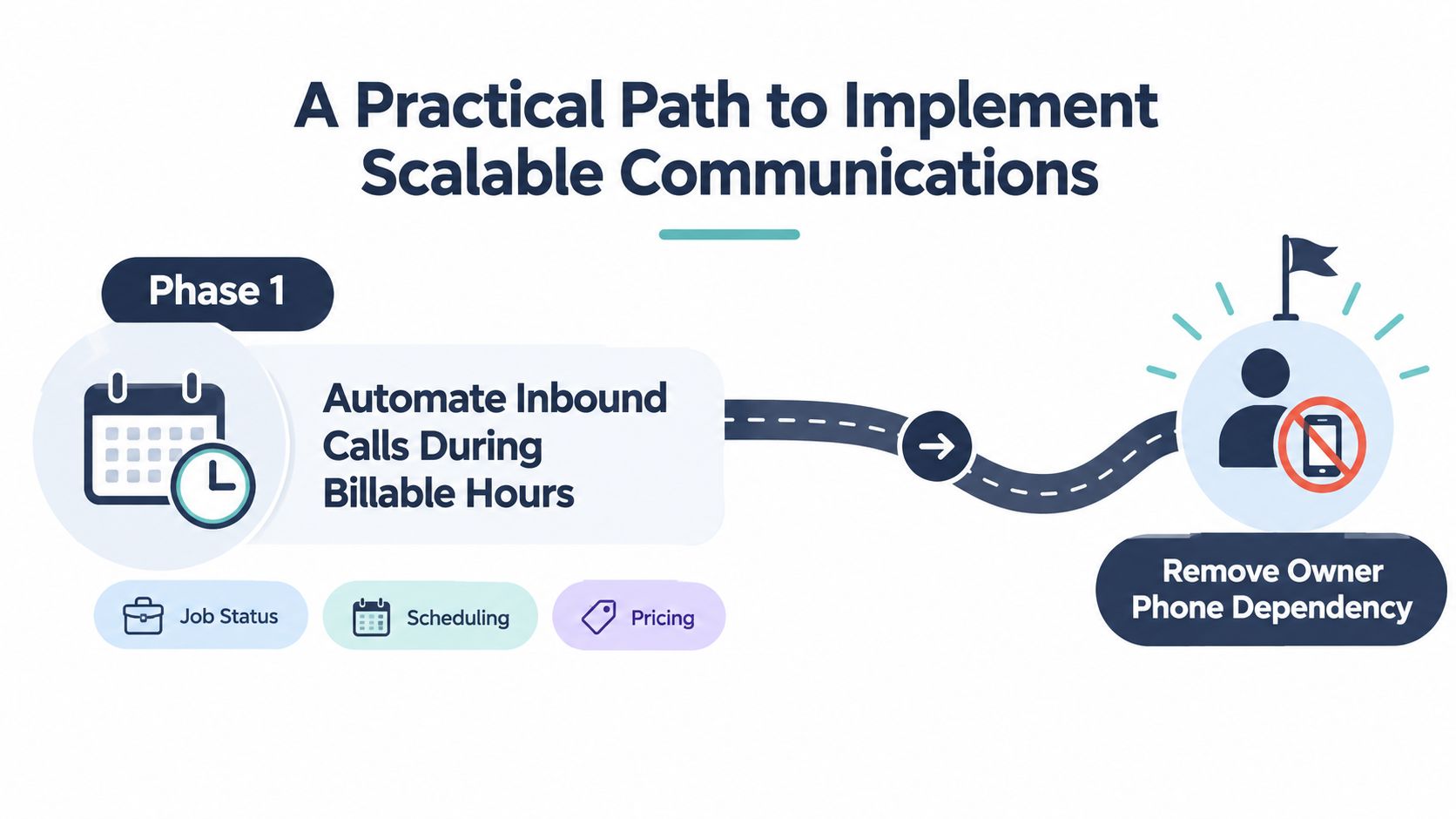
A Practical Path to Implement Scalable Communications
Don't automate the entire phone operation on day one. Start with the calls that consume attention but rarely require expertise.
Build the first call map
Review recent call records and group enquiries by purpose. Typical first candidates include job status, appointment requests, service-area checks, opening hours, and basic pricing questions. Write the approved answer for each one, including what the assistant must never promise.
Then define the human boundary:
- Emergency or safety issue: Escalate immediately or follow the emergency protocol.
- Complaint or vulnerable caller: Route to a trained person.
- Quote negotiation: Capture the details and assign a human.
- Unclear request: Ask a clarifying question, then escalate if uncertainty remains.
- Repeated failed attempts: Stop the loop and create a human follow-up.
Connect the workflow
The phone assistant should connect to the calendar and customer record. A booking without customer details creates more work later. A lead without a next action is still a lead sitting in a queue.
Set up the minimum useful fields:
1. Caller name and contact details. 2. Service requested. 3. Location or service area. 4. Urgency and preferred timing. 5. Summary of the conversation. 6. Assigned person and next action.
Add the top frequently asked questions, test different accents and phrasing, and call the system as if you were an impatient customer. Test cancellations, rescheduling, unclear addresses, duplicate bookings, and calls that switch languages.
Pilot before expanding
Run the first version during billable hours, when the owner's interruptions are most expensive. Keep sensitive and complex calls human. Review transcripts weekly, correct weak answers, and expand only after the basic route works.
Then extend coverage to overflow and after-hours calls. Track missed-call rate, first-response time, completed bookings, escalation quality, and owner hours spent on phone work. Scripts can be adjusted quickly, so treat the workflow as an operating document rather than a one-time software installation.
The implementation checklist is short:
- Define the first call types.
- Write approved answers.
- Set escalation rules.
- Connect the calendar and customer system.
- Test edge cases.
- Measure booking and missed-call outcomes.
- Review conversations and improve the script.
- Expand coverage gradually.
Your Scalability Checklist and Next Steps
Scalability begins with reclaimed attention. Revenue follows when the owner can deliver billable work, improve the operation, and support the team instead of constantly interrupting those activities to answer routine calls.
Audit these indicators this week:
- Missed-call rate: Aim for less than 10%. If your current rate is higher, fix access before increasing lead generation.
- First-response time: Aim for less than 30 seconds for routine inbound enquiries.
- Booking conversion: Aim for more than 60% of qualified enquiries becoming scheduled work.
- Owner phone time: Aim for fewer than 5 hours per week spent on routine customer access and follow-up.
These are operating targets, not universal laws. Use them to expose friction, then adjust them to your service model and margins. The important point is to measure the phone layer separately from total revenue, because revenue can rise while owner capacity deteriorates.
Watch for warning signs:
- Callbacks accumulate after the working day ends.
- Customers mention voicemail or slow responses.
- The owner skips billable work to answer enquiries.
- Technicians receive incomplete job information.
- The calendar contains gaps even though demand is strong.
- Staff spend time repeating answers that could be standardised.
Pick one call type and automate it for a trial week. Compare the number of answered enquiries, completed bookings, escalations, and owner callback hours with the previous week. If the customer experience holds and the owner gets meaningful time back, expand to the next repeatable call type.
---
rednea gives small teams a 24/7 AI phone assistant that answers routine enquiries, detects the caller's language, qualifies leads, books appointments, and escalates important conversations to people. Visit rednea to test a practical way to increase customer access without making the owner the bottleneck.
Try rednea, no strings attached
AI phone assistant for business. Hear a live demo in your browser, book a call with our team, or get started — from £90/month, cancel monthly, no minimum term.
GDPR-compliant · EU & UK GDPR · Multilingual