Operational Cost Reduction: A Practical Playbook

A missed call doesn't look like a cost on the income statement. It looks like a customer who never calls back, a quote that never gets sent, or an empty appointment slot that nobody notices until the end of the week. A technician's unnecessary return visit looks like a scheduling problem, but it also consumes labor, fuel, capacity, and margin.
That's why operational cost reduction for trades and small businesses should start with the leaks closest to daily work: unanswered inbound calls and reactive field-service work. You don't need a company-wide transformation to address them. You need clear measurements, tighter processes, and AI that handles routine customer contact while your people focus on judgment, relationships, and skilled work.
The Day Operational Cost Reduction Stops Being Theory
Mike owns a small HVAC business with three trucks. On a Tuesday morning, a customer calls while his dispatcher is already handling another appointment. The call rings out. A second caller leaves no message because the first call still hasn't finished.
Neither missed call appears as a line item marked “lost margin.” Mike sees only a quieter schedule later in the week.
Before lunch, one of his technicians drives forty minutes to investigate a thermostat complaint. The system is working normally. The customer needed basic guidance, but nobody captured enough information during the first conversation to resolve the issue remotely. A few days later, the same customer needs a return visit because the original job notes don't clearly record what the technician checked. Mike absorbs $180 in unbillable labor.
By midday, he estimates that the business has lost $620 in margin through missed demand, unnecessary travel, and rework. The accounting system may classify those costs under payroll, fuel, or general overhead. Operationally, they all have the same cause: the business failed to resolve work efficiently the first time.
The leaks owners feel first
A missed call is an incomplete sales process. A needless truck roll is an incomplete diagnostic process. A callback is an incomplete knowledge process. Each one forces the business to spend resources twice or leaves revenue uncaptured altogether.
The problem isn't that Mike's team is careless. His dispatcher is busy, his technician is moving between jobs, and his customers expect immediate answers. A small service business can lose money without making any obviously bad decision. The cost hides inside normal activity:
- Inbound demand: Calls arrive when nobody can answer.
- Scheduling: Jobs get assigned by habit instead of route density or urgency.
- Field work: Technicians repeat checks because prior information isn't easy to find.
- Follow-up: Quotes and callbacks wait until someone has spare time.
Practical rule: Start by removing the work your team shouldn't have to repeat. Don't begin with a blanket cut to people or service quality.
Operational cost reduction becomes useful when it lowers the cost of completing a call, appointment, or job while preserving the result the customer paid for. The playbook below targets the points where trades and SMBs lose money in motion, not abstract efficiency targets that never reach the dispatch board.
What Operational Cost Reduction Actually Means
Operational cost reduction means lowering the resources required to deliver one unit of work. That unit might be a completed repair, a handled customer call, a booked appointment, a delivered quote, or a resolved support request.
It isn't the same as cutting the budget and hoping performance holds. Hiring freezes, broad payroll reductions, and procurement squeezes can reduce spending while also reducing capacity. If fewer people answer the phone, more calls go unanswered. If dispatchers have less time to prepare technicians, repeat visits become more likely.
A better test is simple: does the customer receive the same or better outcome at a lower delivery cost?
Three cost buckets you can act on
Labor cost per job is the time your team spends completing the work. For a plumber, that includes diagnosis, preparation, travel, installation, documentation, and customer explanation. If a technician spends extra time searching for job history or waiting for approval, the job costs more even when the invoice stays unchanged.
Rework and callbacks are costs created by an incomplete first attempt. An electrician may return because the original notes omitted a panel detail. A dental practice may spend staff time rescheduling an appointment that was booked with the wrong duration. The customer may not pay for that extra work, but the business still pays for it.
Missed demand is the cost of failing to capture work already trying to reach you. An unanswered call, delayed quote, or abandoned booking request can turn existing demand into lost revenue. The business doesn't need to generate another lead to fix that leak. It needs to respond to the lead it already earned.
What not to cut first
Don't remove the person who understands exceptions before you remove the repetitive task that consumes their day. Don't reduce technician preparation time before measuring how much rework it prevents. Don't cancel every software subscription without checking whether one system is carrying essential scheduling or customer information.
The strongest savings usually come from better sequencing, clearer information, and faster first response. People should handle judgment-heavy conversations and skilled work. Processes should make routine work consistent. Technology should absorb repetitive volume instead of forcing employees to perform it manually.
Diagnosing Cost Drivers and Choosing the Right KPIs
You can diagnose the main cost leaks in a week if you stop looking only at monthly expenses. Pull the last quarter of call logs, job tickets, dispatch records, and invoices. Then tag each interaction as first-time fix, callback, or missed.
The tags don't need to be complex. You need enough consistency to see patterns. Mark whether the customer reached a person, whether the job required another visit, whether the technician had the information needed before arrival, and whether the business converted the original enquiry into a booked job.
Follow the work, not just the spend
Look for four places where time and money disappear:
1. Drive time: Measure travel between jobs and identify routes with avoidable backtracking. 2. Repeat visits: Compare completed jobs with jobs that required another visit. 3. Recent callbacks: Flag callbacks within thirty days and record the stated reason. 4. Peak-hour misses: Identify when calls go unanswered and whether those periods align with busy field work.
Use the findings to calculate the cost of each unit of delivery. The basic formula is:
Cost per completed job = (labor + drive + materials + overhead allocation) ÷ jobs completed
For customer service, use the same discipline. Calculate the cost per call handled by combining the relevant labor and overhead cost, then divide it by handled calls. Track first-call resolution, because a call resolved immediately consumes fewer resources than one that creates another call, transfer, message, or appointment.
A practical benchmark rule is directional rather than universal: if cost per job or cost per handled call is rising while volume and service quality are stable, your process is bleeding efficiency. If the cost falls while first-time fixes and customer outcomes hold steady, the reduction is real.
The dashboard should stay small
Don't build a dashboard nobody reviews. Use five measures that connect directly to decisions. For guidance on turning live operating information into action, see real-time operational analytics.
| KPI | What It Measures | How to Calculate |
|---|---|---|
| Cost per call handled | Labor and overhead required to handle inbound demand | Relevant call-handling cost ÷ handled calls |
| First-call resolution rate | How often the customer gets a complete answer without repeat contact | Calls resolved on first contact ÷ total resolved calls |
| Cost per completed job | Total delivery cost for each finished job | Labor + drive + materials + allocated overhead ÷ completed jobs |
| Callback rate | The share of work that creates additional contact or service | Callback jobs or interactions ÷ total jobs or interactions |
| Revenue lost to missed calls | Demand that wasn't captured because the business didn't respond | Estimated value of missed-call opportunities |
Review the numbers at the same time every week. Assign one owner to each metric. If nobody is responsible for explaining a change, the metric is only decoration.
Quick Wins and Strategic Changes Across People, Process, and Technology
Small businesses don't need to start with the same intervention as a growing service company. A team with fewer than ten staff members should usually tighten people and process first. A business with ten to fifty staff members can add technology after it has standardised the work it wants to automate.
The distinction matters because technology can't repair an undefined process. Automating inconsistent intake creates inconsistent records faster.
Start with moves that remove obvious waste
Route every inbound call through one answering layer, whether that layer is a person, a shared queue, or an AI service. Enforce a two-attempt callback rule for missed calls, with the attempts recorded in the customer record. Standardise job-costing sheets so every technician captures labor, travel, materials, diagnosis, and outcome in the same format.
Then audit recurring software. Cancel unused seats, remove overlapping functions, and keep the system that staff update. These changes are inexpensive because they use information and discipline before new technology.
Strategic changes take longer but can reshape the cost base. Rebuild dispatch around route density rather than familiar territories. Adjust technician incentives toward first-time resolution instead of merely counting completed jobs. Replace disconnected point solutions with one customer record and one scheduling process so staff don't re-enter the same details.
Use workflow optimisation to map the handoffs before deciding which task deserves automation.
| Tactic | Pillar | Effort | Payback | KPI to Watch |
|---|---|---|---|---|
| Centralise inbound call handling | Process and technology | Low | Short | Missed-call rate |
| Apply a two-attempt callback rule | People and process | Low | Short | Booked jobs from missed calls |
| Standardise job-costing sheets | Process | Low | Short | Cost per completed job |
| Audit unused software seats | Technology and finance | Low | Short | Monthly software spend |
| Rebuild dispatch around route density | Process and technology | Medium | Medium | Drive cost per job |
| Tie part of technician incentives to first-time resolution | People | Medium | Medium | Callback rate |
| Consolidate customer and scheduling records | Technology | High | Longer | Duplicate admin time and booking accuracy |
Match the move to the team
For a tiny trade business, the owner may need to spend one afternoon defining the callback rule and job sheet. For a growing service operation, a manager should own the dashboard and audit whether each branch follows the same intake process.
Don't launch every initiative at once. Choose one cost leak, one operational change, and one proof metric. A process that employees follow is more valuable than a complex system that nobody trusts.
Where AI Complements Humans in Customer Service and Field Operations
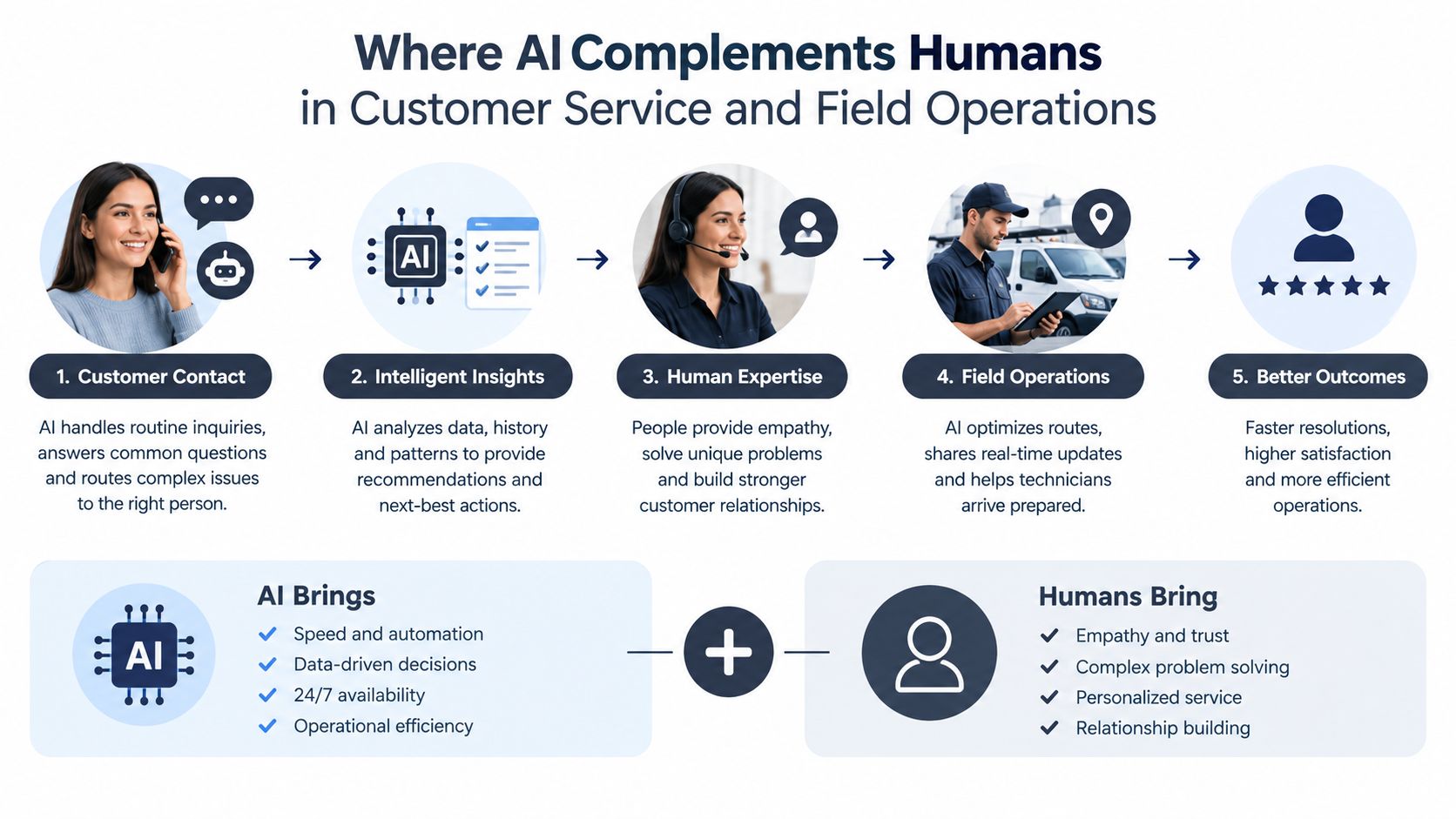
Missed calls and reactive field work create two costly leaks. An AI compression layer reduces both by shortening the time from an inbound call to a useful response, removing routine administration, and sending cleaner information into scheduling and field operations.
Half of small businesses in the United States already use AI in customer service operations. Industry survey data reports that 74% use AI-powered chatbots, 51% use AI-driven knowledge bases or help centres, 39% equip live agents with AI assistance, 38% use AI analytics, and 32% use voice AI or IVR solutions, according to a small-business AI customer service survey.
The practical business case is simple: AI handles routine volume so staff can focus on work that requires judgment.
Give routine contact to the system
An AI phone or chat layer can answer common questions, identify the customer's language, collect an address and service need, qualify urgency, and offer an appointment. It can then send a concise summary to the right employee. For a trade business, that gives the technician a cleaner job brief while office staff handle quotes, escalations, and customers who need a person. See this guide to an AI answering service for how the inbound call layer can handle contact from start to handoff.
Start with the calls your team misses most often. Do not force automation onto urgent, unusual, or emotionally sensitive conversations.
After-hours coverage matters. An analysis of 7,159 small-business website chats found that 38% arrived after hours, with 54% of those after-hours chats coming between 6 p.m. and 10 p.m., as reported in analysis of small-business website chat timing. Customers who cannot reach the business may contact another provider, while a basic automated intake can capture the job and create a follow-up task.
Keep humans on the valuable work
A study of customer support agents and generative AI found that an AI assistant increased issues resolved per hour by 13.8% overall, including a 34% improvement for novice and low-skilled workers, with minimal impact on highly experienced agents. The useful lesson for SMBs is to raise consistency on routine work while experienced employees handle diagnosis, exceptions, and difficult customers.
The research found that productivity improved immediately and stayed stable over time. New workers using AI reached a target resolution rate in about 2 months, compared with 8 to 10 months for comparable workers without AI, according to reporting on the customer support productivity research.
Start with one narrow task: first response, appointment booking, FAQ handling, or structured call intake. The system should identify what it can resolve, what it should book, and what must go to a person, in every language your customers use. That approach cuts avoidable office work without pretending every interaction is routine.
A 30-60-90 Day Implementation Plan for SMBs and Trades
A useful rollout doesn't need a project manager. It needs one owner, one primary KPI, and a decision gate at the end of each phase.
Days 1 to 30
Establish the baseline before changing the workflow.
- Pull call records: Count answered calls, missed calls, callbacks, booked appointments, and after-hours enquiries.
- Calculate delivery cost: Use labor, drive, materials, and allocated overhead to calculate cost per completed job.
- Choose one phone process: Decide who answers, how missed calls are logged, and when callbacks happen.
- Choose one scheduling process: Define the required customer details, appointment types, and confirmation steps.
- Choose one dispatch rule: Record how jobs are assigned and where route density can improve.
At the first decision gate, ask whether the team can produce the same numbers consistently each week. If the data is incomplete, fix the recording process before adding automation.
Days 31 to 60
Add technology to the narrowest high-volume problem. Deploy an AI voice or chat layer for inbound calls, automate appointment confirmations, and route structured summaries to the responsible employee. Re-cut service territories around route density rather than historical habit.
The system should escalate urgent, unusual, or emotionally sensitive conversations. It should never hide a customer from a person just to make the automation rate look better. Use setup time reduction as a practical lens for removing delays between enquiry, booking, and fulfilment.
Days 61 to 90
Move the incentives and review rhythm around the result. Shift one technician bonus measure toward first-time fix, review the dashboard weekly, and remove any software tool that has gone unused for 30 days.
At the end of every phase, use the same gate: did the primary KPI move by at least 10%? If it didn't, revert the change, inspect the data, and diagnose the workflow before adding another tool. More automation won't compensate for a badly defined outcome.
Real Examples From Solo Trades and Growing Service Businesses
The following figures are composite illustrations based on common operating patterns, not measured client results. A solo electrician loses calls while working on a panel. A multi-location dental practice loses appointment capacity when after-hours enquiries go unanswered. Both businesses can reduce operational costs by fixing where work enters the schedule and how it reaches the field.
Consider Mike, who runs a two-truck electrical shop. He misses 30% of inbound calls, and weekend rework takes time away from billable jobs. He adds a 24/7 AI receptionist, structured call tags, and job-cost tracking. In a typical 90-day window, a shop in this position might recover roughly $8,500 in monthly billable work and cut drive-time rework by 40%.
A multi-location dental practice with nine hygienists faces a different leak: after-hours booking demand and gaps in chair time. It introduces an AI booking agent, automated recall texts, and a weekly cost-per-chair dashboard. In a typical 90-day window, a practice with this baseline might raise utilisation by 11 points and reduce monthly overtime by $14,000.
The starting point determines the right intervention. Mike addresses missed demand and reactive field rework. The dental practice addresses booking coverage, unused capacity, and overtime. Neither needs to start by cutting staff. Each improves the existing operation by controlling how work enters the business and moves through it.
| Business Profile | Baseline Problem | Tactic Applied | Illustrative 90-Day Result |
|---|---|---|---|
| Two-truck solo electrician | 30% of inbound calls missed and weekend rework | 24/7 AI receptionist, call tagging, job-cost tracking | Roughly $8,500 in monthly billable work recovered and 40% less drive-time rework |
| Multi-location dental practice with nine hygienists | After-hours booking gaps and unused chair time | AI booking agent, recall texts, cost-per-chair dashboard | Utilisation up 11 points and $14,000 less monthly overtime |
Use these figures to choose what to measure, not to forecast a guaranteed return. Your baseline, call mix, staffing, geography, and service complexity will set the outcome. The transferable method is simple: find the missed demand or reactive work, apply one focused change, and track the operating result.
Your Next Steps and the One Metric That Tells You It Worked
Start Monday with five actions:
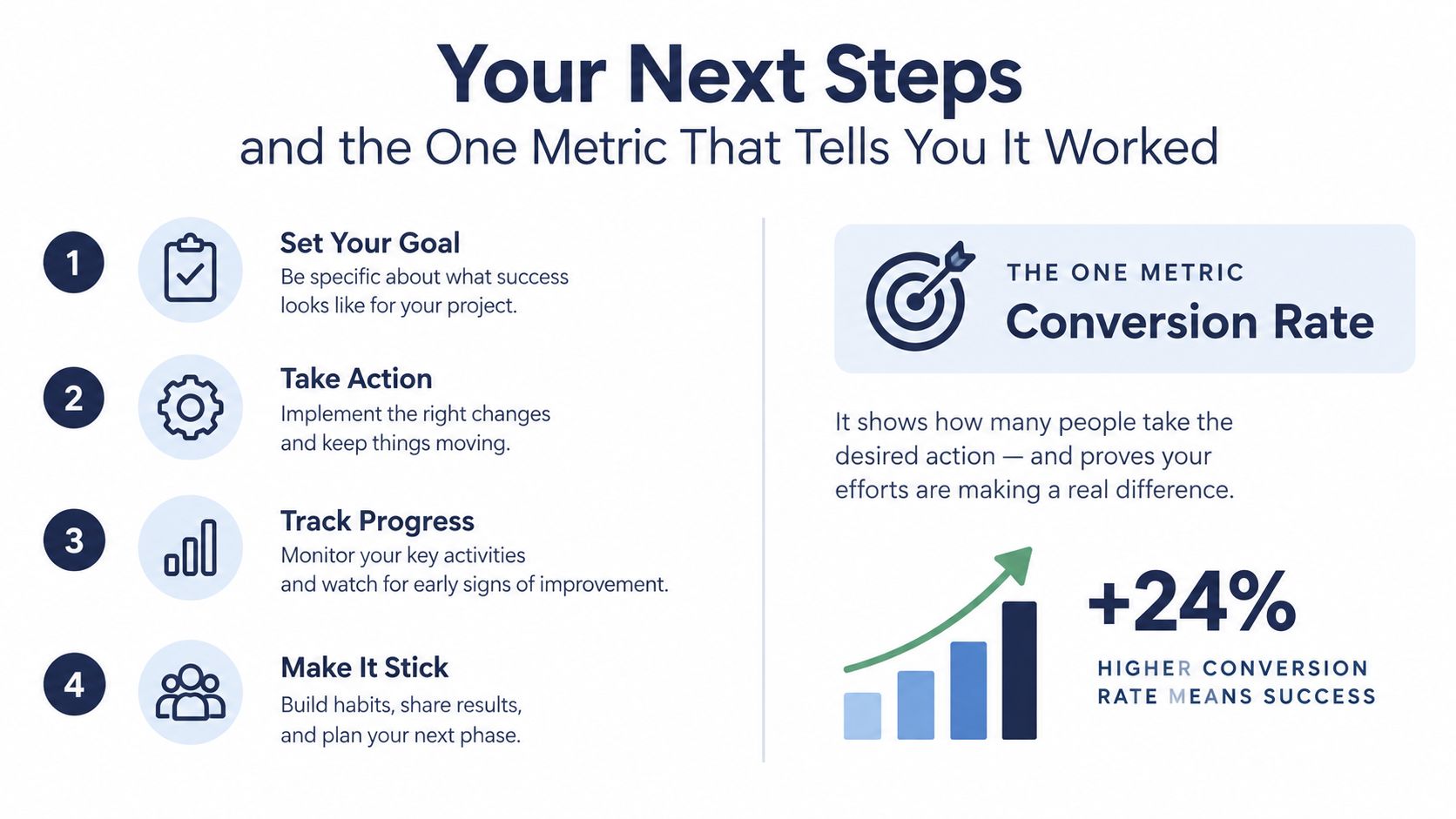
1. Pull the last quarter of call logs and tag missed, answered, booked, and repeat contacts. 2. Calculate cost per booked job using the labor and overhead required to handle the enquiry and deliver the work. 3. Deploy one AI touchpoint on inbound calls, such as first response, qualification, booking, or FAQ handling. 4. Hold a weekly 15-minute cost review with the person responsible for calls, scheduling, and field delivery. 5. Choose one north-star KPI and keep the definition unchanged while you test the process.
The most useful north-star metric is revenue recovered per missed call avoided. It combines demand capture, labor efficiency, and customer experience in one operating number. Review it monthly beside cost per call, first-call resolution, and overtime hours. If recovered revenue rises while the other three measures fall, your cost base is shrinking for the right reason.
The cheapest cost to cut is often the one a customer was already creating through callbacks, rework, unanswered calls, and empty appointment time. Fix those leaks before asking your team to work harder.
---
rednea provides 24/7 AI phone answering for small businesses and trades, including multilingual call handling, lead qualification, appointment booking, and concise follow-up summaries. Visit rednea to add one practical AI touchpoint to your inbound workflow and start measuring the calls, bookings, and service work you recover.
Try rednea, no strings attached
AI phone assistant for business. Hear a live demo in your browser, book a call with our team, or get started — from £90/month, cancel monthly, no minimum term.
GDPR-compliant · EU & UK GDPR · Multilingual