Cost Effective Solution That Actually Saves You Money


You're halfway through an electrical installation when your phone rings. You can't answer safely, the caller hears voicemail, and by the time you call back, they've already contacted someone else. A low-cost phone setup seemed sensible, but the missed opportunity may cost more than the monthly saving.
That's why the right cost effective solution isn't always the cheapest option on an invoice. For a tradesperson, dental practice, law firm, or small service business, the key question is how much revenue the system protects, how much admin time it removes, and how quickly it pays for itself.
AI phone handling adds another practical option. It can answer routine questions, book appointments, qualify leads, support multiple languages, and send complex calls to a person. Used properly, it doesn't need to replace your team. It needs to cover the gaps your team can't cover consistently.
Introduction Why Cheap Can Still Cost You More
A plumber finishes a late afternoon job and notices several missed calls. One caller leaves no message. Another asks for an urgent repair. The third wants to book an estimate. The plumber returns the calls after dinner, but two prospects have already found another provider and the urgent job has gone elsewhere.
The phone system itself may have cost almost nothing. The lost work didn't.
This is the central mistake businesses make when comparing customer-service options. They compare the monthly fee for staffing, voicemail, or automation, but they don't compare the revenue exposed by unanswered calls. A cheap option can create expensive gaps if it fails during jobs, lunch breaks, evenings, weekends, or periods of high demand.
Small-business phone research cited in recent industry analyses estimates that 62% of inbound calls go unanswered, and 85% of those callers never call back. That means voicemail isn't just a low-cost backup. For many businesses, it's a point where potential customers disappear. The small-business phone research behind these figures illustrates why answer rate belongs in a financial conversation.
The cost of an unanswered call
Missed calls matter most when each call represents a valuable job, consultation, treatment, or appointment. A business with fewer calls can still face significant leakage if every conversation has a high potential value.
Independent 2026 analyses estimate that small businesses lose about $126,000 annually from missed calls, with direct missed-call costs averaging $12.15 per call. Some industry models place the cost of one missed call between $100 and $1,200, depending on the industry and customer lifetime value. The missed-call cost analysis shows why the same phone problem produces different financial consequences across trades and professional services.
Practical rule: Measure the value of the calls you miss before deciding what answering method is affordable.
The aim isn't to automate every conversation or remove human contact. It's to identify where a modest amount of coverage can preserve revenue that voicemail, inconsistent callbacks, or overloaded staff currently leaves behind.
What Makes a Solution Truly Cost Effective
A reliable tool is often cheaper than a cheap tool that fails at the wrong moment. A low-priced drill that breaks during an installation creates replacement costs, delays, and frustration. A dependable drill costs more at purchase, but it helps complete more work with fewer interruptions.
Business systems work the same way. Price is what you pay. Value is what the system returns after it has done its job.
A cost effective solution should be judged across four questions:
1. What does it cost to buy and operate? 2. What manual work does it remove? 3. What revenue does it help retain or create? 4. How quickly does the investment pay back?
This approach is called total economic impact. It includes time saved, hiring avoided, faster processing, fewer errors, and revenue that would otherwise leak away. Executives increasingly use this broader view because direct budget reduction doesn't always produce lasting savings.
Start with the hidden work
A phone system may appear inexpensive until you count the work around it. Someone must return calls, copy details into a calendar, qualify enquiries, send confirmations, route urgent requests, and manage messages from outside normal opening hours.
Automation can reduce this repetitive handling. Gartner-related reporting says print, hardware, maintenance, and supply costs can consume 1% to 3% of company revenue, while workflow automation is associated with 10% to 15% reductions in overall costs in some sales and order-processing contexts. The workflow automation reporting supports a broader lesson: repetitive operational work can become a measurable savings driver.
For a small business, the same logic applies to phone administration. An AI assistant can take routine calls while a human focuses on the job, consultation, or clinical task that requires judgment.
Payback matters more than the lowest fee
A solution that costs more upfront can still be economical if it starts recovering value quickly. Conversely, a very cheap option may never pay for itself if it continues to lose qualified enquiries.
AI is especially useful as a complement to people. It can handle predictable tasks, then escalate exceptions. That keeps human attention available for conversations where trust, sensitivity, or technical judgment matters.
How to Measure Value with TCO ROI and KPIs
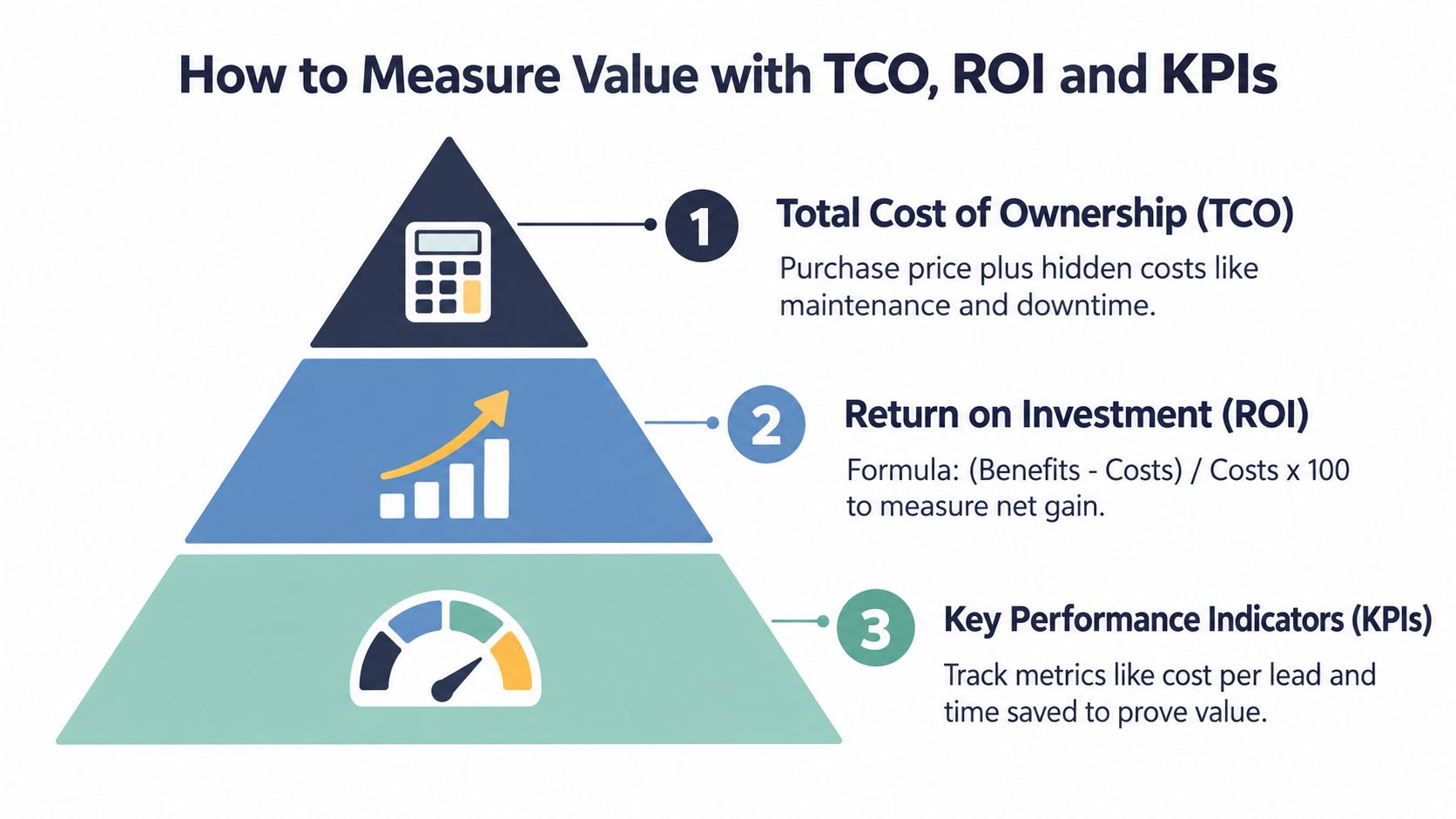
You can evaluate a phone-handling option with three connected measurements: total cost of ownership, return on investment, and key performance indicators. Each answers a different question.
Total cost of ownership
TCO asks what the option costs over the period you'll use it. Include more than the subscription or wage:
- Direct cost: Monthly service fees, wages, or answering-service charges.
- Implementation cost: Setup, configuration, training, and workflow changes.
- Admin cost: Time spent returning calls, updating records, and arranging appointments.
- Coverage cost: Extra staffing for evenings, weekends, holidays, or language support.
- Failure cost: Revenue lost when calls go unanswered or information is recorded incorrectly.
Voicemail has a low direct cost, but its TCO includes the opportunities that vanish when callers don't leave a message. Staffing has broader coverage, but its TCO includes wages, scheduling, absence cover, and the cost of adding capacity as call volume rises.
Return on investment
Use a simple formula:
ROI = (Benefits minus Costs) ÷ Costs × 100
Benefits can include recovered bookings, avoided hiring, saved admin time, and fewer missed opportunities. Costs should cover the same period as the benefits. Don't compare a monthly fee with an annual revenue estimate unless you clearly convert both to the same timeframe.
Independent business-value studies show why this method matters. One composite organization achieved $685,742 in benefits over three years versus $221,776 in costs, producing a 209% ROI. Another productivity-software study reported $36.8 million in benefits over three years versus $17.1 million in costs, equal to a 116% ROI. The business-value analysis demonstrates that value can significantly exceed price when time and operational impact are included.
Key performance indicators
Track the numbers that explain where money is gained or lost:
- Missed-call rate: How many inbound calls aren't answered?
- Answer rate: How many callers reach a person or automated assistant?
- Booking rate: How many qualified calls become appointments or jobs?
- Containment rate: How many routine calls are completed without human help?
- Admin time saved: How much staff time no longer goes to repetitive handling?
- Escalation quality: Are urgent or sensitive calls reaching the right person?
Start with your current baseline. A missed-call calculator can help turn call gaps into an estimate of revenue at risk before you compare vendors or staffing models.
Your Decision Checklist for Choosing the Right Option
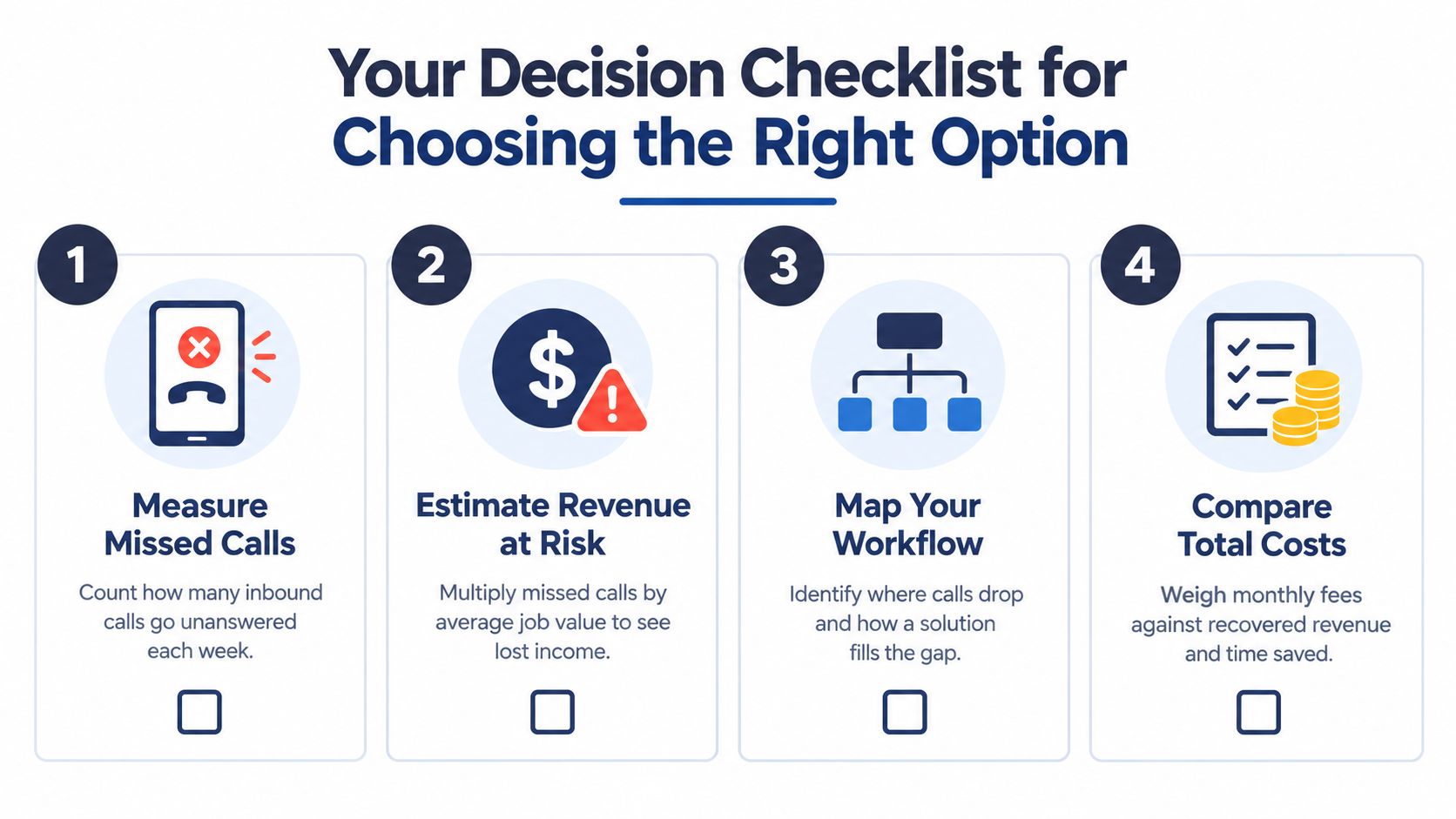
Set aside one hour and work through the decision using your own call history. You don't need a complex finance model. You need a realistic view of the gap between demand and coverage.
1. Measure what you miss
Review recent call records and count unanswered calls by day and time. Separate calls missed while staff were busy from calls missed outside opening hours. Look for repeat callers, abandoned calls, and calls that eventually became appointments.
If you don't have reliable records, start tracking from today. A short period of consistent measurement is more useful than a confident guess.
2. Estimate revenue at risk
For each missed call category, estimate the likely commercial value. A missed emergency repair, consultation, or treatment enquiry shouldn't be treated the same as a general information call.
Use this basic calculation:
Missed calls × likely booking rate × average value per booking = estimated revenue at risk
Keep your assumptions conservative. The purpose isn't to inflate the opportunity. It's to see whether the cost of coverage is smaller than the value you're currently leaving unprotected.
3. Map the workflow
Write down what should happen when someone calls:
- Routine question: Provide approved information.
- Appointment request: Check availability and book.
- New lead: Gather contact details, service needs, and preferred timing.
- Urgent issue: Transfer to the designated person.
- Complex or sensitive matter: Escalate to a human.
Then check language requirements. 75% of global customers prefer support in their native language, while only 36% of companies offered multilingual support before AI. AI-powered multilingual support can cover 50+ languages without additional staffing, according to the multilingual customer-support statistics. Your own customer mix determines whether that capability has financial value.
4. Compare options on equal terms
Use the decision matrix below. Score each option against your actual needs, not its marketing description.
| Criteria | Staffing | Voicemail | AI Assistant |
|---|---|---|---|
| Routine call coverage | Strong during staffed hours | Weak | Strong when configured well |
| After-hours availability | Requires extra coverage | Message only | Built in |
| Appointment booking | Depends on process | No | Available with calendar connection |
| Human judgment | Strong | None | Escalates exceptions |
| Multilingual coverage | Requires language staffing | None | Available across supported languages |
| Cost per additional handled call | Rises with labor | Low, but misses opportunities | Low after setup |
| Revenue capture | Depends on availability | Low | Designed to reduce unanswered calls |
For a deeper operational view, review this guide to a virtual phone answering service. Choose the option that protects the highest-value gap without paying for capacity you won't use.
Comparing Staffing Voicemail and AI on Real Costs
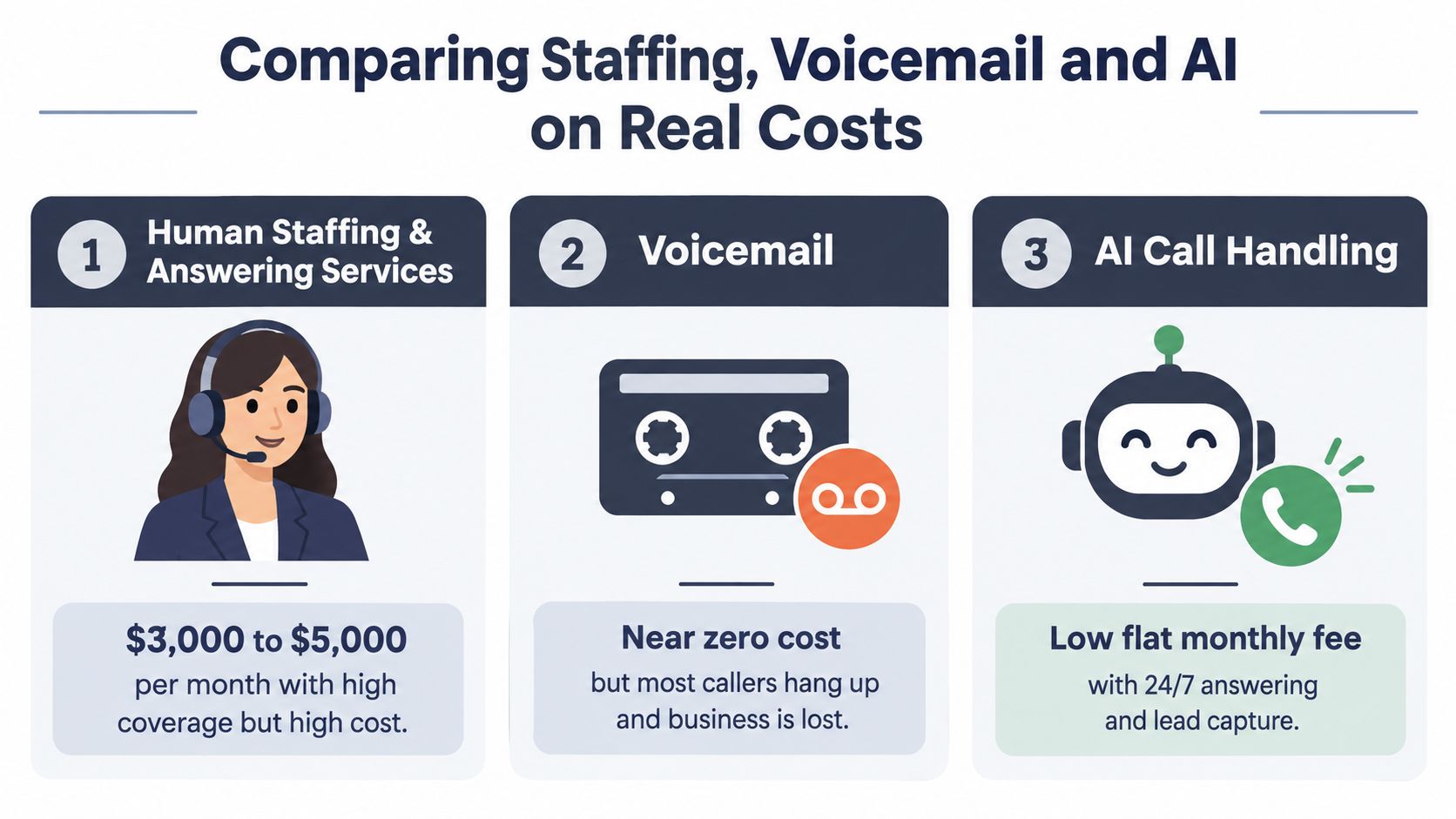
Human staffing offers the strongest support for nuanced conversations, but it can be expensive to maintain around the clock. A live answering service typically costs $3,000 to $5,000 per month, while a dedicated AI voice agent can cost under $500 per month in SMB-oriented models. The AI voice automation analysis provides these benchmarks and reports enterprise deployments delivering 331% to 391% ROI over three years, with payback periods under six months.
Human staffing
A receptionist or answering service can build rapport, understand unusual requests, and handle sensitive situations. The trade-off is that coverage expands with labor cost. If your busiest periods are evenings, job-site hours, or weekends, you may pay for a staffing pattern that still leaves gaps.
Human coverage makes sense when calls require judgment throughout the conversation or when customers strongly expect a person from the start. It becomes harder to justify when most calls involve simple questions, appointment requests, or lead capture.
Voicemail
Voicemail wins on price but loses on recovery. It records a message only when the caller chooses to leave one, and the business still has to respond later. If callers don't leave details, the team can't qualify the opportunity or prioritize urgent work.
Voicemail can remain useful as a fallback, but it shouldn't be treated as full customer-service coverage for a phone-dependent business.
AI call handling
AI changes the cost structure by shifting routine call handling from labor-intensive coverage to software-mediated service. It can answer at any hour, manage predictable conversations, book appointments, and transfer exceptions. The marginal cost of handling another routine call is generally lower than adding human coverage, although quality depends on configuration and monitoring.
The best comparison isn't “AI versus people.” It's containment rate versus platform cost. If the assistant resolves routine calls reliably and sends important calls to humans, the business can protect revenue without forcing staff to answer every call personally.
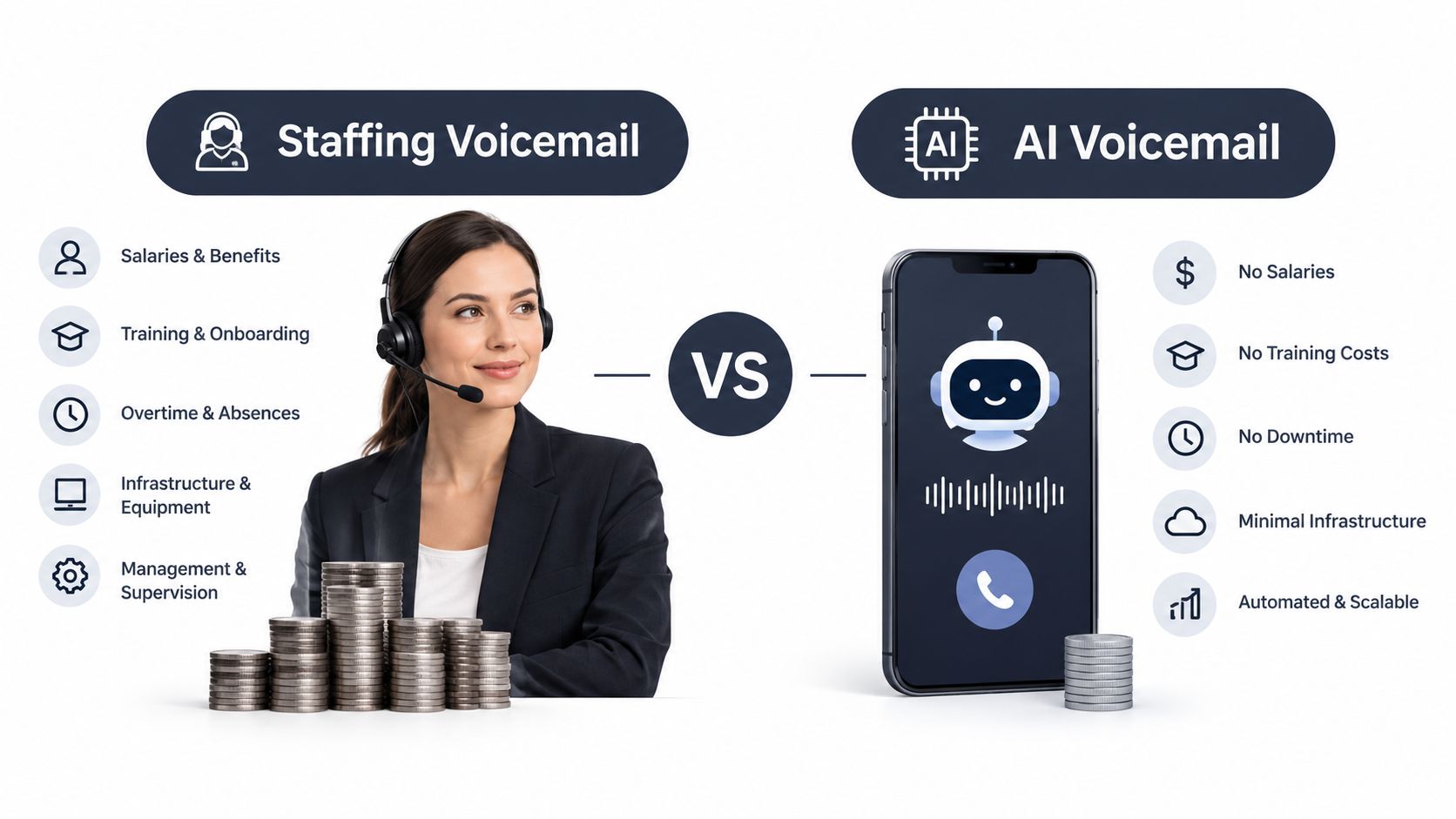
A hybrid model also respects customer preference. Research reports that 85% of consumers prefer speaking to a real person over AI, 73% say they're more loyal to companies providing human customer support, and 78% consider it important to switch from AI to a human agent. The customer-service findings support clear escalation paths rather than an attempt to keep every caller inside automation.
For a practical starting point, explore an AI answering service and assess how it handles your routine call types before expanding its responsibilities.
Real Examples and Calculations That Show the Math
A contractor receives missed calls during site work. The owner identifies several calls that could have become estimates, but doesn't assume every missed call would convert. Instead, the owner separates urgent requests, quote requests, and general questions, then assigns each category a conservative value.
Suppose the business estimates that a portion of missed quote requests would have become booked site visits. The useful calculation isn't the total number of calls alone. It's the relationship between missed calls, realistic conversion, and the value of completed work. That makes the decision less emotional and prevents the owner from buying more coverage than the opportunity justifies.
A dental practice faces a different pattern. Many calls involve appointment availability, rescheduling, directions, or basic preparation questions. An AI assistant can answer those routine enquiries, check a connected calendar, and pass clinical or sensitive matters to the practice team. Multilingual support can also reduce the need to make every language a staffing problem, provided the system's supported languages match the patients the practice serves.
A professional-services firm may value lead qualification more than appointment volume. The assistant can collect the caller's name, reason for contacting the firm, preferred callback time, and urgency. The team then receives a concise summary instead of an unstructured voicemail.
A simple break-even view
Assume a business compares a monthly AI fee with the cost of live coverage. The break-even point occurs when:
Monthly solution cost ÷ average contribution from one recovered booking = bookings needed to pay for the solution
Use contribution, not headline sale value, if delivery costs vary. If the assistant also saves staff time, add that value to the benefit side. If it creates poor bookings or transfers too many calls, subtract those costs from the estimate.
The same logic applies to a 30-to-60-day payback target. Recent 2026 coverage estimates realistic monthly AI phone costs at roughly $50 to $500, depending on volume and category, and notes that some small businesses see positive ROI within 30 to 60 days. The AI phone cost analysis makes the practical question clear: what call volume and conversion rate make coverage outperform staffing or voicemail?
A business can test this with one line, one service category, and one escalation rule. A virtual receptionist cost guide can help frame the staffing comparison, but your own call records should determine the final decision.
Making Your Choice Pay Off Long Term
The purchase decision is only the beginning. Savings disappear when the assistant answers calls but can't book, route, record, or escalate them properly.
Start with a narrow workflow. Give the system approved answers for routine questions, clear booking rules, and a short list of situations that require a human. A trades business might begin with service areas, availability requests, emergency routing, and estimate enquiries. A practice might start with appointment booking and rescheduling.
Build the handoff before launch
Define who receives each type of escalation. Set rules for urgent calls, existing customers, new leads, and sensitive conversations. Connect the assistant to the calendar, CRM, or scheduling system your team already uses so staff don't have to copy information manually.
Review the first conversations for accuracy and tone. Update answers when customers repeatedly ask questions the system doesn't handle well. Good automation improves through controlled adjustments, not by being left unattended.
Measure the operating result
Track missed-call rate, answer rate, booking rate, containment, escalation quality, and admin time saved each month. Compare those results with the cost of the service and the revenue associated with recovered opportunities.
AI resolutions are estimated to cost $0.50 to $2.00 per interaction, compared with $6.00 to $12.00 for human-agent interactions, according to the customer-service cost analysis. The comparison only matters if the AI resolution is accurate and appropriate. A low interaction cost doesn't compensate for a poor customer experience or a missed urgent call.
Implementation principle: Let AI handle predictable work, and reserve human attention for judgment, trust, and exceptions.
Once the first workflow performs reliably, expand gradually. Add another language, an after-hours route, outbound confirmations, or a second location. The right cost effective solution should become more useful as your business grows without forcing you to redesign the entire customer-service operation.
---
rednea provides an AI phone assistant that answers business calls 24/7, detects the caller's language, handles routine questions, books appointments, and escalates important conversations to your team. Visit rednea to see how you can start with a focused workflow, measure the revenue it protects, and scale coverage as call volume grows.
Try rednea, no strings attached
AI phone assistant for business. Hear a live demo in your browser, book a call with our team, or get started — from £90/month, cancel monthly, no minimum term.
GDPR-compliant · EU & UK GDPR · Multilingual