Lead Qualification Framework for SMBs and Trades

Most lead qualification frameworks fail before qualification even begins. A benchmark audit of 2,241 U.S. companies found that 23% never responded to web-generated leads, while the average response time among companies that did respond was 42 hours (Heeya's analysis of speed to lead). If nobody answers the phone, there's no budget, need, authority, or timeline to score.
For a small business, a lead qualification framework must therefore do two jobs. It must identify whether an inquiry fits, and it must make sure the inquiry is captured while the buyer is still ready to talk. AI can support that first response without replacing the person who handles exceptions, complex advice, or the final sale.
Why Qualification Starts Before the Score
A local electrician receives a call while working inside a customer's property. The caller needs an urgent repair, but the call goes to voicemail. By the time the electrician returns it, the caller has already contacted another provider. No scoring model failed here. The business failed to capture a live buying signal.
Traditional frameworks such as BANT, which stands for Budget, Authority, Need, and Timeline, became formalized as structured sales checklists during the expansion of enterprise technology markets in the mid-20th century. The framework is widely attributed to IBM's sales organization in the 1950s or 1960s, and its enduring value is simple: interest alone doesn't make a lead sales-ready. A viable opportunity needs evidence across several dimensions of fit and intent (background on BANT and its development).

The missed-call qualification gap
For tradespeople, clinics, legal practices, and other appointment-led businesses, the first qualification question is often operational: can the business answer now? A caller may be in the right service area, need the right service, and be ready to book, but none of those facts reach the CRM when the call disappears into voicemail.
The response-time evidence is unusually clear. A study summarized by Harvard Business Review examined approximately 1.25 million leads across 42 companies and found that contacting a lead within one hour made an organization nearly 7 times as likely to qualify the lead as waiting an additional hour, and more than 60 times as likely as waiting 24 hours (research summarized by Machina on speed to lead). Speed isn't merely a service metric. It changes whether qualification can happen at all.
Practical rule: Treat “not reachable” as an operational outcome, not as proof that the lead was unqualified.
A practical operating system answers every call, identifies the basic situation, and routes the next action. That might mean booking a suitable appointment, sending a concise summary to a human, or escalating an urgent matter. The principles covered in this guide to small-business systems and processes apply directly here: remove avoidable handoff friction before adding complexity.
AI phone assistants fit at the front of this process. They can greet callers, identify their language, collect a few decision-relevant details, and keep the record alive until a person takes over. The human still owns judgment, but the business no longer treats unanswered calls as invisible demand.
Defining Your Criteria and Scoring Rules
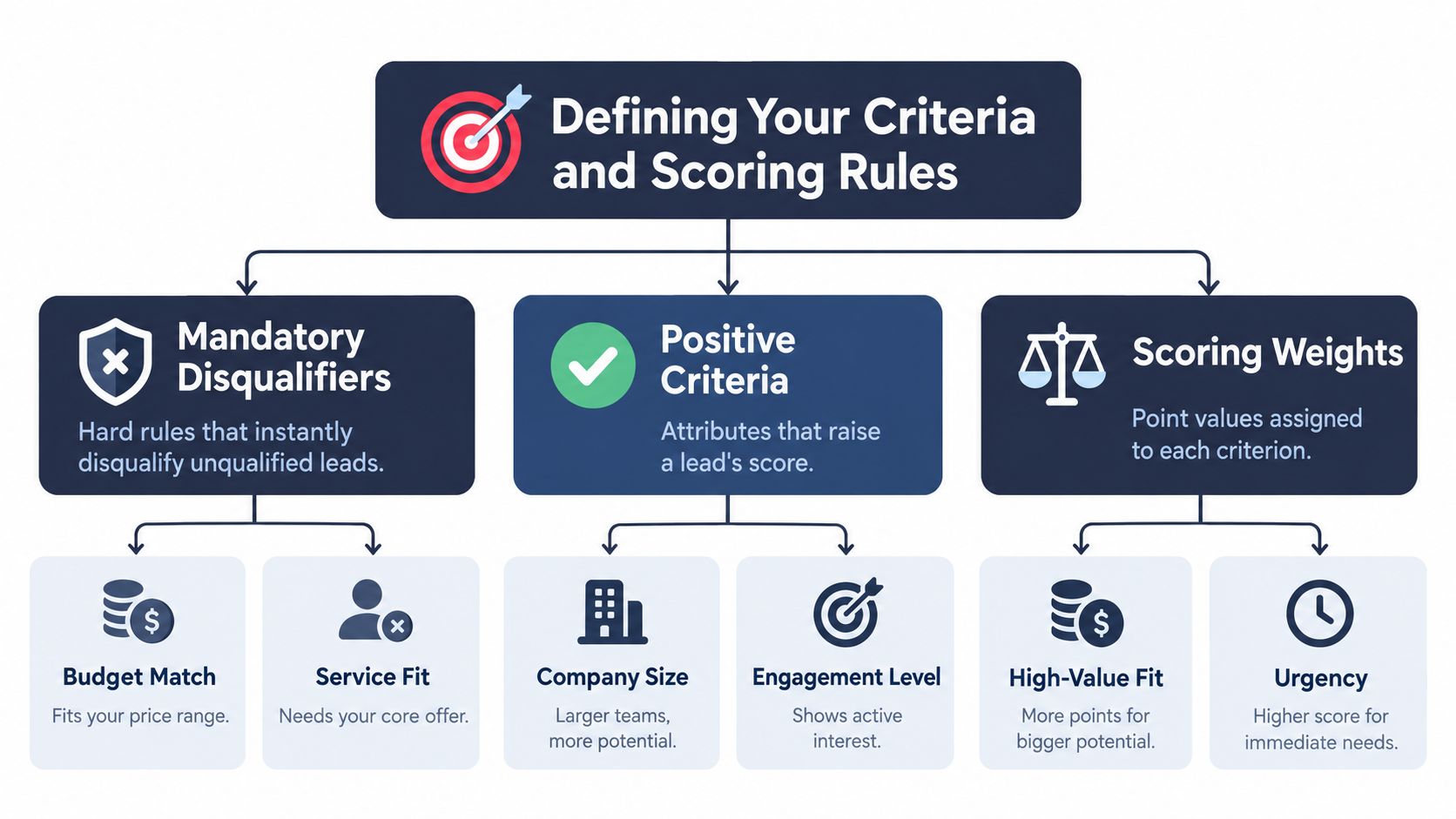
Start with the rules that can disqualify a lead immediately. A service business might reject locations outside its coverage area, job types it doesn't perform, or requests that fall outside its operating model. These aren't negative opinions about the caller. They're capacity and fit rules that prevent staff from spending time on work the business can't deliver.
Next, define positive criteria. Keep the first version short enough that a receptionist, salesperson, or AI assistant can apply it consistently during a normal conversation.
Build the framework in five passes
1. Set hard exclusions. Record unsupported geography, service categories, customer types, and other firm requirements. If a lead fails one of these checks, mark it as disqualified with a reason code.
2. Capture operating fit. Ask for the service needed, general location, urgency, preferred appointment time, and whether the caller can authorize the work. For a business-to-business service, company size and job type may matter. For a clinic, the relevant distinction may be appointment type and urgency.
3. Add intent signals. A quote request, appointment request, active problem, or clear preferred time indicates stronger buying intent than a general information request. Don't confuse a long conversation with intent. A brief request to book can be more valuable than an extended exploratory call.
4. Use simple states. Start with sales-ready, nurture, and disqualified. A fourth state, needs human review, is useful when the information is incomplete or the situation carries risk.
5. Attach the next action. Every classification needs an owner, a reason, and a deadline. “Warm” without a callback rule is just a label.
Don't overbuild the score
A small firm rarely needs an enterprise qualification matrix. Begin with the fields that determine whether someone should receive attention today. For example, a plumbing business might prioritize an active leak in its service area, while a consultancy might prioritize a defined business problem, decision-maker access, and a realistic start window.
Budget deserves careful treatment. It can be a useful fit check, but an undisclosed budget shouldn't automatically disqualify a caller who has a clear need and authority. Likewise, a person asking about availability may not know the final decision process yet. Score what's evidenced, flag what's unknown, and avoid turning missing information into a false negative.
A framework should also reflect timing. Research covering more than 15,000 leads and 100,000 call attempts found that leads contacted within five minutes were 21 times more likely to qualify than leads contacted after 30 minutes, while the chance of reaching a lead was about 100 times higher (speed-to-lead findings from Callingly). That makes a rapid first response a scoring input in practice, even if it isn't represented by a numerical field.
Use the practical guide to qualifying sales leads to turn these principles into conversational questions. The right question is the one that changes the next action, not the one that fills another CRM field.
How AI Phone Assistants Qualify Leads Automatically
AI qualification works best when it behaves like a capable intake coordinator, not like a form read aloud over the phone. The assistant should greet the caller, disclose that it's a machine, offer a route to a human, and ask only questions that affect routing or scheduling.
The European Commission states that chatbot systems must clearly inform users when they're interacting with a machine under the EU AI Act's transparency rules (European Commission guidance on the AI Act). For a phone assistant, that disclosure belongs at the start of the call, not buried in a later message.
Ask for the minimum useful context
Configure the conversation around five practical fields:
- Service needed: Identify the job, appointment type, or problem.
- Location: Capture a postcode, city, or general service area rather than unnecessary personal detail.
- Urgency: Separate emergencies, time-sensitive requests, and routine inquiries.
- Preferred time: Offer appointment windows that match actual availability.
- Contact permission: Confirm whether the business may send a callback, confirmation, or summary.
An assistant supporting callers in English, Spanish, French, German, or Italian can detect the caller's language and continue naturally in that language. That matters for clarity, but it doesn't remove the need for human escalation when the caller is distressed, uncertain, or asking for professional advice.
Configure escalation before launch
The assistant should stop qualifying and transfer or flag the call when it encounters an emergency, medical or legal advice request, safeguarding concern, payment dispute, uncertain identity, repeated misunderstanding, or a request outside the approved knowledge base. Article 14 of the EU AI Act emphasizes effective human oversight, including monitoring limitations, detecting unexpected performance, and guarding against overreliance on automated outputs (Article 14 of the EU AI Act).
A small business can implement this with a named owner for exceptions, a short approved-answer library, and regular review of corrections and complaints. Lead-scoring automation becomes useful when the score triggers a real action, such as immediate transfer, priority callback, nurture, or disqualification.
The assistant can then create a structured CRM record, summarize the conversation, and make a calendar-eligible appointment. It shouldn't conduct a long scripted interview just because more fields are available. Short, accurate intake beats exhaustive data collection that frustrates the caller.
Integrating Qualification with Your CRM and Automation
A qualification framework becomes operational only when the conversation produces a usable record. The CRM entry should show what the caller needed, where they're located, how urgent the request is, what time they prefer, whether they consented to follow-up, and what happens next.
A useful handoff has three layers:
The record
Store structured fields instead of relying on free-text notes. A human should be able to see the classification, reason code, owner, appointment status, and unresolved question without replaying the entire call.
The notification
Send a concise email or SMS summary when the lead needs attention. The message should state the problem, location, urgency, preferred time, and recommended action. Avoid sending sensitive information through channels that aren't appropriate for it.
The route
Use explicit rules. Appointment-ready requests go to the calendar workflow. High-value or urgent inquiries go to the assigned person. Unsupported requests receive a clear disposition. Low-intent inquiries enter a nurture process rather than occupying the active sales queue.
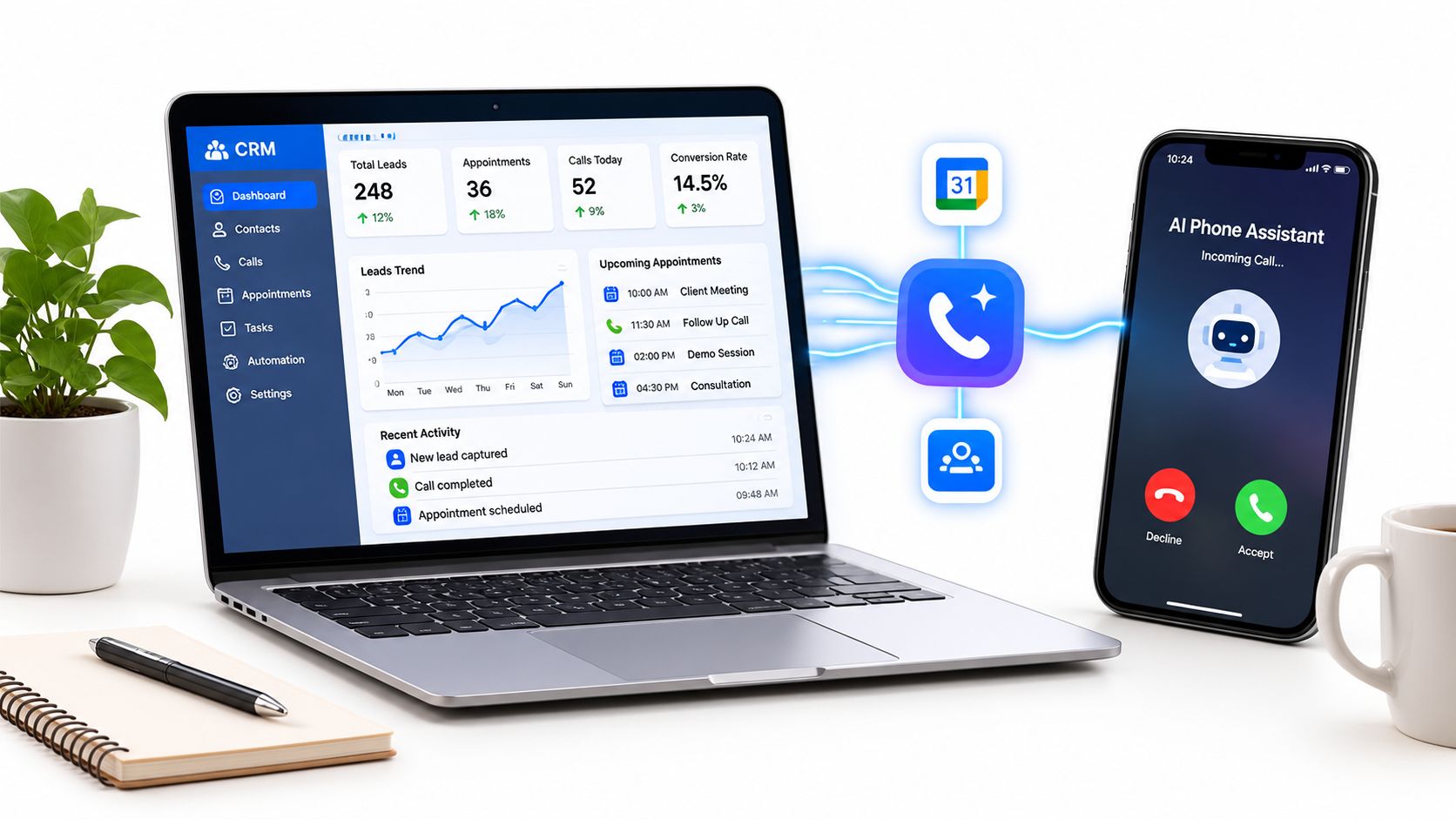
The handoff should preserve context, not just contact details. A salesperson who receives “Caller wants a quote” still has to repeat the intake. A salesperson who receives “Caller needs an electrical inspection at a service-area property, wants an afternoon appointment, and requested a quote” can move directly into confirmation and sale.
Privacy changes what the system should collect. For healthcare, legal, financial, and home-service businesses, the minimum useful data may be limited to service type, general location, urgency, availability, and permission to follow up. Sensitive details should move to an authorized human when they're necessary.
The CRM phone integration approach should also include deletion and retention rules. NIST's AI Risk Management Framework recommends defining human roles and responsibilities around AI systems and evaluating trustworthiness throughout design, use, and review (NIST AI Risk Management Framework). In practice, assign one person to own exceptions, call quality, approved answers, and changes to escalation rules.
Measuring What Matters
A lead qualification framework should be judged by downstream outcomes, not by how many questions the assistant asked or how long callers stayed on the line. Track whether the business reached the caller, captured enough context, booked the right appointment, and converted suitable opportunities.
| Metric | Definition | Target |
|---|---|---|
| Contact rate | Share of inquiries that receive a live or automated first response | Set a consistently high internal standard |
| Qualified-opportunity rate | Share of captured inquiries that meet the agreed fit and intent rules | Establish a baseline, then improve lead quality |
| Appointment-show rate | Share of booked appointments that are completed | Monitor by service, channel, and time window |
| Win rate | Share of qualified opportunities that become customers | Compare by qualification state |
| Revenue per qualified lead | Revenue generated per qualified opportunity | Use for capacity and routing decisions |
| False-positive rate | Share of leads marked qualified that later fail fit checks | Lower through better disqualifiers |
| False-negative rate | Share of leads rejected that later show viable intent | Review rejected and reactivated records |
A five-minute operating rule is useful for high-intent inbound inquiries, but it shouldn't become a substitute for fit. A fast response to an unsupported job still wastes capacity. A slow response to an ideal customer still loses momentum.
Review cohorts, not anecdotes
Compare predicted qualification with booked appointments, completed appointments, opportunities, and closed revenue. Review edge cases by language, channel, trade, and location. If a rule appears to underperform, inspect enough comparable records before changing it.
The benchmark evidence also supports measuring execution separately from demand. A missed call, failed transfer, or incomplete record shouldn't be grouped with a caller who clearly declined the service. This distinction tells the owner whether to change the offer, the script, the staffing plan, or the routing.
Use weekly operational reviews at first. Keep the review focused on a small set of questions: Which qualified leads weren't contacted quickly? Which disqualified leads should have been reviewed? Which questions created confusion? Which escalations reached a human too late?
Best Practices for Implementation and Optimization
Start with one call flow and one business outcome. For a tradesperson, that might be answering every inbound call and booking suitable jobs. For a dental practice, it might be capturing appointment requests and escalating clinical questions. For a professional service firm, it might be separating consultation requests from general information calls.
A workable implementation has a clear sequence:
- Define fit first: Write down service areas, supported job types, customer types, and essential exclusions.
- Choose minimal fields: Capture only information that changes routing, scheduling, or follow-up.
- Set response tiers: Handle emergencies and appointment requests immediately, route quote requests quickly, and nurture low-intent inquiries.
- Make humans accountable: Name the employee who owns exceptions, callbacks, corrections, and complaints.
- Record reasons: Require a reason code for disqualification, escalation, and nurture.
- Test real conversations: Include accents, multiple languages, interruptions, unclear requests, and callers who change their minds.
- Review outcomes: Compare classifications with appointments, opportunities, revenue, and customer feedback.
AI adoption doesn't need to begin with full automation. The OECD's 2026 survey of more than 2,000 SMEs across 12 OECD countries found that 54% reported at least moderate value from AI use, including 33% reporting moderate improvements, 15% significant gains, and 6% transformational results (OECD survey of SMEs and AI). For a small company, the sensible starting point is narrower: answer routine calls, capture structured details, summarize conversations, and book appointments while humans retain control of difficult decisions.
The right automation removes waiting and repetition. It doesn't remove accountability.
Avoid three common mistakes. Don't collect sensitive information just because the system can store it. Don't label an unanswered call as unqualified. And don't expand the score before the team can apply the basic rules consistently.
A strong lead qualification framework is a living operating system. It connects response speed, fit, intent, consent, routing, and human judgment. Start with one service line, measure the handoff, correct the failure points, and expand only after the process works under real call pressure.
---
rednea answers inbound calls, identifies the caller's language, captures qualification details, books appointments, sends concise follow-up summaries, and escalates situations that need a person. Set up a focused call flow for your business and visit rednea to see how an AI phone assistant can complement your team without taking over its judgment.
Try rednea, no strings attached
AI phone assistant for business. Hear a live demo in your browser, book a call with our team, or get started — from £90/month, cancel monthly, no minimum term.
GDPR-compliant · EU & UK GDPR · Multilingual