AI Phone Call Assistant Guide for Small Businesses

You're under a sink finishing a repair when your phone rings. Across town, a receptionist is helping a patient while another caller waits. Neither business lacks commitment to customer service. There isn't a free pair of hands.
An AI phone call assistant can cover that gap without taking over every customer conversation. The practical question isn't whether software can sound convincing. It's whether it can complete a useful task, recognize its limits, and bring a person in when needed.
Why Small Businesses Are Adopting AI Call Support
For a plumber working in someone's home, answering the phone can mean interrupting the customer already being served. For a consultant, it can mean stepping out of a meeting. Hiring someone to cover every possible call window may not fit the business, but leaving callers without a clear next step isn't ideal either.
A 2024 observational study of 85 small businesses across 58 industries found that only 37.8% of inbound calls reached a live person, while approximately 62.1% reached voicemail or no answer option. The sample was relatively small and observational, so those results shouldn't be treated as a universal benchmark.
The opportunity is better coverage
An unanswered call isn't automatically a lost sale. An existing customer might call back, leave a message, or contact the business another way. Still, the owner has less control over what happens next when nobody acknowledges the request.
An AI assistant offers a different first response. Configured appropriately, it can answer the call, establish what the caller needs, and either handle an approved request or pass the conversation to staff.
- For solo operators: It can collect enquiries while the owner finishes paid work.
- For small teams: It can cover overflow when the receptionist is occupied.
- For growing businesses: It can provide a consistent starting point across locations without making every call follow the same rigid menu.
The buying decision should therefore start with the missing service, not the technology. Do callers need opening hours, an appointment request, a callback, or someone qualified to discuss a sensitive problem?
Practical rule: Start with a bounded task, keep sensitive decisions human, and expand only after checking real call outcomes.
That approach makes AI a customer-service supplement rather than an all-or-nothing staffing decision. It also gives owners a concrete basis for judging capabilities, implementation effort, pricing, privacy, and financial value.
Understanding What an AI Phone Call Assistant Does
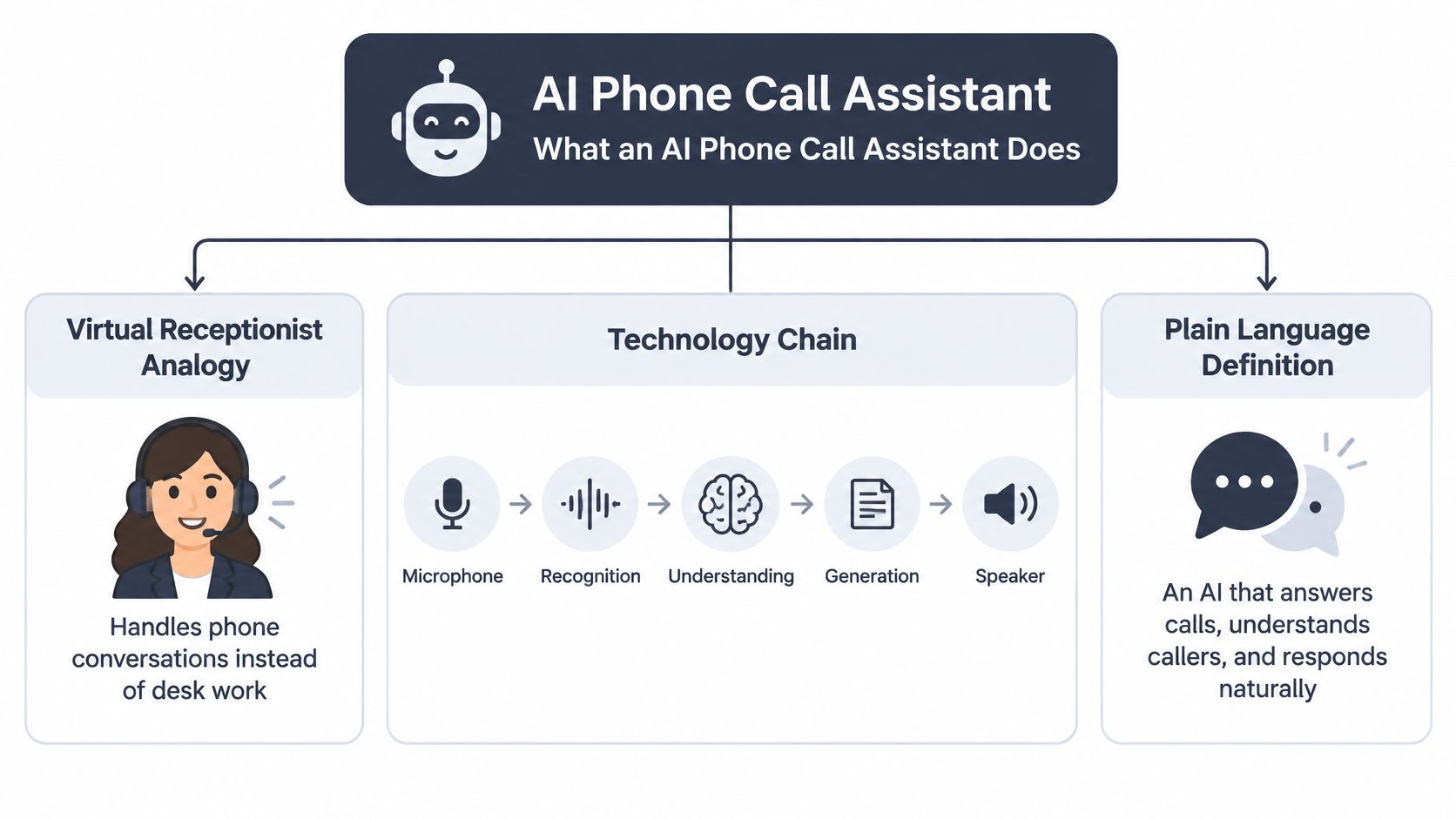
An AI phone call assistant is software that handles spoken telephone conversations. Think of it as a virtual receptionist with a defined job description, not an employee with unrestricted judgment.
Its job might be to answer service questions and collect appointment requests. Whether it can book an appointment depends on its permissions and connection to the booking system.
From spoken words to a useful action
The conversation passes through several stages:
- Speech recognition: The system converts the caller's voice into text.
- Language and intent understanding: It identifies the language and works out whether the caller wants information, a booking, or another kind of help.
- Dialogue management: It decides whether to answer, ask a question, use an approved tool, or transfer.
- Speech synthesis: It turns the response into spoken audio.
- Action-taking: Where authorized, it creates a booking, records an enquiry, or starts a handoff.
Consider a caller who wants to move an appointment. The assistant needs more than a pleasant voice. It must identify the relevant booking, check permitted alternatives, obtain confirmation, and receive a successful update from the calendar before saying the change is complete.
If the calendar connection fails, the correct response is to explain the limitation and arrange follow-up. It shouldn't claim success because the conversation sounded finished.
How it differs from familiar answering systems
Voicemail records a message for someone to handle later. A traditional interactive voice response system, or IVR, directs callers through predefined options. An AI assistant is intended to let callers explain their needs conversationally and then follow an approved workflow.
A human receptionist brings something different: judgment informed by relationships, context, and experience. Software shouldn't be assumed to have that judgment because its speech sounds natural.
The important distinction is between conversation and authority. An assistant may understand a request without being authorized to fulfill it. Buyers should ask what information it uses, which actions it can take, and what happens when it doesn't know the answer.
Core Capabilities That Determine Practical Value
A good greeting is only the beginning. Like a receptionist taking a message, the assistant needs somewhere reliable to put the information and someone responsible for the next action.
Evaluate capabilities against completed work, not the smoothness of a demonstration.
Conversation quality includes getting details right
Telephone recognition has improved, but it isn't infallible. NIST's telephone-speech evaluation history describes approximately 20% error rates in earlier systems and more recent English conversational word-error rates of 5.5% on Switchboard and 10.3% on CallHome. Those benchmark results aren't a guarantee for your callers or telephone conditions.
A misheard address can matter more than several harmless transcription errors. Ask for selective confirmation of dates, times, phone numbers, addresses, and quoted prices rather than repetition of every sentence.
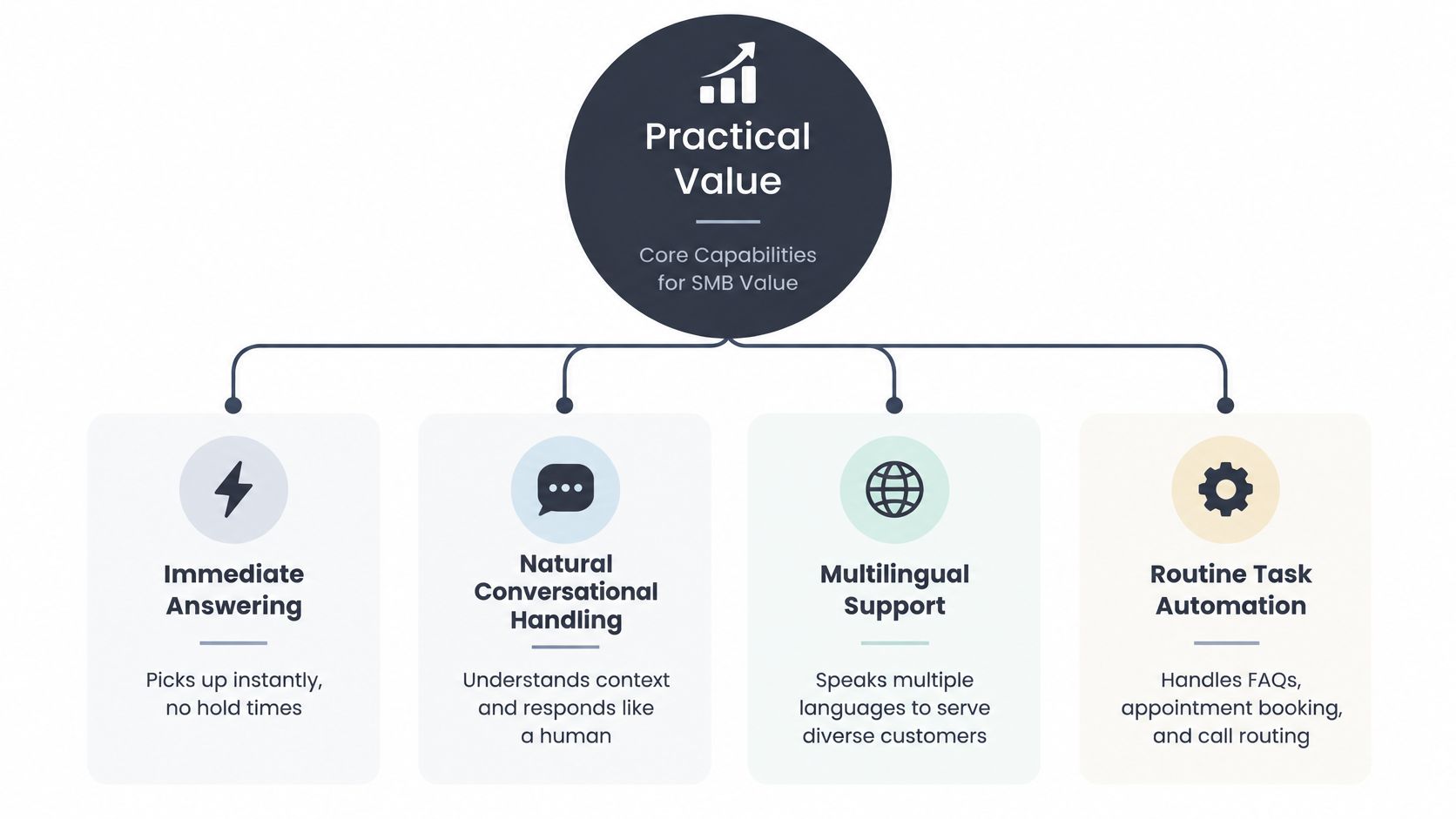
- Immediate answering: Check what happens during simultaneous calls and service interruptions.
- Routine information: Confirm that answers come from approved business information, with an owner responsible for updates.
- Qualification and booking: Define required fields, eligibility rules, and the difference between a request and a confirmed appointment.
- Routing and reporting: Require useful summaries, notifications, escalation reasons, and visibility into failed actions.
Multilingual support needs end-to-end testing
Language detection alone isn't multilingual service. Recognition, dialogue, spoken output, and the final task must work together throughout the call.
Cross-linguistic research on conversational speech recognition found that performance doesn't transfer equally from English to other languages. Test names, interruptions, numbers, and task completion separately in each language your customers use. Don't let a strong overall result hide a weak experience in a particular market.
Among SMB-focused options, rednea supports English, Spanish, French, German, and Italian, connects with common calendars, scheduling tools, and CRMs, and is designed for practical small-business workflows. Buyers should still verify the exact integration and language behavior their own operation requires.
A useful multilingual test ends with a valid booking or a correctly routed enquiry, not just a fluent exchange. If nobody on staff understands the caller's language, establish how the resulting summary will be reviewed and how follow-up will happen.
Practical Use Cases for Trades and Service Businesses
A caller tells an electrical contractor that part of the property has lost power. In a representative workflow, the assistant could collect the location, ask approved intake questions, and follow the business's urgency-routing policy. It shouldn't improvise technical safety advice or promise that an engineer is available without confirmation.
For a routine plumbing enquiry, the task is simpler: explain the approved service area, collect a description of the job, and record suitable callback times. A practical guide to AI receptionists for trades can help translate those enquiries into a defined intake workflow.
Different services need different boundaries
In a dental practice, an appointment request and a clinical question should take different paths. The assistant could gather scheduling preferences, while clinical concerns go to the practice's approved staff or urgent-care instructions.
A law firm could use a similarly narrow approach. Collect contact details and a general enquiry category, but leave advice, conflict-sensitive intake, and decisions about representation to qualified people.
- For multilingual businesses: Let callers begin in a supported language, then verify that staff can act on the resulting enquiry.
- For freelancers: Capture after-hours requests without implying that work has been accepted.
- For multi-location services: Confirm the relevant branch before giving hours or offering availability.
Follow-up is part of the service
A freelancer returning from a client meeting needs a concise message identifying the caller, request, and agreed next step. A service coordinator may need that same information sent to the appropriate location by email or optional SMS, rather than buried in a general inbox.
A 2025 survey of 400 U.S. small-business owners reported 32% using voice AI or IVR, while 60% of AI customer-service users reported round-the-clock support among their outcomes. These findings describe reported adoption and benefits, not guaranteed results for a new installation.
The sensible boundary is straightforward: automate repeatable information gathering. Keep complaints, emergencies, vulnerable callers, payment disputes, and high-value decisions with people who have the authority to respond.
Choosing Between AI Voicemail and Human Support
Choose the least complex approach that solves your actual phone problem. If customers only need to leave nonurgent messages, voicemail may be sufficient. If they need straightforward departmental routing, a well-maintained IVR may fit.
An AI phone call assistant becomes more relevant when callers need conversational help connected to a business action. A human receptionist remains important when relationship knowledge, discretion, or emotional sensitivity determines the right response.
Compare phone answering approaches
| Approach | Best at | Human escalation | Key limitation |
|---|---|---|---|
| Voicemail | Capturing messages outside staffed hours | Staff return the call later | Doesn't resolve the request during the call |
| IVR | Routing predictable requests through fixed choices | Routes to configured destinations | Callers must navigate its structure |
| AI phone assistant | Conversational handling of approved routine tasks | Requires configured transfer and fallback rules | Accuracy and usefulness depend on scope and integrations |
| Human receptionist | Nuanced conversations and relationship management | Can involve the appropriate colleague | Coverage depends on staffing and availability |
Operating effort matters as much as availability. Voicemail needs callback discipline. IVR needs accurate menus. AI needs knowledge maintenance, integration checks, and quality review. Human support needs training, scheduling, and access to reliable information.
A 2026 Sinch survey of 2,501 shoppers found that 48% trusted a human more than a voice-AI agent, while 52% were open to voice AI when transfer to a person remained available. That's a reason to evaluate handoff quality alongside automated task completion.
A successful transfer isn't an automation failure. It can be the correct customer-service outcome.
The practical choice is often a combination. AI handles a bounded front-desk task, while staff receive conversations that require judgment. Compare total operating effort rather than assuming one category is always cheaper.
For urgent, sensitive, or out-of-scope requests, use a human-first escalation policy. If staff are unavailable, the caller should receive an honest explanation and the appropriate approved next step, not an endless loop.
How to Start a Low-Risk Implementation
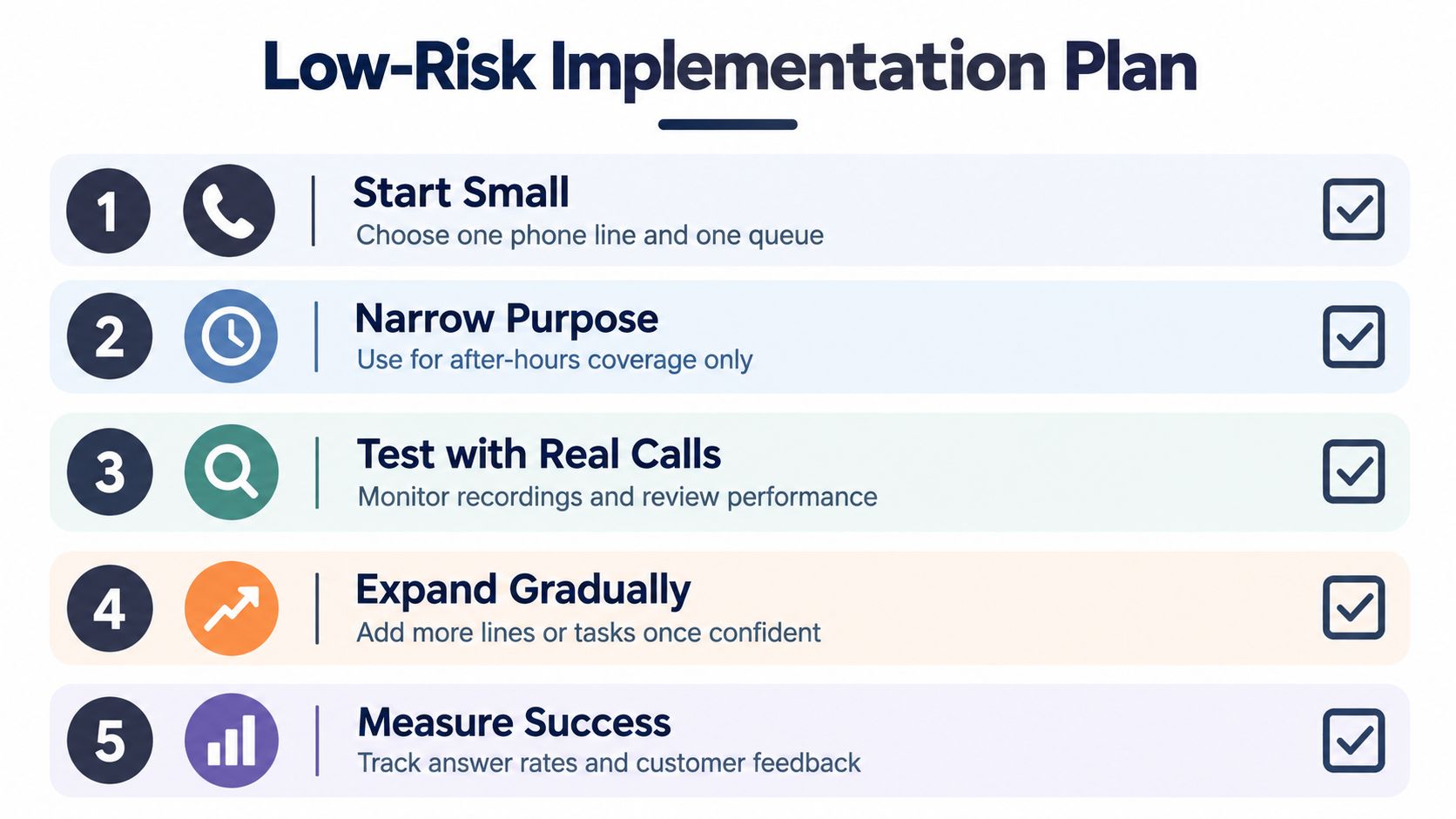
Begin with a phone line, a queue, and a narrow purpose, such as after-hours appointment requests. You don't need to automate the full customer journey to find out whether the assistant is useful.
Verizon's 2025 survey of 600 U.S. small and medium-sized businesses found that 38% used AI in at least one business function. That adoption figure doesn't establish readiness for a particular business, but it provides context for evaluating AI as a practical operational tool.
Prepare the operating instructions
Build a small, approved knowledge base before connecting live calls. Include services, opening hours, service areas, approved pricing language, booking restrictions, and emergency-routing instructions.
- Assign an owner: Name who approves answers and updates business information.
- Define permissions: Specify what the assistant may read, create, change, or cancel.
- Write fallback behavior: Decide what happens when a caller is unclear, a transfer fails, or a connected system is unavailable.
- Set review responsibility: Make someone accountable for examining summaries and escalation reasons.
Test the basic conversation before adding write access to business systems. For appointment workflows, a calendar integration walkthrough can help you identify availability rules and booking dependencies without treating calendar access as a substitute for testing.
Separate technical setup from service readiness
For rednea, setup is provider-managed and described as ready in about 30 minutes. Treat that as a provider-specific setup description, not a universal deployment time or a promise that every workflow is ready for unrestricted use.
Ask staff to make realistic test calls: change a request midway, provide an unfamiliar surname, interrupt, or ask for something outside scope. Check both the conversation and the resulting record.
Then introduce limited live coverage with a clear route back to the existing process. Expand only when reviewers can see that the assistant follows instructions, records usable information, and handles failures appropriately.
How to Evaluate Pricing and Vendor Claims
A low advertised rate tells you little if staff must repair bookings or chase incomplete messages. Compare the cost of operating the workflow, not just the cost of answering the call.
Ask each prospective provider to price the same scenario, using your actual call patterns and required tasks. A guide to AI voice-agent pricing can help organize the questions, but the written proposal should control the purchase.
Compare the full scope
Separate recurring charges from setup, integration, and communication costs. Clarify what happens when usage exceeds an allowance and whether unsuccessful calls or transfers count toward billing.
- Usage: Ask about per-minute or per-call charges, included usage, top-ups, and billing increments.
- Implementation: Identify who configures call flows, updates information, and fixes broken connections.
- Features: Confirm supported languages, reporting access, handoff options, and any additional charges.
- Third-party services: Establish whether telephone, messaging, or connected-system charges are separate.
As a provider-specific example, rednea describes transparent plans, per-minute billing, optional top-ups, managed setup, and integrations with common calendar, scheduling, and CRM systems. Confirm the exact connection and commercial terms for your workflow rather than assuming that an integration category guarantees compatibility.
Require evidence before signing
A polished demonstration isn't an acceptance test. Ask the provider to run your real call scenario, including a supported non-English conversation where relevant.
| Buying question | Evidence to request |
|---|---|
| Can it complete the task? | A verified record in the destination system |
| Does it respect permissions? | A demonstration of refused unauthorized actions |
| Can it recover from failure? | A failed integration and an unavailable recipient test |
| Are responsibilities clear? | Written support, data-handling, cancellation, and export terms |
Choose a provider whose limits are understandable. A clear refusal to perform an unsafe action is more useful than an impressive but unverifiable promise of autonomy.
Trust, Privacy and a Practical Rollout Checklist
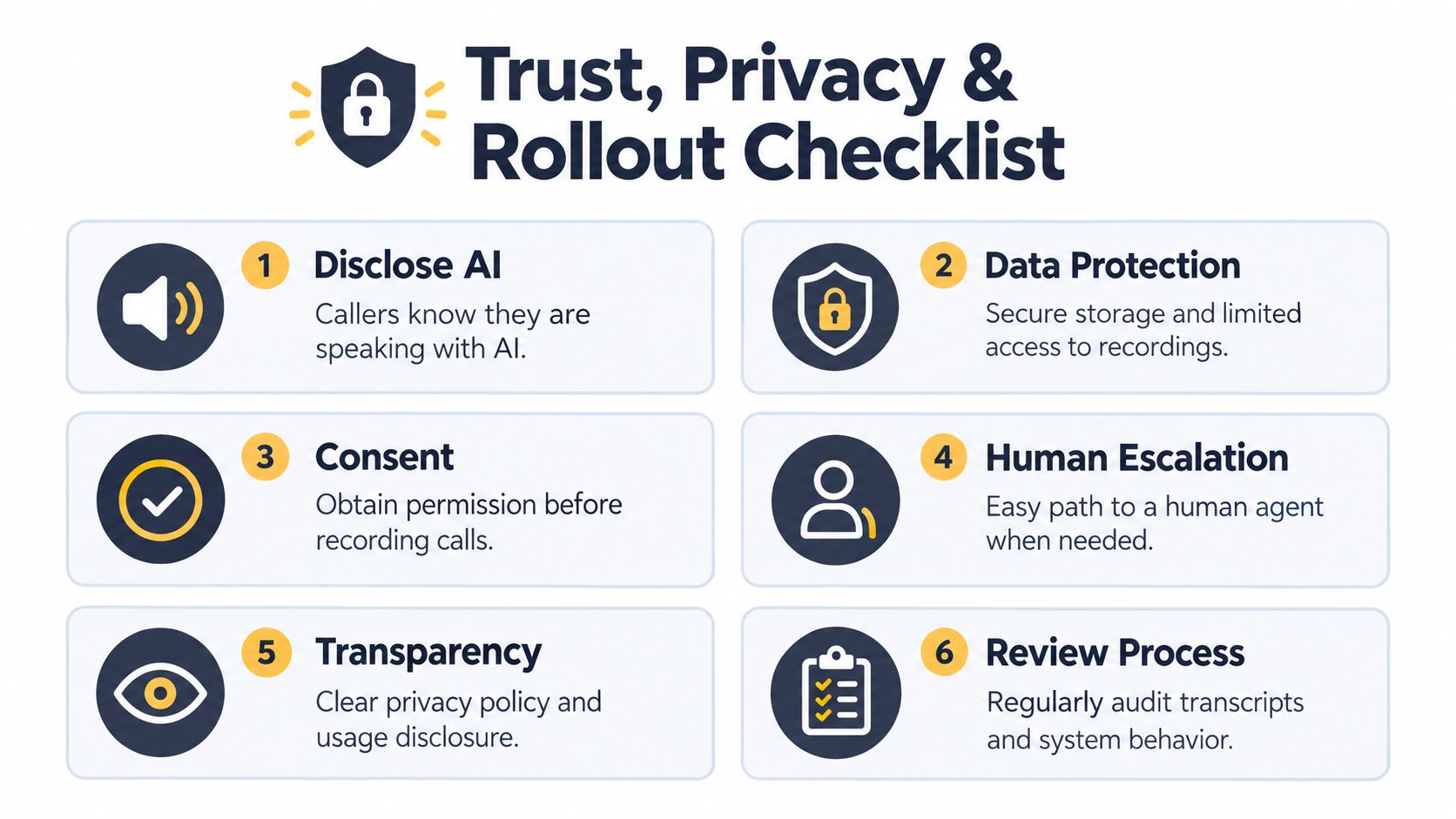
Answering more calls isn't enough if callers misunderstand who they're speaking with or what has been agreed. Trust calibration means making the assistant's identity, abilities, and limits clear.
Use a direct opening that identifies it as an AI assistant, explains its approved role, and offers a route to a person. Don't make callers discover the limitation after sharing sensitive information.
Make privacy part of purchasing
Map where audio, transcripts, summaries, and contact details travel. Ask who processes each item, where it's stored, who can access it, how long it remains, and how deletion requests reach connected systems.
A customer-data protection overview is a useful starting point for vendor questions. It doesn't replace reviewing processor responsibilities, retention settings, access controls, and deletion workflows against your own EU or UK GDPR obligations.
Forbes reported that AI-generated voices fall under the U.S. Telephone Consumer Protection Act, with prior consent generally required for outbound AI calls and written consent required for marketing calls. Obtain qualified advice on applicable calling and recording requirements before enabling outbound workflows.
Define explicit escalation triggers for emergencies, complaints, vulnerable customers, payment disputes, legal matters, sensitive health information, and requests for a human. Also document what happens when staff cannot accept the transfer.
Calculate value from your own records
Use a worksheet rather than a universal earnings claim:
- Coverage opportunity: Actual inbound calls multiplied by your measured missed-call rate.
- Recovered demand: Eligible enquiries successfully captured that otherwise lacked a usable response.
- Commercial contribution: Recovered enquiries multiplied by your observed conversion rate and contribution per completed job.
- Net value: Contribution and demonstrable staff-time value, minus service costs and correction effort.
Don't count every answered call as recovered revenue. Keep appointment requests, confirmed appointments, completed work, and repeat callers separate.
Before expanding: Review whether customers received the right outcome, not merely whether the assistant kept them on the line.
Approve the use case and knowledge base, test names and numbers, review escalation transcripts, and monitor abandonment, repeat calls, complaints, and transfer success. Keep humans responsible for high-stakes outcomes. AI is useful when it gives staff better information and customers a dependable next step, not when it hides the need for human help.
---
rednea offers managed AI phone answering for routine questions, appointment bookings, lead qualification, and handoff to your team. Visit rednea to discuss a narrowly scoped first workflow and arrange a demonstration using the calls your business receives.
Try rednea, no strings attached
AI phone assistant for business. Hear a live demo in your browser, book a call with our team, or get started — from £90/month, cancel monthly, no minimum term.
GDPR-compliant · EU & UK GDPR · Multilingual