Time to Resolution: A Practical Guide for Small Teams

You're halfway through a job when the phone rings. You can't answer, so the caller reaches voicemail. You call back later, ask what they need, discover the job details are incomplete, and start another round of messages to find a suitable time. By then, the caller may already have booked the electrician, plumber, clinic, or consultant who answered first and moved the request forward.
That's the time to resolution problem for small businesses. It starts with the phone, not the ticket system. A call that isn't answered, qualified, scheduled, and routed properly can sit unresolved even if someone eventually logs it in a neat dashboard.
Why Time to Resolution Is the Metric That Pays You Back
A caller reaches your business between site visits. You miss the call, receive a voicemail, and plan to return it after the current job. The caller still needs an answer, a price, or an appointment. If another local business responds with a clear next step, that opportunity can disappear before you make contact.

Time to resolution measures whether the customer received a complete outcome, not whether someone acknowledged the request or entered it into a system. A fast answer does little if the caller still waits for a quote, appointment, diagnosis, or decision from the right person.
For tradespeople and small businesses, the phone is usually the first part of the customer journey. That makes the quality of the first conversation more important than the speed of a later ticket update. An unanswered call creates delay immediately. A poorly qualified call creates more delay through follow-up questions, repeated explanations, and scheduling errors.
The historical case for fixing that delay is strong. A 1996 U.S. National Performance Review benchmarking paper reported that one highly technical organization reduced average complaint resolution from 55 days to 19 days, approximately 65%, while another reduced case resolution from 27 days to 6 days, below its formal 15-day standard. The point for a small operation is practical: redesigning the route to completion can produce more improvement than telling staff to work faster. (The National Performance Review benchmarking paper)
The phone is often your sales funnel
If calls generate your jobs, every missed or weakly handled call leaks demand. Returning the call is only part of the job. The customer needs a concrete next outcome without having to chase your team.
That outcome may be:
- A booking: a confirmed appointment that matches your real availability.
- A qualified job: the location, problem, urgency, equipment, and access details needed to decide the next action.
- A clear answer: a reliable response to a routine question.
- A human escalation: an urgent or complex request sent to the right person with enough context to act.
Front-loaded AI qualification can compress the journey before a human gets involved. It can collect the details needed to judge urgency, identify routine requests, and pass a usable summary to the person who will schedule or resolve the work. Faster answering helps, but faster qualification prevents the longer delays that follow an incomplete call.
A practical service continuity process keeps calls progressing when the usual caller-handler is busy or unavailable. It prevents every absence from becoming a callback queue.
Operator's rule: If the customer must repeat the problem, wait for a callback, or ask when you are available, the request is probably still open.
Reducing time to resolution helps convert more of the demand you already worked to generate. It also cuts evening follow-up and administrative work. Set the operation around one promise: capture the call, qualify it properly, complete routine requests, and send genuine exceptions to a human.
What Time to Resolution Means (and What It Doesn't)
A caller reports a burst pipe at 9:00 a.m. Someone answers within ten seconds, but the repair happens four days later. The business delivered a quick response, not a quick resolution. Time to resolution measures the full customer journey.
Use one definition across the team:
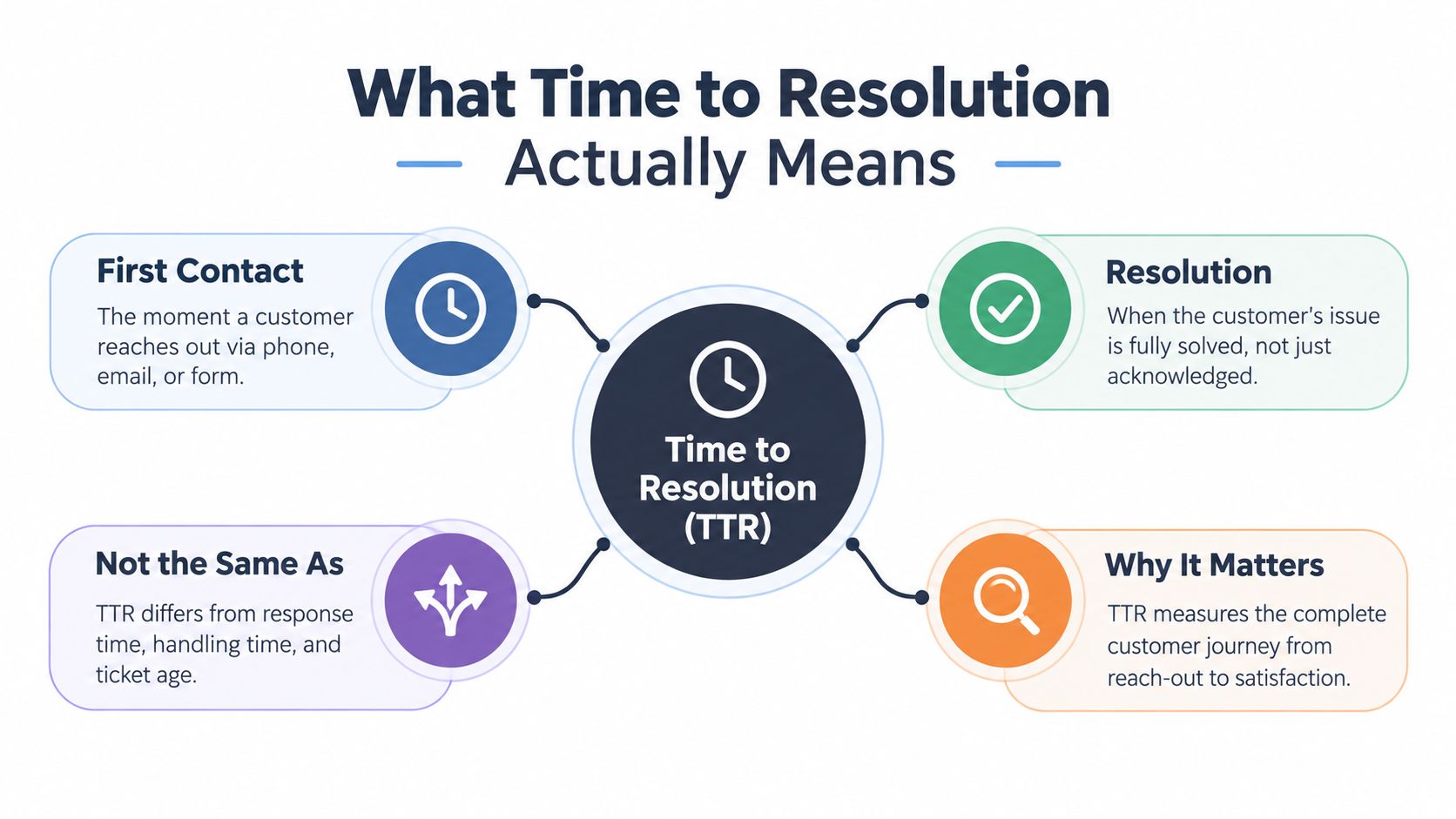
Time to resolution is the elapsed time from the customer's first contact to the moment the customer's issue is fully solved and confirmed.
For a plumbing business, the clock starts when the caller reports the leak. It stops when the repair is complete, the customer knows what happened, and the record is closed. Front-loaded qualification matters because a fast answer still leaves the customer waiting if the call lacks the details needed to schedule or act.
Keep these metrics separate
Small teams often group speed measures together. Keep them distinct. Each metric points to a different operating problem.
- First-response time: How long it took someone or something to acknowledge the customer.
- Handling time: How long the active conversation lasted.
- First-contact resolution: Whether the issue was solved during the initial interaction.
- Ticket age: How long the record has remained open.
- Time to resolution: How long the customer waited for the complete outcome.
A fast pickup improves response time; only a completed outcome improves the customer journey. A caller who gets transferred, repeats the problem, waits for a calendar check, and receives a later callback has experienced a slow resolution, regardless of the initial answer speed.
Use the formula your team can repeat
Track:
Time to resolution = confirmed resolution timestamp − first-contact timestamp
Define both timestamps before measuring. “First contact” means the first inbound call, message, form submission, or other agreed starting point. “Confirmed resolution” means the request is complete, the customer has the required answer or appointment, and no further action remains with your team.
Choose whether the clock runs in calendar hours or business hours. HDI's summary of MetricNet's global desktop-support benchmark reported an average incident resolution time of 8.85 business hours, with a range from 0.6 to 27.5 hours. The wide range shows why triage, availability, and escalation design matter alongside issue complexity. (HDI's MTTR benchmark summary)
For appointment-driven businesses, calendar hours may reflect customer experience more directly. Teams operating only during defined hours may get a clearer view of staffing capacity from business hours. Pick one, document it, and keep the definition fixed when the result looks uncomfortable.
How to Measure Time to Resolution Step by Step
Start with a single call type, such as new repair requests or appointment bookings. Don't attempt to instrument every customer journey on day one. Choose a category that generates frequent calls and has a clear finish point.
Record four timestamps:
1. Time to acknowledge: When someone or the assistant first responds. 2. Time to schedule: When the customer receives a confirmed appointment or next action. 3. Time to complete the work: When the service, answer, or intervention is delivered. 4. Time to close the record: When the case is checked, documented, and no follow-up remains.
These stages expose different problems. A long acknowledgment time points to missed calls or coverage gaps. A long scheduling period suggests poor calendar visibility or too many approval steps. A delay between booking and completion may reflect capacity or routing. A long close time often means staff finish the work but fail to update the record.
Don't let averages hide painful cases
Report the median and the 90th percentile, not just the average. The median shows the typical customer journey. The 90th percentile shows what happens to customers near the slow end, where frustration and repeat contacts usually concentrate.
Also track reopened cases. A record marked complete and reopened shortly afterward wasn't a clean resolution. For a field-service business, segment the results by job type, urgency, geography, technician, and whether the first visit succeeded. A single overall number is too blunt to tell you what to fix.
A fast booking isn't automatically a resolved customer issue. It's resolved only when the promised outcome is complete.
A practical dashboard might include:
| Stage | What it tells you | Action when it rises |
|---|---|---|
| Acknowledge | Whether calls are being answered promptly | Add coverage, voicemail recovery, or automated intake |
| Schedule | Whether availability and qualification are working | Connect the calendar and standardize booking rules |
| Complete | Whether the team can deliver the promised service | Review capacity, routing, and first-visit readiness |
| Close | Whether records and follow-up are controlled | Add completion checks and ownership |
Keep each case tied to the original call. If staff create a new record every time the customer calls back, your reporting will make repeated contact look like separate demand. Real-time visibility makes this easier to monitor, especially when the owner needs to spot a stuck booking or overdue escalation without searching through messages. A focused real-time analytics workflow should show open cases by stage, age, owner, and urgency.
Benchmarks and Customer Expectations You Should Plan Around
A customer calls about a failed boiler, a missed appointment, or a blocked payment. They do not measure your performance by the ticket's status. They want someone to qualify the problem, set the next action, and finish the job within a reasonable window.
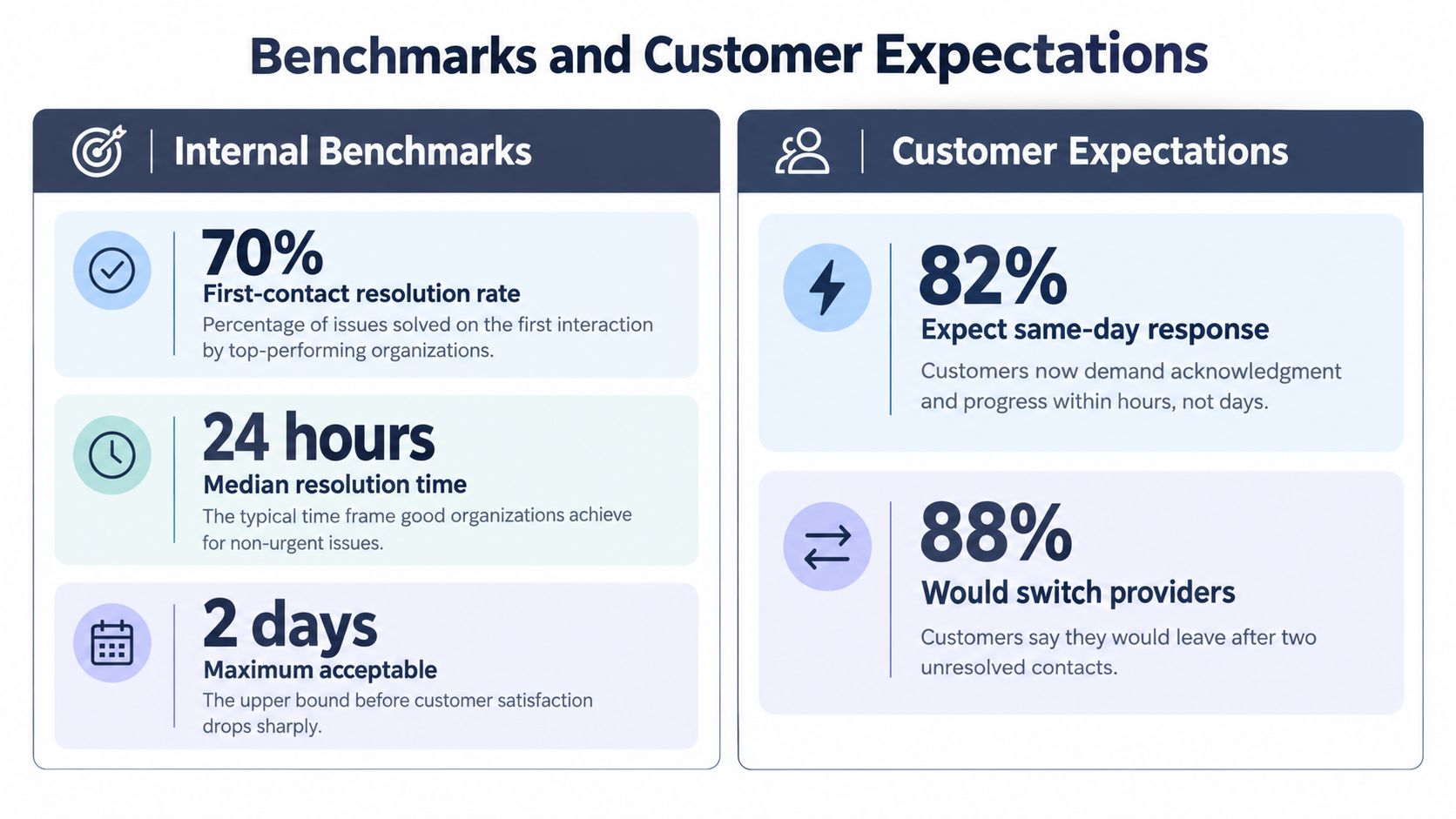
Customers increasingly measure responsiveness in hours, not days. A 2024 customer-service survey summary found that roughly nine in ten respondents expected resolution within half a day or less, with 37.2% expecting it within four hours and 26.3% within 30 minutes (Customer-service expectation data). The categories may overlap, so use these figures as directional guidance rather than separate portions of one audience.
That expectation does not mean every emergency, repair, legal question, or clinical request can be completed immediately. It means customers expect visible progress. For a small business, that may be a confirmed appointment, a qualified job, a clear answer to a routine question, or a named person taking ownership.
Use benchmarks as operating signals
Historical service benchmarks reported 85% first-contact resolution, along with targets for short queue waits, brief holds, fast answer speed, and high service levels. Those figures are not a universal target for a two-person trade business. They support a practical rule: measure how quickly the phone is answered, then measure whether the customer's need was resolved. (Historical customer-service benchmarks)
Field-service performance shows why the slow tail deserves attention. The 2025 Field Service Benchmark Report states that top-performing companies resolve issues in about three days, while bottom performers take about 11 days, nearly four times longer. The report defines resolution time as the period between case creation and closure. (2025 Field Service Benchmark Report)
Set targets by request type:
- Routine information: Answer during the initial call when the information is known.
- Appointment requests: Confirm the slot during the call whenever the calendar allows.
- Qualified jobs: Capture enough detail for the next dispatch decision without another discovery call.
- Urgent or sensitive issues: Escalate immediately under a written rule.
- Complex work: Define the next milestone clearly, even when completion requires a visit.
Front-load qualification on the phone. A fast answer that produces an incomplete record only creates another call, while a properly qualified first conversation can compress the entire customer journey.
Compare your current median with your slow tail and the expectation for each call type. If routine bookings finish quickly but urgent cases stall, strengthen escalation. If every category waits too long for acknowledgment, fix phone coverage first.
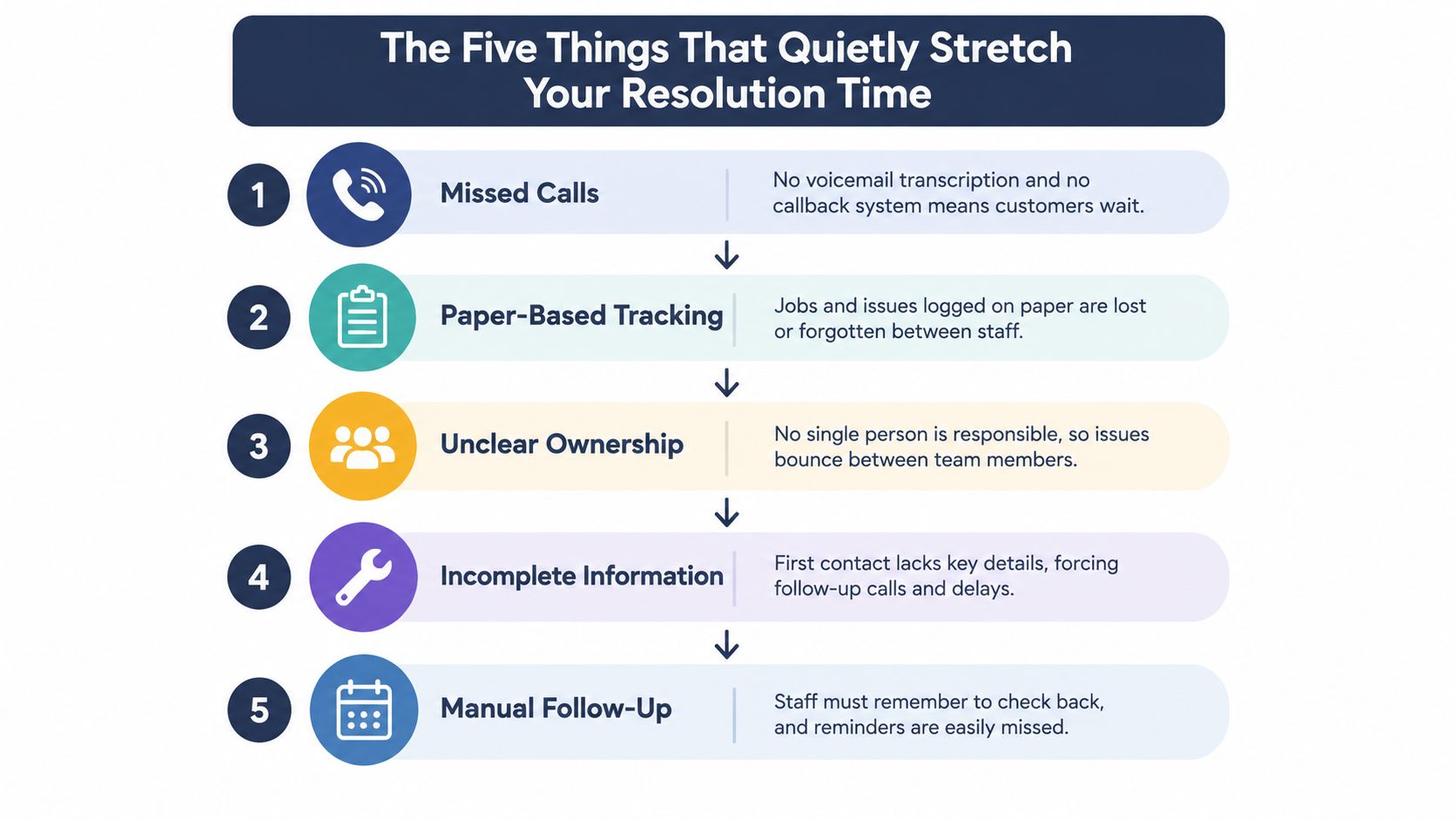
The Five Things That Quietly Stretch Your Resolution Time
Most small businesses don't lose time because every customer has a difficult problem. They lose time because ordinary requests move through a messy path.
Missed calls create invisible queues
A caller reaches voicemail while you're under a sink, driving between jobs, treating a patient, or meeting a client. The voicemail may contain no location, urgency, or useful description. You return the call later, ask for the missing details, and discover the caller is no longer available.
Fix: Create one immediate intake path that captures the caller's reason, contact details, urgency, and preferred next step, even when you can't speak personally.
Incomplete intake forces another conversation
A receptionist books “boiler not working” without asking the property type, symptoms, access conditions, or equipment details. The technician arrives without the information needed to prepare, or calls the customer again before dispatch.
Fix: Write the minimum qualification questions for each high-volume call type and ask them in the first interaction.
Language gaps turn simple requests into slow requests
A caller may be comfortable speaking a language other than the one your team uses internally. If the conversation becomes awkward, the assistant may collect partial information, or the customer may abandon the interaction altogether.
Fix: Support the languages your customer base uses, then pass a structured summary to the human team so the job record remains consistent.
Manual calendar checks add avoidable handoffs
The caller suggests a time. Your staff member checks a calendar, sends a message to someone else, waits for confirmation, and calls back. The customer has now become part of an internal scheduling chain.
Fix: Give the booking process access to the availability rules and let it offer only genuine slots.
Unclear escalation leaves exceptions stranded
A routine request can move automatically. A safety concern, complaint, payment dispute, or unusual job needs human judgment. Without a rule, the call bounces between whoever happens to see it first.
Fix: Define who owns each exception, what information must accompany the handoff, and how quickly that person must act.
A failed first visit is an expensive example of poor qualification. Field-service research found that it adds roughly two more visits and about 14 days to resolution. The same evidence reported top organizations closing cases in about three days, compared with around 11 days for lower performers. (Field-service resolution findings)
That's why the right fix isn't always “answer faster.” A short, structured intake can take slightly longer than a greeting, yet reduce the total journey by preventing a wrong dispatch, missing part, or unnecessary callback. Use first-call resolution practices to identify which details must be captured before the request moves forward.
How an AI Phone Assistant Compresses Time to Resolution
A customer calls a plumbing company with a leaking boiler. The team is already on a job, so the caller leaves a vague voicemail, waits for a callback, explains the problem again, and then discovers that the first available appointment does not fit. The delay began on the phone, long before anyone opened a ticket.
A capable AI phone assistant handles that front end. It answers when the team is busy, outside normal hours, or already speaking with another caller. It identifies the caller's language between English, Spanish, French, German, and Italian, continues naturally, and gathers the details needed for the next decision. The electrician, clinician, consultant, or receptionist receives an actionable request instead of a missed call.
Start with structured qualification
Configure the assistant around the work your business performs:
- Intent: Is this a new job, an existing job, a price question, an appointment request, or an urgent issue?
- Context: What happened, where is it happening, and how long has it been happening?
- Job details: What equipment, property type, service, or account is involved?
- Constraints: Is there an access issue, a deadline, a preferred appointment window, or a safety concern?
- Contact details: Who should receive confirmation, and what is the best way to follow up?
Do not force every caller through the same long script. Ask only what is needed to classify the request, answer it, schedule it, or send it to a person. A short, relevant intake protects the caller's time and gives the team enough information to act without starting the conversation again.
Connect the call to the next action
The assistant can book into Google Calendar or Microsoft 365, apply availability rules, and send an email or optional SMS summary. It can route an important call to the right person instead of making every employee listen to the full conversation.
The slow route is familiar: missed call, voicemail, callback, missing details, calendar check, another callback, appointment, then a technician discovers that the request was incomplete. A better route is direct: answer, identify the request, capture the job details, offer a genuine slot, confirm the booking, and send the summary to the person doing the work.
The objective is not the shortest greeting. It is the shortest complete journey, with fewer repeated explanations, unnecessary transfers, and manual scheduling loops.
Industry research on intelligent triage reports savings of roughly 45 seconds per customer issue. For a small business handling 30 calls a week, saving those seconds on each call removes a measurable amount of avoidable phone time while improving the information passed to the team. The larger gain comes when better qualification prevents a second call or an unsuitable appointment.
Keep humans in control
AI should complete routine requests and escalate exceptions. Routine work may include business hours, service areas, appointment availability, basic qualification, and job-status questions. Humans should handle complaints, safety concerns, unusual requests, payment disputes, vulnerable customers, and anything requiring discretion.
Set explicit handoff rules:
1. Escalate immediately when the caller describes danger, a safety risk, or a serious complaint. 2. Escalate with a summary when the request falls outside approved knowledge or booking rules. 3. Complete automatically when the request is routine and the customer receives a clear outcome. 4. Flag for review when the caller's information is incomplete or contradictory.
A practical option is rednea, an AI phone assistant that answers calls, detects the caller's language, handles routine questions, qualifies leads, books appointments, connects with calendars, and sends concise summaries for follow-up. Its AI answering service for small businesses can support a small team without a call center, while people retain control of exceptions that require judgment.
Start with one call type, one calendar, one escalation path, and one summary format. Review real conversations, remove questions that create confusion, and check whether the human can act without calling the customer back. That is how front-loaded qualification compresses time to resolution.
Your 30-Minute Plan to Cut Time to Resolution Starting Today
You don't need a perfect service system to start measuring. You need one clear definition and one call type.
1. Choose one metric: Track time from first call to confirmed resolution. 2. Define the finish line: Decide what “resolved” means for a booking, job, question, or escalation. 3. List the intake fields: Write the details a human needs before taking the next action. 4. Turn on an AI phone assistant: Start with routine calls and a clear human handoff. 5. Connect your calendar: Let the system offer real availability instead of creating callbacks. 6. Set two escalation rules: Choose the urgent cases and sensitive cases that always reach a person. 7. Review the first week: Compare time to resolution by call type, first-contact resolution, escalation rate, and repeat-contact rate.
If the acknowledgment time is high, fix coverage. If bookings are fast but jobs reopen, improve qualification. If escalations pile up, assign ownership and response rules. Measure the customer's completed outcome, not the activity your team performed.
---
rednea answers routine calls, qualifies requests, books appointments, and sends structured summaries so your team can spend human time on the conversations that need judgment. Visit rednea to set up an AI phone assistant and start reducing time to resolution from the first call.
Try rednea, no strings attached
AI phone assistant for business. Hear a live demo in your browser, book a call with our team, or get started — from £90/month, cancel monthly, no minimum term.
GDPR-compliant · EU & UK GDPR · Multilingual