Market Differentiation: A Practical Playbook for SMBs

At 8:14 on a weekday morning, a homeowner calls three electricians because a fuse board keeps tripping. Two calls go unanswered. One reaches a full voicemail box. The third electrician answers within two rings, asks a few useful questions, and books the visit for that afternoon.
The winning electrician didn't necessarily have the lowest price, the longest trading history, or the most polished website. They were available at the moment the customer needed help. That missed call wasn't a moral failure. It was evidence of how customers make decisions under pressure.
Market differentiation starts with the choices customers can actually notice. For a local service business, that may mean answering first, quoting clearly, serving a narrow area, or making the booking process easier than the alternatives. The following playbook turns those choices into practical actions you can implement this quarter.
The Call You Missed This Morning
The homeowner with the tripping fuse board probably wasn't conducting a detailed comparison. They weren't studying brand values or reading a carefully crafted positioning statement. They wanted to know whether someone could help, how soon they could arrive, and whether the conversation felt competent.
The electrician who answered won the immediate decision because they removed uncertainty. The customer could stop calling around, arrange an appointment, and get on with the morning. For a small business, that one interaction can be more valuable than another week of polishing a homepage headline.
Practical rule: If a customer can notice the difference before the job starts, it can become a differentiator.
Owners often treat missed calls as an unavoidable part of being on-site, driving, treating patients, or serving another customer. That's understandable. A tradesperson can't safely answer while working in a consumer unit, and a clinician shouldn't interrupt an appointment every time the phone rings. The operational problem isn't that humans are busy. It's that the business has no reliable response layer when they are.
A useful guide to immediate availability frames the issue in customer terms. A caller doesn't know whether you're under a sink, in a consultation, or on another line. They only know that one business answered and yours didn't.
Start there. Don't ask whether your branding feels distinctive. Ask what the last caller experienced, what they had to do next, and whether the next step made it easier for them to choose you. The business that consistently picks up, qualifies the need, and gives a clear path forward has already made a meaningful market choice.
What Market Differentiation Actually Means
Market differentiation is the specific reason a customer chooses your business over a close alternative. It needs to be visible in the buying experience, not just written in marketing language.
Think about two cafés on the same street. One serves coffee. The other remembers that you want oat milk and no sugar, has your order ready when you arrive, and makes correcting an error painless. The drinks may be similar, but the second café has created a reason to return that customers can feel.
For an electrician, the reason might be a clear arrival window and a written explanation after every job. For an estate agent, it might be deep knowledge of one local area. For a freelancer, it might be a straightforward fixed-fee process that removes uncertainty before work begins.
Separate the choice from the description
Differentiation is the real distinction. Positioning is how you describe it.
“Reliable service” is positioning language with little practical force because every competitor can say it. “A written quote within four hours for jobs in our service area” is a customer-facing promise that can be tested. The first sounds positive. The second gives a buyer something concrete to compare.
A customer often evaluates several alternatives quickly. They may compare response speed, confidence, convenience, price, and whether the provider appears to understand their specific problem. You don't need to win on every dimension. You need to own one important dimension and meet the basic expectation on the others.
Choose an axis customers can verify
The strongest differentiators survive contact with the actual operation. A claim about personal service collapses if calls disappear into voicemail. A claim about speed fails if the quote arrives days later. A claim about expertise weakens when the first conversation feels generic.
Use five practical axes:
- Product: What you deliver and for whom.
- Service: How quickly, clearly, or reliably you deliver it.
- Channel: How customers reach and transact with you.
- Price: How you structure and explain the cost.
- Experience: How the entire interaction feels before, during, and after purchase.
The right axis is the one your best customer would notice immediately if you removed it overnight.
The Five Ways a Small Business Can Stand Out
Small businesses don't need an original category to differentiate. They need a deliberate choice about where they will be easier to choose.
| Axis | Example | Trade-off |
|---|---|---|
| Product | An estate agent specialising in one postcode | Narrow expertise can limit the number of properties you accept |
| Service | A plumber who provides a quote within an hour | Fast quoting requires protected office time and dependable information |
| Channel | A salon accepting bookings through WhatsApp | Informal channels can create missed details and fragmented records |
| Price | A freelance bookkeeper using transparent flat fees | Clear pricing attracts comparison shoppers and can reduce upsell room |
| Experience | A dental clinic that remembers family names and preferences | Personal service requires disciplined notes and consistent staff habits |
Product differentiation works when a narrower offer solves a clearer problem. An estate agent focused on one postcode can build sharper local knowledge, but they'll turn away work outside that area. A contractor specialising in older properties may command more trust from that audience while missing general renovation enquiries.
Service differentiation changes the customer's waiting experience. A plumber who quotes within an hour gives a nervous homeowner a decision point instead of an open loop. The trade-off is operational: someone must receive the details, assess the job, and send a credible quote without compromising accuracy.
Channel differentiation removes friction. A salon that lets people book through a familiar messaging channel may capture enquiries that would never become website bookings. That convenience needs a process for confirmations, deposits, cancellations, and handover.
Price differentiation is not the same as being cheapest. A freelance bookkeeper can publish flat fees that make budgeting easier, but transparent fees may invite direct comparison. Experience differentiation then works through accumulated detail, such as remembering a family's names, previous treatment, or preferred appointment times.
Personalised intake can support this last axis when it captures the right information before a human takes over. A practical example appears in call personalisation for customer conversations. The point isn't to make every interaction elaborate. It's to make the detail that matters arrive at the right moment.
Test your choice with one question: what would your best customer notice if you stopped doing it tomorrow? If the answer is “nothing specific,” you've chosen a slogan rather than a differentiator.
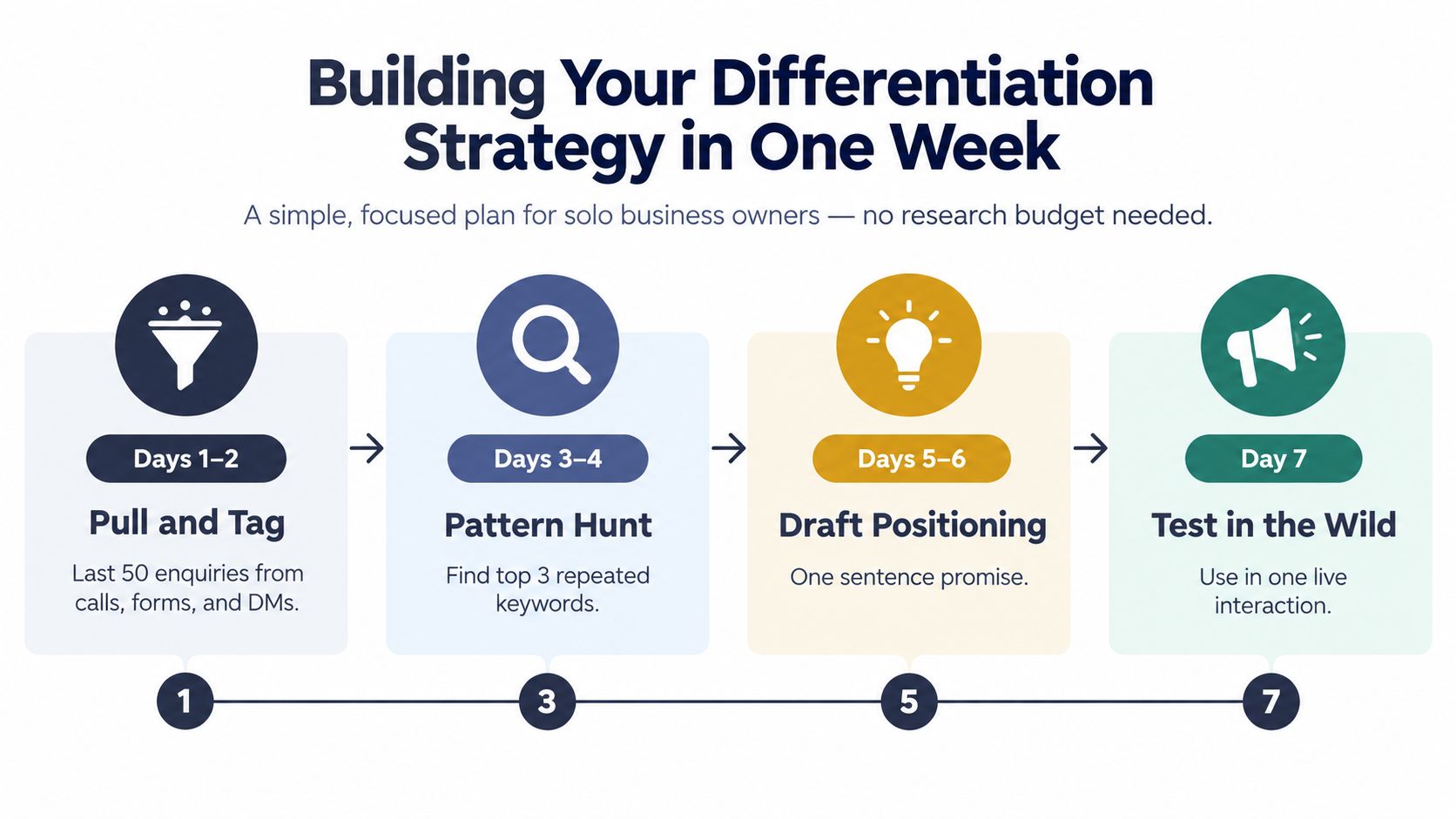
Building Your Differentiation Strategy in One Week
You can find a workable differentiator without buying a research report. A solo owner can extract enough evidence from recent enquiries, customer conversations, and competitor behaviour to make a focused decision.
Days one and two
Pull the last 50 enquiries from calls, forms, and direct messages. Tag each one with three simple notes:
- What they wanted: The job, appointment, product, or answer.
- What slowed them down: Price uncertainty, lack of availability, confusing scope, location, or trust.
- What happened next: Booked, went elsewhere, stopped replying, or still needs follow-up.
Don't try to build an elaborate database. A spreadsheet is enough. You're looking for repeated friction, especially friction you can remove without hiring a full team.
Days three and four
Call five recent customers. Ask two blunt questions:
1. What almost made you choose someone else? 2. Why did you stick with us?
Write down their exact meaning, not the polished version you hoped to hear. If several customers mention quick replies, clear explanations, or flexible scheduling, you may have a stronger axis than the one currently featured on your website.
Then inspect the three competitors you most often lose work to. Note their visible promises, pricing pattern, opening hours, response behaviour, and the questions they ask before quoting. You're not copying their wording. You're identifying which customer needs are already crowded and which ones remain poorly served.
Days five to seven
Choose one axis and turn it into a promise a customer can verify. Examples include:
- A same-day callback window.
- A written quote within four hours.
- A senior tradesperson on every job.
- A confirmed appointment summary by message.
- A clear service-area and job-size filter.
Update the website, voicemail, enquiry forms, and job sheets so the promise appears before, during, and after contact. Test it in real conversations rather than waiting for a perfect campaign.
Don't try to own all five axes at once. A small business that promises the lowest price, fastest response, deepest expertise, widest availability, and most personal service usually creates an operation that can deliver none of them consistently.
Where AI Fits Without Replacing the Human Touch
AI works best in the parts of customer service that are repetitive, time-sensitive, and easy to define. Human judgment remains essential when the customer needs a nuanced price decision, reassurance, negotiation, clinical care, legal judgment, or a complaint resolved with empathy.
The preference data points to a clear boundary. A 2026 Sinch survey reported by Tucson.com found that 88% of companies expect AI agents to handle some customer conversations by the end of 2026, while Gartner reported that nearly 80% of customer service organisations plan to reshape human-agent roles as routine work becomes automated. That supports a hybrid model, not a total replacement model.
Customer satisfaction also depends on where the handoff occurs. Customer Experience Dive's summary of Verizon Business research reported 88% satisfaction for human-led digital service interactions, compared with 60% for AI-only interactions, and noted that 47% of consumers become frustrated by a lack of human agents. A separate Kim.cc consumer study reported by PR Newswire found that 45% welcomed AI for simple support tasks, while 45% to 60% wanted human involvement for sensitive issues such as billing disputes, complaints, and bug resolution. Capgemini's global consumer survey found that 55% preferred interactions enabled by a mix of AI and humans in its reported benchmark, as detailed in its consumer experience report.
A practical electrician workflow
An electrician could use an AI phone assistant at 6 a.m. to answer immediately, confirm the address, identify the problem type, check availability, and book a suitable slot. A caller describing smoke, exposed wiring, or an urgent safety concern can be routed to the electrician or an agreed emergency process.
The assistant handles the boring first layer. The electrician handles diagnosis, pricing judgment, safety decisions, and the work itself. That is the useful distinction explained in guidance on sensitive calls and human handoff.
Language matters too. An assistant that detects the caller's language and handles English, Spanish, French, German, or Italian can reduce friction for a multilingual customer base. Start narrowly, with opening hours, service areas, booking rules, and qualification questions. Add complexity only after the team trusts the handoff.
Why the Moment Matters More Than the Average Answer Rate
An average weekly answer rate can hide the failure that costs you the best enquiry. If your team answers most calls but misses the short period when emergency work, new listings, or same-day appointments arrive, the average gives false comfort.
Reported missed-call rates vary substantially by sector. Phone2's analysis of missed calls cites 32% in healthcare, 28% in legal services, 14% in home services, and 9% in real estate. The same analysis estimates that a missed call costs about $12.15 on average, with annual SMB losses ranging from about $26,000 to $126,000 depending on volume. Those figures are estimates, not a universal price tag for every business.
| Vertical | Avg missed-call rate | Est. revenue lost per missed call | Highest-urgency moment |
|---|---|---|---|
| Healthcare | 32% | About $12.15 average estimate | A patient seeking a timely appointment |
| Legal services | 28% | About $12.15 average estimate | A prospective client with an urgent matter |
| Home services | 14% | About $12.15 average estimate | A burst pipe, electrical fault, or heating failure |
| Real estate | 9% | About $12.15 average estimate | A viewing request on a new listing |
The average cost is less useful than the value of the specific call. A missed emergency plumbing enquiry may represent a substantial job, while a missed request for a routine brochure may represent little immediate revenue. A dental practice may lose a new patient relationship, while an estate agent may lose the first viewing request on a property that has just come to market.
That's why better answer rate alone isn't a complete differentiator. The stronger operational question is whether you answer during the moments when a caller is most likely to book, buy, or switch.
Track two views:
- Worst-hour answer rate: Your performance during the busiest or highest-value window.
- Revenue at risk: The likely value of missed calls, separated by urgency and service type.
The business that answers an urgent call at 11 p.m., a viewing request as a new listing goes live, or a same-day appointment enquiry has created a service-level difference customers can experience immediately.
KPIs That Prove Your Differentiation Is Working
A differentiator needs an operating dashboard, not just attractive copy. You can review four numbers without a data team, provided you define them consistently and compare your performance with your own rolling three-month median, rather than an unverifiable industry average.
| KPI | Target | Review Cadence | Action If Slipping |
|---|---|---|---|
| Missed-call rate | Under 8% during business hours, near zero after-hours | Weekly for the first quarter, then monthly | Add overflow coverage, improve routing, or narrow published availability |
| Callback time | Under 15 minutes during hours, under 5 minutes after-hours | Weekly for the first quarter, then monthly | Assign ownership for callbacks and automate immediate acknowledgement |
| Bookings per 100 inbound calls | 30 or more for trades and clinics, 20 or more for salons | Weekly for the first quarter, then monthly | Review qualification, pricing clarity, and booking friction |
| Qualified-lead share | Set a baseline from your current calls | Weekly for the first quarter, then monthly | Tighten service-area, job-size, or budget filters |
The missed-call rate tells you whether the entry point is leaking. Callback time tells you whether recovery is fast enough. Bookings per 100 inbound calls tells you whether availability is converting into appointments, while qualified-lead share shows whether the calls reaching you fit the work you want.
Use simple decision rules. If missed calls rise, fix coverage before spending more on advertising. If callbacks slow down, assign one person or one automated workflow to own the next step. If bookings fall while pickup remains stable, inspect the conversation, price explanation, and booking process.
If pickup improves but bookings don't, the differentiator is cosmetic. If pickup holds steady and bookings increase, the promise is doing useful work.
For businesses that need a closer view of call outcomes, real-time analytics for customer conversations can help connect response behaviour with follow-up decisions. The measurement only matters if someone reviews it and changes the operation.
Your One-Page Differentiation Checklist
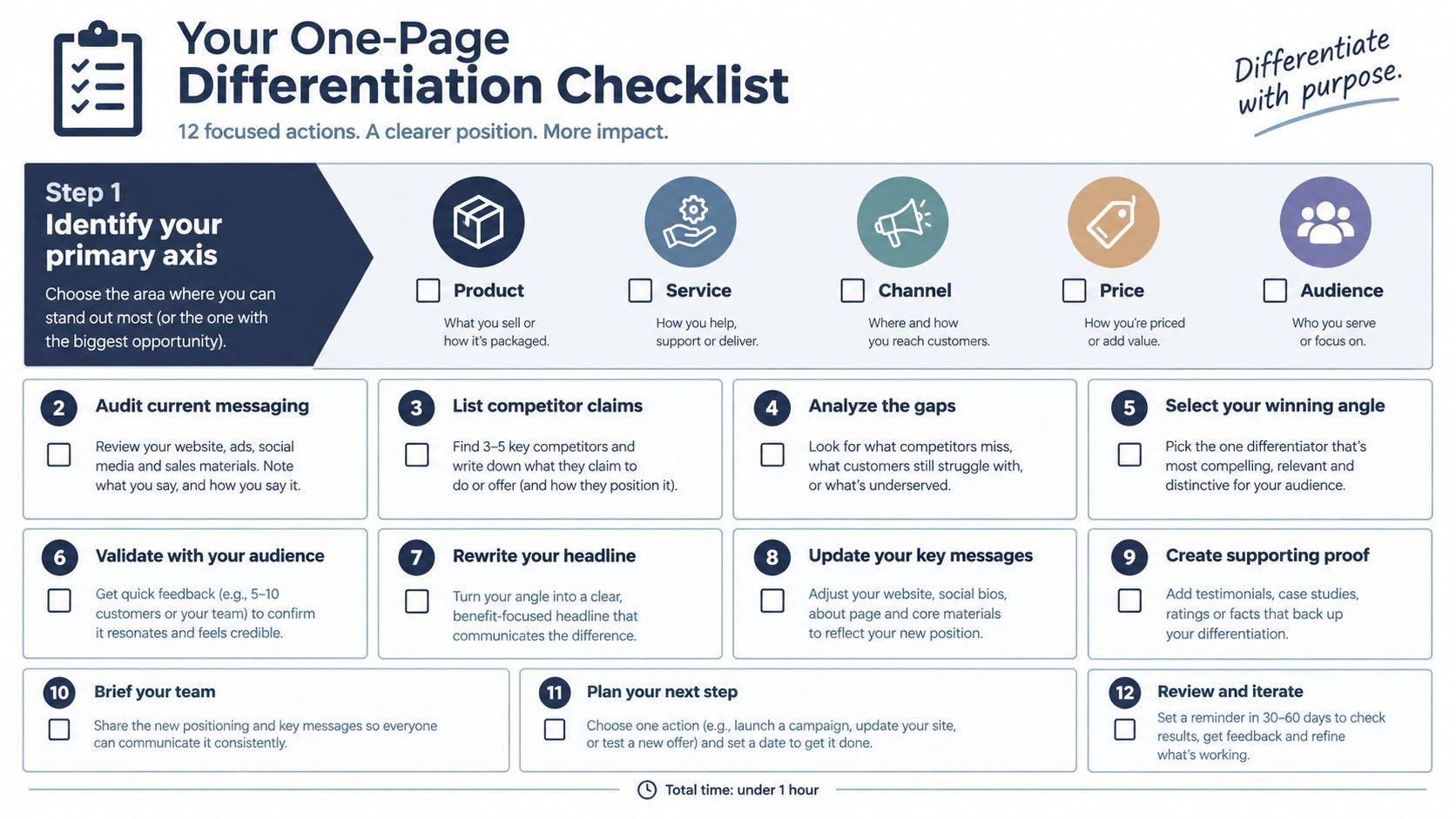
Print this as a weekly action sheet. Complete the first pass in under an hour, then revisit it regularly.
- Choose one axis: Product, service, channel, price, or experience.
- Write one promise: State what the customer can verify.
- Audit current messaging: Check your website, voicemail, forms, and social profiles.
- List competitor claims: Record what alternatives visibly promise.
- Identify the friction: Note what nearly stopped recent customers buying.
- Set a baseline: Capture missed calls, callback time, bookings, and qualified leads.
- Instrument the phone: Make sure calls, outcomes, and callbacks are recorded.
- Choose the coverage model: Decide whether AI handles after-hours, overflow, or neither.
- Write the handoff script: Define when an automated conversation becomes human.
- Train the team: Make sure everyone can deliver the new promise.
- Publish one proof point: Use a review, completed-job image, or booking confirmation.
- Review the movement: After twelve weeks, invest more in the axis linked to the strongest KPI change.
The phone decision deserves special attention. Decide whether an AI assistant should answer after-hours calls, cover busy periods, qualify leads while you work, or stay out of the process until your team has clarified the rules. A workable setup can answer routine questions, book appointments, detect the caller's language, send a concise summary, and escalate important conversations.
Review the promise with the team every week. If the promise is “same-day callback,” someone needs ownership. If it's “written quote within four hours,” the job information must arrive in a usable format. If it's “senior tradesperson on every job,” the schedule has to support it.
For tradespeople, clinics, salons, estate agents, and freelancers, differentiation becomes durable when it is pinned to a repeatable behaviour. Choose one customer-visible advantage, measure whether it changes bookings, and remove anything that makes delivery unreliable.
---
rednea provides an AI phone assistant that answers calls 24/7, handles routine questions, qualifies enquiries, books appointments, and escalates important conversations to people. If missed calls or slow follow-up are weakening your market differentiation, visit rednea to see how a practical human and AI handoff could fit your business.
Try rednea, no strings attached
AI phone assistant for business. Hear a live demo in your browser, book a call with our team, or get started — from £90/month, cancel monthly, no minimum term.
GDPR-compliant · EU & UK GDPR · Multilingual