Billing Transparency That Builds Trust and Gets Paid


A customer calls while you're under a sink, on a ladder, or with another client in front of you. They ask how much the job will cost. Your website says “contact us for pricing,” the call goes unanswered, and the customer moves on. Later, someone accepts a vague estimate, receives an invoice with extra labor and materials, and questions every line.
That pattern costs more than one missed booking. It weakens trust before the work begins and turns payment into a negotiation after the work ends. Billing transparency gives customers a clear path from question to quote to final invoice, while AI phone support helps small teams stay reachable when nobody can answer manually.
The practical approach is straightforward. Make prices and assumptions easy to understand, itemize the final bill, explain changes before they become surprises, and use AI for routine questions in the customer's language. Keep people involved when judgment, empathy, or dispute resolution matters.
Introduction Why Billing Transparency Wins Clients
A homeowner rarely expects an exact price before a plumber sees the problem. They do expect to understand what affects the price. A service call, hourly labor, parts, travel, tax, and possible additional work can all be clear without pretending that every job has a fixed cost.
The same principle applies to a clinic, contractor, legal practice, repair company, or freelancer. Customers accept uncertainty more readily when you explain its boundaries. They become frustrated when the business appears to hide the boundaries until the invoice arrives.
Practical rule: Customers don't need every answer immediately. They need an honest explanation of what's known, what's estimated, and what requires approval.
Billing transparency is therefore a bottom-of-funnel growth lever. It supports the moment when a prospect decides whether to book, the moment a customer approves added work, and the moment an accounts receivable process asks for payment. Clear billing can reduce friction at all three points.
Healthcare provides a useful warning. Federal hospital disclosure rules made machine-readable pricing information mandatory, but publication alone hasn't guaranteed usable transparency. By the end of 2023, at least 91% of U.S. hospitals, representing 5,763 hospitals, had posted a machine-readable file, yet one analysis still found more than half of hospitals posting files judged incomplete. The American Hospital Association's analysis of hospital price transparency shows why uploading data isn't enough.
This guide focuses on the practical layer small and medium-sized businesses can control:
- Readable prices: Show starting prices, ranges, inclusions, exclusions, and approval points.
- Consistent documents: Make quotes and invoices use the same service names and assumptions.
- Accessible support: Let customers ask billing questions by phone, including in the language they prefer.
- Human escalation: Send unusual, sensitive, or disputed matters to a person with authority to resolve them.
Start with one service, one quote template, and one invoice format. You don't need a large transformation project to make the next customer interaction clearer.
What Billing Transparency Really Means
Think about a restaurant menu. You don't need the kitchen's supplier contracts or every preparation detail. You do need to know the price of each dish, what comes with it, and whether an extra charge applies. A surprise bill with unfamiliar fees creates suspicion, even if every charge is technically valid.
A transparent service price works the same way. It tells customers what they're buying, what the displayed price covers, what may change, and how they'll approve that change. The information must be understandable to a person, not merely available somewhere in a file.
Billing transparency means customers can see, understand, and verify what they'll pay before service and after the invoice arrives.
Start with the customer's question
Most customers aren't asking for accounting theory. They want answers to practical questions:
- What does the initial visit include?
- Is labor billed by the hour, by the job, or by another unit?
- Which materials or taxes are separate?
- What happens if the work takes longer than expected?
- Who approves additional work?
- How can I question an invoice?
Answer those questions in your service pages, quotes, appointment confirmations, and invoices. Use the same terms everywhere. If your website says “diagnostic visit,” your quote shouldn't call it “inspection labor” unless you explain that they refer to the same service.
Separate types of prices
Healthcare billing illustrates why labels matter. Under U.S. hospital price-transparency rules, hospitals must publish gross charges, payer-specific negotiated charges, discounted cash prices, minimum negotiated charges, and maximum negotiated charges for shoppable services, alongside billing codes and service descriptions. The technical description of required standard charges demonstrates that a number without context can mislead.
For an SMB, the equivalent distinctions might be:
- List price: The standard amount before an agreed discount.
- Customer price: The amount you quote for this specific job.
- Cash or direct-payment price: A clearly labeled amount available under stated conditions.
- Estimate: A reasoned projection that can change when defined conditions occur.
- Fixed quote: An agreed amount for a defined scope, subject to stated exclusions.
Make data usable
Machine-readable formats matter because software can ingest, compare, and reconcile structured information more reliably than a person copying figures from a document. Use stable service names, codes or internal IDs, units, descriptions, and approval notes in your own systems.
That structure helps your team answer questions consistently, helps an AI assistant retrieve approved information, and makes it easier to compare the quote with the final invoice. Transparency isn't only a design choice. It's also a data-quality choice.
Benefits and Risks Every Small Business Should Weigh
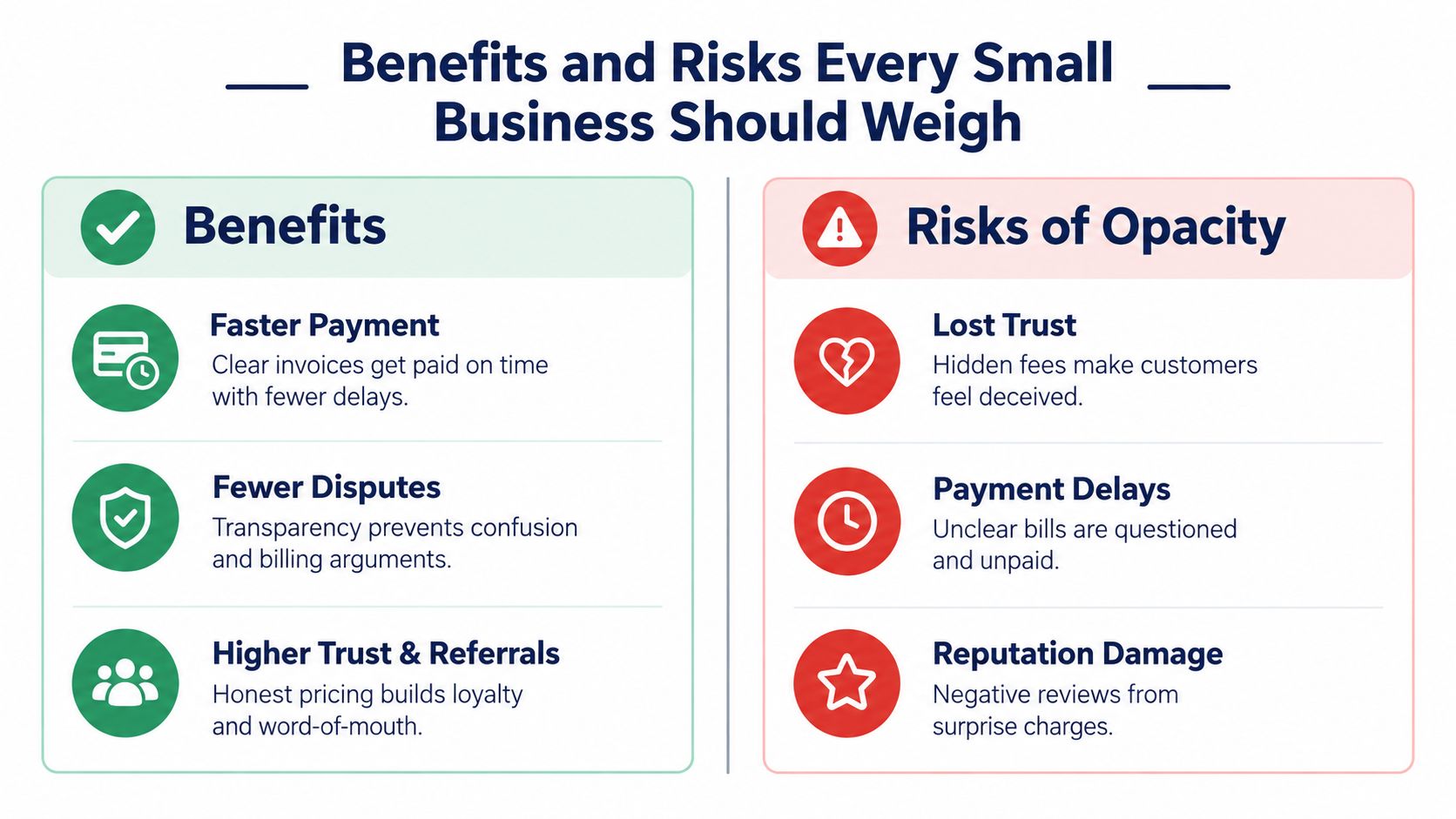
Clear billing improves the customer's decision process. A prospect can compare your service against alternatives, understand the next step, and book without feeling trapped. A customer can approve changes with a record of what changed and why. Your team spends less time reconstructing promises from memory.
The benefits become especially strong when the service is shoppable and legible. Research on Florida hospitals found that federal price-transparency rules didn't broadly lower hospital charges overall, but charges for self-pay patients choosing elective procedures fell, and demand shifted toward compliant hospitals priced below the market average. The healthcare economics study on transparency and patient choice points to a useful SMB lesson: customers exert more price pressure when they can compare options and choose before urgency takes over.
Where transparency creates value
For a trades business, a planned boiler replacement is easier to price clearly than an emergency leak behind a wall. For a clinic, a routine appointment or standard service package is easier to explain than a treatment plan that depends on examination. For a professional service firm, a defined document review may support a fixed quote, while an open-ended matter needs a rate, scope, and approval process.
Prioritize transparency where customers have time to decide:
- Standard services: Publish the scope, price basis, and common exclusions.
- Repeat work: Keep approved rates and service descriptions consistent.
- Add-on work: Require written or recorded approval before proceeding.
- High-question invoices: Identify charges that repeatedly trigger calls or disputes.
A transparent process can also support referrals. Customers are more comfortable recommending a business when they can explain what the business charges and what the customer receives.
Where opacity creates risk
Vague pricing can lose a booking before your team ever learns the prospect's name. Unclear invoices create payment delays because customers pause while they investigate. A defensible charge can still feel unfair if the customer didn't see the condition that produced it.
Healthcare compliance research captures the gap between legal disclosure and practical usability. A peer-reviewed study found hospital compliance ranging from 13% to 49%, with variation by region and hospital size, as reported in the study of hospital price-transparency compliance. Another review of 4,910 hospitals found only 33.40% fully compliant in 2021, meaning 1,640 hospitals met the rule completely, according to the same research record.
The numbers aren't a direct forecast for your company. They show a broader operating principle: a published price doesn't automatically become a usable price. If a customer can't connect a service description to a real amount, your disclosure hasn't finished its job.
Decide what to fix first
Don't begin by rewriting every document. Review the customer journey from first inquiry to payment and find the point where uncertainty creates the most friction. A business that misses calls needs reachable support. A business with frequent invoice disputes needs better itemization and approval records. A business losing quotes needs clearer scope and price language.
For businesses comparing staffing options, the cost of a virtual receptionist can help frame the operational trade-off, but the decision is broader than answering calls. The right process connects the inquiry, the estimate, the approval, and the invoice.
How to Implement Transparent Billing Step by Step
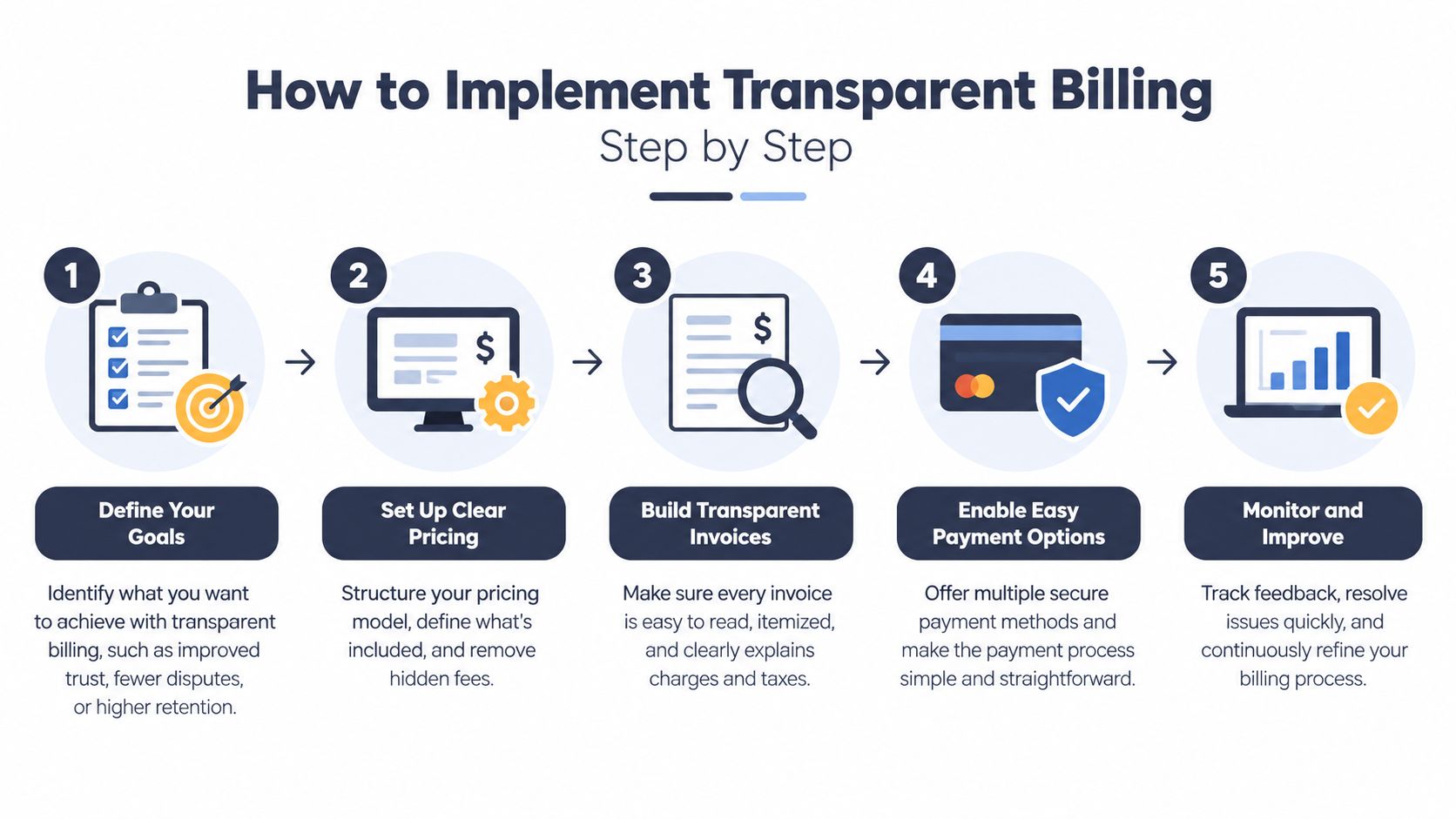
Start with the service customers ask about most often. Write the process as if a new employee had to explain it without calling you for help.
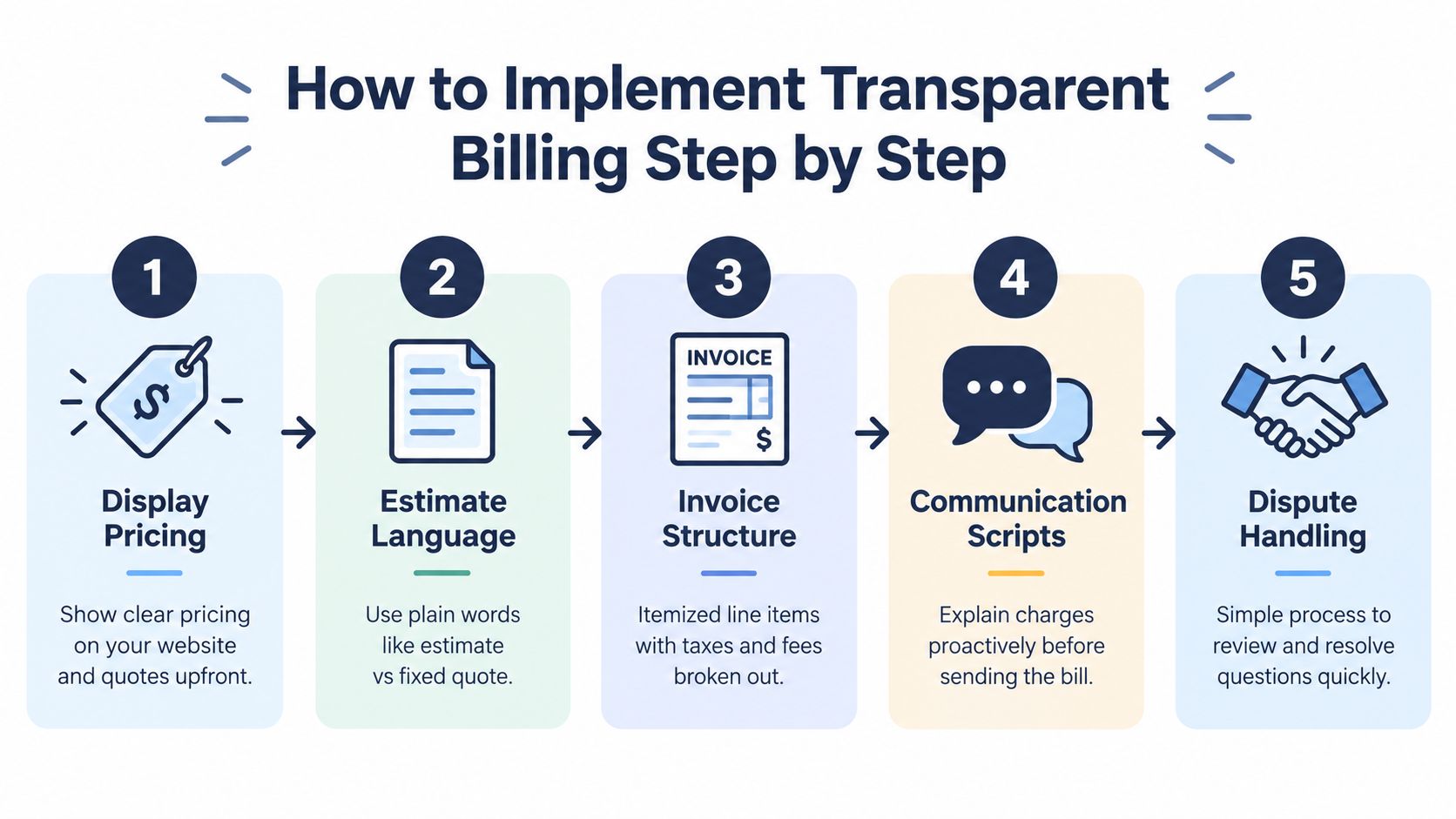
Display pricing without overpromising
Use a service page with four parts:
Service: Electrical fault diagnosis Starting price: [amount or range] Includes: Initial assessment, explanation of findings, and written recommendation May change when: Additional access, parts, or approved work is required
If you can't publish a fixed amount, publish the price basis. “Hourly labor plus materials” is more useful than “pricing varies.” State whether travel, taxes, minimum charges, or urgent-service conditions apply.
Use estimate language carefully
Customers often treat an estimate like a promise because businesses use the words casually. Label each document clearly:
- Estimate: “This is a projected price based on the information available. We'll contact you before work outside this scope.”
- Fixed quote: “This price covers the listed scope. Work not listed requires approval before it begins.”
- Allowance: “This amount is reserved for a selected item. The final amount changes if the selected item costs more or less.”
Avoid hiding uncertainty in fine print. Put the main condition beside the relevant line.
Build an invoice someone can audit
An itemized invoice should let a customer trace each amount back to the quote or an approved change. Include the service date, work description, quantity or time basis, unit price, materials, taxes, discounts, payments received, balance due, and payment instructions.
Use plain descriptions. “Labor adjustment” invites questions. “Two additional labor hours approved by phone on [date] for replacing damaged wiring” gives the customer a useful record.
Explain changes before sending the bill
Give staff a short script:
“We found [condition], which isn't included in the original scope. The additional work is [description] and the added cost is [amount]. Would you like us to proceed?”
Record the answer, the date, and the person who approved it. If the customer can't decide, pause the work when safe to do so. A short conversation before the invoice is easier than a long dispute afterward.
Create a simple dispute path
Put one sentence on every invoice: “Questions about this invoice? Contact [person or channel] within [defined period], and we'll review the quote, approvals, and completed work.”
Then give staff a checklist:
1. Match the invoice to the latest approved quote. 2. Confirm each added charge has an approval record. 3. Check quantities, rates, taxes, discounts, and payments. 4. Explain any correction in writing. 5. Escalate safety, legal, clinical, or high-value matters to the appropriate human.
Review your usage rules as your services evolve. A clear usage-based pricing approach can help when customers pay according to time, consumption, calls, or other measurable units, but the unit must be visible and understandable.
Using AI to Support Transparent Billing and Customer Service
AI works best here as a front door and information assistant, not as the final authority on unusual charges. It can answer routine questions, retrieve approved pricing, collect details, and route exceptions while your team handles judgment and accountability.
Small businesses are already adopting this model. A 2026 survey reported that 51% of small businesses in the United States had integrated AI into customer service, while 94% expected to grow their customer service teams or keep staffing steady over the next two years. The same survey reported use of AI-powered chatbots by 74%, AI-driven knowledge bases or help centers by 51%, live-agent assistance by 39%, AI analytics by 38%, and voice AI or IVR systems by 32%, as described in the small-business AI customer service survey.
Start with narrow billing questions
Give the assistant an approved knowledge base containing services, price bases, inclusions, exclusions, tax rules, appointment policies, and escalation contacts. Begin with questions such as:
- “What does the initial visit include?”
- “Do you offer a cash or direct-payment price?”
- “Is the estimate fixed?”
- “Can I receive an itemized invoice?”
- “When is payment due?”
The assistant should never invent a rate. If the information isn't available, it should say that a team member needs to confirm it.
AI support can also work by phone, which matters when tradespeople are driving, working on-site, or serving another customer. Industry reporting has cited routine support cost-per-interaction reductions of 68% and self-service bot resolution rates of 54%, with simple FAQ or order-status questions reaching up to 96% in some estimates. Treat those figures as directional industry reporting from AI customer service coverage for small businesses, not a promise for your operation.
Let customers use their preferred language
A multilingual phone assistant can detect the caller's language, explain standard billing information, and pass a concise summary to staff. That helps a business serve customers in English, Spanish, French, German, Italian, or another supported language without forcing every employee to speak every language.
Language support doesn't remove the need for human review. Route complaints, unclear consent, sensitive personal information, legal threats, clinical questions, and exceptions to a trained person. Tell the caller when a human will follow up and preserve the conversation summary.
Protect the handoff
Set explicit escalation rules:
- Price outside the approved range: Send to a staff member.
- Customer disputes completed work: Create a review task.
- Customer requests a refund or correction: Route to the authorized decision-maker.
- Safety or health concern: Escalate immediately according to company policy.
- Unclear language or identity: Ask for clarification or transfer.
AI receptionist reporting has estimated that small businesses miss 62% of incoming calls, while 85% of callers never call back. The AI receptionist trends analysis explains why always-on phone coverage can protect opportunities that would otherwise disappear.
For a practical option, rednea answers calls, detects language, handles routine questions, books appointments, and escalates important calls to people. It can also send concise follow-up summaries, helping your team connect what the customer asked with the quote or invoice that follows. Review the AI answering service workflow before deciding which calls to automate.

Real World Examples That Make Transparency Tangible
A vague estimate might say, “Repair appliance, price to be confirmed.” The customer approves because the technician is already there. The final invoice includes diagnosis, labor, replacement parts, travel, and disposal, but the customer doesn't know which items were included or separately approved.
A transparent version names the service and its boundaries. It might show a diagnostic charge, explain what the charge includes, identify the labor rate, list likely parts as an allowance or estimate, and state that additional work requires approval. The technician then sends an update before replacing a part outside the original scope.
Copyable pattern: name the unit, explain the condition, and obtain approval before the amount changes.
An electrician can use the same pattern. “Install lighting” is vague. “Install customer-supplied fixture at the existing point, excluding rewiring, ceiling repair, and replacement switches” gives the customer a workable scope. If damaged wiring appears, the electrician documents it, provides the added price, and waits for approval where the situation allows.
A clinic faces a different version of the problem. A patient may see a service label but still not know whether the amount is a direct-payment price, an insurance-related negotiated amount, or an estimate subject to later processing. Healthcare disclosure research found that only 18% of hospitals in a 2,000-hospital review posted dollar-and-cents prices for at least half of their items and services, showing why algorithms or percentages without a clear code crosswalk can remain difficult for people to use, as reported in coverage of hospital price-transparency compliance.
Copyable pattern: publish an amount when possible, and define every label when an amount depends on another process.
A professional service firm can show a fixed price for a defined document package, an hourly rate for additional work, and the approval method for expanding scope. The invoice then uses the same names as the proposal.
Copyable pattern: make the quote and invoice speak the same language.
These examples share one idea. Transparency isn't a large pile of information. It's a connected record that lets the customer follow the path from promise to approval to payment.
Measuring Success and Keeping Billing Transparent
Track the points where confusion becomes expensive. Compare the quoted amount with the final invoice, record how often customers question charges, monitor how quickly invoices get paid, and measure how often calls receive an answer. The purpose isn't to chase a perfect number. It's to find the handoff that needs repair.
A practical weekly review can use four measures:
- Quote-to-invoice variance: Compare the original scope, approved changes, and final amount.
- Dispute rate: Categorize questions by unclear scope, missing approval, incorrect amount, or service dissatisfaction.
- Days to payment: Watch whether clearer invoices reduce avoidable waiting.
- Call-answer rate: Identify when missed calls occur and which questions callers ask.
Post-bill reconciliation deserves its own control. Recent policy coverage has highlighted stronger efforts to connect posted rates with claims or invoice data, including itemized bills and proof that published amounts can be matched to actual records. The consumer perspective on matching transparent prices to final bills reinforces a point that applies to every SMB: disclosure creates value only when someone can verify the final charge.
Use this checklist before closing each billing cycle:
- Scope match: Does the invoice describe the approved work?
- Change approval: Can staff show when the customer accepted added work?
- Price match: Do rates and units match the current price list or quote?
- Tax and fee review: Are additions labeled and calculated correctly?
- Customer access: Can the customer reach a person for unresolved questions?
- AI knowledge review: Are automated answers based on current prices and policies?
Review public prices and invoice templates on a regular schedule, and review them sooner whenever labor rates, materials, taxes, or service scope changes. Use real-time analytics to spot unanswered calls, recurring billing questions, and follow-up gaps that a monthly invoice review may miss.
---
Rednea helps small businesses stay reachable with an AI phone assistant that answers calls around the clock, detects the caller's language, handles routine questions, books appointments, and escalates complex matters to your team. Visit rednea to connect clearer customer support with fewer missed opportunities and more consistent billing conversations.
Try rednea, no strings attached
AI phone assistant for business. Hear a live demo in your browser, book a call with our team, or get started — from £90/month, cancel monthly, no minimum term.
GDPR-compliant · EU & UK GDPR · Multilingual