AI Receptionist Cost: Real Pricing for Small Businesses

Most small businesses should budget roughly $50 to $300 per month for an AI receptionist in 2026, but the actual cost depends on call volume, average call length, and whether billing is per-minute or flat-rate. Treat that as a directional shopping range, not a guaranteed final invoice.
You're halfway through a job, your hands are occupied, and a prospective customer calls. You don't need another dashboard to check. You need someone to answer, understand what the caller wants, and either arrange the next step or bring you into the conversation.
The useful question isn't just what an AI receptionist costs. It's what you'll pay for each call that ends with the right outcome, without creating extra work for your team.
Why the Phone Still Decides Your Next Customer
An electrician working at a customer's property can't always stop to discuss another job. A dental receptionist checking in a patient can't give an incoming caller undivided attention. For a freelancer delivering paid work, answering every interruption can be impractical.
Those are ordinary capacity problems, not signs of poor customer service. But the caller still needs help, and your ability to respond affects whether you get the opportunity to quote, book, or qualify the enquiry.
A 30-day analysis of 85 small businesses across 58 industries found that 37.8% of incoming calls were answered by a live person, while 24.3% received no response at all. That sample isn't a forecast for your business, but it gives you a reason to inspect your own call records rather than assume voicemail covers the gaps.
Start with the uncovered calls
A sensible first deployment doesn't put automation in charge of every conversation. It covers the moments when nobody can answer and gives callers a useful next step.
- For a tradesperson, that might mean collecting the address, job type, urgency, and preferred callback time.
- For a practice, it could mean handling approved appointment requests while routing clinical questions to staff.
- For a professional firm, it might mean distinguishing a new enquiry from an existing client's time-sensitive message.
Practical rule: Buy coverage for a defined problem before buying automation for the entire phone system.
That distinction changes the budget conversation. You're comparing the cost of reliably handling a specific workload, not buying a theoretical replacement for an employee.
A cheap plan that captures unusable messages isn't good value. A more expensive service may be worthwhile if it consistently records the right details and leaves staff with a clear action rather than another conversation to reconstruct.
The Two Pricing Models That Actually Matter
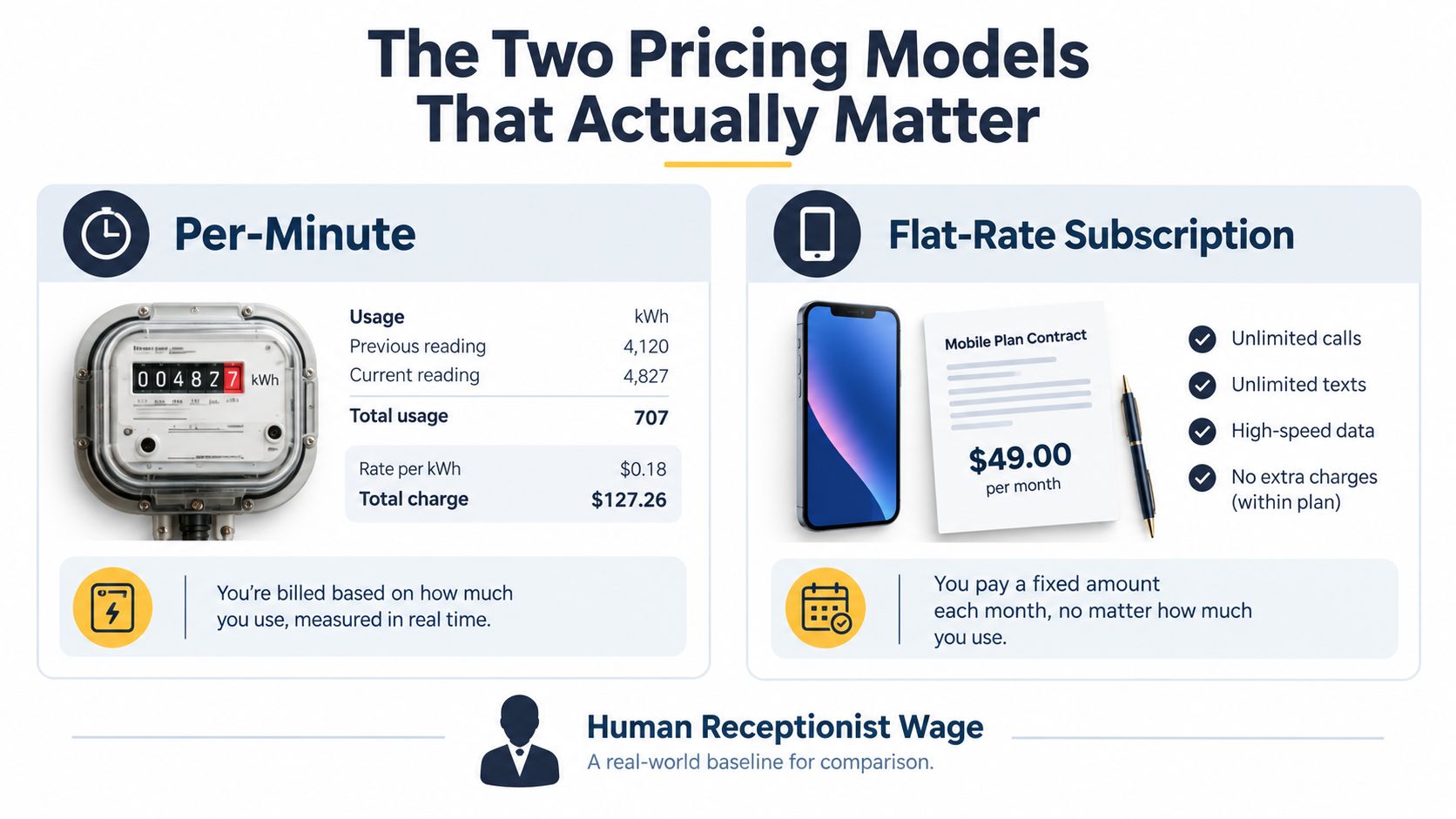
Per-minute pricing works like a utility bill. You pay according to usage, sometimes alongside a base charge or minimum commitment. It makes the relationship between call duration and spending visible.
Flat-rate subscription pricing resembles a mobile phone contract. You pay a recurring amount for an allowance or defined service, but “flat-rate” doesn't necessarily mean unlimited. The included capacity and rules beyond that capacity matter more than the label.
Match the model to demand
Choose usage-based billing when quiet periods and busy periods look substantially different. An independent contractor shouldn't have to purchase a large block of idle capacity just to cover occasional surges. This explanation of usage-based pricing is useful when checking how a provider meters consumption.
A subscription becomes more attractive when your recurring workload is stable and comfortably fits the allowance. It's less attractive when you're repeatedly buying a larger package to avoid unpredictable excess charges.
| Decision factor | Per-minute approach | Subscription approach |
|---|---|---|
| Quiet periods | Spending can fall with usage | Base payment usually remains |
| Busy periods | Usage charges rise visibly | Included capacity may run out |
| Budget control | Requires monitoring and alerts | Requires allowance and overage checks |
| Main buying question | What counts as a billable minute? | What exactly does the fee include? |
For context, the U.S. receptionist wage benchmark was $18.27 per hour, or $38,010 annually, in May 2025, before employer costs such as taxes, benefits, recruitment, training, and equipment.
That's a labor benchmark, not a like-for-like replacement price. A human receptionist may welcome visitors, coordinate staff, and handle sensitive situations. Compare AI with the telephone workload it can take on, not the employee's entire role.
What Drives the Final Number on Your Invoice
A plumber's urgent intake call, a dentist's appointment change, and a freelancer's opening-hours enquiry create different workloads. Counting calls without examining what happens during them won't produce a reliable estimate.

Volume and duration set the usage baseline
Monthly calls × average call duration = estimated monthly handling minutes.
Use actual connected-call records where possible. Separate short enquiries from booking conversations rather than assuming every caller takes the same amount of time.
A plumber may need the assistant to establish location, urgency, access arrangements, and the nature of the problem. A freelancer may only need it to confirm availability and collect contact details. The longer conversation isn't necessarily inefficient if those details make the follow-up useful.
The infrastructure underneath voice services helps explain metered billing. Published cloud speech-recognition pricing lists $0.016 per minute for the first 500,000 minutes, falling to $0.010, $0.008, and $0.004 at higher volume tiers. Those are transcription charges, not complete AI receptionist prices: telephony, speech generation, processing, support, and other components remain separate.
Language coverage and integrations change the job
- Language coverage: Ask whether the quote covers the languages your callers use, including switching languages during a conversation. Test names, addresses, and trade terminology, not just a greeting.
- Scheduling: A dental practice needs more than a verbal promise that an appointment is booked. Verify that the correct calendar receives the booking and that appointment rules are respected.
- Customer records: A useful integration should send structured information into the right record. An email summary isn't equivalent to updating your scheduling or customer-management system.
Don't pay for broad capabilities you won't use. Equally, don't strip out the connection that makes the service useful: manually re-entering every booking can erase the operational benefit of a cheaper plan.
Sample Prices for Small Businesses in 2026
Use the opening budget range to shortlist services, then request a quote against your own workload. A low-volume freelancer and a busy trades company shouldn't assume that the same advertised package will suit both.
The lower end of a shopping range is a starting point for a narrow answering task. The upper end isn't a guarantee that complex booking, multiple locations, outbound follow-up, or specialist data handling will fit. Feature inclusion must come from the written quote, not assumptions about the monthly price.
AI receptionist pricing models at a glance
A vendor-published 2026 pricing comparison reports overage rates of roughly $0.25 to $0.95 per minute and per-call AI pricing of about $2.17 to $3.00. These are directional market observations, not universal tariffs.
| Pricing model | Typical 2026 range | Best fit | Main risk |
|---|---|---|---|
| Per-minute | Quote-specific base and usage rate | Variable demand and intermittent coverage | Long or unnecessary conversations increase usage |
| Flat-rate subscription | Package-specific monthly allowance | Consistent, measurable workload | Overage or unused capacity |
| Subscription with overage | Directional excess-minute range cited above | Stable baseline with occasional peaks | Busy months exceed the advertised fee |
| Per-call | Directional per-call range cited above | Predictable, clearly defined interactions | Brief or unsuccessful calls may still be billable |
Compare the same workload
Ask every shortlisted provider to price your ordinary month and a busy month using identical call assumptions. Include the same booking workflow, languages, escalation rules, and reporting requirements.
Then inspect what happens outside the allowance. A plan can be predictable during normal operations yet unsuitable during a weather-related surge or marketing campaign.
A fixed subscription is only a predictable expense when you understand the limits attached to it.
Don't select a plan purely because its included minutes look generous. If your business needs appointment changes but the package only takes messages, you haven't bought equivalent coverage. Compare the delivered service first, then its billing structure.
Three Real Call Profiles and What Each One Pays
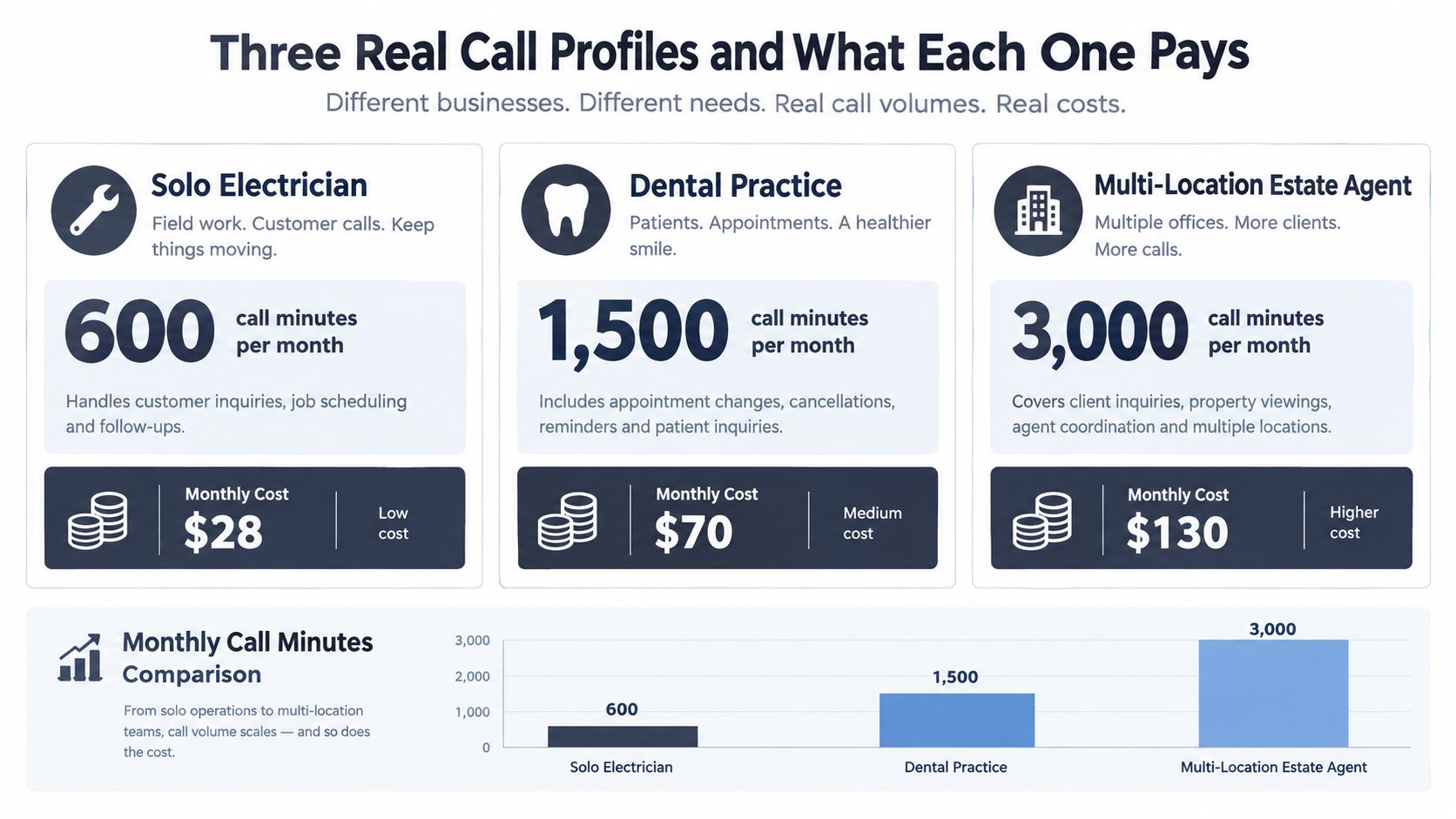
The following are illustrative workloads, not customer case studies or vendor quotes. The electrician's roughly 600 minutes, the dental practice's 1,500 minutes, and the estate agency's 3,000 minutes are planning assumptions. Without a complete provider tariff, claiming a final monthly bill would be misleading.
The electrician and the dental practice
For the solo electrician, start by pricing the assumed minutes at the provider's complete inbound rate, then add the base fee and required extras. Compare that total with the smallest subscription covering the same workload. Per-minute wins if it avoids enough unused subscription capacity, not merely because the business is small.
For the dental practice, appointment changes and scheduling questions make workflow quality particularly important. A subscription can suit the assumed workload if the allowance covers it and the scheduling connection works correctly. If staff must repair bookings afterward, the nominally cheaper package may cost more to operate.
| Profile | Per-minute bill | Subscription bill |
|---|---|---|
| Solo electrician | Base fee + actual usage + extras | Package fee + excess usage + extras |
| Dental practice | Same formula, including scheduling costs | Package covering booking workflow + any excess |
| Estate agency | Direction-specific usage + location costs | Shared or location-based package + excess |
The estate agency needs directional pricing
For a multi-location estate agency, separate inbound enquiries from outbound follow-up before comparing a hybrid plan with usage-only billing.
Published U.S. telephony rates list $0.0085 per inbound minute, $0.0140 per outbound minute, and an additional $0.0025 per recorded minute. At 3,000 inbound minutes, transport alone is $25.50, before the rest of the AI service.
That infrastructure example isn't the agency's final bill, especially if its assumed workload mixes call directions. Use a business AI-minute estimate to organize the inputs, then request itemized totals. A hybrid plan wins only if its shared allowance and excess rates beat the alternatives for that mix.
Hidden Fees That Quietly Inflate Your Bill
A cheap headline price tells you little about ownership cost. Before signing, request the full fee schedule and a sample invoice showing the workflow you intend to run.
One published annual cost comparison claims $600 to $4,800 for AI reception versus $30,000 to $60,000 for human reception. Those headline comparisons don't settle the purchase decision when transfers, recording, messaging, multilingual handling, and setup sit outside the advertised amount.
Ask what triggers each charge
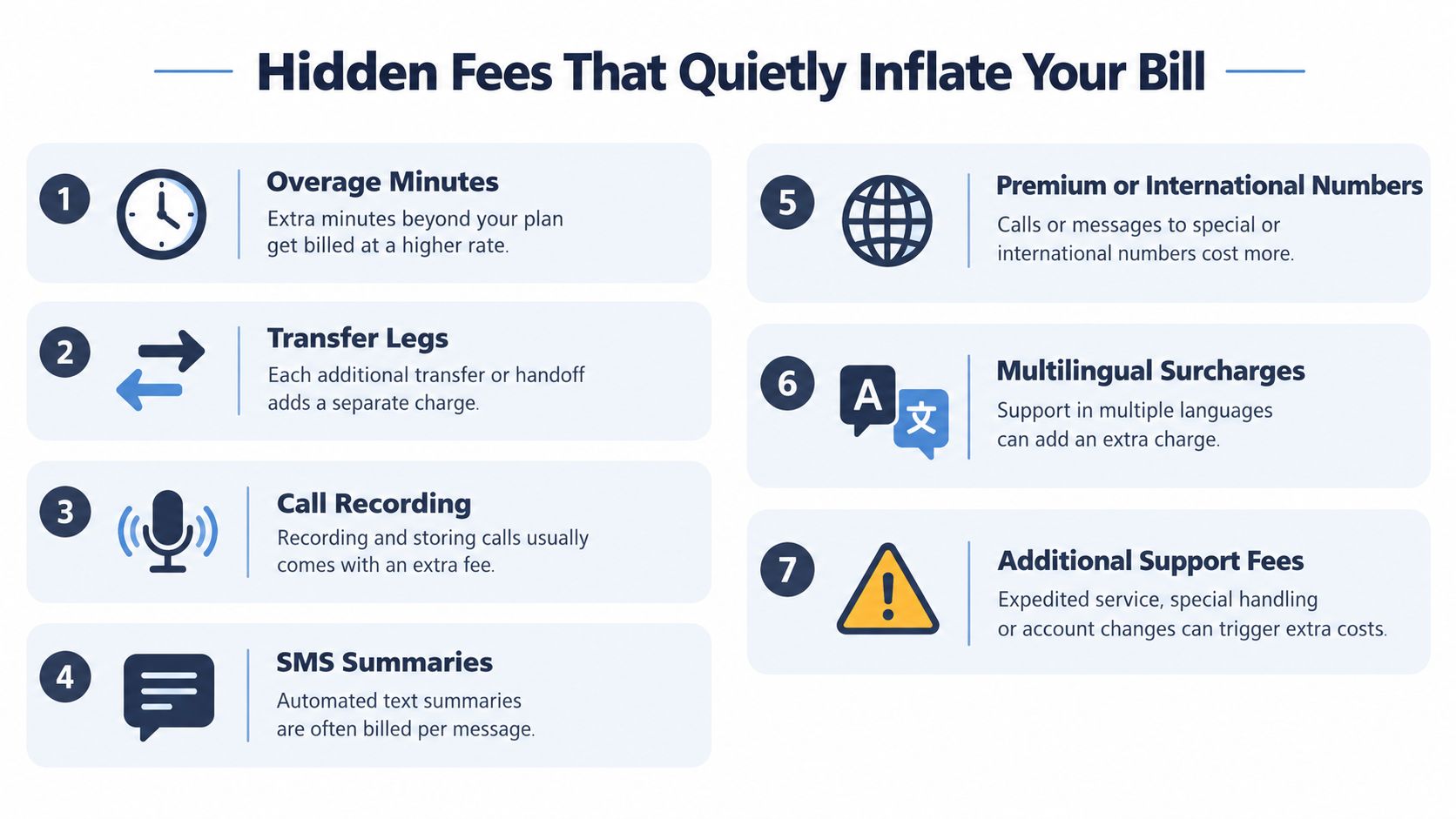
- Overage minutes: Does the provider alert you before the allowance runs out, and can you set a spending limit?
- Transfer legs: Does billing continue after a human answers? Can both sides of a connected call incur charges?
- Recording and transcripts: Are capture, storage, retrieval, and export included or separately billed?
- SMS summaries: Is messaging optional, and does the charge depend on message length or destination?
- Premium or international numbers: Which destinations and number types fall outside the standard quote?
- Multilingual handling: Are your required languages included, or do they require another package?
- Failed transfers: What happens financially and operationally when the intended staff member doesn't answer?
Inspect the terms beyond usage
Implementation deserves its own line in the quote. Ask who writes the intake flow, tests calendar behavior, corrects routing, and maintains the configuration when your opening hours or services change.
Check cancellation terms, renewal conditions, minimum commitments, and promotional pricing. A flexible-looking plan can still be awkward to leave if exporting your number or records isn't straightforward.
Before signing: Ask the vendor to explain an unsuccessful call on a sample invoice, not just a successful booking.
That exposes whether you're paying for attempted service, completed service, or both. It also gives you a clearer basis for comparing support commitments and dispute procedures.
How to Calculate Real ROI Before You Buy
Cost per successfully handled call needs a business-specific definition. A booked appointment, qualified job enquiry, approved answer, or correctly escalated urgent call may count. A greeting followed by an unresolved request shouldn't.
Speed matters, but it isn't the same as resolution. In customer-service survey findings, 96.5% rated a fast response important or very important, while 37.2% expected resolution within four hours and 26.3% within 30 minutes.
Build an outcome-based comparison
- Measure the starting position. Record answered calls, voicemail, abandonment, bookings, and staff escalations. Identify which uncovered calls the assistant would receive.
- Estimate recoverable value. Use your own enquiry-to-booking history and contribution margin. Don't treat every unanswered call as a lost sale.
- Price that workload. Apply the proposed tariff to eligible calls, including their duration and required workflow.
- Deduct operating costs. Include implementation, paid extras, staff review, error correction, and follow-up that still needs human attention.
- Compare the alternatives. Assess the telephone capacity you're adding against the human wage benchmark and your existing process, rather than assuming a headcount reduction.
You can use a missed-call calculator to organize the commercial assumptions. Replace estimates with pilot results before making a longer commitment.
Use margin rather than optimistic revenue
Cost per successful action = total service and oversight cost ÷ verified successful actions.
For break-even, divide the incremental operating cost by the contribution margin from an additional completed job or appointment. Keep recovered sales separate from routine enquiries resolved and staff time released, so you don't count the same benefit twice.
Review unsuccessful calls as carefully as successful ones. Track incorrect information, repeat contact, failed escalation, and bookings that staff need to fix.
Privacy belongs in that evaluation too. Confirm recording consent, storage location, retention, deletion rights, and access controls. Healthcare and legal teams should check their sector-specific obligations before allowing sensitive intake. A favorable financial estimate doesn't compensate for an unsuitable data-handling arrangement.
Choosing the Right Plan Without Overpaying
Choose the smallest deployment that can complete a useful customer action reliably. That might be after-hours intake, overflow scheduling, or basic enquiry handling, rather than every incoming call.
AI can complement a human team without taking over its judgment. Keep complex advice, emotionally difficult conversations, disputes, and sensitive exceptions with trained staff. Give the assistant approved information and a clear boundary for escalation.
Match the plan to the business
- Tradespeople and freelancers: Start with per-minute quotes when demand is uneven, then check spending controls and busy-period costs.
- Practices with stable scheduling traffic: Consider a subscription when the allowance and booking workflow fit the measured workload.
- Growing multi-line operations: Compare hybrid arrangements where shared capacity and routing can simplify administration.
- Professional and regulated services: Prioritize appropriate intake boundaries, data handling, and dependable handoff before optimizing the tariff.
Use this AI receptionist selection guide to turn the requirements into a shortlist. Require a demonstration using your own awkward calls: an unclear address, an unavailable appointment, a language change, and a staff member who doesn't answer a transfer.
Make the buying decision measurable
Before committing, agree on what constitutes a successful call and how you'll verify it. Ask for exportable usage records, clear billing definitions, and a process for correcting the assistant's information.
For customer service in any language you need to support, test actual conversations rather than accepting a language list. The right plan is the one that handles your customers' requests appropriately at an acceptable total cost, not the one with the lowest advertised fee.
---
rednea offers AI phone answering, appointment booking, routine enquiry handling, and escalation to your team, with per-minute billing. Visit to discuss your call workload, required languages, and scheduling connections, and ask for a quote that separates usage from optional charges before you decide.
Try rednea, no strings attached
AI phone assistant for business. Hear a live demo in your browser, book a call with our team, or get started — from £90/month, cancel monthly, no minimum term.
GDPR-compliant · EU & UK GDPR · Multilingual